

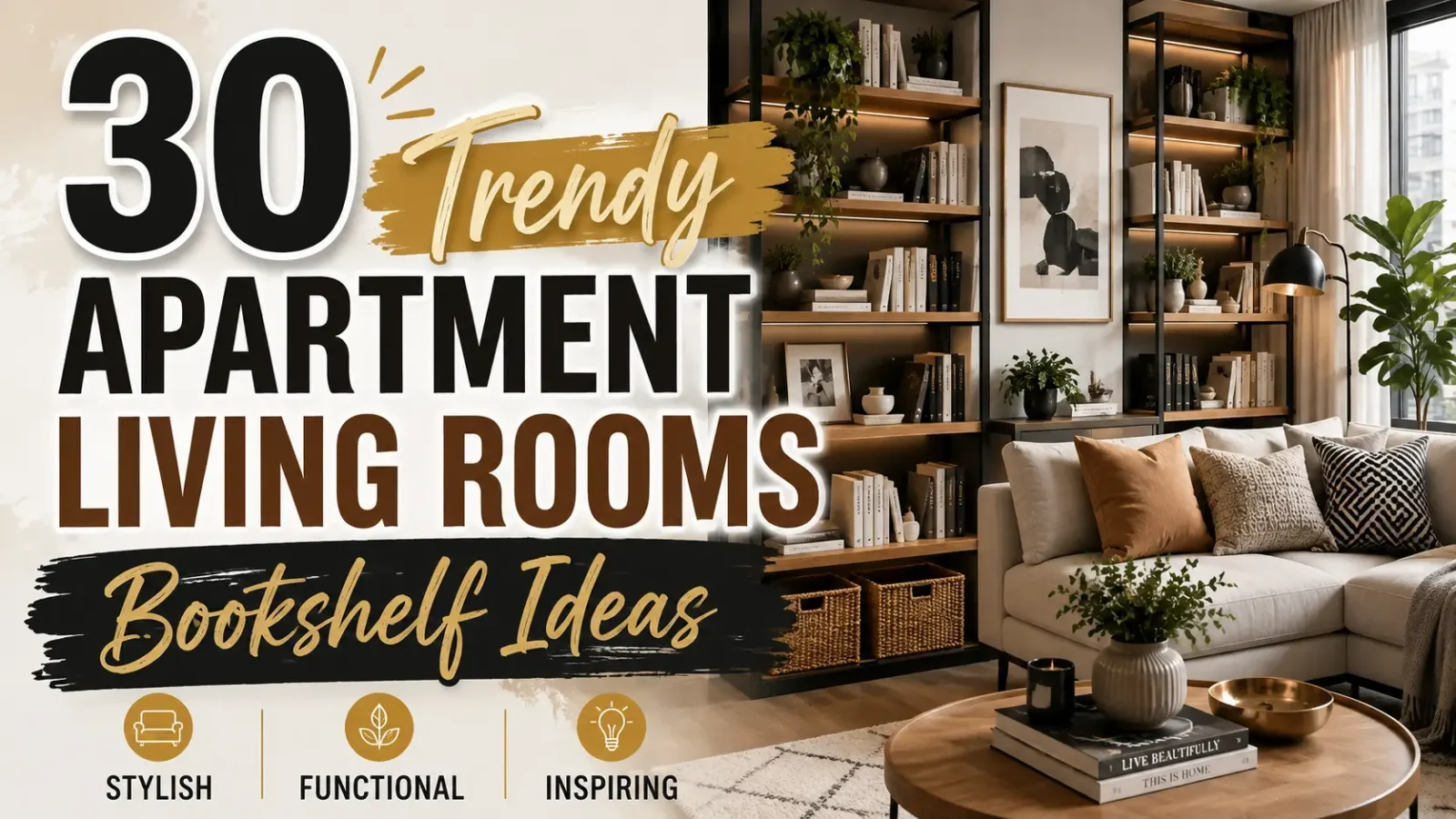
Apartment living rooms bookshelf ideas are the easiest way to add storage, personality, and style to a small space without renovation. Whether you rent a studio or own a compact city apartment, the right bookshelf turns blank walls into a functional focal point. From floating shelves to ladder units, modern bookshelf designs work double duty — displaying books, plants, and decor while keeping clutter off the floor. In this guide, you will find thirty trendy, renter-friendly ideas that suit every budget, layout, and aesthetic, so your living room finally feels curated instead of cramped.
The best apartment bookshelves solve two problems at once: limited square footage and limited storage. Designers today favor vertical styling, mixed materials like wood and black metal, and open shelving that keeps rooms feeling airy. You do not need a huge library wall to make an impact — even a single styled shelf above a sofa changes the whole room. Below, each idea includes practical styling tips you can copy today, whether your style is minimalist, boho, mid-century modern, or industrial. Pick two or three ideas, combine them, and watch your living room transform.
Finding bookshelves for small apartment living rooms is a balancing act: you need real storage for books and decor, but the wrong piece can swallow half the room. The best options use height instead of floor space, keep a light visual profile, and earn their footprint by working as display and storage at once. The stylish bookshelves for small spaces below are chosen with renters and compact layouts in mind, from narrow towers to wall-mounted designs. The same wall-by-wall thinking applies over the sofa, where these living room wall decor ideas above couch can help you fill the space with confidence.
1. Floor-to-Ceiling Bookshelf Wall
A floor-to-ceiling bookshelf wall is the single most dramatic upgrade for an apartment living room. It draws the eye upward, making low ceilings feel taller and small rooms feel grander. Choose a slim-depth unit (25–30 cm) so it stores plenty without eating floor space. Paint it the same color as your wall for a built-in look, or keep it white for a bright, gallery feel. Style shelves in a 60/30/10 ratio — 60% books, 30% decor objects, 10% empty space — so the wall looks curated, not crowded. Renters can use freestanding modular units anchored safely to the wall.
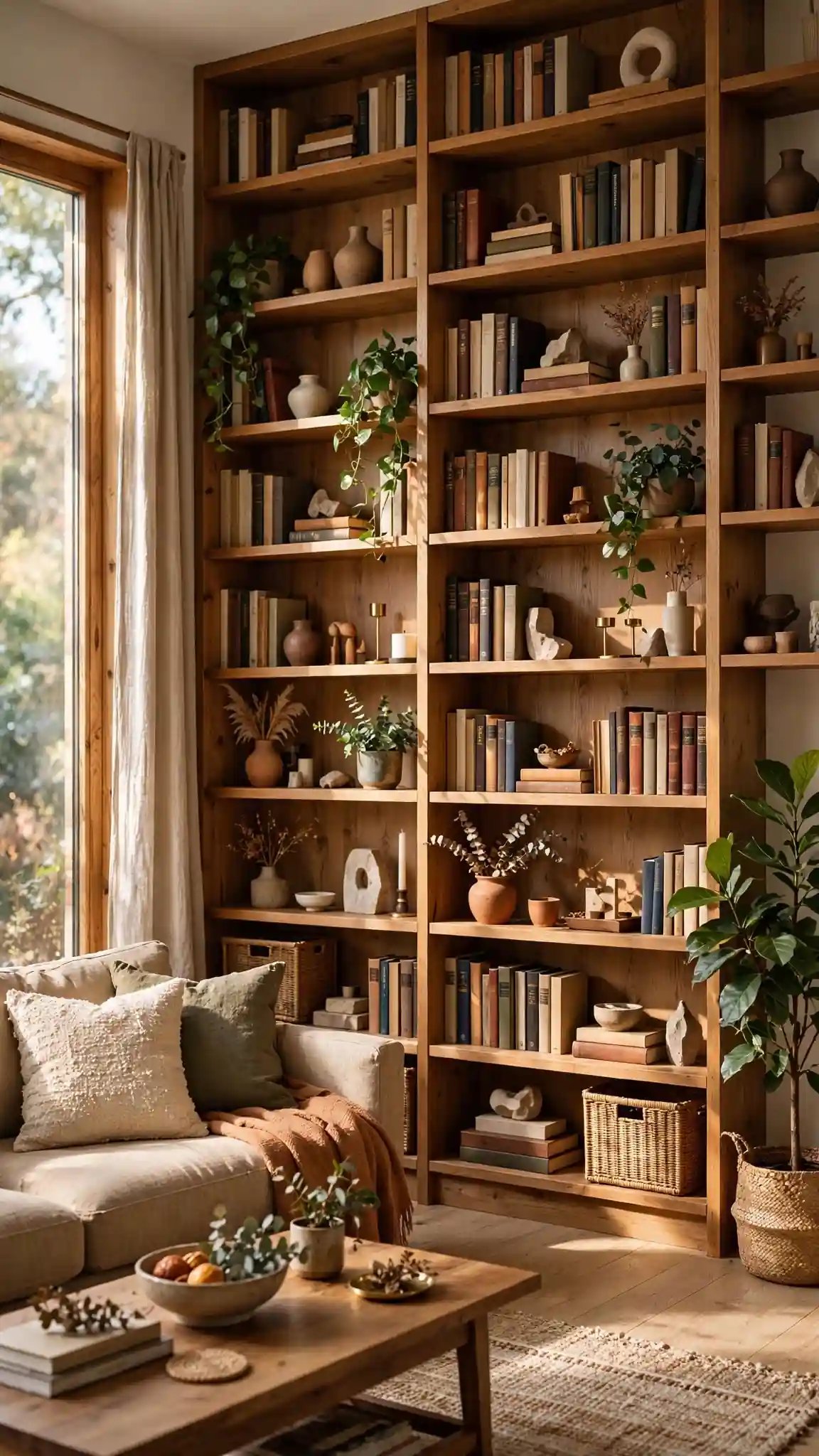
Floor-to-ceiling shelving must be anchored to wall studs — a loaded bookcase can weigh 500+ lbs, and anti-tip straps ($10–$15) are non-negotiable, especially in rentals with kids. IKEA Billy bookcases ($80–$100 each) lined up wall-to-wall, topped with crown molding and a painted back panel, deliver the built-in look for under $600 total. Leave the top shelf for display and rarely-used items; keep daily books between knee and eye level. Add a rolling library ladder ($200–$400) only if ceilings exceed 9 feet. Pro tip: paint the bookcases the same color as the walls — it makes the whole wall read as architecture rather than furniture.
2. Floating Shelves Above the Sofa
Floating shelves above the sofa use the most wasted wall in any apartment. Install two or three staggered shelves about 25–30 cm above head height so no one bumps into them. Mix horizontal book stacks with vertical rows, then add a trailing pothos plant and one framed print for balance. Floating shelves cost little, install in under an hour, and leave zero floor footprint — perfect for studios. Choose shelves at least 20 cm deep for standard books. Matching the wood tone to your coffee table ties the whole living room together instantly.
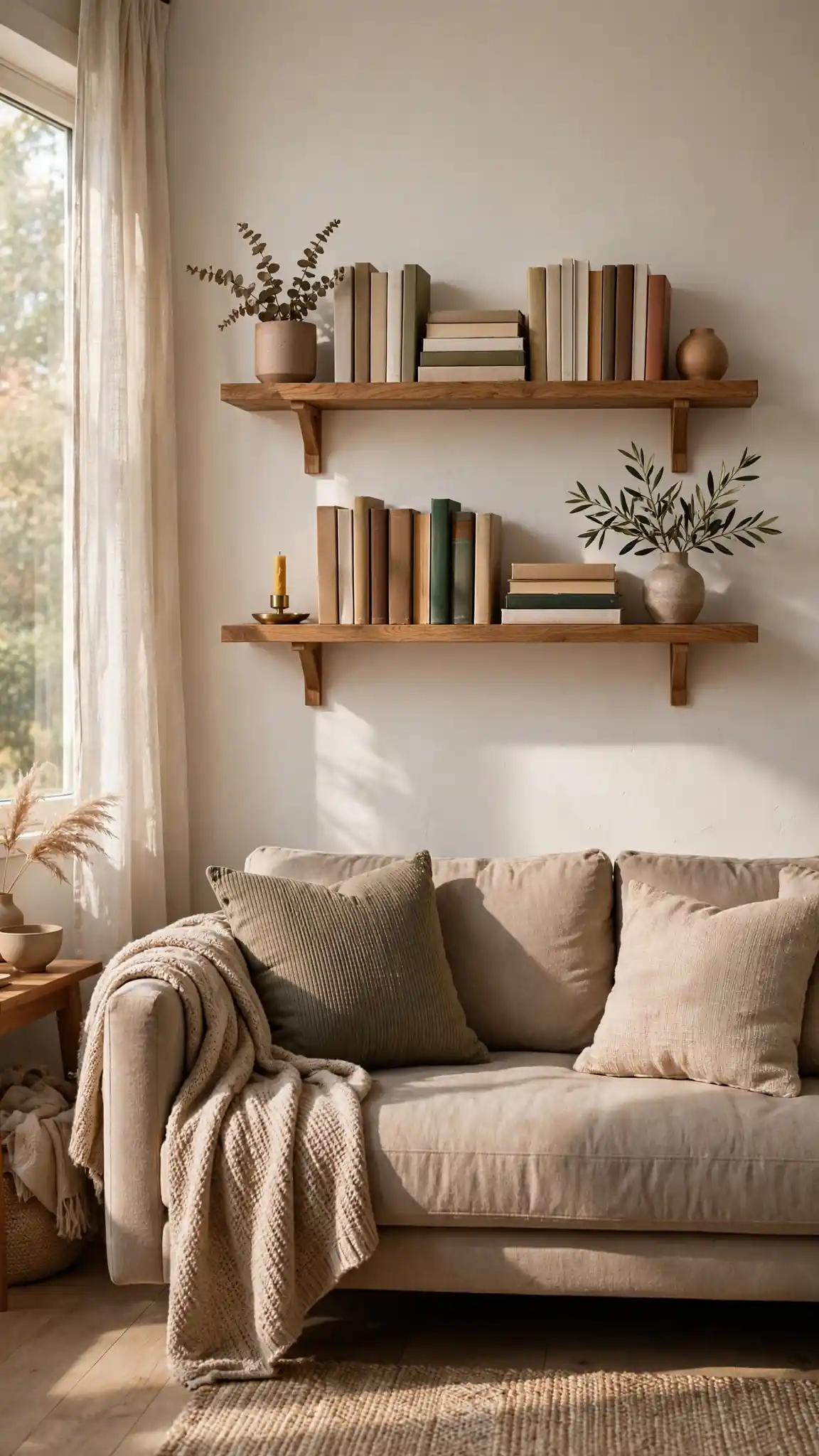
Mount floating shelves into studs with brackets rated for at least 50 lbs per shelf — books are deceptively heavy (about 20 lbs per linear foot). Two or three staggered shelves, 8–10 inches deep, above a sofa create the classic look; keep the bottom shelf 12–18 inches above the sofa back. Alternate books with plants and objects so it reads as styling, not storage. Quality floating shelf brackets run $20–$40 per pair. Pro tip: use a laser level ($25) for installation — even a quarter-inch tilt is glaringly obvious on a long shelf, and it is the difference between DIY and designer.
3. Ladder Bookshelf in the Corner
A ladder bookshelf leans against the wall, tapering as it rises, which makes it feel lighter than a boxy unit. Corners are usually dead space in apartments, so this idea reclaims real storage without blocking walkways. Place heavier books on the bottom rungs for stability, medium items in the middle, and small plants or candles on top. Black metal ladder shelves suit industrial rooms, while oak versions warm up Scandinavian interiors. Most ladder shelves cost less than standard bookcases and require no wall drilling — a major win for renters with strict landlords.
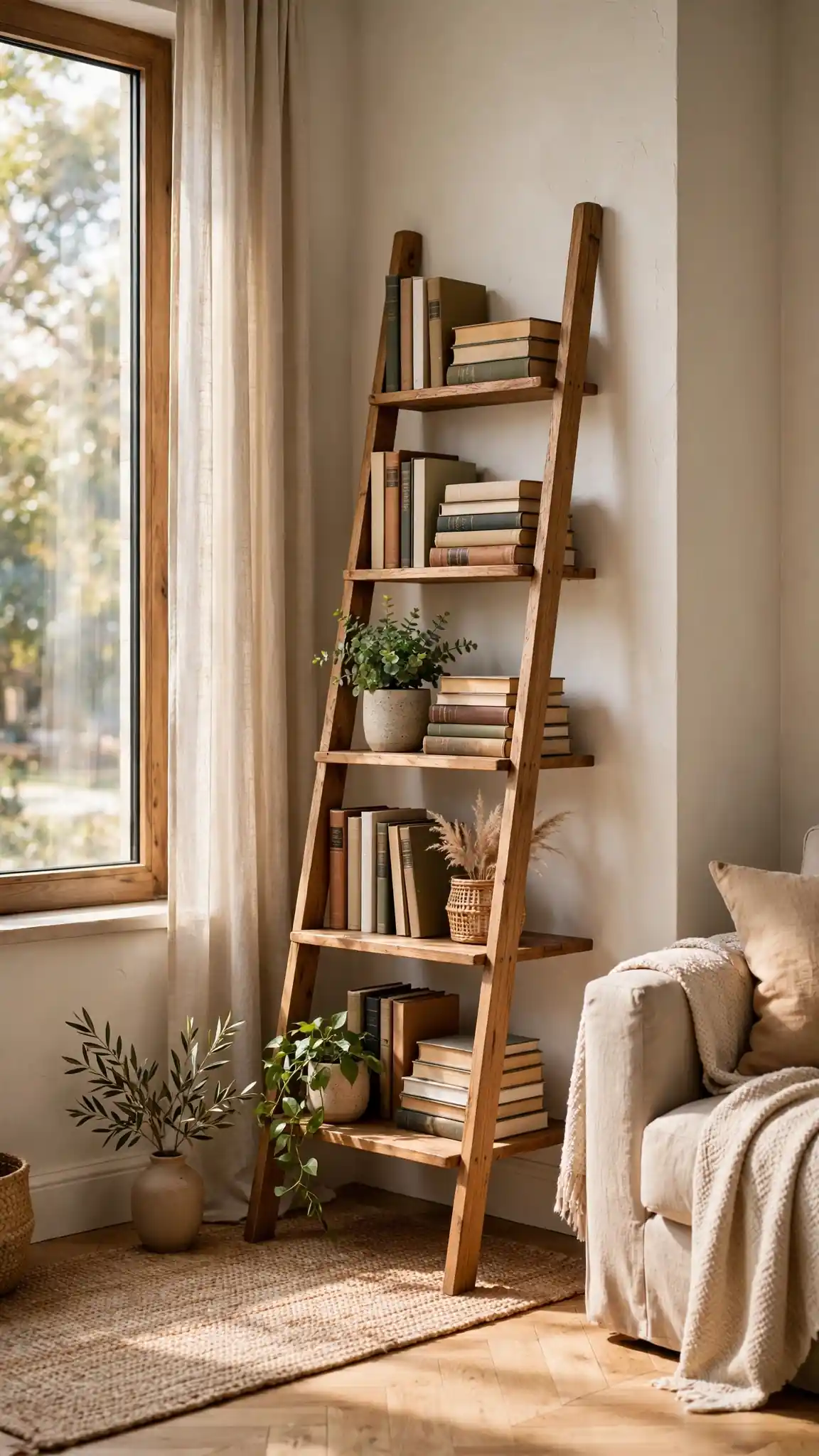
Ladder shelves are ideal for corners because their tapered profile wastes no visual space — deep at the bottom for books, shallow at top for display. Anchor the top to the wall even though it leans; a $10 anti-tip kit prevents disaster. Style with books on the lower two-thirds and plants, art, and objects above for balance. Ladder bookcases run $70–$200 at Target, IKEA, and Wayfair. They suit small apartments because the open sides keep light flowing. Pro tip: place a small LED puck light ($15 for 6) on the top shelf aimed down — it turns a simple ladder shelf into a glowing feature at night.
4. Bookshelf Room Divider for Studios
In a studio apartment, an open-back bookshelf works as a room divider that separates the living area from the bed without blocking light. A cube-style unit like a 4×4 grid gives you storage accessible from both sides while defining two distinct zones. Keep the top third mostly open so sightlines stay clear and the studio still feels spacious. Anchor the unit to the floor or ceiling for safety. Style both faces — books and baskets on the living side, folded throws or a small lamp on the bedroom side — so it looks intentional from every angle.
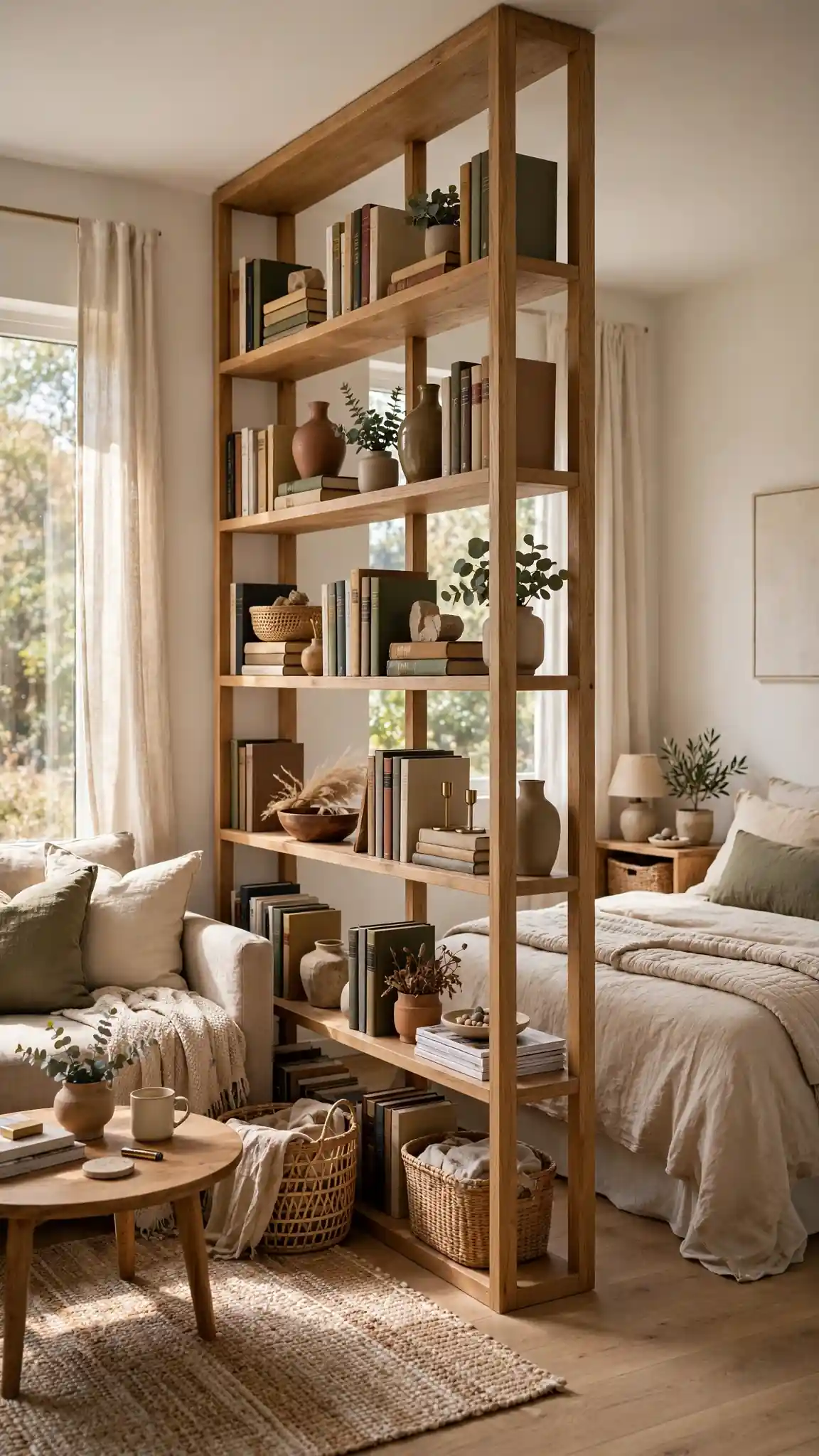
An open-back bookcase ($150–$400) divides a studio without blocking light — the key is keeping both sides styled, since you will see through it daily. Kallax units from IKEA are the classic choice: 2×4 units on their side make perfect room dividers with storage cubes. Leave some cubbies open and styled, others with fabric bins for hidden clutter. Position it perpendicular to the longest wall, leaving 30+ inches of walkway on each side. Pro tip: style the 'back' side as intentionally as the front — a one-sided divider looks unfinished from the bedroom side and ruins the effect.
5. Built-In Look with IKEA Billy Hack
The IKEA Billy hack gives you custom built-in bookshelves at a fraction of carpenter prices. Line up two or three Billy bookcases wall to wall, add extension units to reach the ceiling, then attach trim, crown molding, and baseboard to hide the gaps. Paint everything one color, including the wall behind, and the result looks like architectural millwork. This idea is hugely popular on Pinterest and works even in rentals if you skip permanent trim. Total cost usually stays under a few hundred dollars, and resale value of your styling skills is priceless.
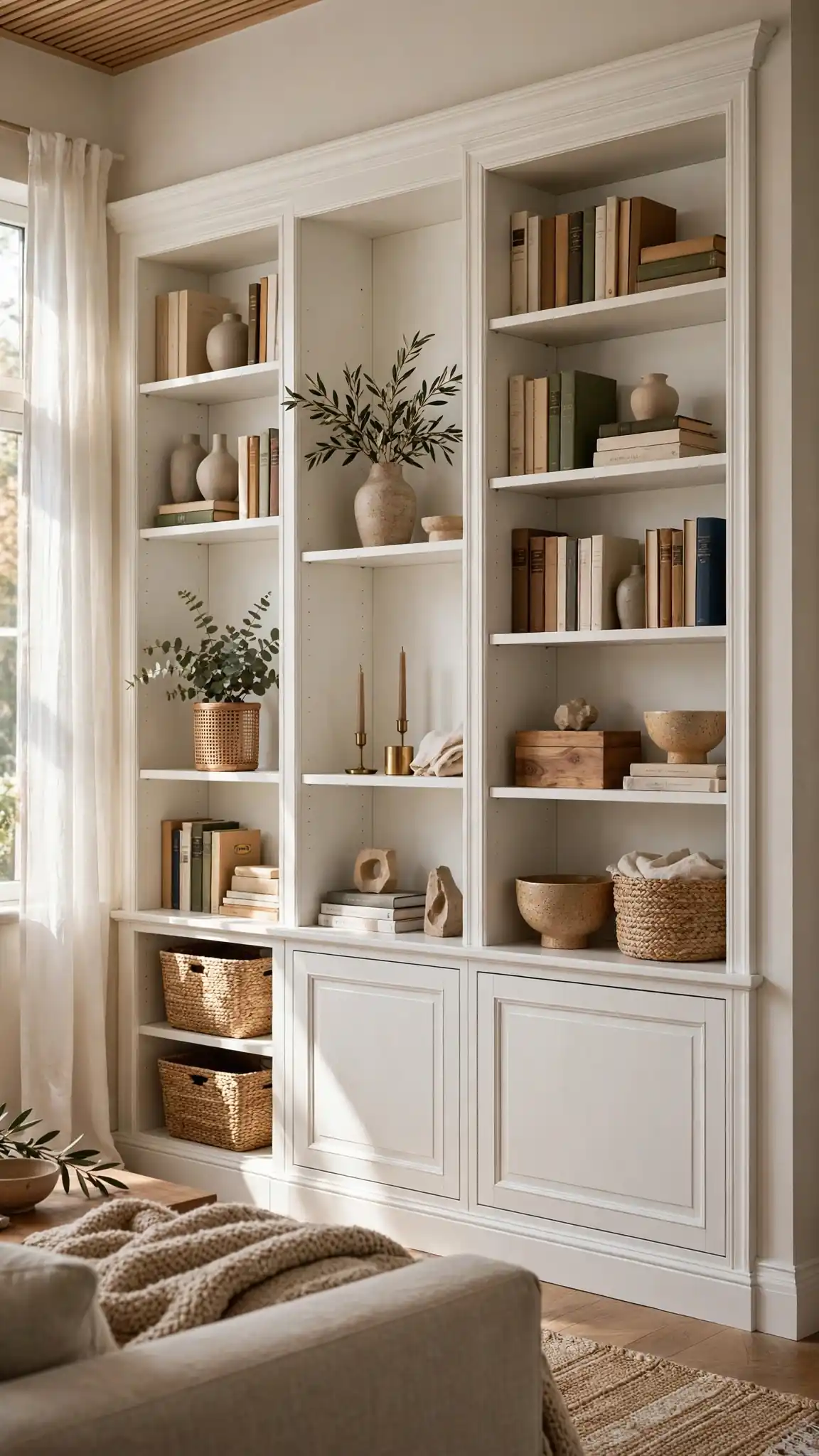
The Billy hack formula: line up Billy bookcases ($80 each), secure them together and to the wall, add a 1×2 baseboard at the bottom, crown molding at top, and caulk every seam. Paint everything — cases included — one color (white or a deep moody tone) and the seams vanish. Total cost for a 6-foot wall: $400–$600 versus $3,000+ for custom built-ins. Add IKEA's Oxberg glass doors ($40 each) to half the units for a library feel. This is renter-friendly only with landlord approval since it involves wall anchoring. Pro tip: the caulk is the magic — a $6 tube of paintable caulk along every joint is what separates 'IKEA' from 'custom'.
6. Asymmetrical Modular Cube Shelving
Asymmetrical cube shelving stacks open boxes in an irregular, staggered pattern that reads as modern art on the wall. Brands sell modular systems you rearrange anytime, which suits renters who move often. Mix cube sizes — a few large squares for oversized art books, smaller ones for paperbacks and plants. Leave one or two cubes completely empty; negative space is what makes asymmetry look designed rather than messy. Choose walnut or matte black finishes for a high-end look. This idea photographs beautifully, which is why it dominates trendy apartment tours online.
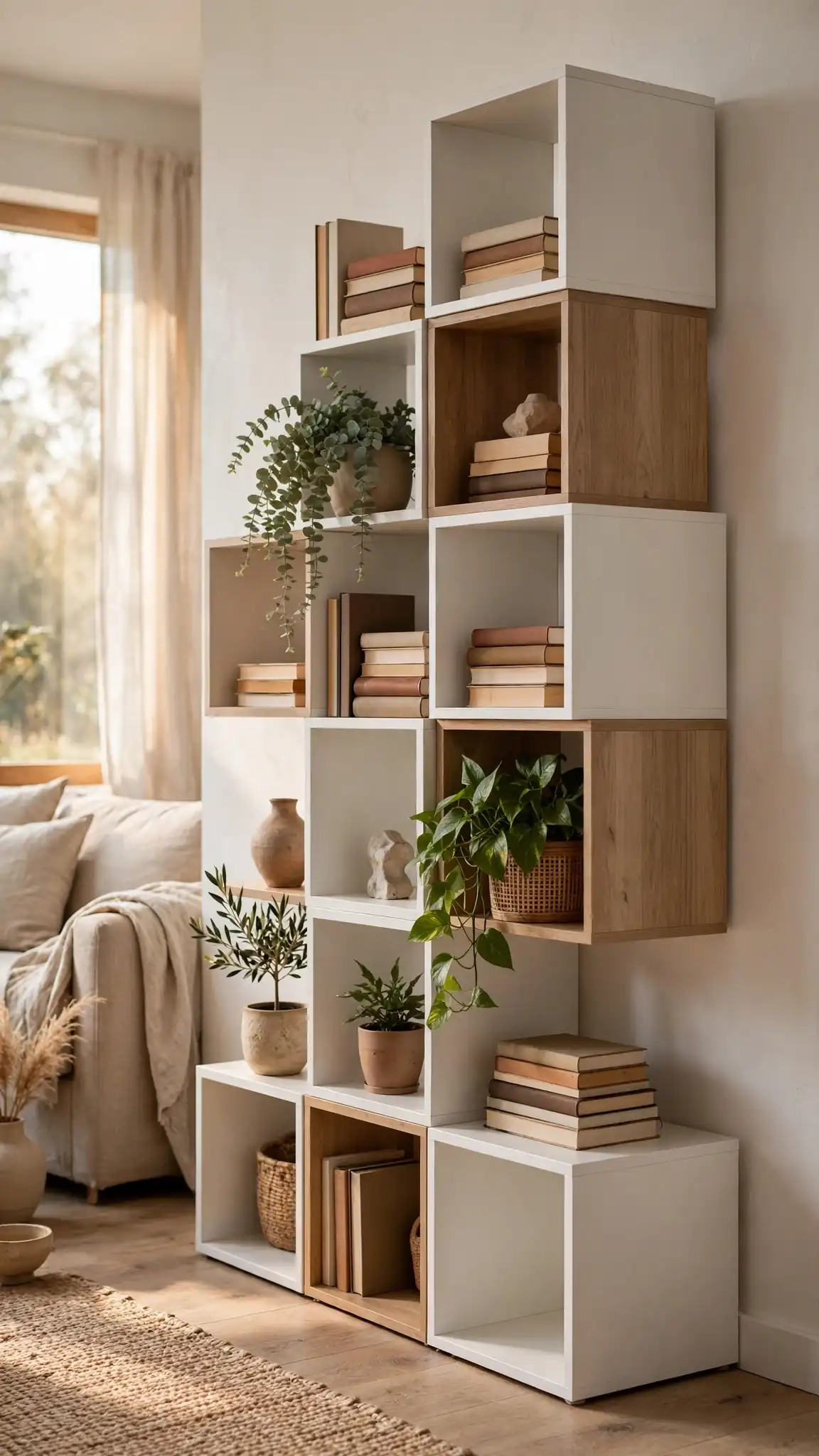
Asymmetrical shelving works when the overall silhouette stays roughly rectangular — scatter the cubes, but keep the outer edges aligned or the arrangement looks accidental. Secure stacked cubes together with brackets and anchor the whole unit to the wall. Mix open cubes (display) with closed ones (storage bins, $8–$15 each) in about a 60/40 ratio. Modular cube sets run $100–$300. This style suits modern and playful rooms; in traditional spaces it can look chaotic. Pro tip: sketch the arrangement on paper first, numbering each cube — rebuilding a 12-cube tower three times because you 'winged it' is a rite of passage you can skip.
7. Bookshelf Styled with Plants and Books
The “shelfie” trend proves greenery is the secret ingredient of every trendy bookshelf. Alternate book stacks with trailing plants like pothos, string of pearls, or philodendron that spill over shelf edges and soften hard lines. Place one plant per shelf maximum so it feels lush, not jungly. Snake plants and ZZ plants survive the low light common in apartments. Terracotta pots warm up white shelving, while ceramic white pots keep minimalist shelves clean. This idea costs almost nothing if you propagate cuttings, and it makes the living room feel instantly alive.
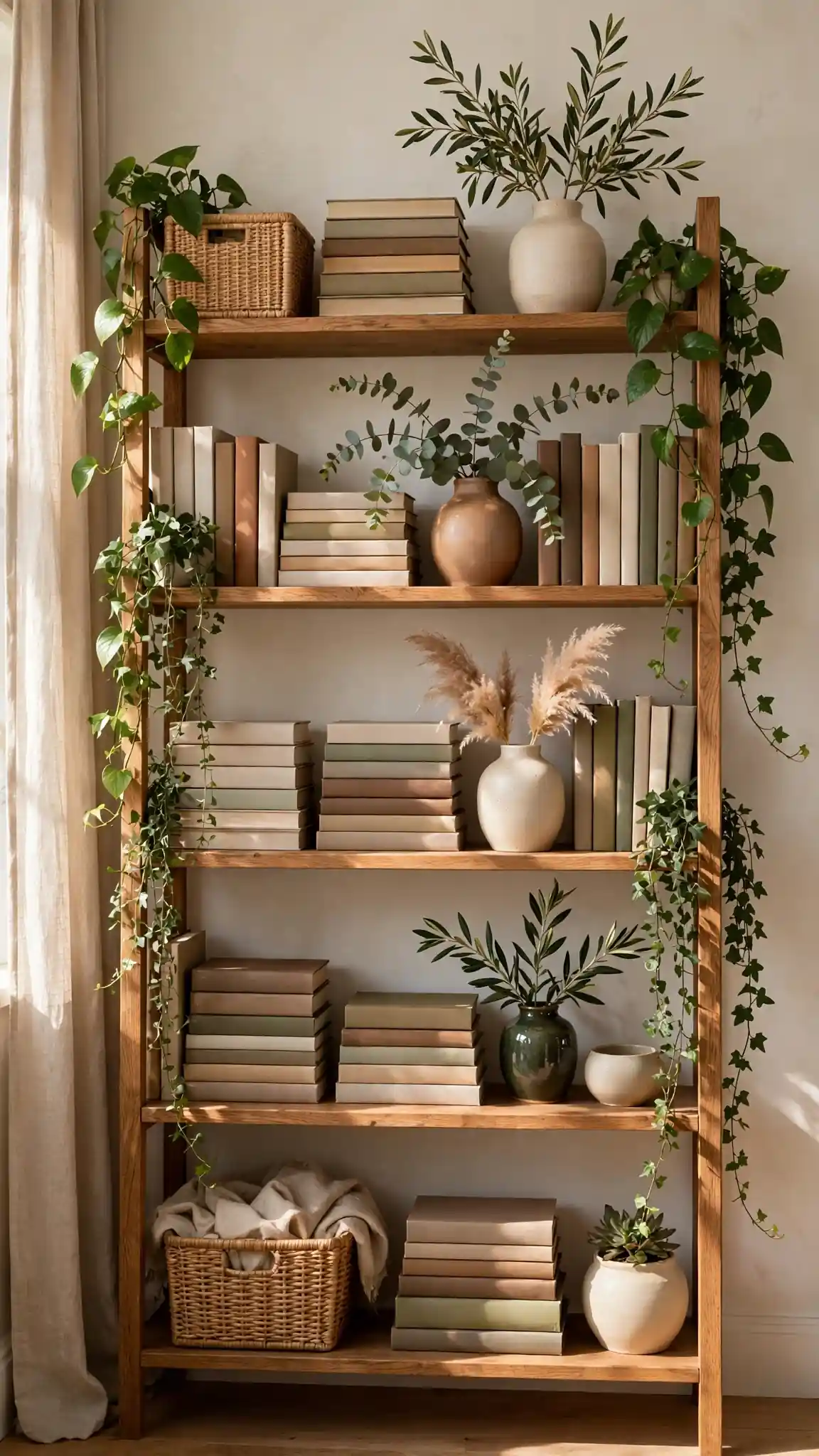
The shelfie ratio that works: roughly 60% books, 25% plants, 15% objects. Trail pothos or philodendron from upper shelves (they thrive in indirect light), and place a snake plant or ZZ on lower shelves where light is dimmer. Alternate book orientations — some vertical rows, some horizontal stacks — with plants tucked into the gaps. Small pots ($5–$12) in matching materials (terracotta, white ceramic) keep it cohesive. Pro tip: fake plants are fine on high shelves nobody can touch, but use real ones at eye level — the difference is obvious up close, and real plants improve air quality while they decorate.
8. Color-Coded Rainbow Book Arrangement
Arranging books by spine color turns an ordinary bookshelf into a statement piece. Group whites, then yellows, oranges, reds, pinks, blues, greens, and finally blacks for a smooth gradient across the shelves. This works best when you own fifty or more books, and it photographs incredibly well — a favorite of interior bloggers everywhere. Critics say it makes titles harder to find, but most people remember covers by color anyway. If a full rainbow feels loud, try grouping just two or three tones that match your living room palette for a subtler designer effect.
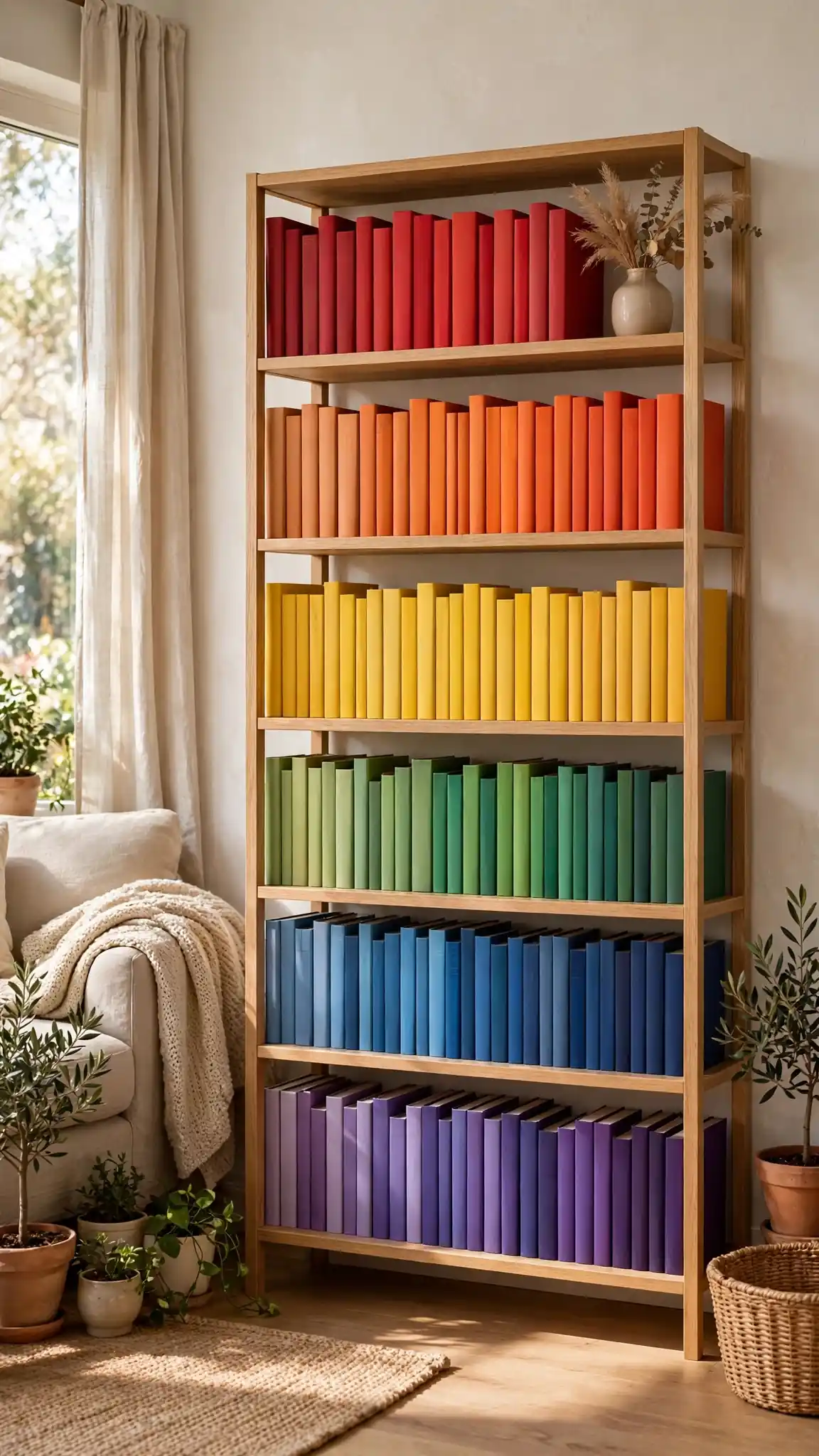
Rainbow shelving is pure visual impact, but finding books becomes harder — it suits display collections, not daily reference libraries. Group by spine color in spectral order (red, orange, yellow, green, blue, purple, then black/white/neutrals), and it helps to remove dust jackets for cleaner color blocks. This works best on a single feature bookcase; rainbow the whole library and the effect dilutes. It photographs beautifully for social media, which is half the point. Pro tip: keep one shelf in normal order for the books you actually reach for weekly — a hybrid approach gives you the Instagram look without the daily frustration.
9. Black Metal Industrial Pipe Shelves
Industrial pipe shelving combines reclaimed wood planks with black iron pipes for a loft-style look that suits exposed-brick apartments perfectly. You can buy ready-made units or DIY with plumbing pipes and stained pine boards. The open structure keeps small living rooms feeling airy while holding serious weight — great for heavy hardcovers. Pair with a leather sofa, Edison bulb lamps, and a jute rug to complete the industrial aesthetic. Because the pipes mount to studs, these shelves feel permanent and sturdy, though renters should check wall rules before drilling.
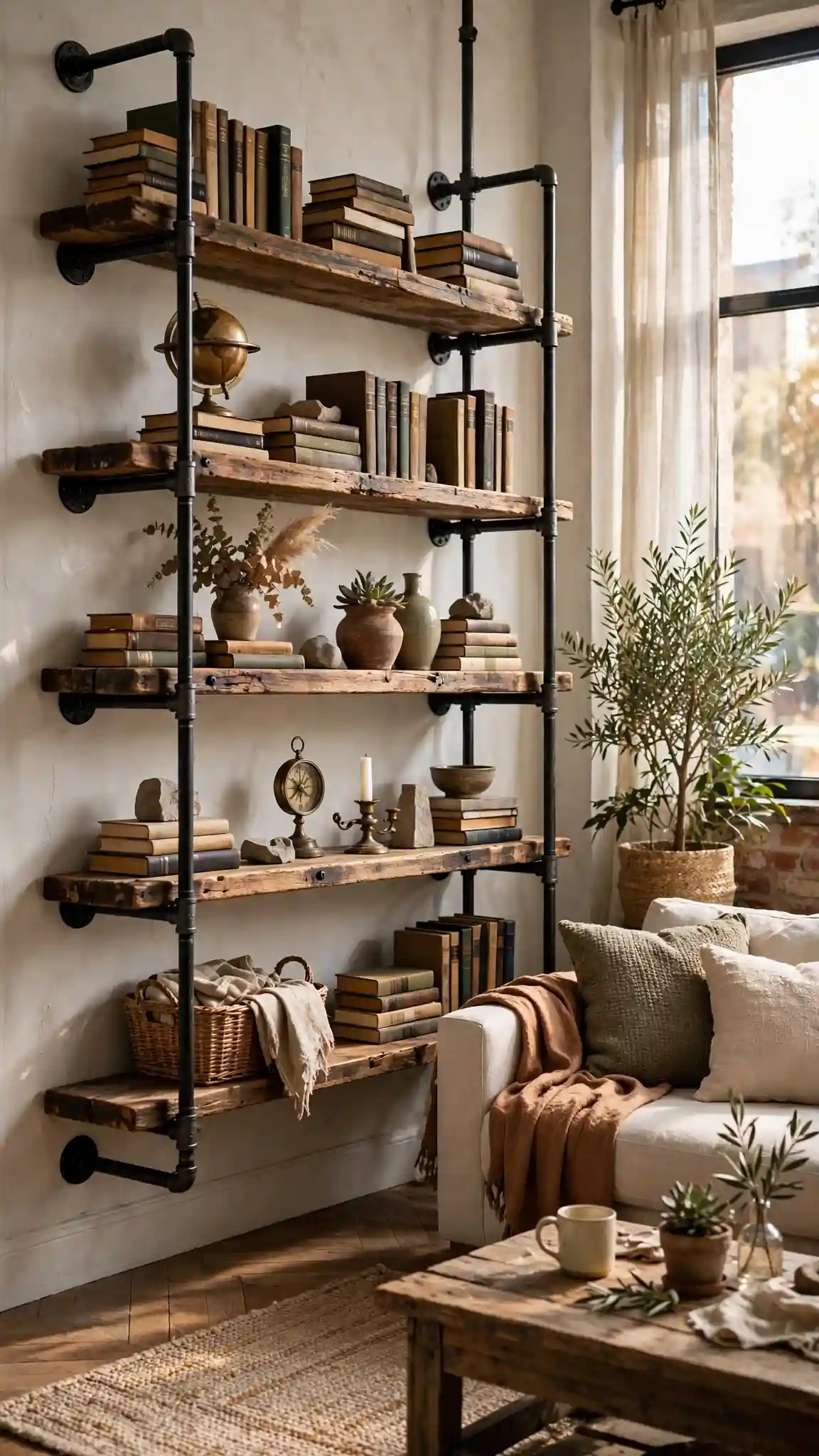
Real iron pipe shelving is heavy and expensive ($200–$500 for a multi-shelf unit), so most people use the look: black metal brackets ($15–$30 per pair) with reclaimed-wood-look planks. Mount every bracket into studs — pipe shelves tempt overloading, and a collapsed shelf of books is dangerous. The style suits lofts, industrial, and modern farmhouse rooms; it fights traditional decor. Seal raw wood planks with matte polyurethane to prevent splinters. Pro tip: buy flanges and pipes from the plumbing aisle for authentic fittings at half the decor-store price — a 3/4-inch flange costs about $6 at Home Depot versus $18 as 'shelf hardware.'
10. Mid-Century Modern Low Credenza Shelf
A low, long mid-century bookshelf or credenza-style unit keeps sightlines open in small living rooms, making them feel wider. Choose walnut wood, tapered legs, and clean horizontal lines — hallmarks of the mid-century style trending for years. The top surface doubles as a display ledge for a record player, art, or a table lamp. Store books vertically below with a few bookends made of brass or marble. This idea works beautifully under windows where tall shelving would block light, solving a common apartment layout problem elegantly.
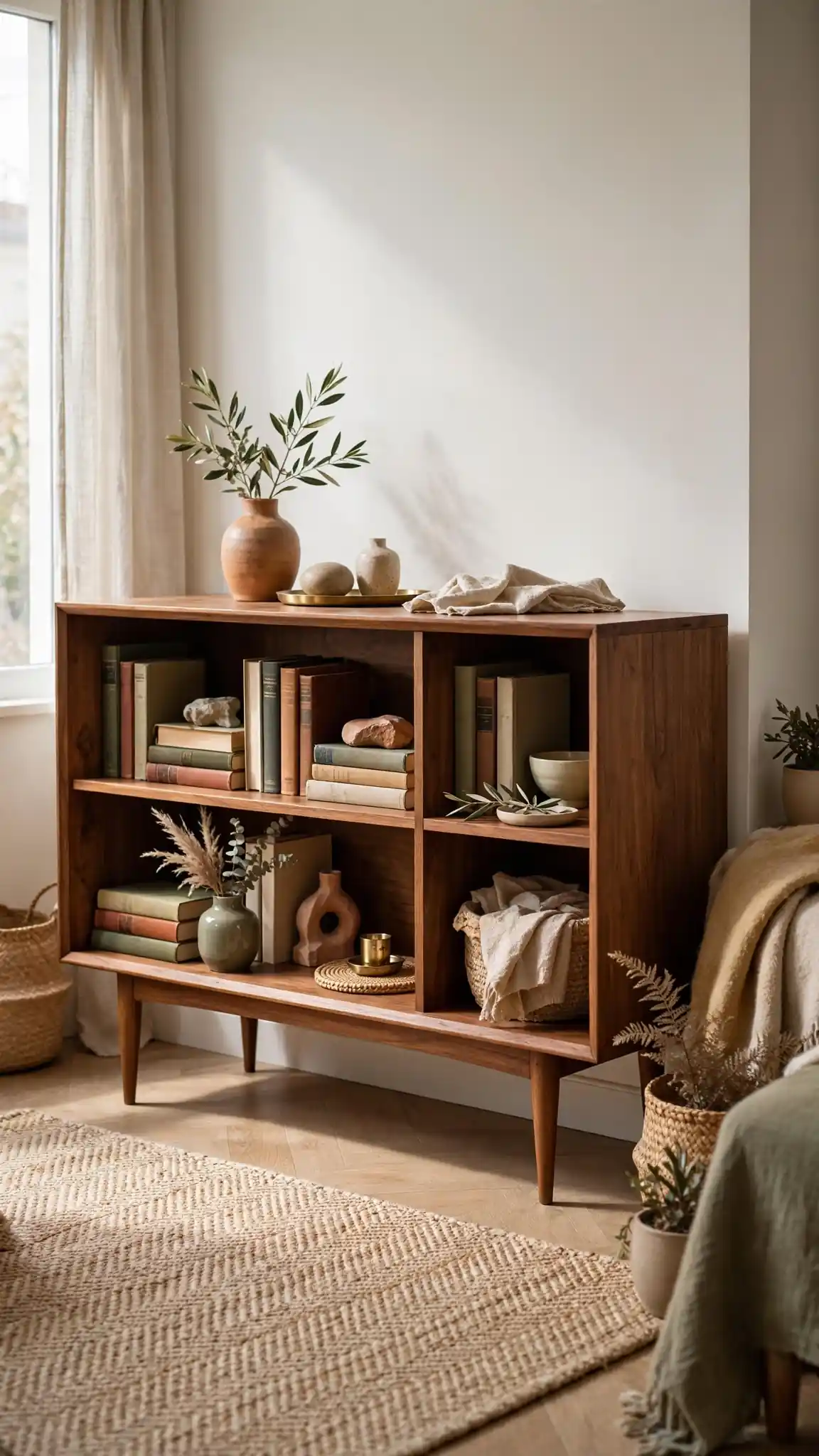
A low credenza (28–32 inches high) keeps sightlines open, making small living rooms feel larger — the top becomes bonus display space for plants and art. Look for solid walnut or teak veneer, tapered legs, and sliding doors; vintage pieces ($200–$600 on Facebook Marketplace) often beat new reproductions in quality. Inside, store books horizontally in stacks plus media equipment. Keep the top styling minimal: one plant, one stack of books, one object. Pro tip: measure your TV before buying if it will hold media — the credenza should be at least 6 inches wider than the screen on each side for proper proportion.
11. Window-Surround Bookshelf Frame
Framing a window with bookshelves turns an awkward wall into a cozy reading nook. Install shelving on both sides of the window and connect them with a bridge shelf above, creating a built-in look that celebrates natural light instead of fighting it. Add a bench or two floor cushions beneath the window and you have an instant library corner. Keep shelf contents lighter near the glass — plants love the spot — and books deeper in. This design maximizes storage in apartments where every wall counts, and it looks straight out of a design magazine.

Framing a window with bookshelves creates the coveted library nook, but protect the books: UV film on the glass ($50–$100 professionally installed) prevents spine fading, and keep shelves 6+ inches from the window frame to avoid condensation damage. Use narrow bookcases (12-inch depth) flanking the window plus a bridge shelf above for the full surround. Add a window seat cushion ($60–$120 custom) below and you have a reading nook. This works best on windows at least 4 feet wide. Pro tip: leave the window trim and sill accessible — you will need to open the window for ventilation, so do not block the latch with a fixed shelf.
12. Picture Ledge Shelves for Forward-Facing Books
Picture ledges are narrow shelves with a front lip that display books cover-out like a boutique bookstore. Stack two or three ledges on one wall and rotate your prettiest covers monthly — it doubles as changeable wall art. This idea suits people with fewer books who still want the literary look, and it is perfect for displaying kids’ books, vinyl records, or magazines. Ledges cost very little, install with two screws each, and suit narrow walls beside doors or hallways leading into the living room where deep shelves would never fit.

Picture ledges display books cover-out like a boutique bookstore, which is perfect for kids' rooms and style-forward living rooms — but they hold far fewer books than spine-out shelving, so use them for display, not storage. Install ledges 10–14 inches apart vertically to fit most book heights, and keep them shallow (4–6 inches) so books lean securely against the wall. A 45-inch ledge ($25–$40 at IKEA) holds 8–12 books. Rotate the display seasonally or monthly. Pro tip: this is the best format for showcasing beautiful covers and art books — keep the everyday paperbacks spine-out on a proper bookcase nearby.
13. Curved and Arched Bookshelf Designs
Curved furniture is one of the biggest interior trends right now, and arched bookshelves bring that softness to apartment living rooms. An arch-topped bookcase reads like a piece of sculpture, especially in cream, sage green, or burnt orange finishes. The rounded silhouette contrasts beautifully with boxy sofas and rectangular TVs, adding visual relief in small rooms full of straight lines. Style it sparsely — curves deserve breathing room. Place one arched unit beside the sofa as an accent rather than lining a whole wall, and let it be the room’s conversation piece.
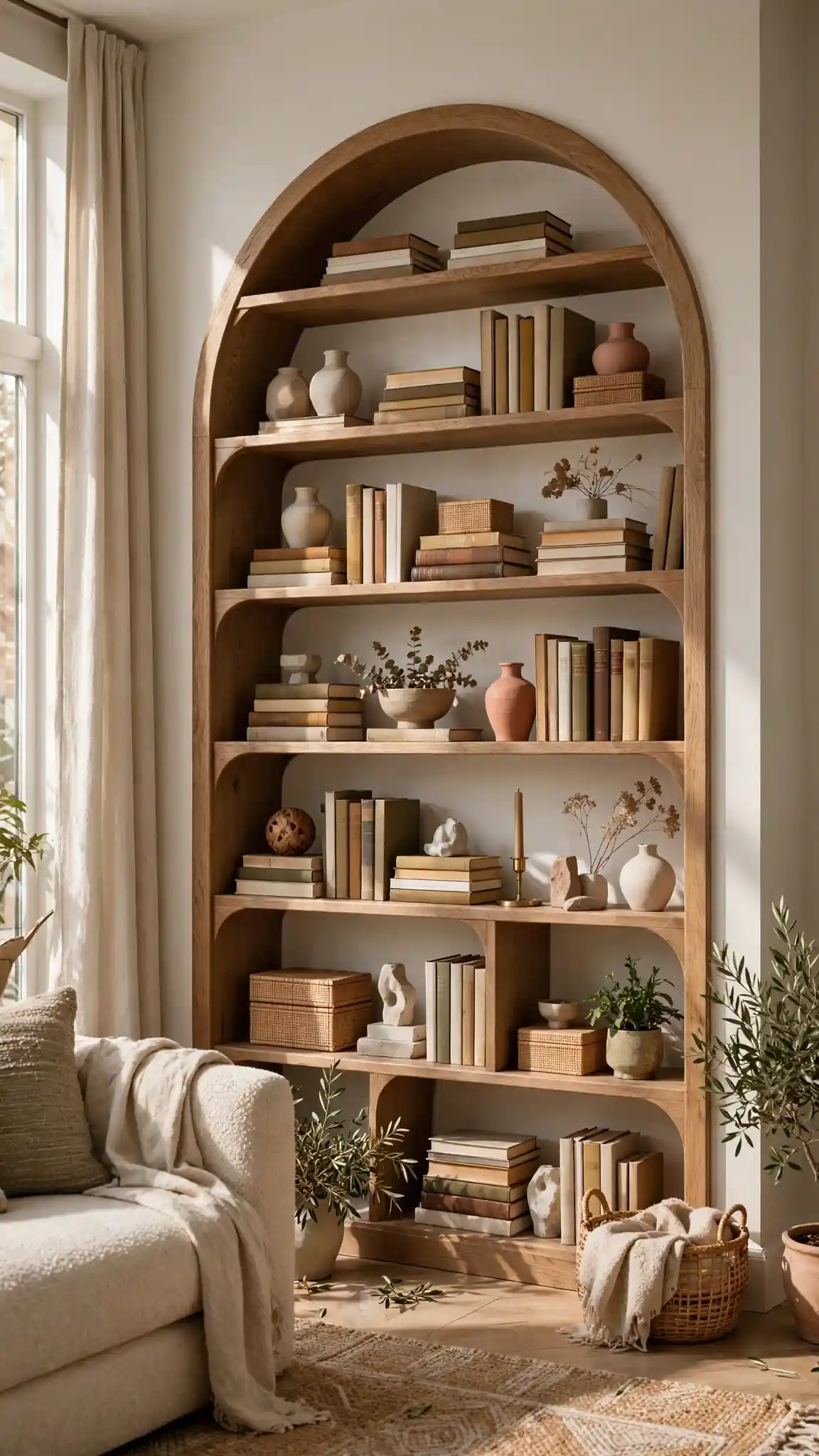
Arched bookcases are having a major moment, with prices from $150 (Target, Walmart) to $1,500+ (designer brands). The arch softens rooms full of rectangles and suits boho, modern organic, and art-deco styles. Because the curved top reduces usable shelf space, pair an arched unit with a standard bookcase for actual storage. Check the arch's inner clearance — tall art books may not fit the curved section. Pro tip: if a full arched bookcase is out of budget, an arched mirror ($80–$150) hung above a standard bookcase gives a similar softening effect for a fraction of the price.
14. Bookshelf Behind the Sofa Console Style
A console-height bookshelf placed directly behind a floating sofa creates a smart storage strip in open-plan apartments. It defines the living zone, gives you a surface for lamps and drinks, and stores a full library at arm’s reach from your reading spot. Choose a unit the same length as the sofa and slightly lower than its backrest for clean proportions. This trick works especially well when your sofa cannot sit against a wall. Add two small table lamps on top for cozy, layered lighting that makes evenings feel intentional.

A console-height bookcase (30–34 inches) behind a floating sofa creates a storage strip that doubles as a surface for lamps, drinks, and decor — brilliant in open-plan apartments. Leave 6–12 inches between the sofa back and the shelf so cushions have room and the shelf stays accessible. Anchor it to the wall; a sofa bumped into an unanchored bookcase is a toppling hazard. Narrow 10–12-inch-deep units work best to avoid eating floor space. Pro tip: run a power strip along the back of the unit before pushing the sofa in — it gives you lamp and charger outlets exactly where the seating needs them.
15. Minimalist Single-Shelf Statement
Sometimes one long, thick floating shelf says more than a full bookcase. Mount a chunky oak shelf — 4–5 cm thick, up to two meters long — on an empty wall and style it with a short row of books held by sculptural bookends, one vase, and one framed artwork leaning against the wall. The generous empty space around it is the design. This minimalist approach suits Japandi and Scandinavian apartments where calm matters more than storage volume. It is also the fastest idea on this list: one shelf, five objects, done.

One thick floating shelf (at least 2.5 inches thick, 8–10 inches deep) makes a stronger statement than three thin ones — the chunkiness is the design. Mount it into studs with heavy-duty hidden brackets rated for 75+ lbs; a 6-foot oak shelf loaded with books is seriously heavy. Style it sparsely: a row of books on one third, a plant and one object on the rest. Negative space is the whole point. A solid oak shelf costs $80–$200. Pro tip: this is the highest-impact lowest-cost bookshelf look, but it only works with ruthless editing — if the shelf fills up, the minimalism dies, so commit to the discipline.
16. Bookshelf with Integrated TV Wall
Combining your TV and bookshelf into one wall unit solves the biggest styling dilemma in apartment living rooms. Surround the screen with open shelving so the black rectangle blends into a wall of books, plants, and objects instead of dominating the room. Symmetrical shelving on both sides looks classic; asymmetrical arrangements look modern. Keep the shelves nearest the TV visually quiet — matte objects, no glare-prone glass. This “disappearing TV” trick is a designer favorite because it makes the living room feel like a library that happens to have a screen.

The integrated TV wall solves the black-rectangle problem: flank the screen with bookshelves and style the shelves so the TV reads as one element among many. Mount the TV on the wall (not on a shelf) at eye level from the sofa — center of screen 42–48 inches from the floor. Hide cables with a cord cover painted to match ($15–$25) or route them through the wall. Keep shelving symmetrical around the TV for a built-in look. Media consoles with cable management ($200–$500) complete the setup. Pro tip: add bias LED lighting behind the TV ($20 strip) — it reduces eye strain, makes the screen look better, and turns the whole wall into an evening feature.
17. Boho Bookshelf with Baskets and Textures
A boho bookshelf layers natural textures: rattan baskets, macramé, wooden beads, terracotta, and plenty of plants alongside your books. Use woven baskets on lower shelves to hide remotes, chargers, and clutter — essential in small apartments. Stack books horizontally and top the stacks with small treasures like shells, brass objects, or candles. Warm white or natural wood shelving works best as a backdrop. The boho approach forgives imperfection; slightly overfilled, layered shelves are the point. Finish with a small salt lamp or fairy lights for a cozy evening glow.

Boho shelving is about layered natural textures: rattan baskets ($15–$35 each) for hidden storage, macramé hangings, wooden beads, and terracotta pots. The rule is warm materials only — no chrome, no glass, no high-gloss. Mix basket sizes and weave patterns, but keep the color palette tight (honey, cream, terracotta) so it reads collected, not chaotic. Plants are mandatory: trailing pothos softens every shelf edge. This style forgives clutter better than most, but still edit — even boho needs breathing room. Pro tip: thrift stores are boho goldmines for baskets and ceramics at $2–$8 each; buy the interesting shapes and skip anything mass-produced looking.
18. Two-Tone Painted Bookshelf Back Panel
Painting or wallpapering the back panel of a bookshelf instantly elevates a basic unit. Deep navy, forest green, or terracotta backs make white ceramics and book spines pop like a boutique display. Renters can use peel-and-stick wallpaper cut to fit each cubby — removable and damage-free. This trick costs under twenty dollars and takes one afternoon, yet it delivers the biggest visual return of any budget idea here. Match the back-panel color to a cushion or artwork elsewhere in the living room so the whole space feels professionally coordinated.
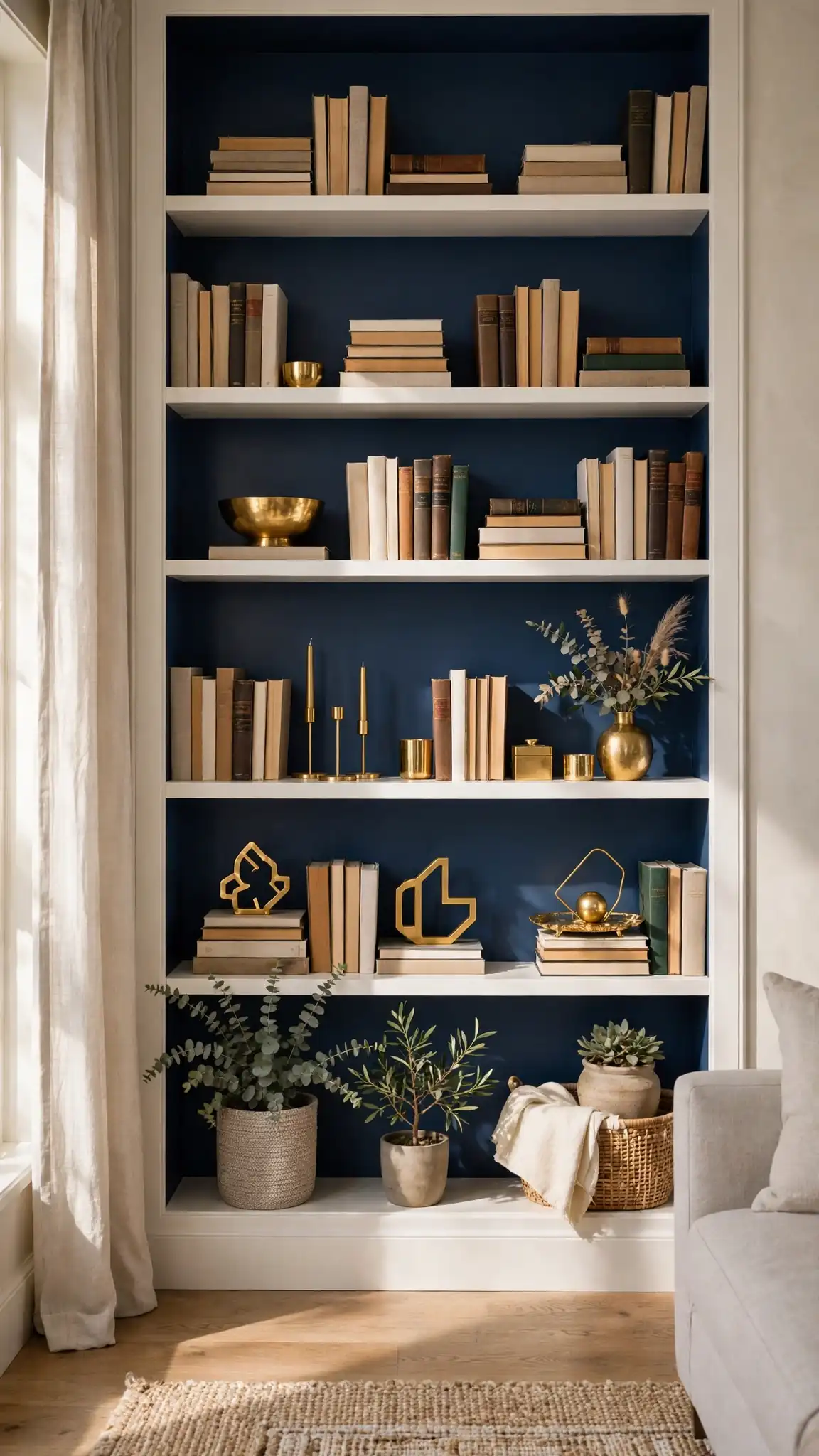
Painting just the back panel is the highest-impact bookcase upgrade for under $30: remove the shelves, sand lightly, apply two coats of a deep tone (navy, forest, oxblood, or charcoal), and reassemble. The dark backdrop makes book spines and light objects pop dramatically. For wallpaper instead, peel-and-stick ($30–$50 per roll) is renter-friendly and equally striking — grasscloth and subtle geometrics work best. This trick elevates even the cheapest bookcase. Pro tip: paint the back panel before assembling a new bookcase — it is ten times easier than painting around installed shelves, and the finish looks factory-perfect.
19. Corner Bookshelf Tower
An L-shaped or rotating corner bookshelf tower squeezes storage into the one spot furniture usually ignores. Corner towers rise tall on a tiny footprint — some hold over a hundred books on half a square meter of floor. Rotating versions let you browse spines from your armchair. Place a reading lamp beside it and a small chair in front, and the dead corner becomes the best seat in the apartment. Choose a tower with a closed base cabinet if you want hidden storage for board games, cables, or paperwork.

Corners waste the most space in small apartments, and a tower bookcase reclaims it: L-shaped or rotating units ($100–$250) fit where standard bookcases cannot. Measure the corner carefully — baseboards and crown molding eat into the listed dimensions. Rotating towers are fun for kids and great for tight spots since every shelf spins into reach. Anchor tall towers to both walls; corner units are tippy by geometry. Style the most visible face carefully since corners catch the eye from two directions. Pro tip: a corner tower plus a small armchair and floor lamp creates an instant reading corner in space that was previously dead.
20. Open-Back Shelving Against a Feature Wall
Open-back shelving placed in front of a painted feature wall or exposed brick lets the wall show through, creating depth that closed bookcases kill. The wall color becomes the backdrop of every shelf, so a dark green or plaster-pink wall turns even cheap shelving into a designer moment. Keep styling loose — 50% filled is ideal — so the wall stays visible. This idea suits apartments with beautiful architecture worth showing off, and it keeps small rooms feeling open because light passes straight through the unit.

Open-back shelving lets a painted feature wall or exposed brick show through, doubling the visual interest — the wall becomes part of the display. This works best with a bold wall color (deep green, terracotta, navy) behind light wood or white shelving for maximum contrast. Keep shelf styling airier than usual since the wall is already busy: fewer objects, more negative space. The downside is dust — open backs collect it, so plan a quarterly wipe-down. Pro tip: paint the wall first and live with it for a week before choosing shelving; the wall color dictates whether warm or cool shelf finishes will harmonize.
21. Bookshelf Nook Under a Loft Bed or Stairs
If your apartment has a loft bed, mezzanine, or interior stairs, the space beneath is prime bookshelf territory. Custom-cut shelving that follows the stair angle looks architectural and stores hundreds of books in otherwise wasted space. Under a loft bed, a low bookshelf plus a reading chair creates a genuine library nook within a studio. Add a wall sconce or clip-on lamp for evening reading. This idea proves the trendiest apartment storage is not bought — it is discovered in the odd corners your floor plan already gives you.

Under-stair and under-loft spaces are awkward for furniture but perfect for books: low bookcases (24–30 inches high, $60–$120) slide right in. Add LED puck lights ($15 for 6) since these spots are always dim, and a small rug plus floor cushion turns it into a reading nook kids adore. Measure the sloped clearance at multiple points — stairs slope, so the bookcase must fit the lowest point. This is dead space reclaimed, so even modest styling looks intentional. Pro tip: paint the nook’s walls a shade darker than the room — the cocooning effect makes small readers feel like they have a secret hideaway.
22. Glass-Door Display Bookcase
A glass-door bookcase keeps dust off your collection while still displaying it — practical in city apartments near busy roads. Modern versions with black steel frames look like Parisian vitrine cabinets and suit both industrial and classic interiors. Use interior lighting (battery LED strips work in rentals) to make the cabinet glow at night like a boutique display. Store your most beautiful hardcovers, collectibles, or ceramics inside. Because the doors add visual weight, one glass cabinet is enough; pair it with open shelving elsewhere for balance.
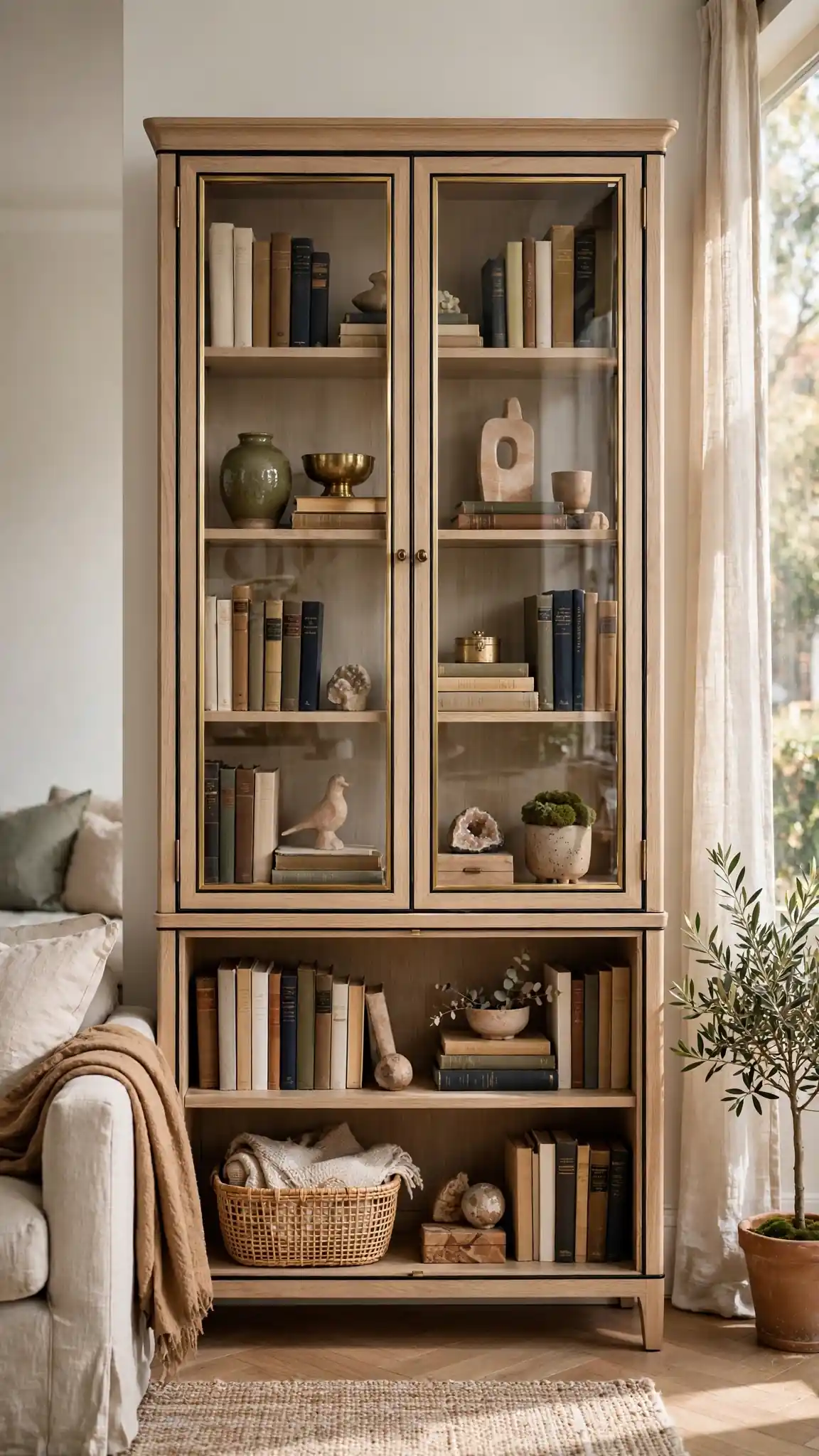
Glass doors keep dust off collections while keeping them visible — ideal for city apartments and prized sets. IKEA’s Billy with Oxberg doors ($80 + $40/door) is the budget classic; vintage glass-front bookcases ($150–$400) have better proportions and charm. The catch: glass shows messy shelves mercilessly, so this format demands tidier styling than open shelving. Add interior LED strips ($20) for a lit-library glow that makes the whole unit a feature at night. Pro tip: put the books you actually read on open shelves elsewhere and reserve the glass case for display-worthy collections — form and function each get their ideal home.
23. Honeycomb Hexagon Shelves
Hexagon shelves cluster on the wall like honeycomb, holding a few books each while functioning as geometric wall art. Arrange five to seven hexagons in an organic, spreading pattern rather than a rigid grid. They suit small collections and add instant personality above a desk corner or beside the TV. Mix wood hexagons with one or two painted in your accent color. Because each piece is light, they mount with small hooks — renter-friendly and easy to rearrange. This playful idea works especially well in creative, eclectic living rooms.
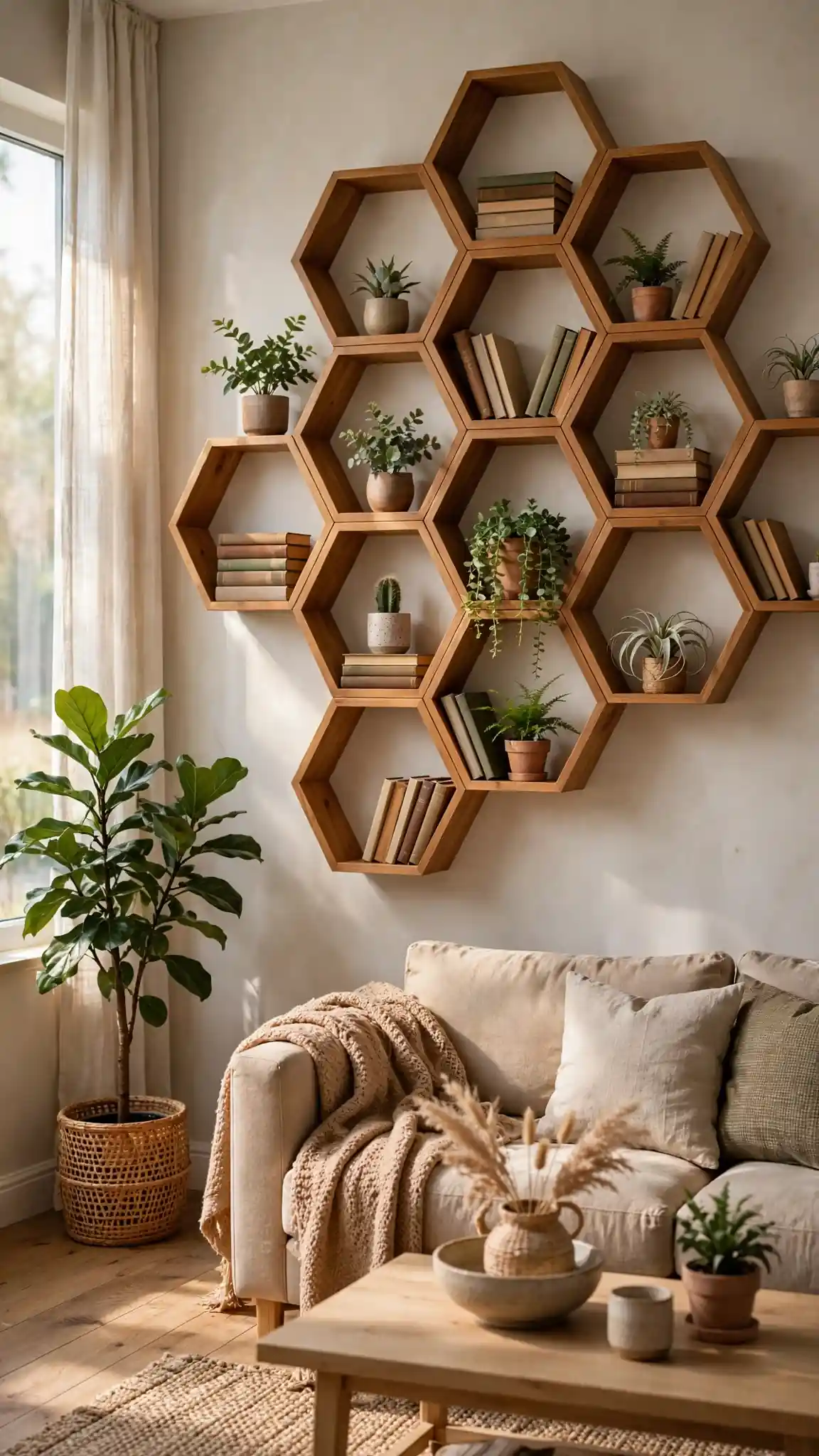
Hexagon shelves are wall art that happens to hold books — each cell fits 4–8 books, so plan them as accents, not primary storage. Mount each hexagon into a stud or with heavy-duty drywall anchors rated for 25+ lbs; a cluster of five hexagons fully loaded is heavy. Arrange them in an organic honeycomb cluster rather than a rigid grid for the best look. Sets of 5–6 hexagons run $60–$150. They suit modern, playful, and kids’ rooms. Pro tip: leave at least one hexagon empty or with a single plant — the negative space is what makes the honeycomb pattern read clearly instead of looking cluttered.
24. Monochrome Book Styling with Neutral Covers
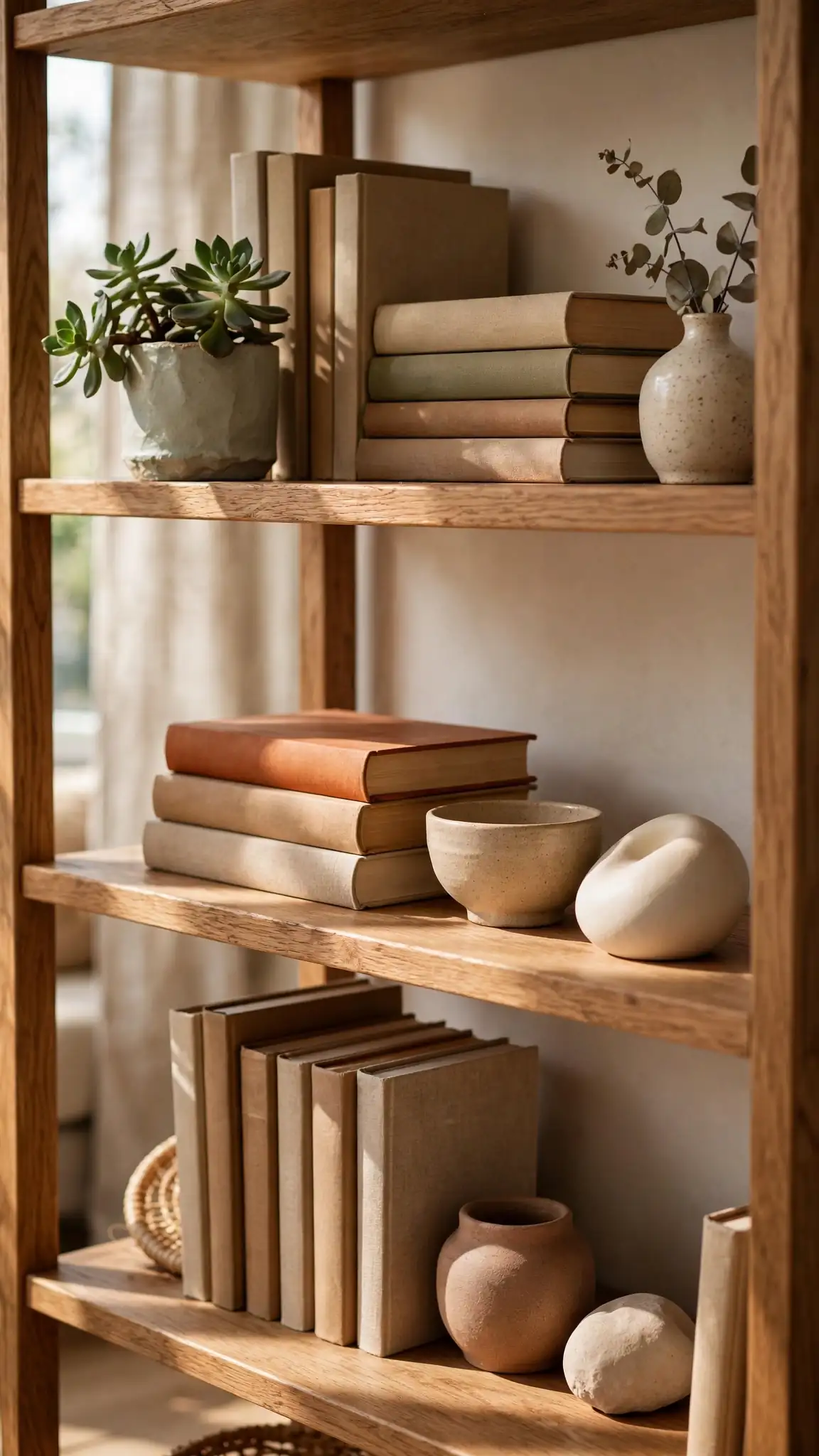
Turning books spine-in or wrapping them in kraft paper creates a calm, monochrome bookshelf that suits ultra-minimalist apartments. The uniform cream and white palette makes the shelf read as texture rather than clutter. Purists object — you lose the titles — so a gentler version groups only neutral-toned books together and shelves colorful ones elsewhere. Add black accents like iron bookends and one dried-branch vase for contrast. This aesthetic dominates modern organic and Japandi interiors where visual quiet is the ultimate luxury in a busy city life.

Turning books spine-in or wrapping them in kraft paper ($10 for a big roll) creates a calm, textural bookshelf that suits minimalist and Japandi rooms — but you will never find a book again, so reserve this for decorative collections. Wrap only the books on the most visible shelves and keep daily reads normally shelved elsewhere. Kraft paper, white, and natural linen covers all work; avoid glossy wraps that look cheap. Secure wraps with double-sided tape, not glue, so covers stay pristine underneath. Pro tip: this is a styling choice, not a storage solution — be honest about which shelves are for show and which are for use, and design each accordingly.
25. Bookshelf with Built-In Desk Combo
A bookshelf with an integrated fold-down or fixed desk creates a work-from-home station inside your living room without a separate office. Wall units with a desk surface at the center and shelving above and beside keep everything — laptop, books, files — in one vertical footprint. When work ends, close the fold-down panel and the living room returns to leisure mode. This idea exploded with remote work and remains essential for apartment dwellers. Add a wall lamp and a comfortable compact chair that tucks fully under the desk.

A bookcase with a fold-down or fixed desk creates a work-from-home station in zero extra floor space — perfect for studio apartments. The desk surface should be at least 36 inches wide and 20 inches deep for a laptop plus notebook; fold-down versions ($150–$350) disappear when work ends. Add a task light and cable management before styling the shelves above. Ergonomics matter: pair it with a proper chair, not a dining chair, since you will sit there for hours. Check weight ratings — a loaded desk shelf needs sturdy brackets. Pro tip: face the desk toward the room, not the wall, if possible — the bookshelves behind you become a perfect video-call backdrop.
26. Vintage and Thrifted Bookcase Makeover
A thrifted solid-wood bookcase, sanded and repainted in a trendy shade like sage, oxblood, or cream, delivers character no flat-pack unit can match. Look for dovetail joints and real wood at flea markets — quality bones cost less secondhand than new particleboard. Swap old hardware for brass knobs, line the back with wallpaper, and you own a one-of-a-kind piece. Vintage pieces also anchor a room emotionally; guests always ask about them. Sustainable, budget-friendly, and unique: thrifting checks every box trending in apartment decor right now.

Thrifted solid-wood bookcases ($30–$100) beat new flat-pack in durability every time — look for dovetail joints, solid backs, and smooth shelf adjustment. A makeover needs only sandpaper, a $25 quart of quality paint in a trendy shade (sage, oxblood, cream), and new hardware ($3–$8 per pull). Two coats plus a clear topcoat take a weekend. Check for woodworm holes and musty smells before buying; surface wear is fine, structural damage is not. Pro tip: keep the interior a contrasting color — natural wood inside with a painted exterior, or vice versa. The two-tone detail makes a thrifted piece look custom-designed.
27. Slim Vertical Spine Bookshelf
A spine bookshelf — a single vertical column barely 30 cm wide — slots into gaps beside doorways, radiators, or between the sofa and wall. Despite the tiny footprint, a tall spine tower holds 60–80 books stacked horizontally. Its sculptural, tower-like silhouette adds height to the room without bulk. Place one on each side of a doorway for symmetry, or let a single tower stand alone as an accent. For small apartments where every centimeter matters, this is the highest storage-to-footprint ratio on the entire list.
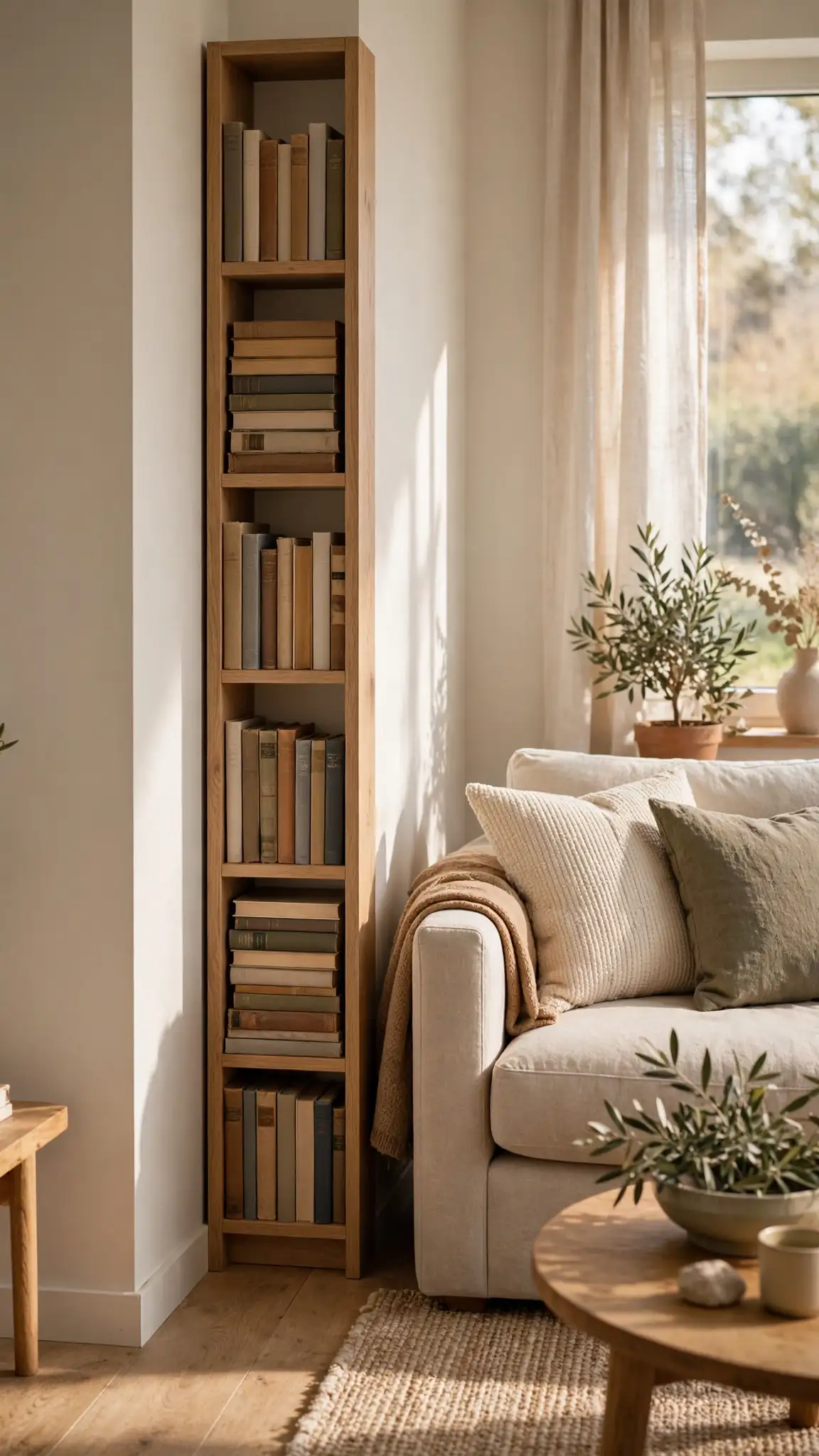
Spine bookcases — a single vertical column barely 12 inches wide — slot into the dead gaps beside doorways, radiators, and between furniture where nothing else fits. They hold 40–80 books in a footprint smaller than a floor lamp. Units run $50–$150; sturdier metal versions suit heavy art books. Anchor to the wall — tall narrow units are inherently tippy. They work brilliantly in pairs flanking a doorway or fireplace. Style the top with one small plant or object since it is at eye level. Pro tip: use spine shelves for the books you are currently reading or want to display — their visibility makes them perfect for a rotating “reading now” collection.
28. Bookshelf Lighting with LED Strips and Sconces
Lighting transforms any bookshelf from furniture into a feature. Stick warm-white LED strips (2700K) under each shelf edge, hidden behind a small lip, and the whole unit glows like a hotel library at night. Battery and USB versions need no electrician — ideal for renters. Alternatively, mount two brass picture lights above the bookcase for a classic, moody effect. Put the lights on a smart plug and schedule them for sunset. Evening ambience is the cheapest luxury in apartment living, and lit shelves deliver it every single night.
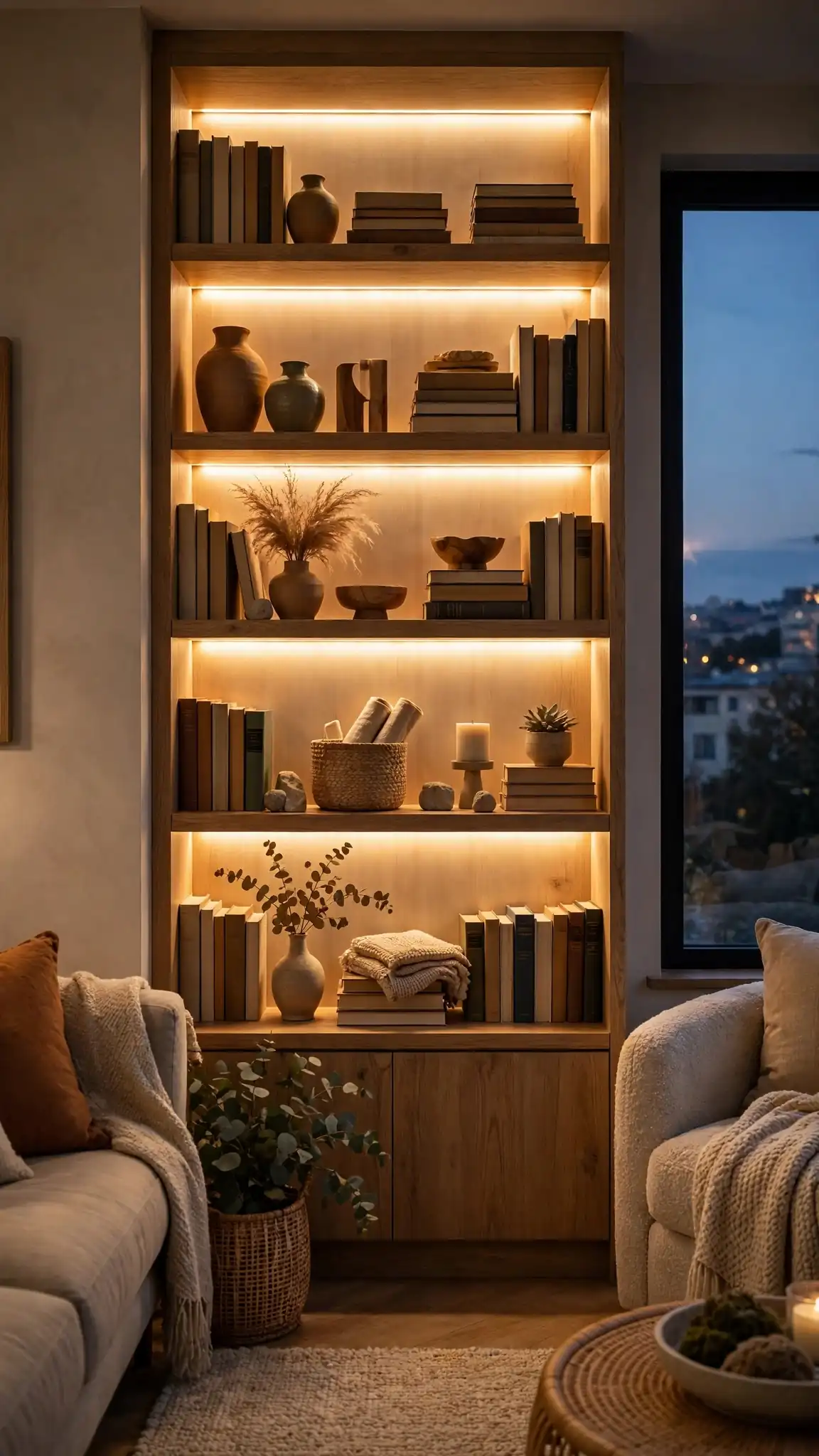
Lighting transforms shelving from furniture into architecture: warm-white LED strips (2700K, $15–$25 per 16 feet) mounted under each shelf front edge wash the shelf below in glow. Battery-operated strips avoid visible cords; hardwired is cleaner for permanent installations. Picture-light-style sconces ($40–$100) on top of the unit wash the whole bookcase. Put the lights on a timer or smart plug so the glow appears automatically at dusk. Avoid cool-white LEDs — they make books and wood look harsh. Pro tip: install the strips toward the front edge of each shelf, not the back — front placement lights the book spines you actually look at.
29. Mixed-Media Shelf Styling with Art and Objects
The trendiest shelves are only about half books. Layer framed art leaning against the back panel, sculptural objects, small mirrors, ceramics, and travel finds between your book stacks. Follow the triangle rule: repeat a color or material in three spots across the unit so the eye travels smoothly. Vary heights on every shelf — something tall, something medium, something low. Leave 20% empty space. This gallery approach turns a bookshelf into a self-portrait of your life, which is exactly why designers style shelves last and photograph them first.
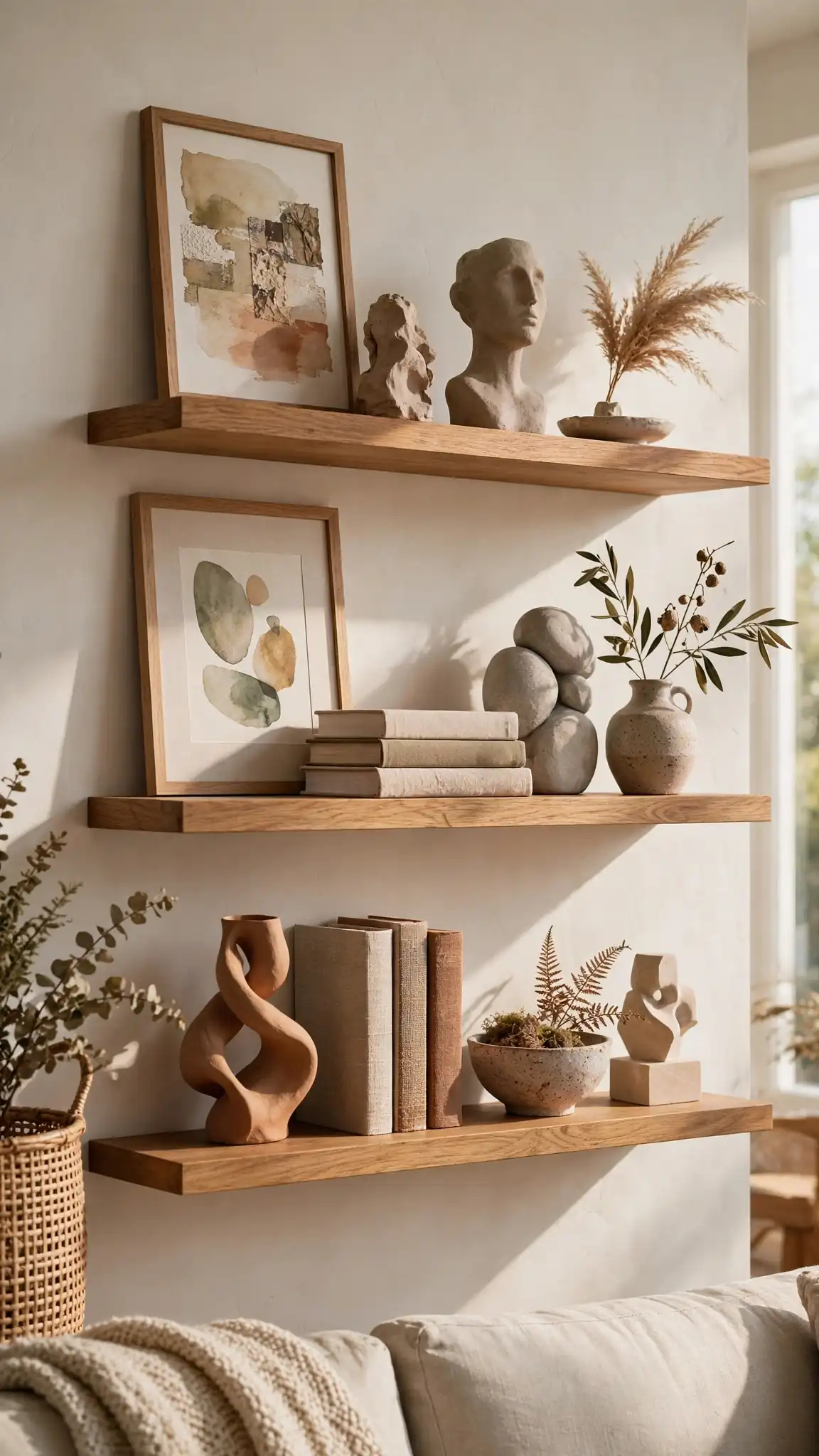
The trendiest shelves are only about half books: layer framed art leaning against the back panel, ceramics, small sculptures, and plants among the book rows. The formula per shelf — a vertical book stack, one horizontal stack, one art piece, one object — never fails. Repeat materials (all ceramics, all brass) for cohesion across mixed items. Leave 20–30% of each shelf empty; negative space is what separates styled from stuffed. Rotate objects seasonally to keep it fresh. Pro tip: shop your own home first — the vase from the bedroom and the frame from the hallway might be exactly what the bookshelf needs, for free.
30. Modular Stackable Crates for Flexible Renters
Wooden crates or modular stacking boxes build a bookshelf that grows, shrinks, and moves with you — the ultimate renter solution. Stack crates in a pyramid, a staircase, or a straight wall; strap or screw them together for safety. Stain them walnut for warmth or paint them to match your wall for a custom look. When you move, the “bookcase” packs itself: books stay inside the crates. Cheap, endlessly reconfigurable, and surprisingly stylish when done deliberately, crate shelving proves trendy apartment storage is about creativity, not budget.
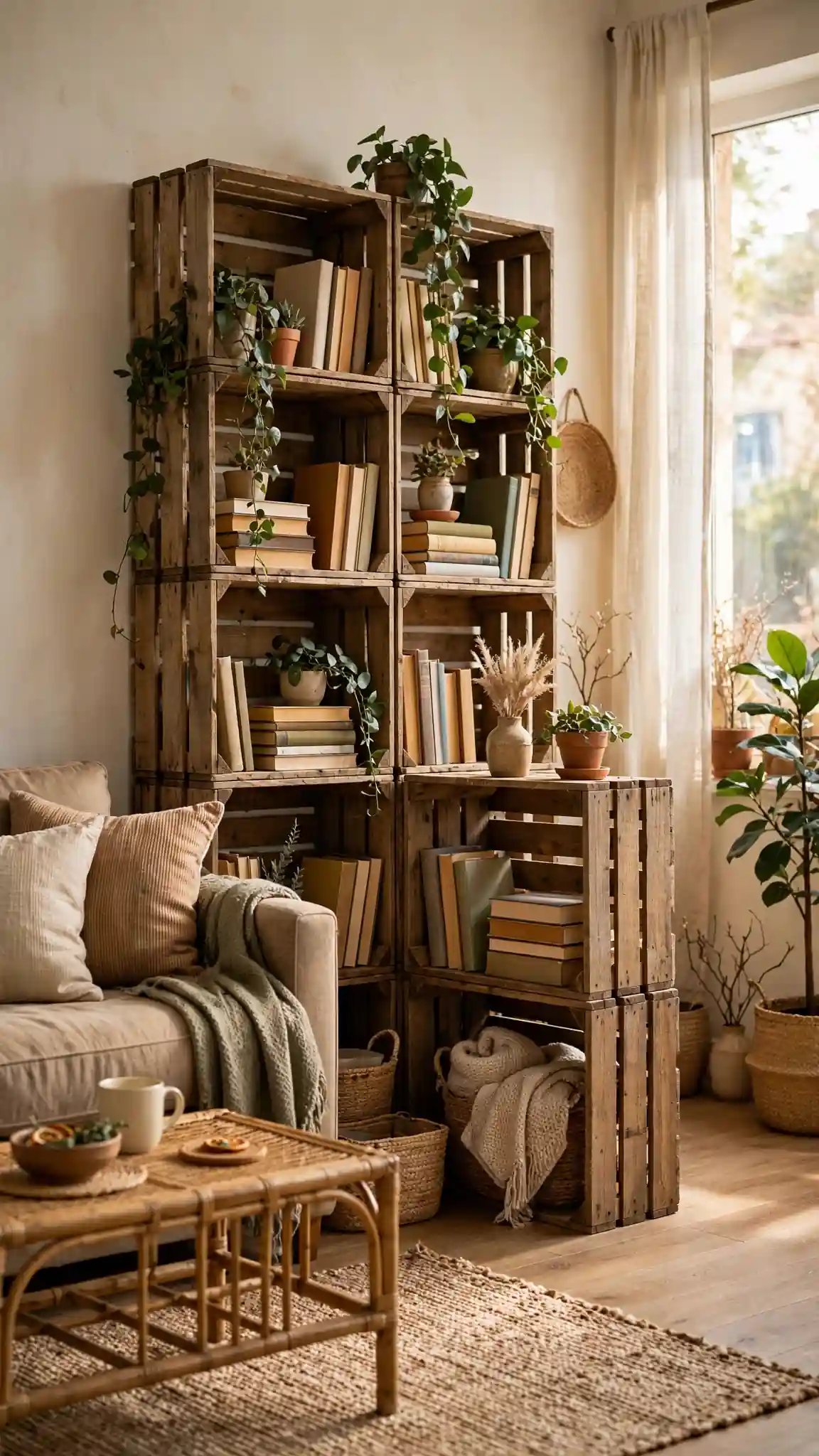
Wooden crates ($15–$30 each) stack into a bookshelf that grows, shrinks, and moves with you — the ultimate renter solution since nothing mounts to walls. Stack them in varied orientations (some vertical, some horizontal) for a custom look, and secure stacks together with small brackets. Sand rough crates and seal with clear wax to avoid splinters. A 3×3 crate wall costs $150–$270 and disassembles in minutes on moving day. Line some crates with fabric bins for hidden storage. Pro tip: buy all your crates at once from the same source — sizes vary between batches, and mismatched crates wobble. Consistency is structural, not just visual.
Conclusion
The best apartment living rooms bookshelf ideas work with your space, not against it — climbing walls instead of spreading across floors, dividing studios without blocking light, and turning storage into decor. Start with one anchor idea like a floor-to-ceiling wall, a ladder shelf, or floating shelves above the sofa, then layer in styling tricks: plants, back-panel color, lighting, and mixed objects. Most ideas here are renter-friendly and budget-conscious, proving you never need a renovation to get a designer look. Pick your favorite this weekend, style it with the 60/30/10 rule, and enjoy a living room that finally feels finished.

The best apartment bookshelf is the one that fits your space, your books, and your life stage right now — not the one from a magazine. Renters should prioritize flexibility (crates, leaning shelves, freestanding units); owners can invest in built-in looks and wall-mounted systems. Whatever you choose, anchor tall units, light the shelves warmly, and style with the 60-30-10 mindset: mostly books, some plants, a few objects. Measure your space and your books before buying anything. Pro tip: live with empty shelves for a week before styling — you will place things with far more intention than if you rush to fill every inch on day one.
FAQs
Bookshelf styling raises practical questions: how to anchor tall units safely, how much weight shelves can hold, and how to make a small collection look intentional. The answers below cover the most common concerns about choosing, installing, and styling bookshelves in apartments of every size.
Remember the three rules that matter most: anchor everything tall to the wall, put the heaviest books on the lowest shelves, and light your shelves warmly. Beyond that, bookshelf style is personal — the best shelf is one that reflects what you actually read and love, not what photographs well. Start with the format that fits your space and budget, style it with books plus a few meaningful objects, and let it evolve. A well-loved bookshelf is never truly finished, and that is exactly its charm.
Which bookshelf is best for a small apartment living room?
A slim floor-to-ceiling unit or a ladder bookshelf is best because both maximize vertical storage on a tiny floor footprint. Floating shelves above the sofa are the top choice when floor space is completely unavailable.
How do I style a bookshelf like a designer?
Use the 60/30/10 rule — 60% books, 30% decor objects and plants, 10% empty space. Vary heights on each shelf, repeat one accent color three times across the unit, and stack some books horizontally.
Are bookshelves renter-friendly?
Yes. Ladder shelves, crate systems, and freestanding units need no drilling. For wall-mounted shelves, use proper anchors and fill holes before moving out. Always anchor tall units with anti-tip straps for safety.
Should I arrange books by color?
Color-coding creates a striking visual gradient and photographs beautifully, but it can make titles harder to locate. A compromise is grouping two or three tones that match your living room palette.
How deep should apartment bookshelves be?
25–30 cm depth fits most books while keeping walkways clear. Picture ledges need only 8–10 cm, while display shelves for decor and plants work well at 20 cm.




Leave a comment