

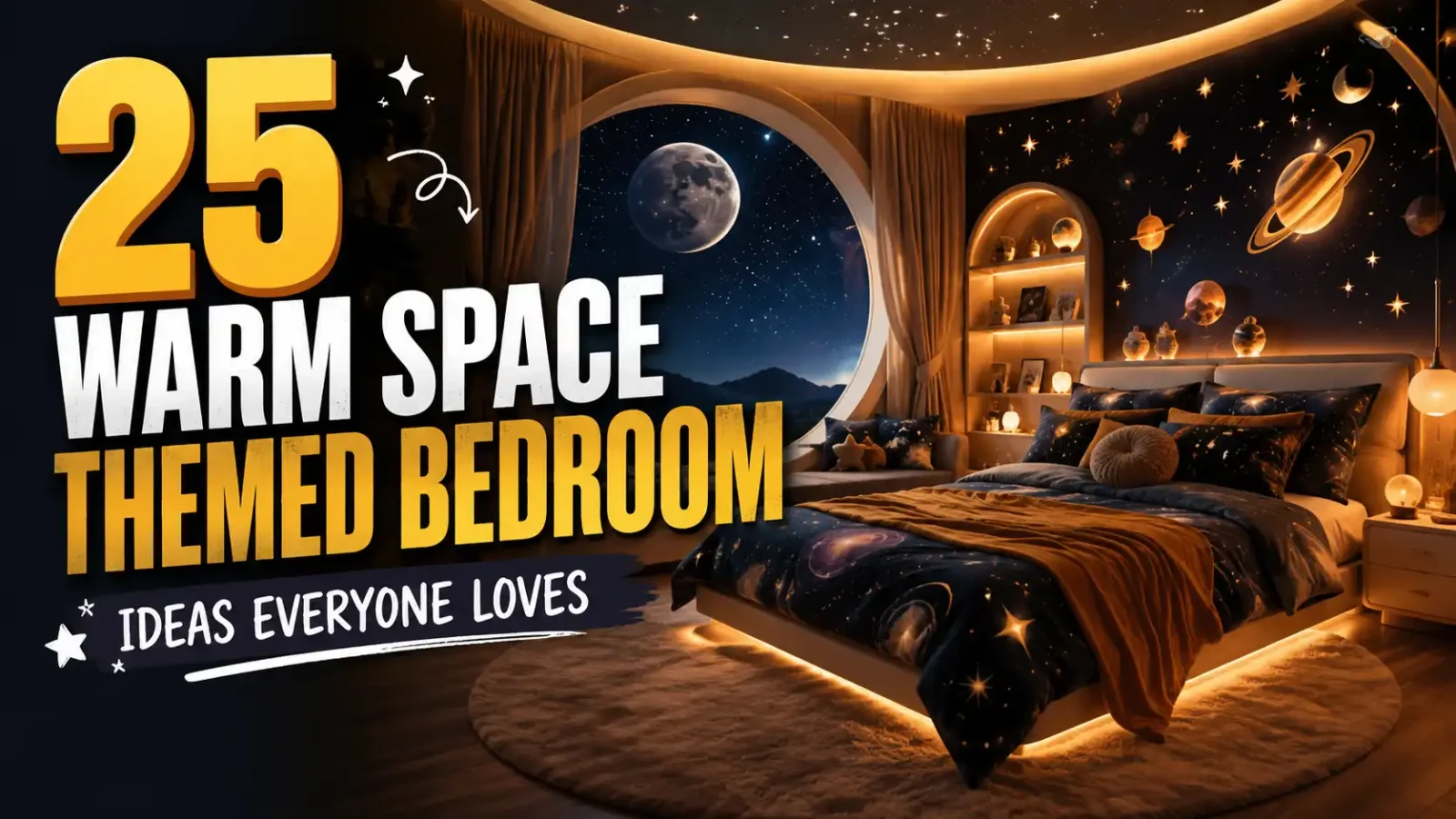
Warm space themed bedroom ideas solve the theme’s biggest problem: most galaxy rooms feel cold. Black walls, icy blues, and plastic planets can turn a bedroom into a chilly void — beautiful in photos, uninviting at bedtime. The fix is warmth: deep navy instead of black, amber and brass instead of silver, golden star glows instead of stark white LEDs, and cozy textures layered under all that cosmos. Done right, a space themed room feels like stargazing wrapped in a blanket. This guide gathers twenty-five ideas for kids, teens, and even adults who never stopped loving the night sky.
The warm-space formula is simple: choose a deep but soft base color (navy, midnight teal, or plum), add warm metallics and wood tones, light everything at 2700K amber warmth, and keep the astronomy accurate enough to spark real curiosity. Themes built this way survive childhood — a well-designed space room transitions from age five to fifteen by swapping accessories, never repainting. Each idea below includes exactly what to buy or paint, where warmth comes from, and how to keep the look sophisticated rather than sticker-covered. Prepare for liftoff, coziness included.
1. Deep Navy Walls Instead of Black
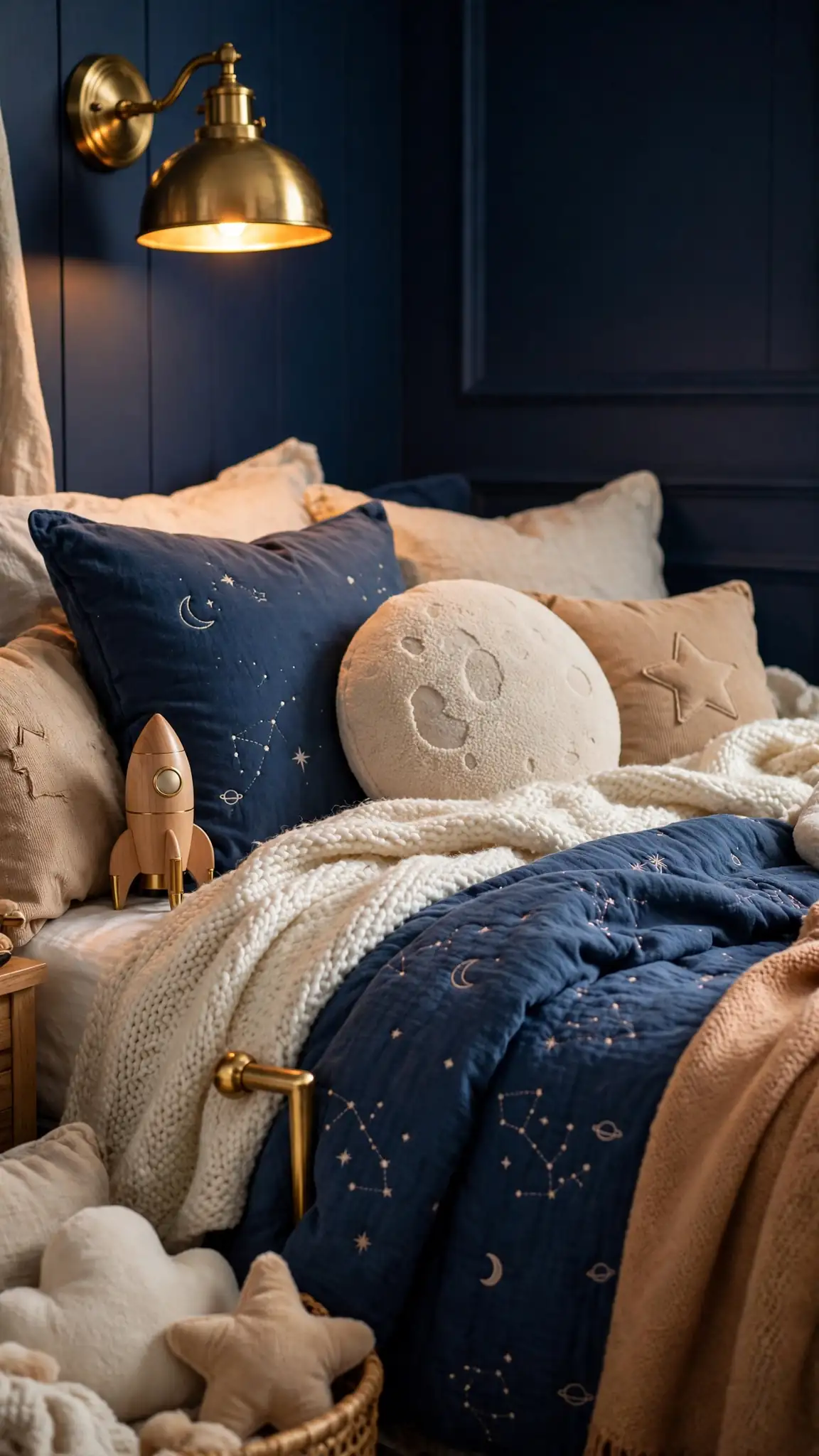
Navy is the warm space room’s foundation. Where black absorbs light and feels stark, deep navy holds warmth, flatters lamplight, and still reads unmistakably as night sky. Paint all four walls for a cocoon effect or one feature wall behind the bed for balance. Against navy, brass fixtures glow, wood furniture warms, and gold star decals shine like real constellations. This single color decision separates cozy space rooms from cold ones. Sample two or three navies at night under warm bulbs before committing — evening is when the room will live.
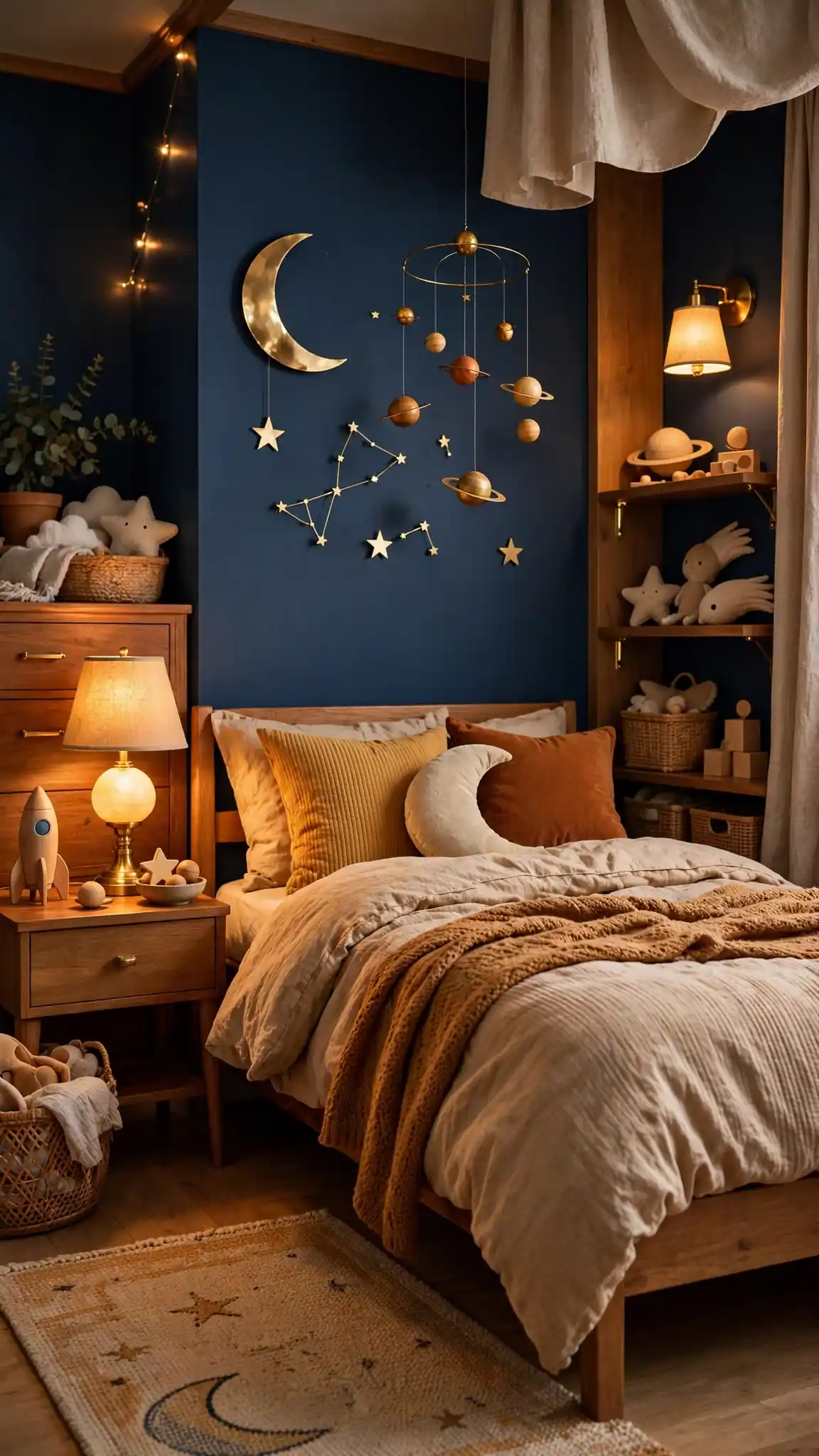
Choose a navy with warm undertones, like Benjamin Moore Hale Navy or Sherwin-Williams Naval, so the room feels cozy rather than cold. Test large swatches on two walls and observe them morning and night, since navy shifts dramatically with light. One gallon covers about 350 square feet; most kids bedrooms need two gallons for two coats, costing $80 to $120 total. Pair navy with warm white trim to keep it from feeling heavy. If painting all four walls feels bold, start with one accent wall behind the bed. Pro tip: use an eggshell or satin finish, which wipes clean of fingerprints far better than flat paint.
2. Golden Constellation Wall Decals
Replace scattered random star stickers with accurate constellations in metallic gold or copper decals — Orion, the Big Dipper, Cassiopeia — mapped correctly across the navy wall. Accuracy adds quiet sophistication and teaches real astronomy every bedtime. Connect stars with fine gold lines for the classic star-chart look. Gold against navy is the warmest possible night sky palette. Renters get the full effect removably. Add a small framed legend naming each constellation, and the wall becomes both decor and a lifelong knowledge gift.
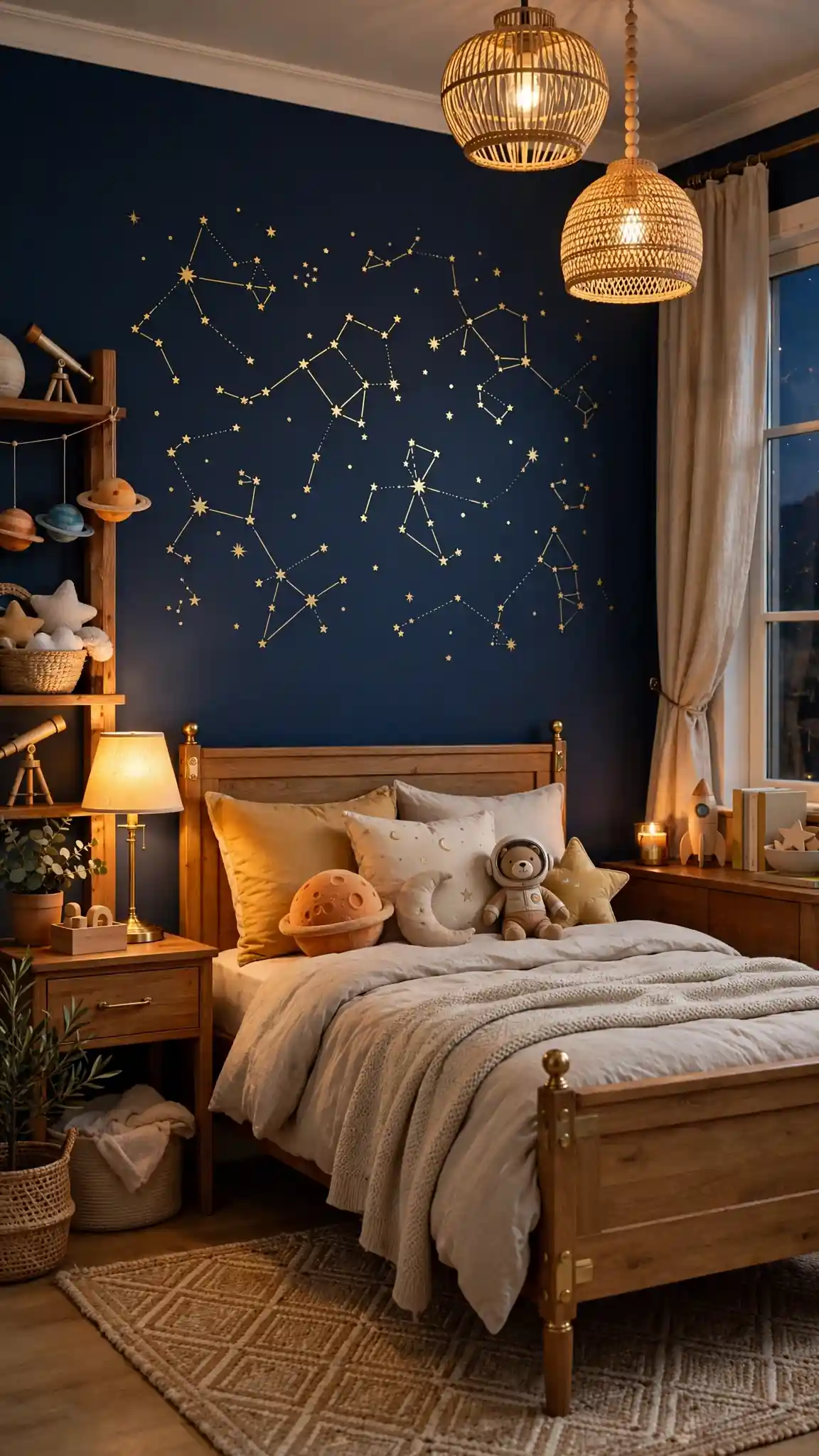
Metallic gold or copper constellation decals cost $15 to $35 for a full set on Amazon or Etsy and remove cleanly, making them renter-friendly. Arrange real constellations like Orion, Ursa Major, and Cassiopeia rather than scattering stars randomly; accuracy is what makes them look designed. Use a level and painter's tape to map the layout before sticking anything. Place the largest constellation above the bed as a focal point. Most decals reposition once or twice if you work slowly. Pro tip: add a few tiny warm-white LED dot lights behind the decal sheet edges for a subtle glow that makes the constellations shine at night.
3. Warm-White Star Projector Nights
A galaxy projector transforms bedtime, but choose settings wisely: warm white or amber star modes soothe, while saturated blue-green nebula modes stimulate. Project onto the ceiling at low brightness with a sleep timer. The slowly drifting stars genuinely help many children (and adults) wind down, replacing harsh night lights with atmosphere. Position the projector out of reach and cable-managed. On weekend nights, the full nebula show becomes a treat — the room’s own planetarium, warmth preserved for school-night sleep.
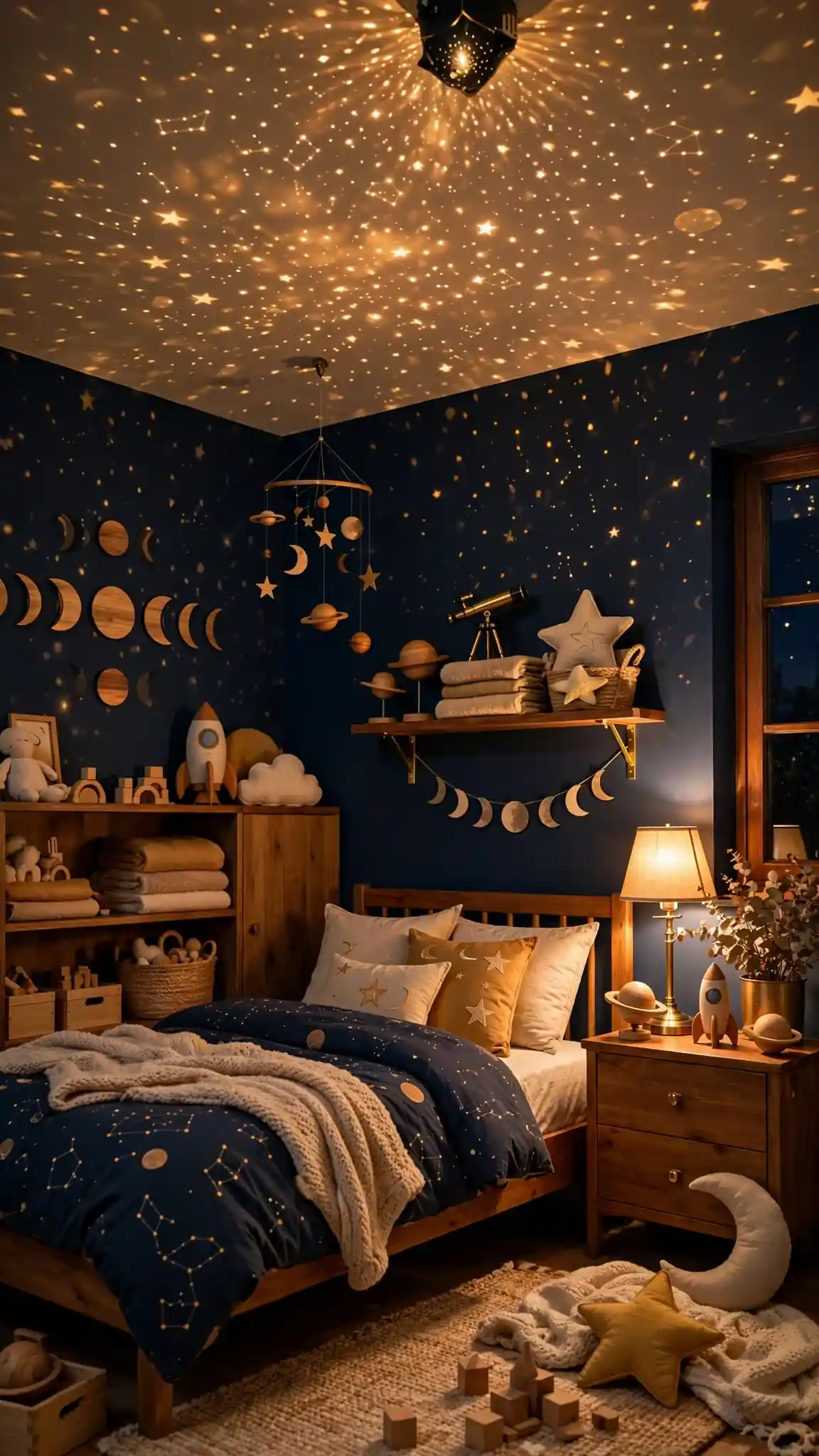
Choose a projector with warm white or amber modes, since cool blue projections feel stark and can disrupt sleep. Top-rated models on Amazon run $30 to $60 and include timers that shut off automatically. Place the projector on a nightstand aimed at the ceiling, about six to eight feet from the surface for the sharpest stars. Use it as part of the bedtime routine: stars on, books, lights out. Avoid projectors with loud fans, which defeat the calming purpose. Pro tip: pair the projector with a white noise machine on low; the combination helps light sleepers drift off faster.
4. Sun and Planet Mobile in Warm Metals
Hang a solar system mobile crafted in brass, copper, and wood tones rather than bright plastic — the planets orbiting slowly above a crib, reading corner, or desk. Warm-metal celestial mobiles read as sculpture, suiting the room into teen years. Scale planet sizes roughly correctly for the education bonus. Position away from fans and reachable heights. The gentle rotation catches lamplight beautifully at bedtime, and the object embodies the entire warm-space philosophy: the cosmos rendered in materials that feel like home.
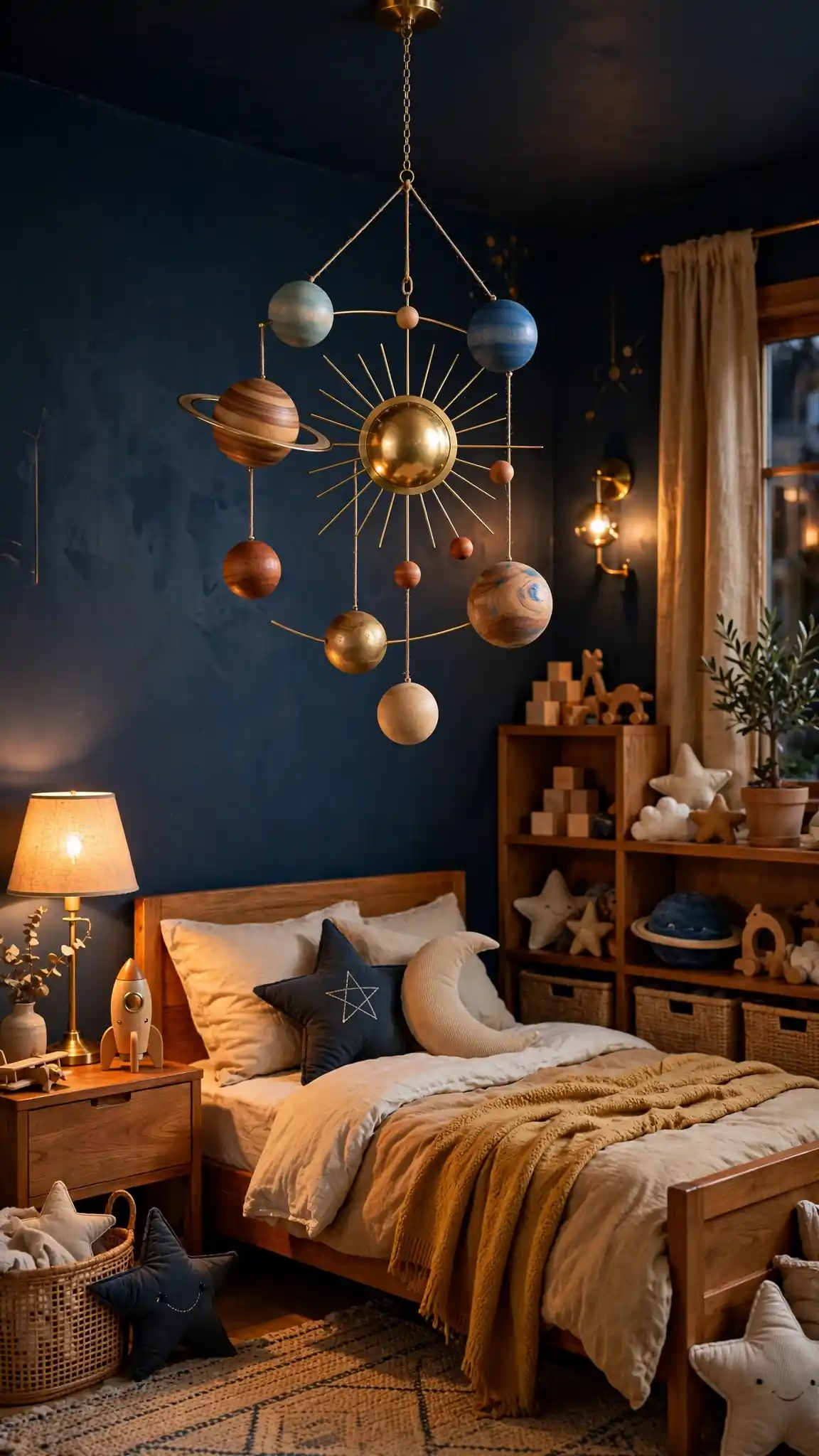
Hang the mobile from a ceiling hook rated for at least twice the mobile's weight, ideally into a joist or with a toggle bolt. Brass, copper, and wood-tone mobiles cost $40 to $120 on Etsy; DIY versions with painted wooden balls run under $25. Hang it high enough that a standing child cannot reach it, about seven feet from the floor. Keep the mobile away from ceiling fans and bunk bed ladders. A slow-spinning motor add-on, about $15, brings the solar system to life. Pro tip: position it where morning light catches the metal planets for a daily moment of magic.
5. Moon Phase Wall Art Above the Bed
A horizontal row of moon phases — new to full and back — in gold foil or ceramic above the headboard is the theme’s chicest single artwork. The linear arrangement suits the wide space above beds perfectly, and the motif appeals from toddlerhood through adulthood. Choose warm gold or cream moons on navy, or wooden moon plaques for texture. This one piece can carry an entire subtle space theme in an otherwise neutral room — the minimalist’s entry point to the cosmos.
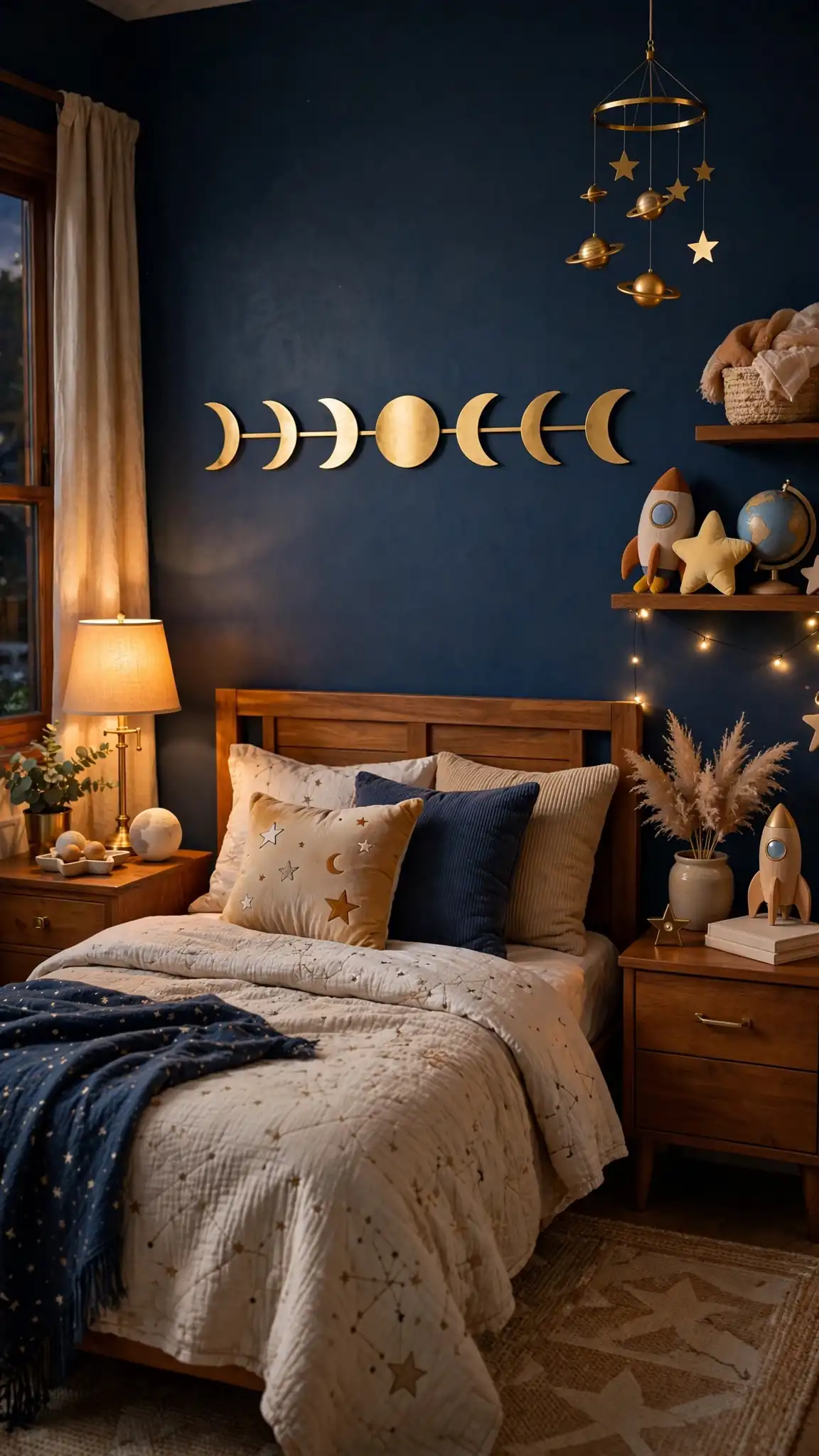
A horizontal row of eight moon phases in gold foil or ceramic spans beautifully above a twin or full bed; aim for a total width of 36 to 48 inches. Sets cost $25 to $70 on Etsy and Amazon. Hang the center of the arrangement at 57 to 60 inches from the floor. For a handmade touch, paint wooden discs with chalk paint and gold leaf pens for under $20. Keep the phases in correct order, new to full and back, since accuracy matters to space-loving kids. Pro tip: flank the moon phases with two small brass sconces to create a glowing nighttime focal point.
6. Cozy Rocket Ship Reading Nook
Build a reading nook shaped as a rocket: a corner tent or fabric teepee styled with a rocket silhouette, filled with cushions, a sheepskin, warm fairy lights, and a basket of space books. The enclosed glow makes it the room’s gravitational center — kids orbit back to it daily. Keep the rocket styling in muted rust, cream, and navy rather than cartoon brights. Add a battery “control panel” of switches for play value. Reading happens where reading feels like adventure; this nook makes it a mission.
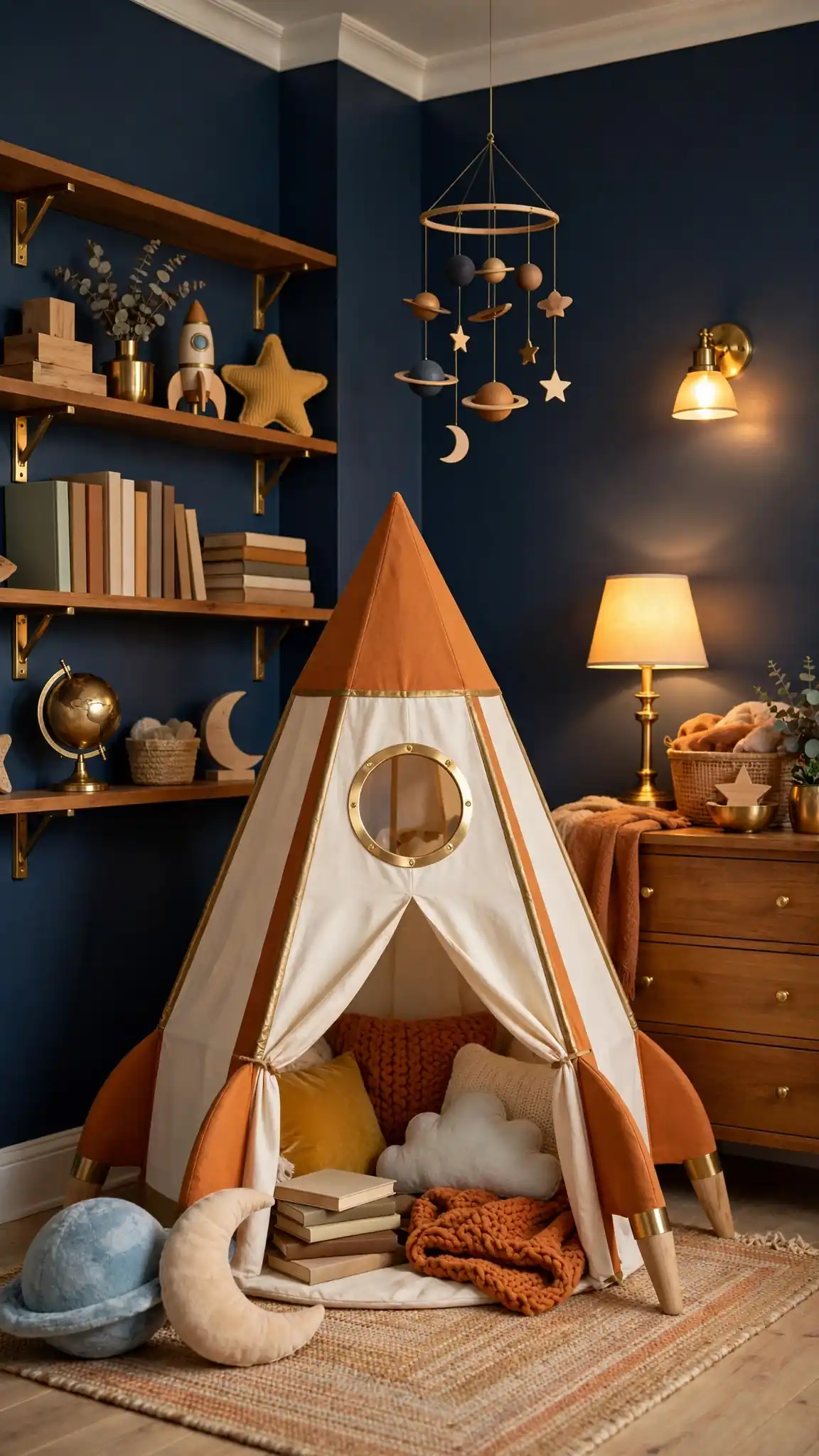
A corner teepee tent in canvas or navy fabric costs $50 to $100 at IKEA, Target, or Amazon and assembles in minutes. Style it with a rocket silhouette pillow, a small bookshelf, and a battery-operated reading light clipped inside. Add a round braided rug underneath to define the nook and cushion the floor. Keep one basket for books so the nook stays tidy. Choose flame-retardant fabrics and LED lights only, never real candles. Pro tip: string a short set of warm fairy lights around the tent's poles; kids will choose the nook over the couch every single time.
7. Amber LED Strip Ceiling Glow
Line the ceiling perimeter with LED strips set to warm amber, creating a soft horizon glow like a permanent sunset above the room — cosmic atmosphere without a single motif. Hide strips behind a small coving or the wardrobe top for indirect light. Smart versions dim gradually at bedtime, cueing sleep beautifully. Avoid the default blue-purple galaxy presets in the evening; amber is the warmth the theme needs. This lighting layer makes every other idea in the room look better after dark, which is when space rooms exist.
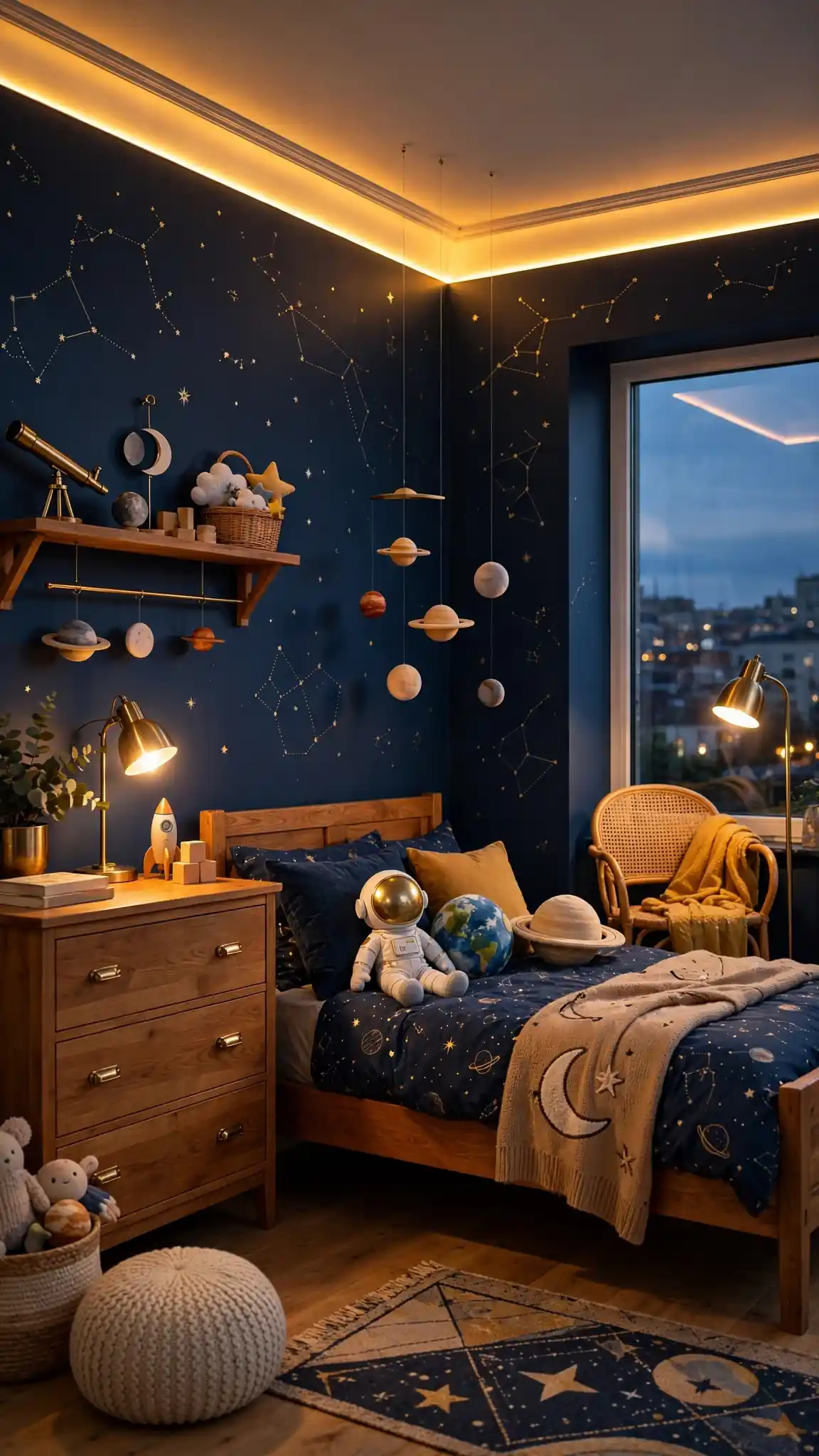
Run adhesive LED strips around the ceiling perimeter where wall meets ceiling, choosing 2700K warm amber for the coziest glow. A 32-foot smart strip costs $25 to $50 on Amazon; add aluminum channels for a polished look at about $1 per foot. Clean the surface with rubbing alcohol before sticking, and press firmly for 30 seconds per section. Plug into a smart plug or use the strip's app to set a bedtime timer. Avoid the cheapest no-name strips, which can flicker. Pro tip: set the strips to 10 percent brightness as a nightlight; it is enough to navigate by without fully waking anyone.
8. Vintage NASA and Retro Space Posters
Frame vintage-style space posters — retro NASA travel prints, 1960s mission graphics, warm-toned planetary illustrations — in wood or brass frames as a gallery wall. Retro space art leans orange, cream, and rust, delivering the theme in inherently warm palettes. Three to six framed prints above a desk or dresser add sophistication no sticker set can. The style suits teens especially, aging into genuinely good design. Print public-domain NASA art affordably, and let your child choose the missions that speak to them.
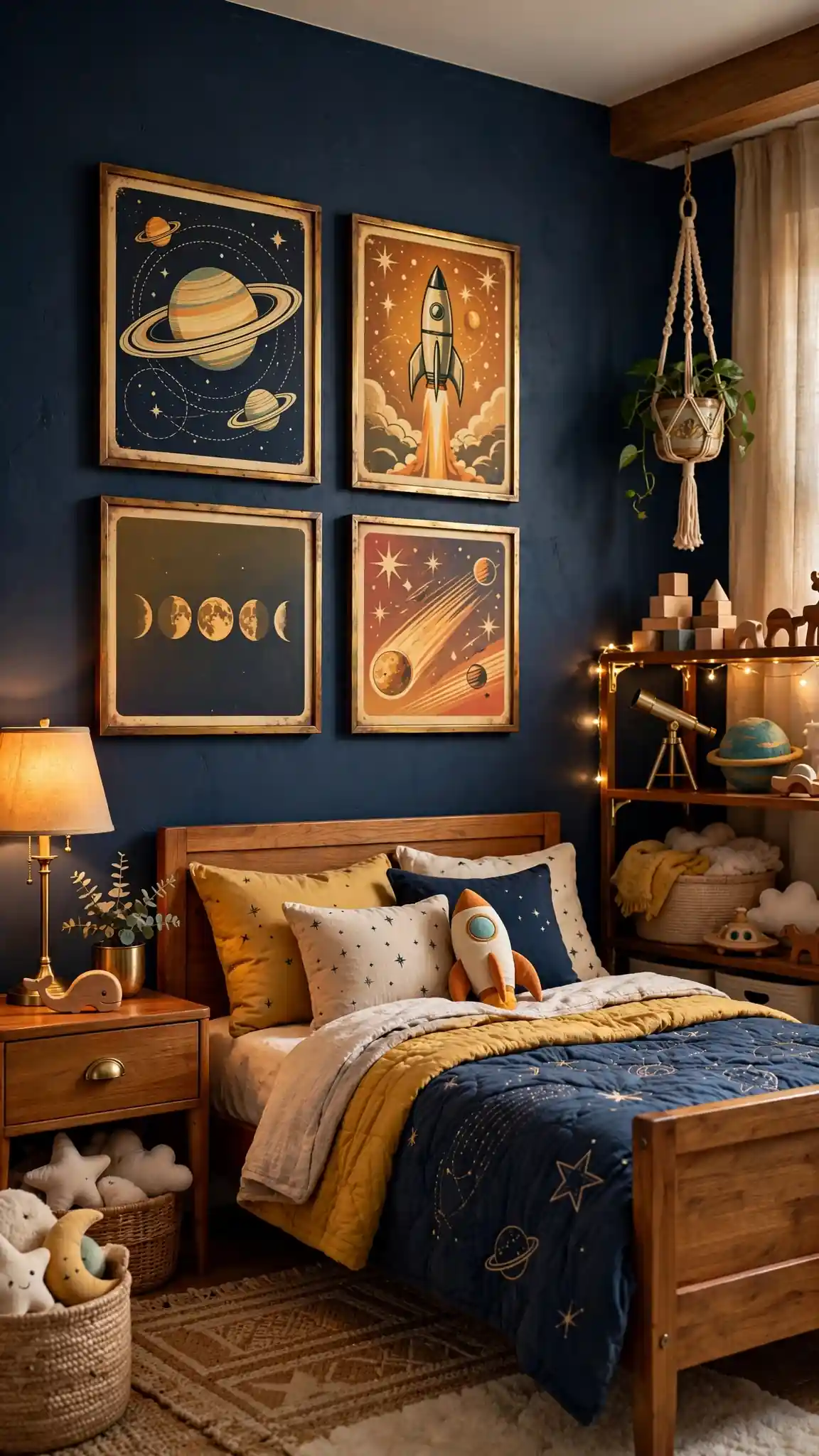
Retro NASA travel posters in warm tones are available as affordable prints from $15 to $40 on Etsy, Amazon, and AllPosters. Choose two or three in matching frames, 16 by 20 inches or larger, for real presence. Black or natural wood frames suit the warm space palette best. Hang them as a group on one wall rather than scattering singles around the room. Look for public-domain NASA artwork for free high-resolution downloads you can print at Staples. Pro tip: mix one poster with a framed star chart of the child's birth date for a personal touch guests always ask about.
9. Glow-in-the-Dark Stars Done Tastefully
The classic glow stars work in a warm room with one rule: accuracy over confetti. Arrange glow decals into real constellations on the ceiling, concentrated above the bed, rather than scattering hundreds everywhere. Charge them with warm lamplight during the bedtime story; they fade gently as sleep arrives — a built-in wind-down timer. Choose soft-green or amber glow tones. The nightly ritual of lights-off revealing the stars never stops delighting, and thirty well-placed stars outshine three hundred random ones.
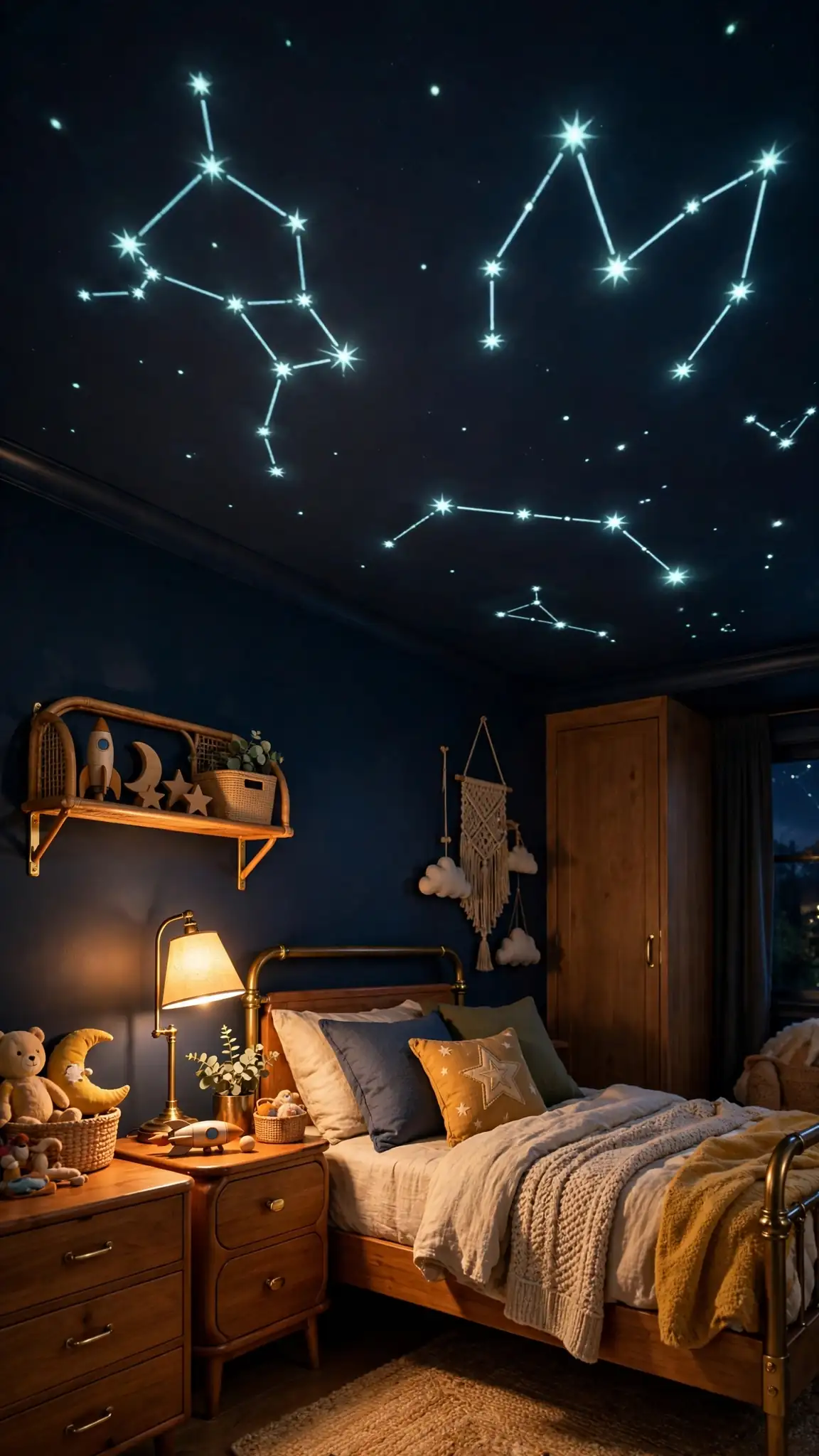
Accuracy beats confetti: arrange glow stars as real constellations with correct relative positions, using a star chart as your guide. Quality packs of 200 stars cost under $12 on Amazon; avoid the cheapest ones, which barely glow. Charge them with a bright light for 30 minutes before bedtime for maximum glow. Place them on the ceiling above the bed where they are visible when lying down. They remove with a hair dryer and dental floss if you ever repaint. Pro tip: add one larger glow moon or planet as an anchor point; a single hero piece makes the whole ceiling look intentional.
10. Warm Wood Furniture Grounding the Cosmos
Anchor the theme with mid-tone wood: an oak bed frame, walnut desk, pine shelving. Wood grain against navy walls creates the warm-cold balance the whole concept depends on — the cabin-under-the-stars feeling rather than the spaceship-corridor one. Avoid glossy white or black plastic furniture that pushes the room cold. Thrifted wood pieces sanded and oiled work perfectly. When the space theme eventually retires, quality wood furniture remains, which is the budget wisdom hiding inside this aesthetic choice.
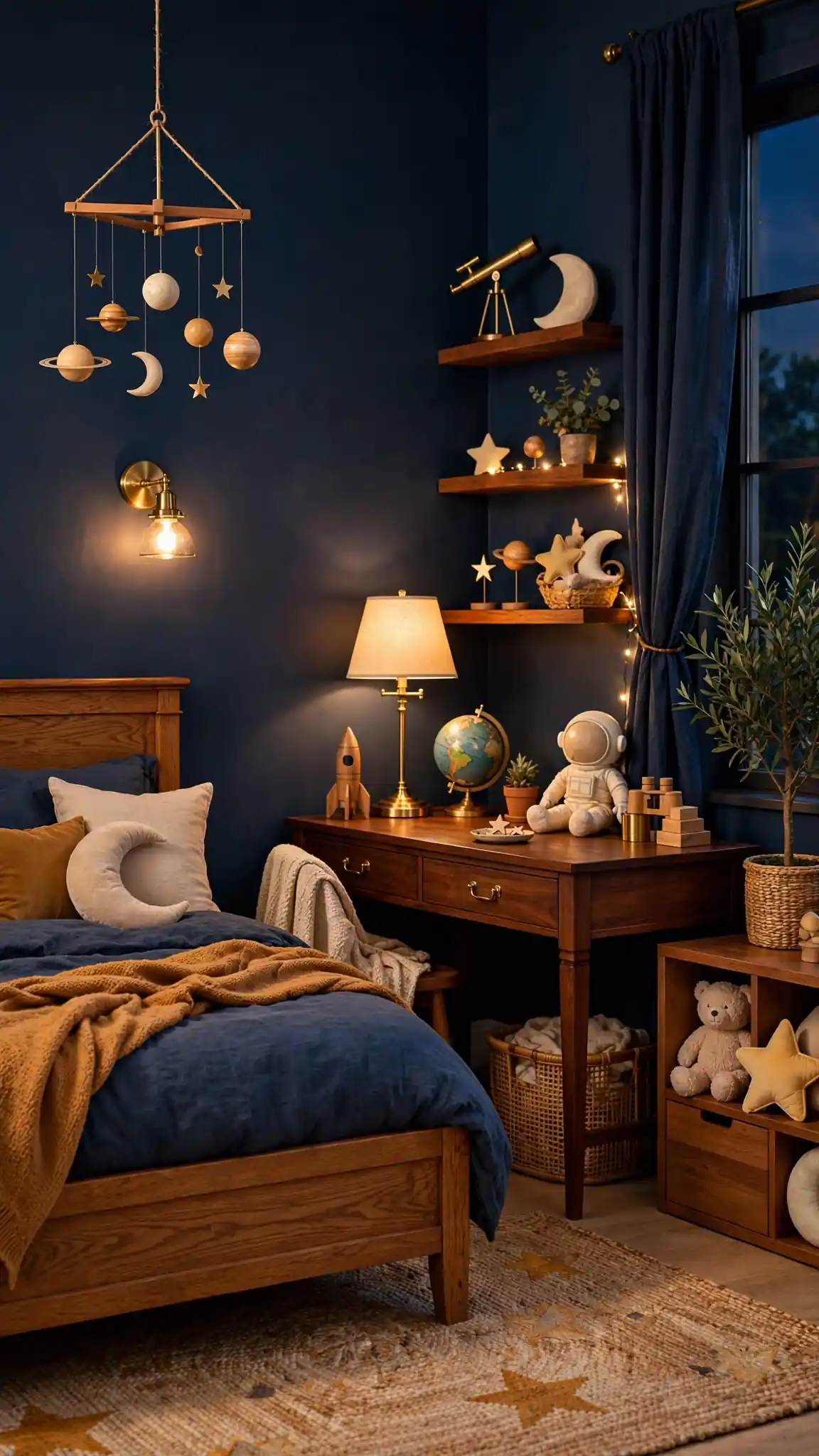
Mid-tone woods like oak, walnut, and pine warm up navy walls instantly. An oak bed frame from IKEA or Article runs $300 to $800; secondhand solid wood pieces on Facebook Marketplace often cost half that. Keep wood tones within the same family, warm with warm, so the room feels cohesive. A walnut desk and pine shelving can coexist if both lean warm. Oil finished wood yearly with a hardwax oil to keep it glowing. Pro tip: if existing furniture is cool-toned gray wood, warm it up with honey-toned bedding and brass hardware instead of replacing everything.
11. Nebula Watercolor Accent in Warm Tones
Commission or DIY a nebula effect in warm colors — rust, amber, rose, and plum clouds with gold splatter stars — as one canvas or a painted wardrobe panel rather than whole walls. Warm nebulae exist astronomically (star-forming regions glow red-orange), so the palette is accurate and inviting. Sponge-blend acrylics for the DIY version; imperfection reads as cosmic gas. One warm nebula moment provides the theme’s drama while walls stay calm navy. It is the room’s supernova: singular, glowing, contained.
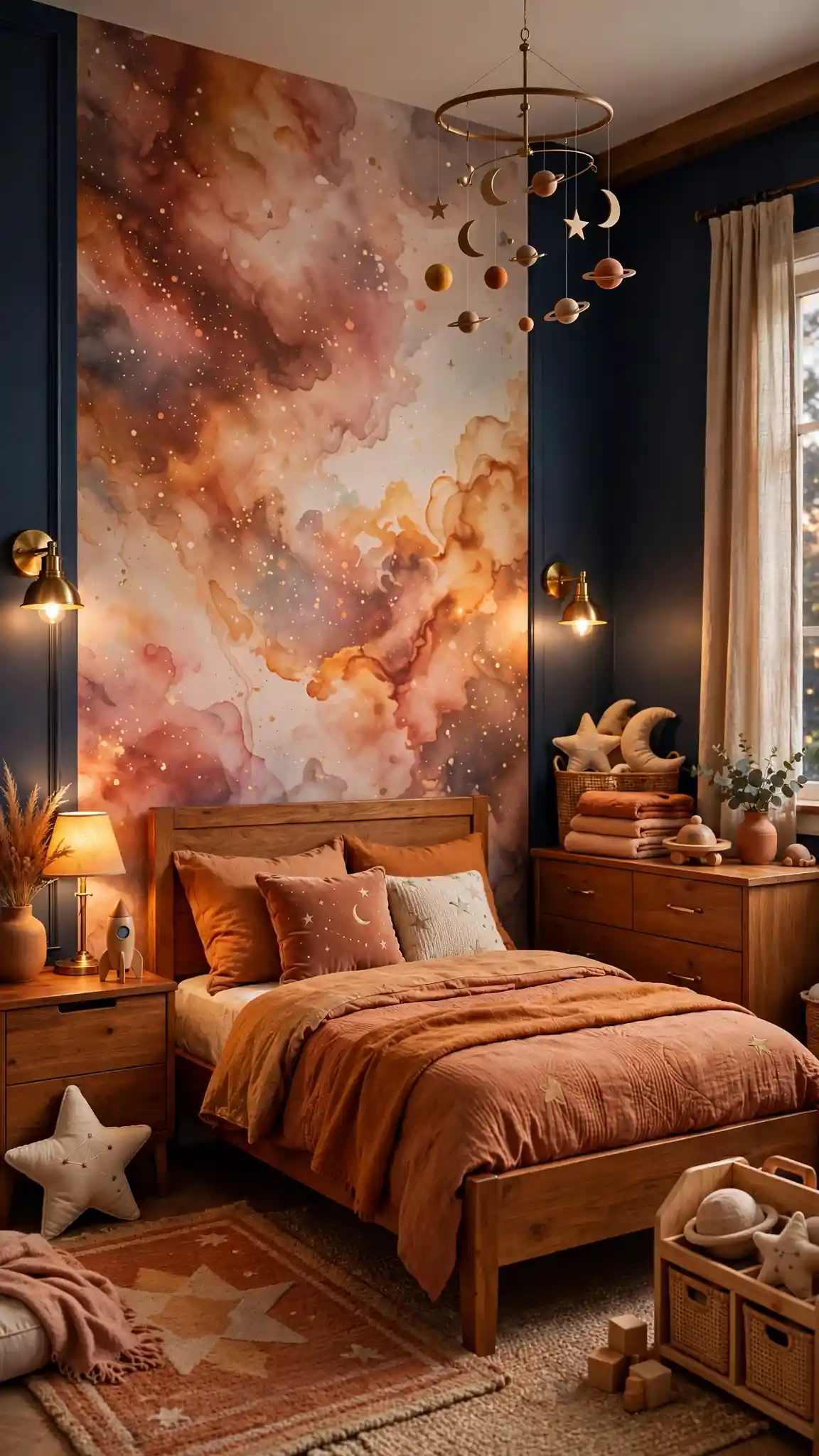
DIY a nebula wall with watercolor-effect paint: sponge rust, amber, rose, and plum craft paints onto a navy base, then flick gold paint off a toothbrush for stars. Sample pots cost $5 each and one accent wall needs four to five colors. Practice on poster board first. For a no-paint option, removable nebula murals run $60 to $150 on Etsy. Keep the effect to one wall so it stays dreamy rather than overwhelming. Seal with clear matte topcoat if little hands will touch it. Pro tip: paint the nebula on the wall behind the bed so it acts as a giant headboard.
Read More Blogs on: decormellow.com
12. Astronaut Teddy and Soft Space Textiles
Warm the theme through touchables: an astronaut-suited teddy, a moon-texture cushion, a rocket-embroidered throw, planet-print bedding in muted tones. Textiles deliver theme softness that painted walls cannot, and they swap effortlessly as tastes evolve. Choose bedding where navy grounds warm accents — rust rockets, gold stars — over busy bright prints. The bed is the room’s largest visible surface; its textiles set the temperature. A space room you can hug is a space room done right.
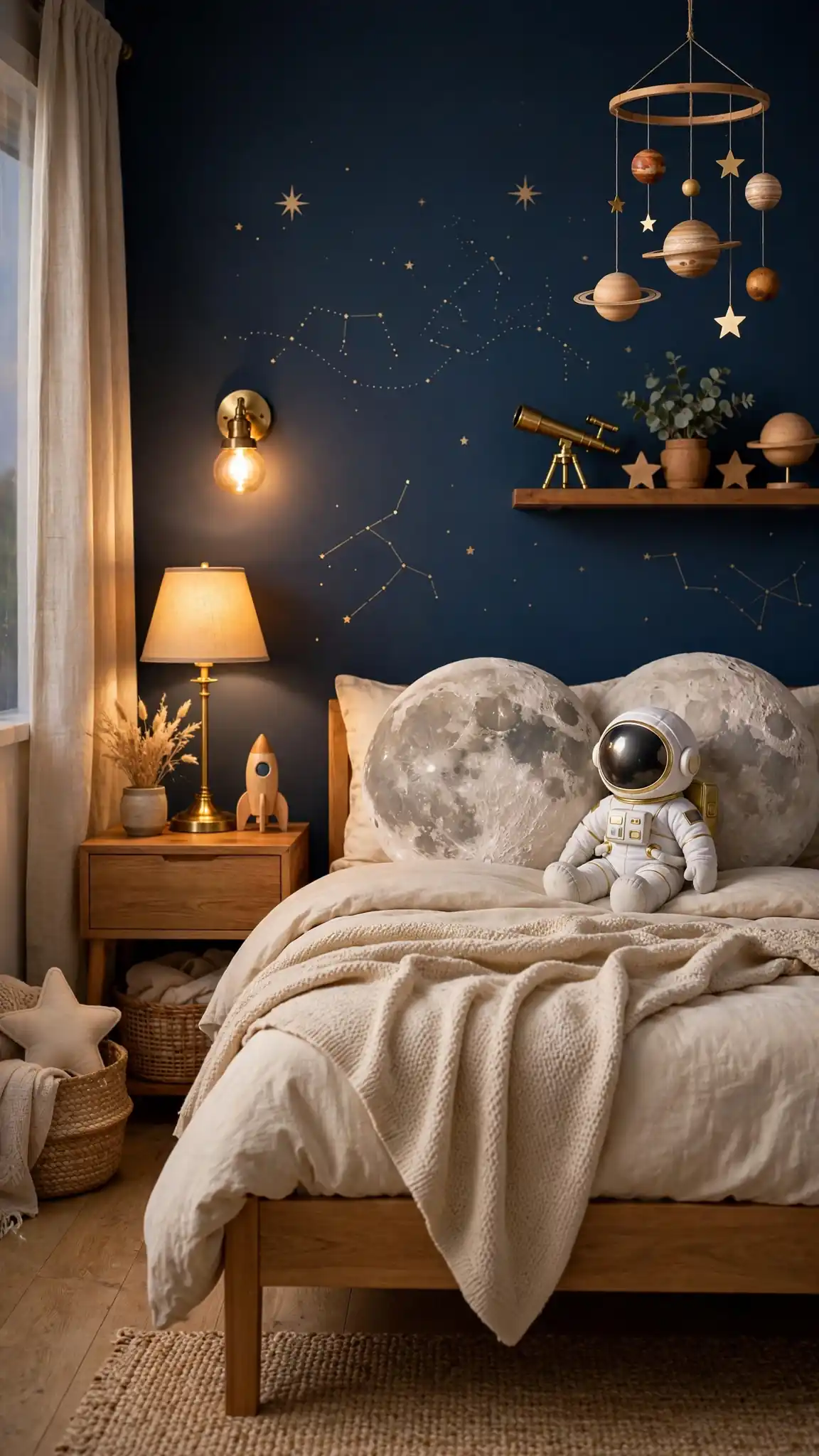
An astronaut-suited teddy bear costs $20 to $40 on Amazon or at museum gift shops and becomes the room's mascot. Layer moon-texture cushions, rocket-embroidered quilts, and star-print throws in navy, cream, and gold. Washable fabrics matter: choose machine-washable covers from Target or IKEA at $10 to $25 each. Limit themed textiles to the bed and one chair so the room stays calm. Rotate a couple of seasonal pieces to keep it fresh. Pro tip: a personalized star-name pillow with the child's name and a constellation makes the theme feel made just for them.
13. Sunrise Alarm Clock as Personal Star
A sunrise simulation clock — glowing gradually from deep red through amber to bright warm light — gives the space room its own rising sun each morning. The astronomy tie-in is charming; the sleep science is real, easing winter wake-ups measurably. Place it bedside as the room’s warmest object. Evening modes reverse into sunset wind-downs. For a theme centered on celestial light, letting the room’s actual lighting follow the sun’s warmth is the most elegant idea here — theme and function in one glowing sphere.
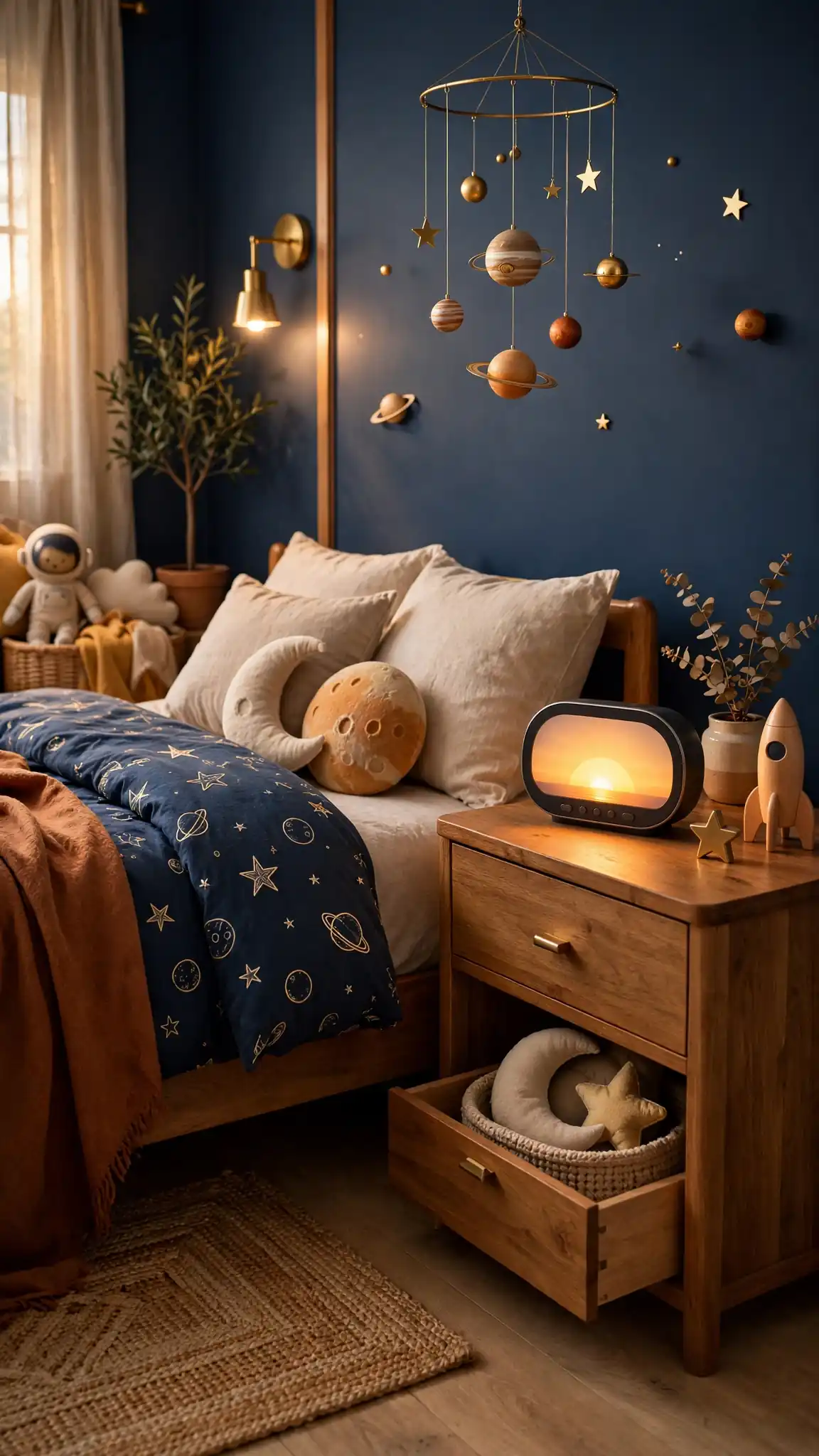
Sunrise simulation clocks glow gradually from deep red through amber to bright warm light over 20 to 30 minutes, mimicking a personal sunrise. Trusted models from Philips and Hatch run $50 to $170 on Amazon. Place it on the nightstand at eye level from the pillow, about arm's length away. Set the maximum brightness to match the room; too bright startles, too dim gets ignored. Most models double as white noise machines and nightlights. Pro tip: use the sunset wind-down mode too; dimming light in the evening is just as powerful for sleep as bright light in the morning.
14. Planet Shelf with Real Collections
Dedicate a shelf to genuine space treasures: a small meteorite fragment, mineral spheres as planets, a vintage brass telescope, mission patches, astronomy books standing cover-out. Real objects beat printed decor for wonder-per-centimeter. Arrange planets in solar order with small labels. Warm brass and stone materials keep the display inviting. Children who own “a real piece of space rock” tell everyone forever. The shelf becomes the room’s museum — curiosity displayed, warmth included, upgraded birthday by birthday.
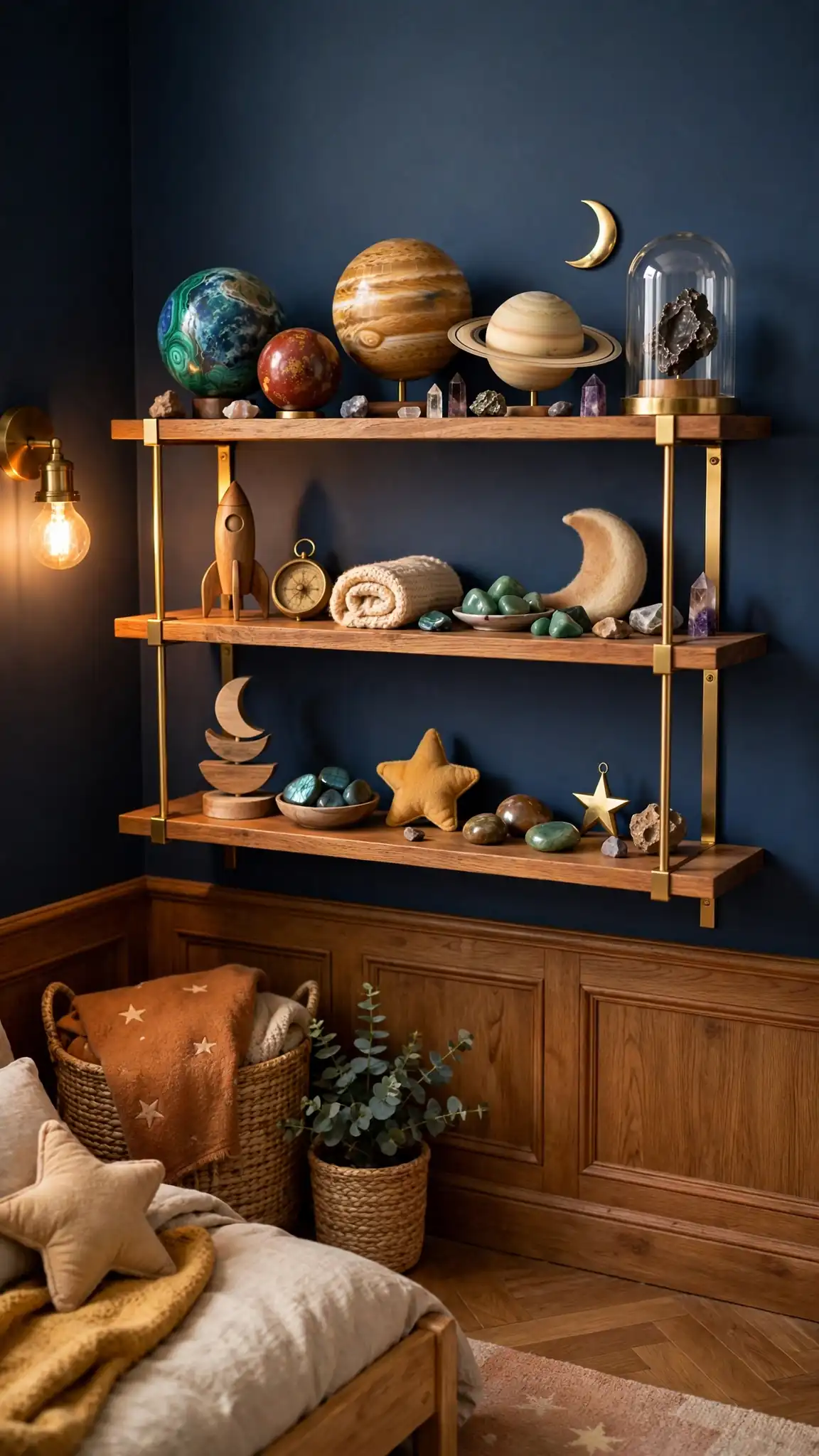
Dedicate one shelf to genuine space treasures: a small meteorite fragment ($20 to $50 on reputable science shops), mineral spheres as planets, and a magnifying glass for inspection. Mount the shelf at the child's eye level or slightly above, using brackets rated for the weight. Label each item with a small tag; kids love a museum feel. Add a beginner astronomy book alongside. Keep fragile items toward the back. Pro tip: a real meteorite, even a tiny one, becomes the most talked-about object in the room and sparks endless curiosity.
15. Midnight Teal Alternative Palette
Not every space room must be navy: deep teal walls with copper accents create a warmer, more unexpected cosmos. Teal reads as nebula-rich night sky while carrying green’s natural warmth; copper stars and fixtures glow against it beautifully. Pair with cream textiles and walnut wood. This palette suits older kids and adults wanting the theme without the primary navy everyone else has. Sample teal at night under warm light — the right shade shimmers like deep space seen from a cozy observatory.
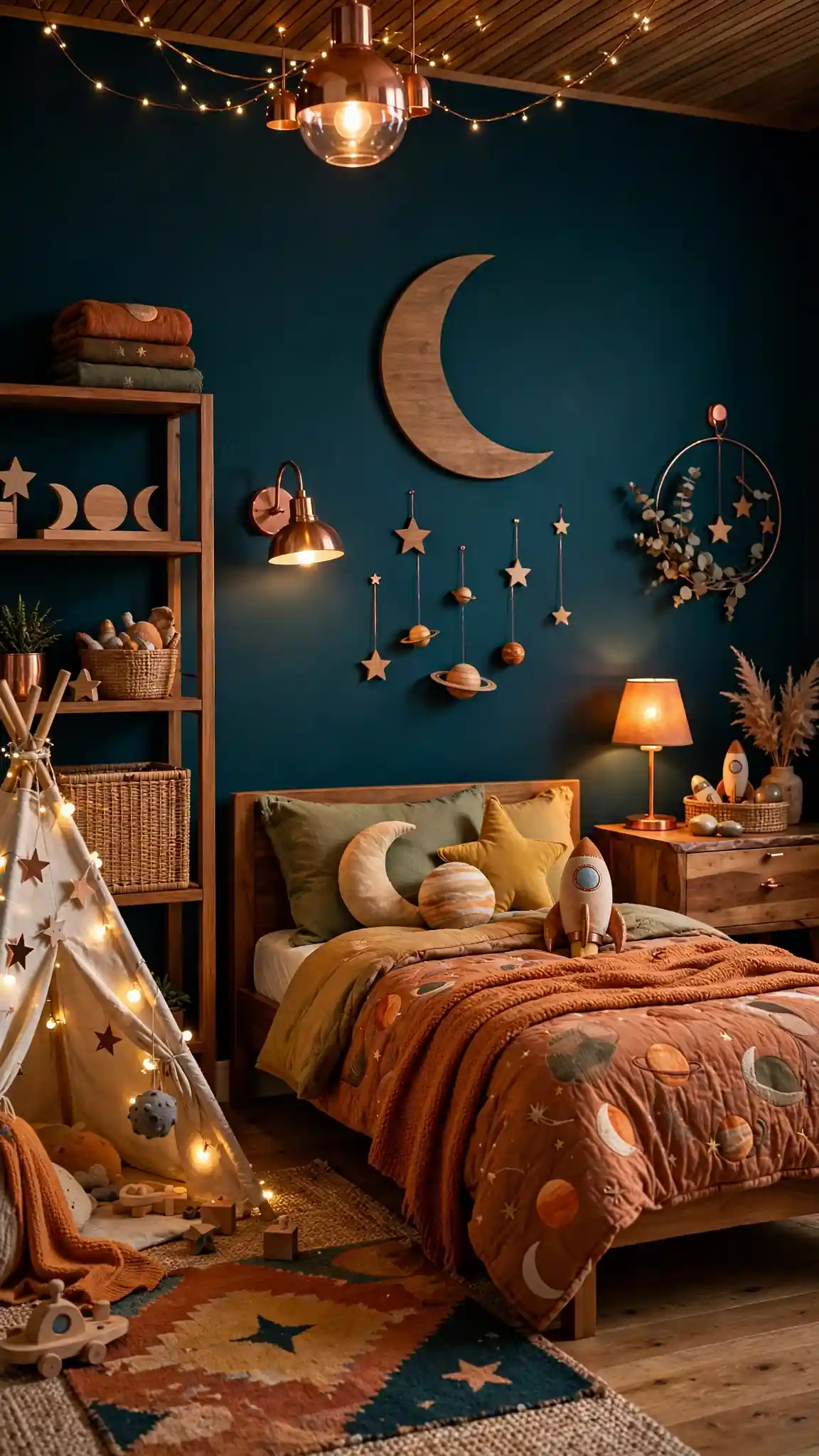
Deep teal with copper accents creates a warmer, more unexpected space room than navy. Try Sherwin-Williams Dark Night or Benjamin Moore Newburg Green, testing swatches in both daylight and lamplight. Copper picture lights, drawer pulls, and curtain rods cost $10 to $30 each at IKEA or Amazon. Teal pairs beautifully with warm wood and cream bedding. Use the 60-30-10 rule: 60 percent teal walls, 30 percent wood and neutrals, 10 percent copper accents. Pro tip: teal shows every imperfection, so spend extra time on wall prep and use two full coats.
16. Window Telescope Station
Position a real beginner telescope at the best window with a small stool, a star chart on the wall beside it, and a red-light torch (astronomers’ warm light that preserves night vision) hanging ready. The station turns theme into practice — actual moon craters beat any decal. Even a modest telescope reveals lunar detail that astonishes children. Frame the window with warm curtains to make the station cozy. A space room that produces real stargazing memories has succeeded beyond decoration.
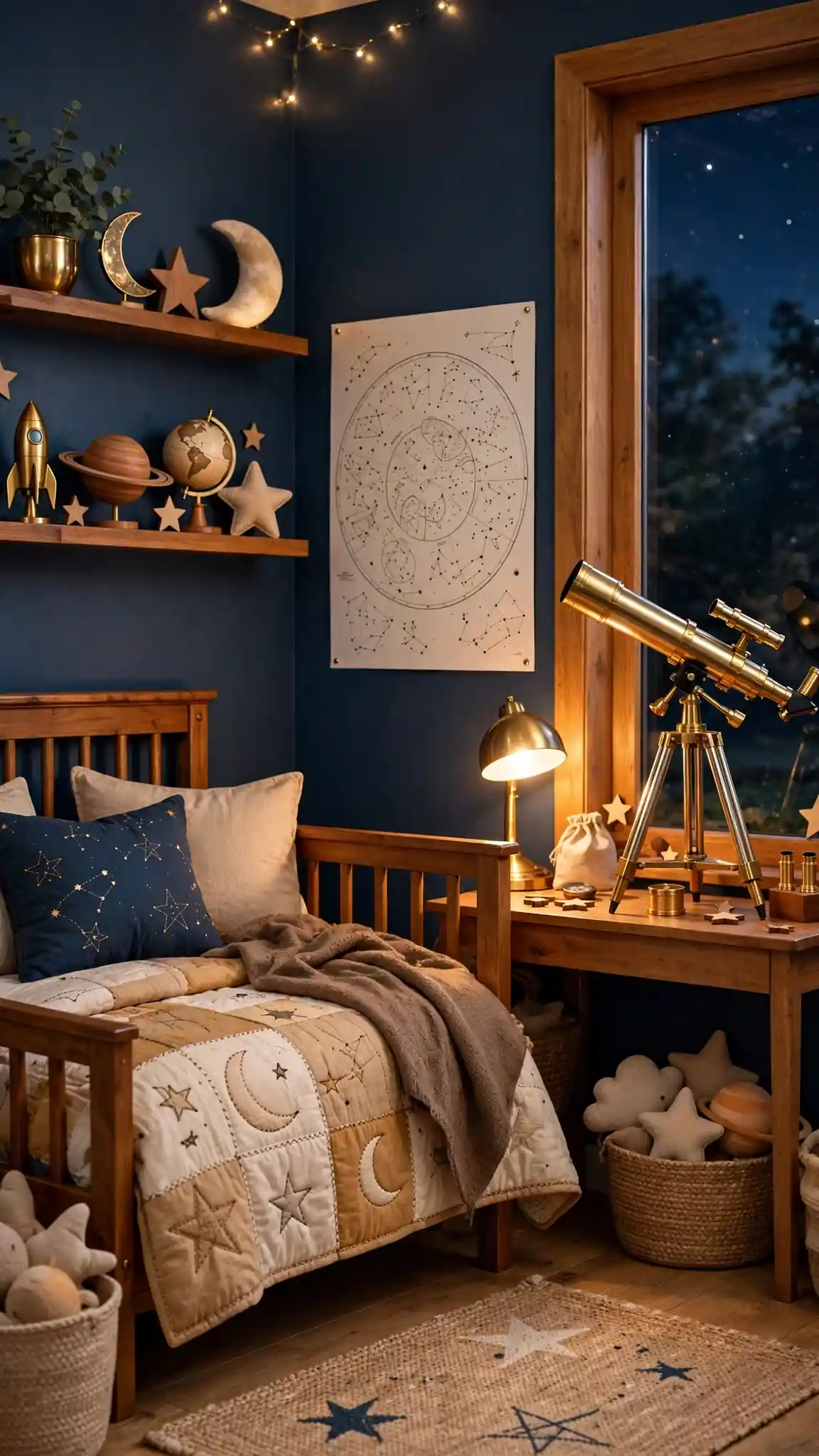
A beginner refractor telescope suitable for kids costs $80 to $200 on Amazon; look for 70mm aperture and a sturdy tripod, not shaky toy scopes. Position it at the window with the clearest sky view, ideally south-facing, with a small stool and a star chart on the wall beside it. Store eyepieces in a padded case to avoid scratches. Join a local astronomy club's public viewing night to learn the basics together. Never point any telescope near the sun. Pro tip: start with the moon; its craters thrill kids instantly and build patience for fainter targets.
17. Galaxy Canopy Over the Bed
Drape a navy sheer canopy scattered with sewn-in warm fairy lights above the bed, creating a personal glowing night sky at pillow level. The enclosed twinkle feels protective and magical — falling asleep inside a constellation. Use battery LEDs at their warmest setting with a timer, secured safely beyond pulling reach for young children. By day the canopy reads as elegant navy fabric; by night it becomes the room’s signature. Teens love the version with remote-dimmed lights for reading glow.
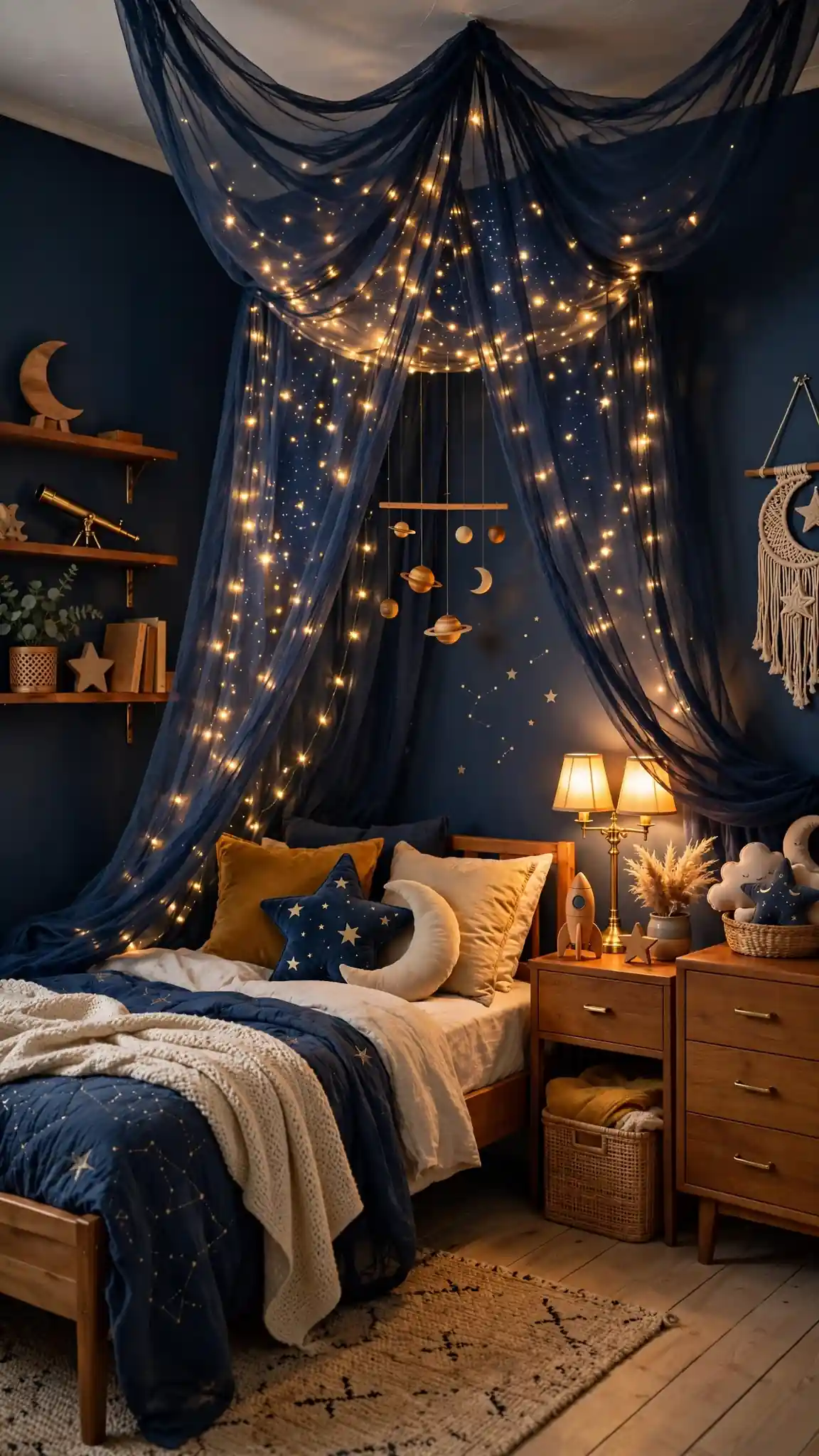
Drape navy sheer panels from a ceiling-mounted hoop or curtain wire to create a galaxy canopy, then weave warm fairy lights through the fabric. Sheer panels cost $15 to $30 per pair at IKEA; a 33-foot warm fairy light string runs about $10. Hang the canopy high enough to sit up in bed comfortably. Use LED lights only, which stay cool to the touch. Wash sheers every few months since they collect dust overhead. Pro tip: add a few sewn-on felt stars to the canopy fabric for a three-dimensional galaxy effect that looks magical with the lights on.
18. Rocket Growth Chart and Countdown Corner
Mount a rocket-shaped growth chart — height markings up the rocket body toward the stars — in warm painted wood. Beside it, a small chalkboard counts down to space events: meteor showers, launches, birthdays. The corner makes the theme participatory and time-alive rather than static decor. Mark heights each birthday with dates. Watching yourself grow toward the stars is the theme’s entire emotional promise rendered literal, and the chart moves house as an heirloom later.
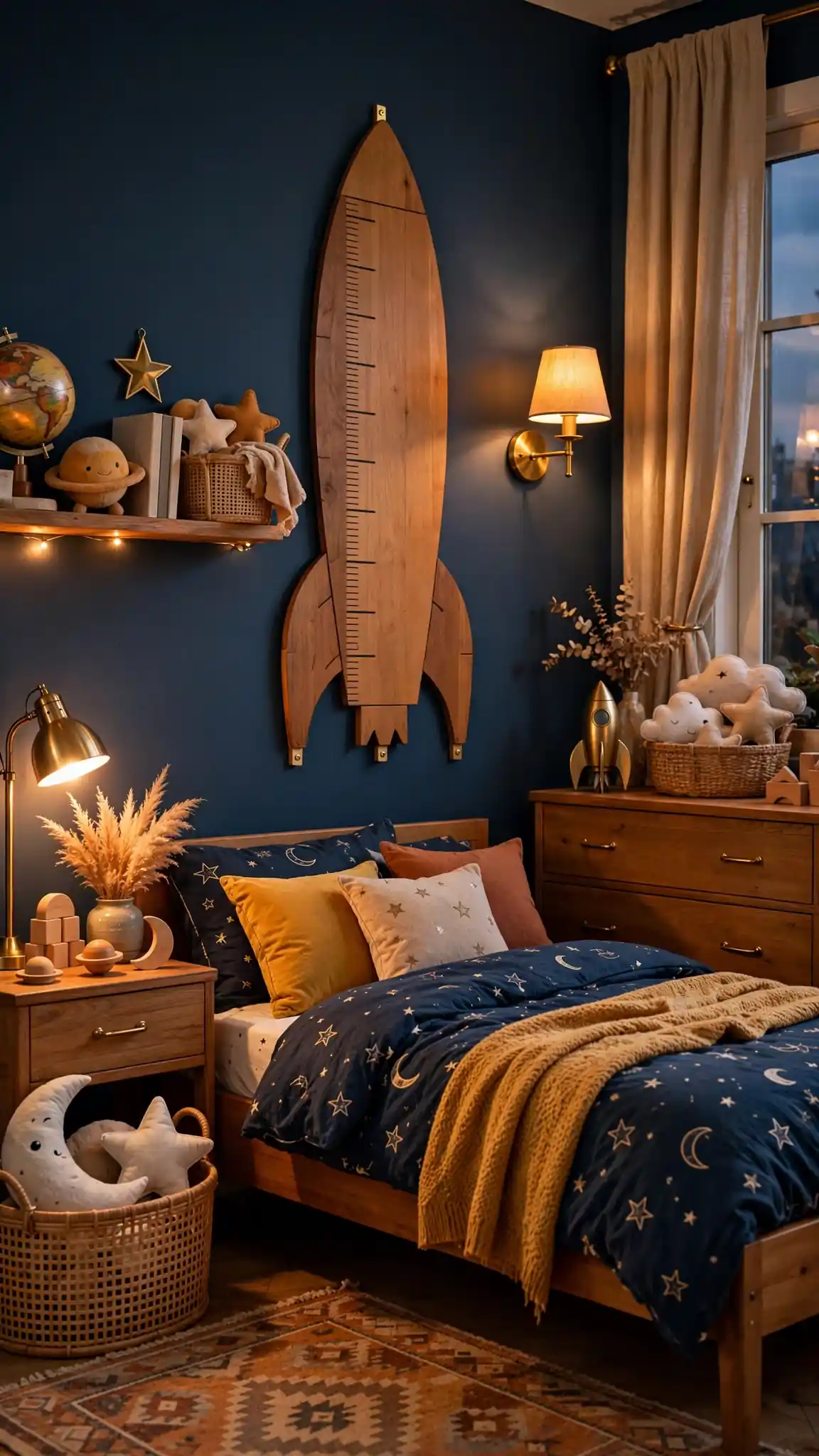
A rocket-shaped wooden growth chart costs $30 to $60 on Etsy and mounts with a single sawtooth hanger. Mark heights with a fine-tip paint pen in metallic gold, dating each entry. Hang it where the child can stand flat against the wall, away from baseboards that skew measurements. Pair it with a countdown chalkboard for launches, trips, or birthdays. Move it carefully when you relocate; it becomes a family keepsake. Pro tip: photograph the chart yearly on the child's birthday so you have a digital backup of every mark.
19. Warm Minimalist Space Room for Teens
The teen edit: navy or plum walls, one moon-phase artwork, a brass desk lamp, LED amber ceiling glow, and a single vintage NASA print — theme reduced to atmosphere. No rockets, no cartoon planets; just the sophisticated suggestion of night sky. Add a good telescope and astronomy shelf for substance. This restraint lets teens keep a childhood love without a childish room, which is exactly the negotiation age fourteen demands. Space matures into mood; the wonder stays.
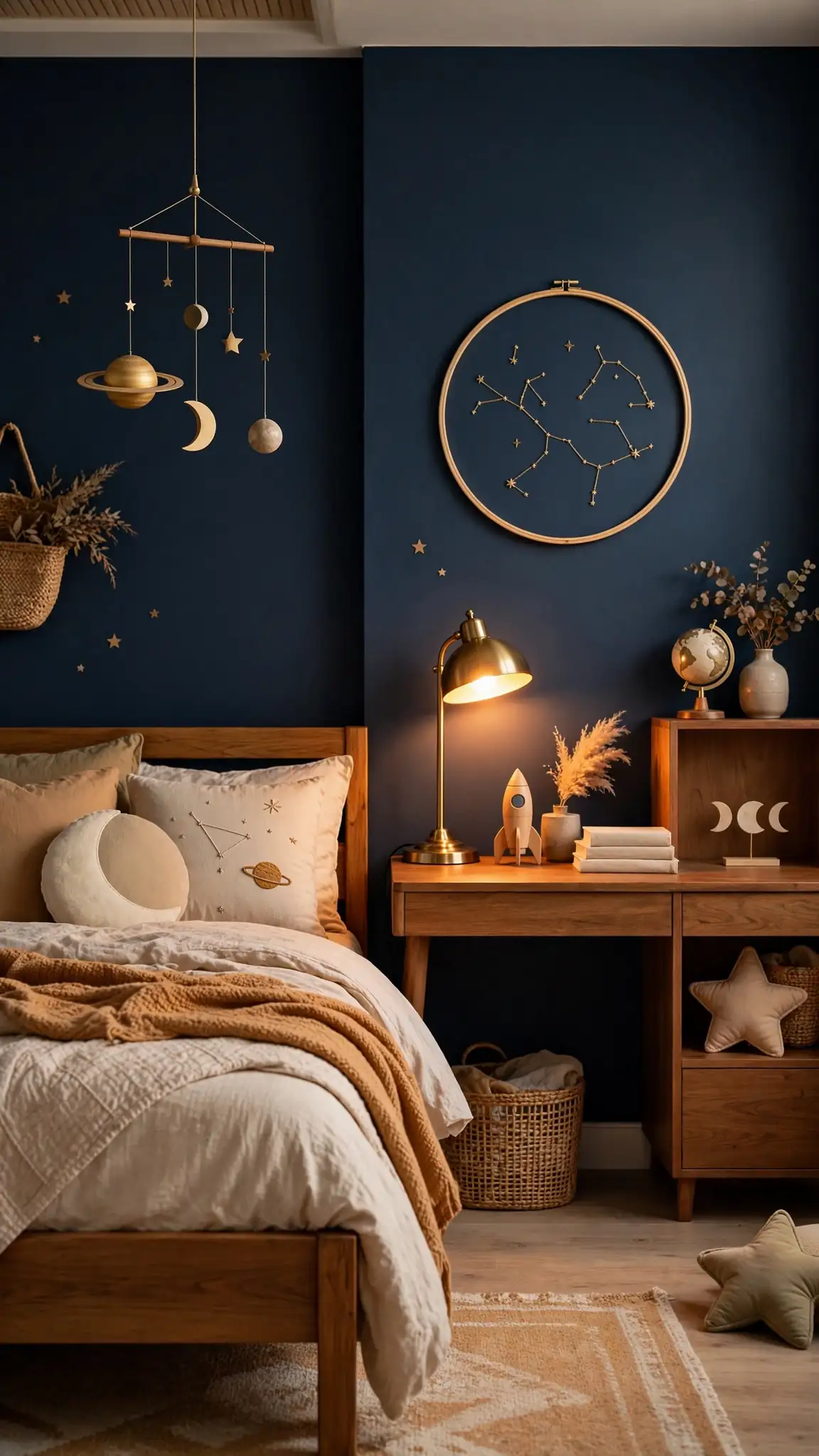
Teens want calm, not cute: keep navy or plum walls, one moon-phase artwork, a brass desk lamp, and amber LED ceiling glow. Edit ruthlessly, removing anything that reads as little-kid. Invest in quality bedding in solid navy or charcoal from Quince or Brooklinen, $80 to $150 for a set. A proper desk with task lighting matters more than decor at this age. Let the teen choose one statement piece so the room feels theirs. Pro tip: blackout curtains in a matching navy make sleepovers and late mornings actually work.
20. Shooting Star Fairy-Light Wall
Arrange warm fairy-light strands diagonally across one wall as shooting star trails, each ending in a larger star decal. The streaking-light composition adds motion to the static night sky and glows gorgeously at dusk. Use adhesive hooks for renter-safe curves. Three or four trails maximum — restraint keeps it elegant. Children make wishes on them nightly, obviously. Of all the lighting ideas, this one photographs best and costs least: two strands of lights and an evening of arranging.
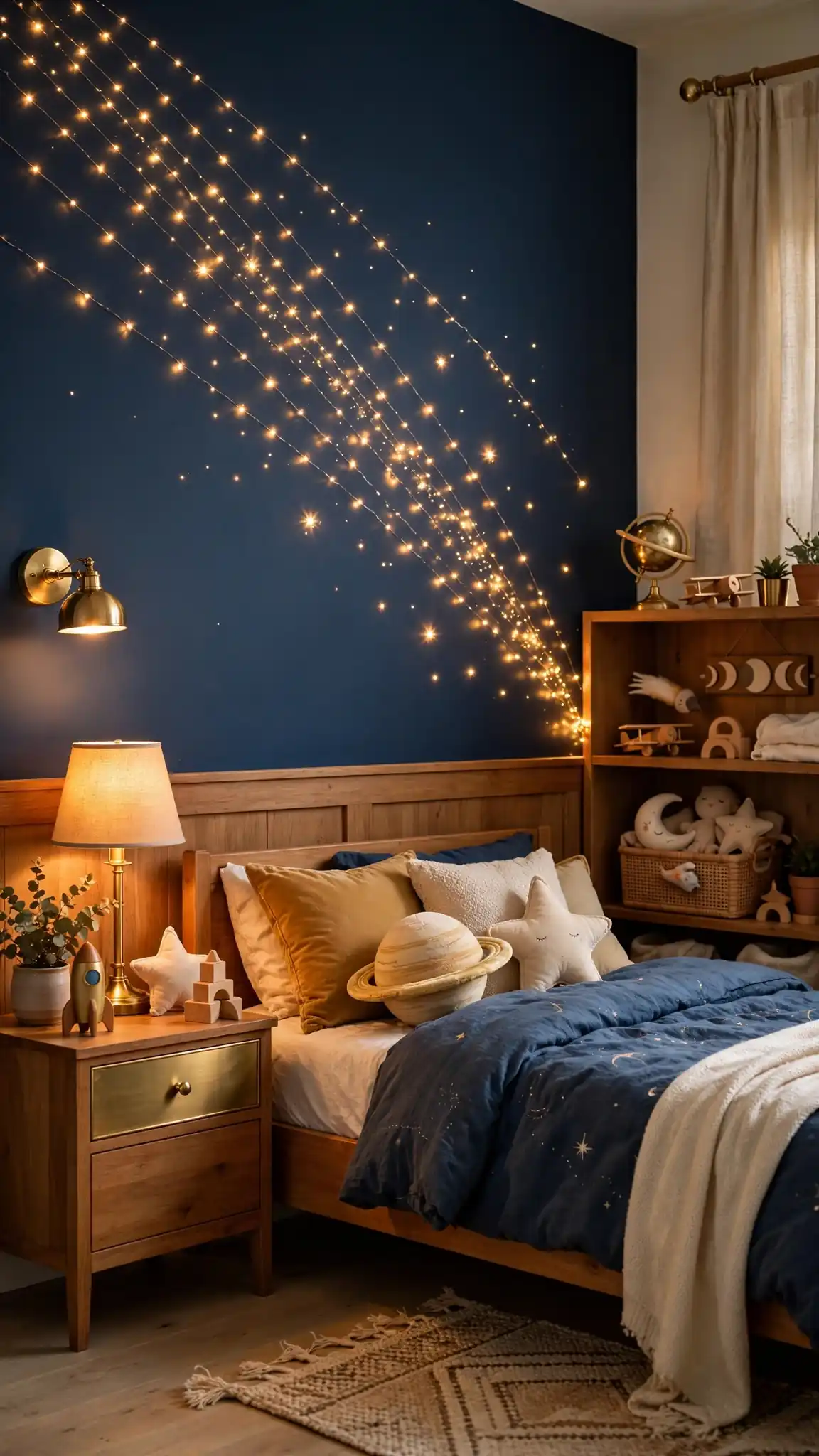
Arrange warm fairy-light strands diagonally across one wall as shooting star trails, securing each strand with small clear adhesive clips. Two 66-foot strings cost about $20 total on Amazon. End each trail with a slightly larger star ornament or a cluster of lights for the starburst effect. Plug into a timer so the display turns off automatically at bedtime. Keep strands taut to avoid sagging lines. Vary the trail lengths for a natural look. Pro tip: use copper wire fairy lights rather than green cord; the thin wire nearly disappears against the wall in daylight.
21. Space Themed Study Zone
Theme the homework corner for motivation: a navy pinboard with gold pins, a brass task lamp, planet bookends, a solar system desk mat, and a framed “reach for the stars” mission-style print. The astronaut framing genuinely helps some kids approach study as mission training. Keep the desk surface itself clear — cosmic surroundings, disciplined workspace. Warm task lighting protects evening focus. When homework happens at mission control, resistance drops; parents report the themed desk gets used more, which is the entire point.
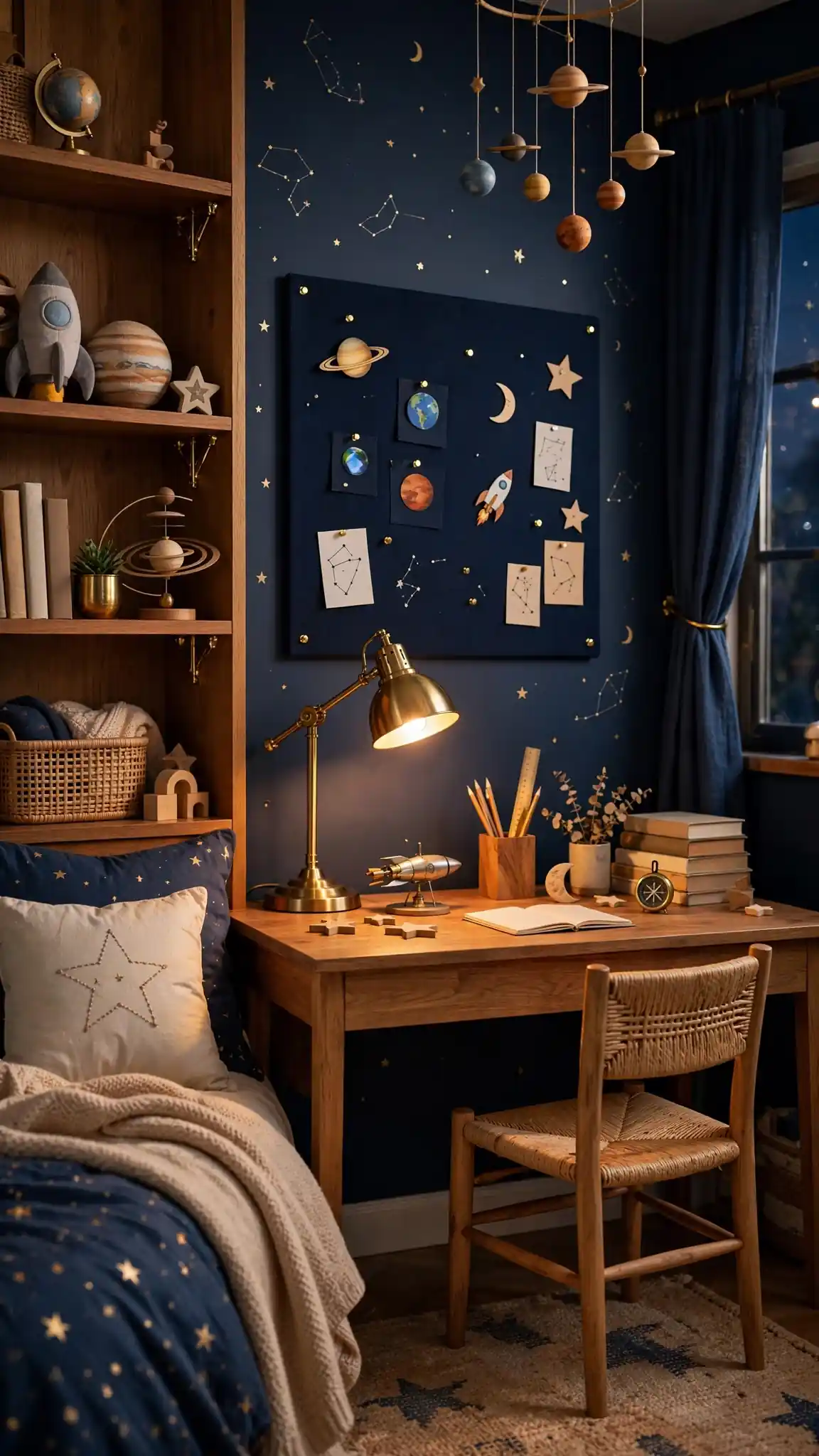
Theme the homework corner for motivation: a navy pinboard with gold pins for schedules, a brass task lamp, and planet bookends. A simple desk from IKEA runs $60 to $150; add the brass lamp for $30 to $60. Position the desk near the window for daylight and face it toward the room to reduce distractions. Keep supplies in a small caddy so the surface stays clear. A comfortable chair matters more than a fancy desk for long homework sessions. Pro tip: a small framed print of Earth from space above the desk reminds kids why the homework matters.
22. Crescent Moon Shelf and Night Light
A crescent-moon-shaped wooden shelf holding a tiny plant or figurine, paired with a warm dimmable moon lamp on the bedside table, gives the room its lunar heart. Moon lamps — the textured 3D-printed spheres — glow amber at their best setting, perfect for bedtime stories. The crescent shelf works even in barely-themed rooms as a single celestial gesture. Together they own the room’s nighttime mood: soft moonlight indoors, every night, warm as candleglow and infinitely more practical.
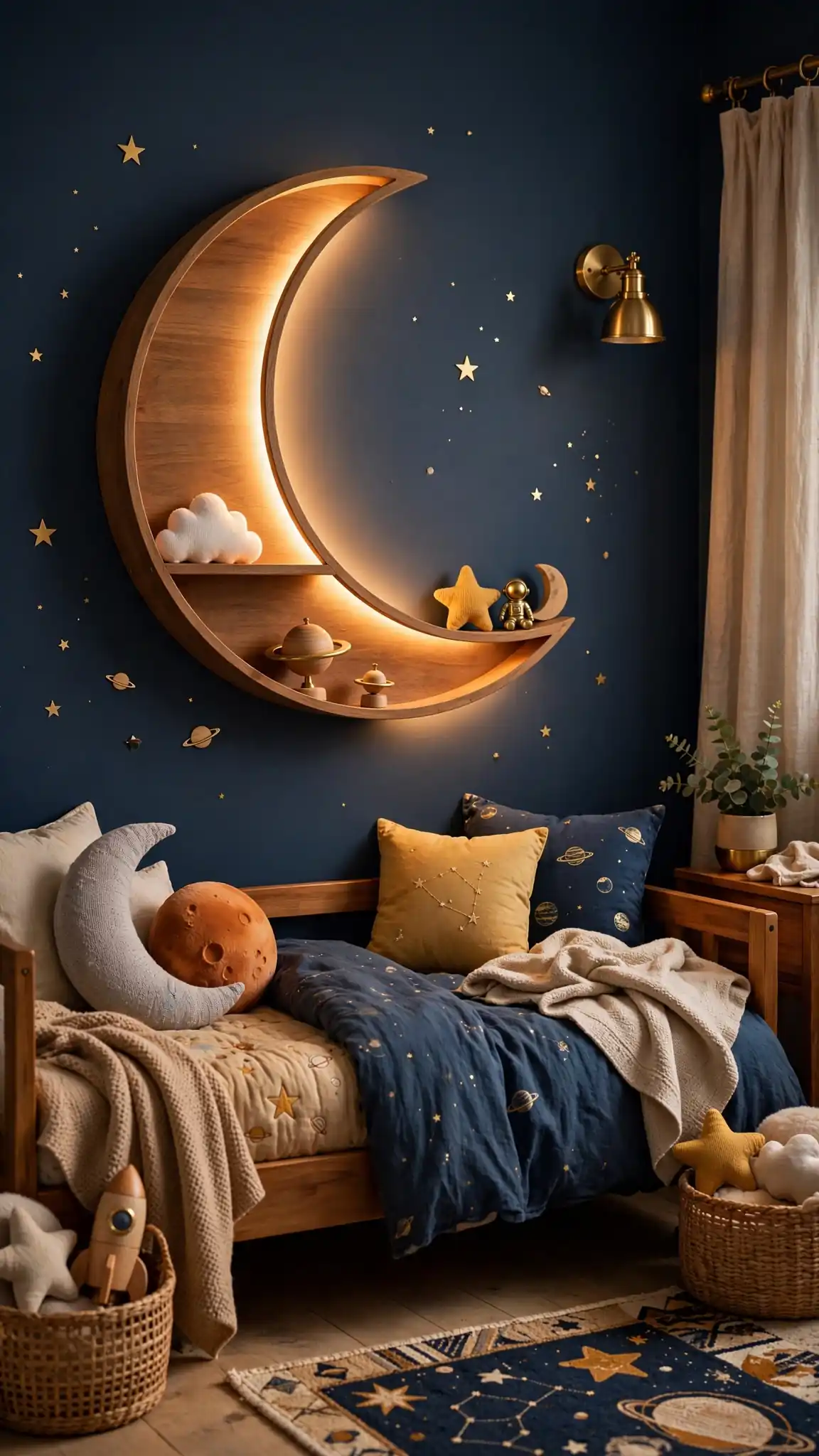
A crescent-moon-shaped wooden shelf costs $25 to $50 on Etsy and holds a tiny plant or figurine while doubling as wall art. Pair it with a warm dimmable moon night light, $15 to $30, plugged into a timer. Mount the shelf at the child's eye level using wall anchors rated for the load. Keep the styling minimal: one small plant, one tiny astronaut figure, done. Dust the shelf monthly since it sits at face height. Pro tip: choose a night light with a warm 2200K glow rather than cool white for genuinely soothing light.
23. Two-Kid Shared Galaxy Room
Sharing the cosmos: matching beds each under its own constellation decal cluster (let each child pick theirs), a shared central rocket rug, and split shelf territories with individual planet collections. The theme unifies the room while personal constellations mark territory — Orion’s bed versus Cassiopeia’s bed settles ownership charmingly. Shared amber ceiling lighting keeps the peace at bedtime. Space is big enough for two; the theme’s scale makes shared rooms feel like a crew cabin rather than a compromise.
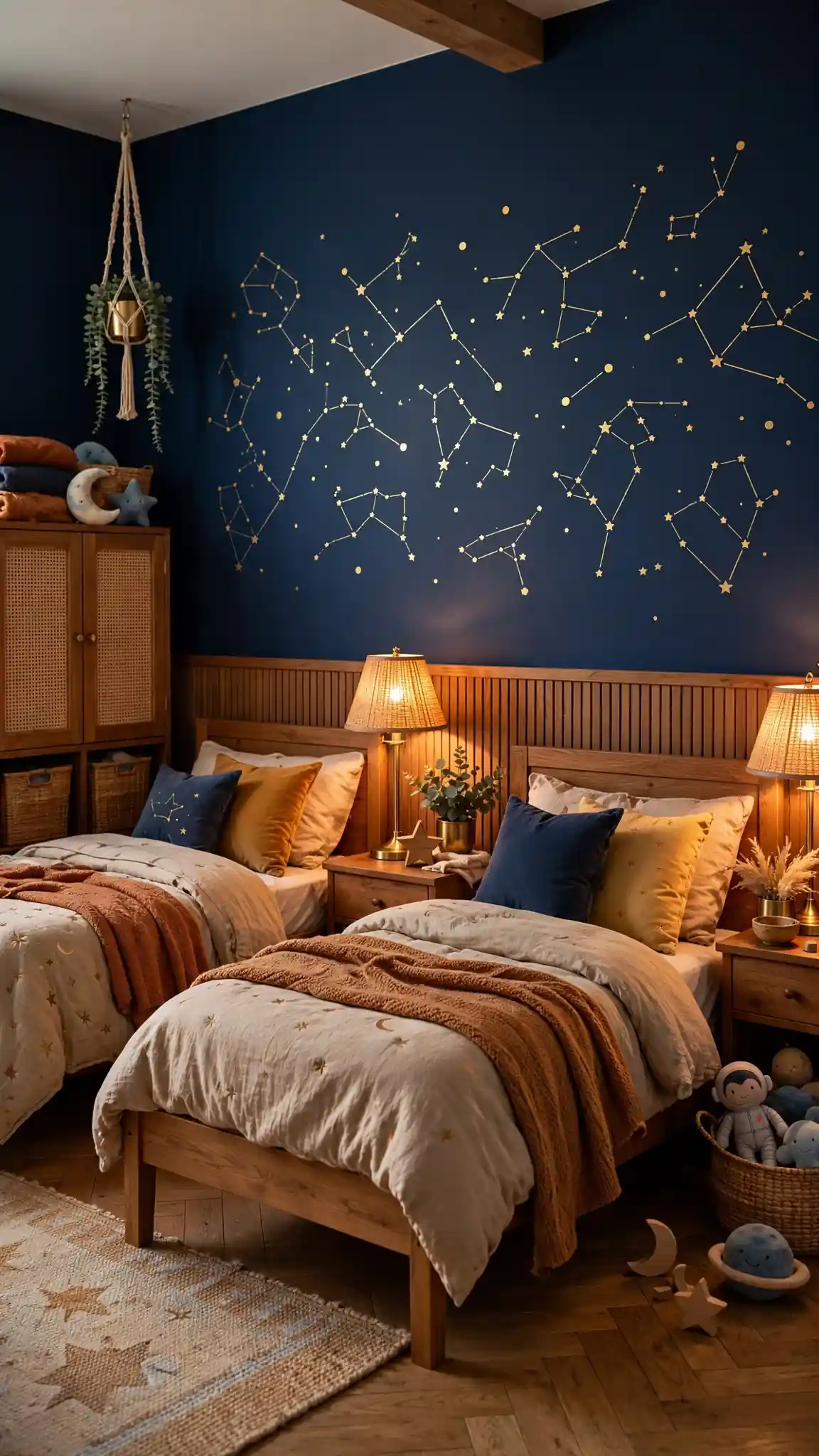
Give each child their own constellation decal cluster above their bed so the shared room still feels personal. Matching bedding in the same palette unifies the space; let each kid pick their own accent pillow. A shared dresser between the beds doubles as a nightstand for both. Use a rug to define each child's zone visually. Keep the lighting warm and dimmable for different bedtimes. Pro tip: a curtain on a ceiling track between beds gives each child privacy on demand and ends most sibling bedtime arguments.
24. Seasonal Space Refresh Rituals
Keep the theme alive through the year: meteor-shower watch nights with the calendar marked, a new planet added to the shelf each birthday, glow stars rearranged into the current season’s constellations, and library rotations of space books on the display ledge. Rooms that change hold attention; static themes get outgrown. These rituals cost nearly nothing but keep the ceiling worth looking at. The warmest thing in any themed room is a parent who keeps feeding the wonder.
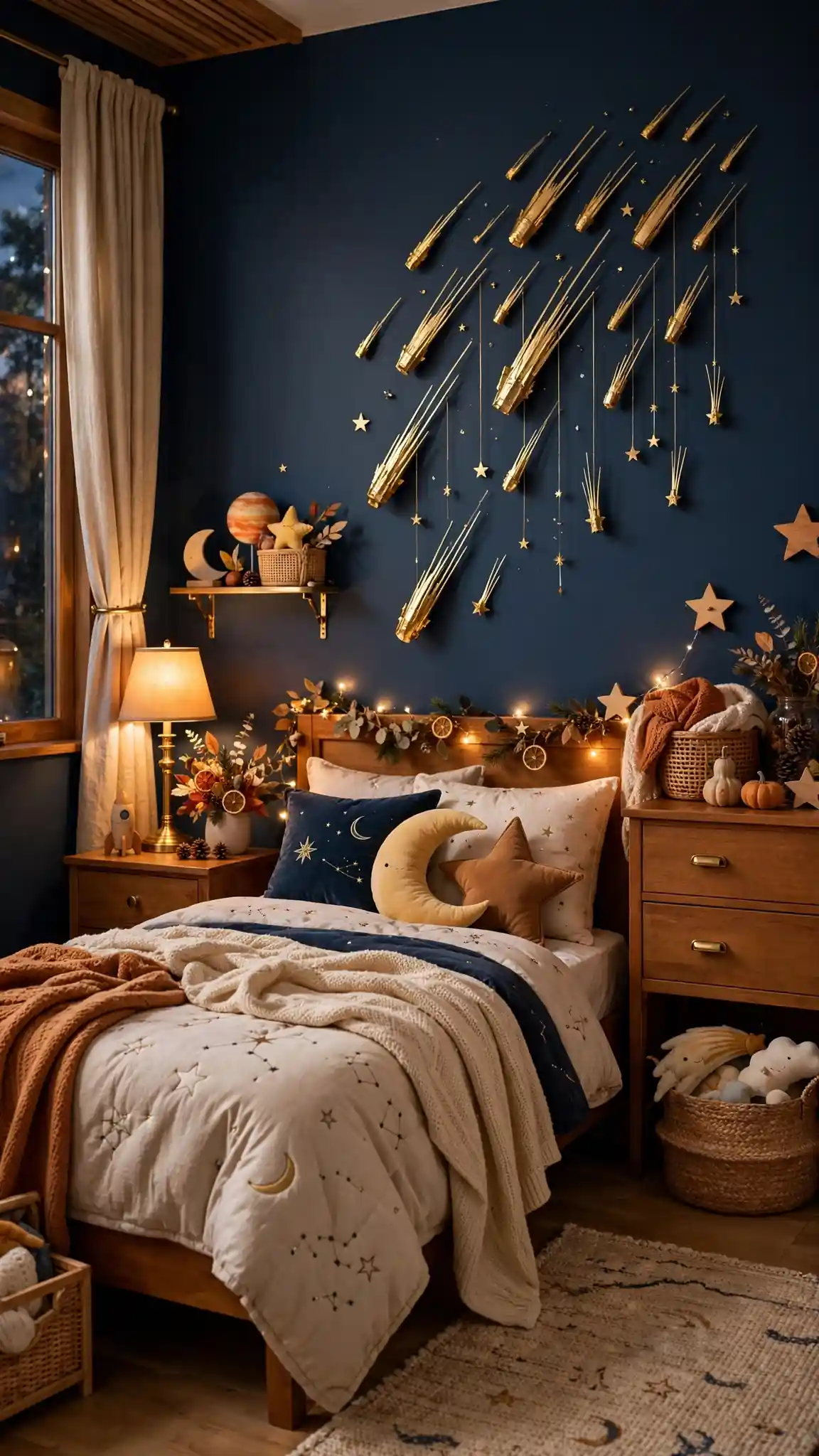
Keep the theme alive through the year: mark meteor showers on a wall calendar and plan watch nights with hot cocoa. Swap one textile per season, a heavier quilt in winter, lighter layers in summer. Add a new constellation decal or poster for birthdays to grow the collection gradually. Rotate books on the space shelf quarterly. These small rituals cost almost nothing but keep the room feeling loved rather than decorated once and forgotten. Pro tip: the Perseids peak every August; make it an annual family tradition with a blanket on the lawn.
25. Growth-Proof Cosmic Plan
Design for the long orbit: keep the navy walls, wood furniture, and lighting as permanent infrastructure, while rockets, cartoon planets, and character bedding live in the swappable layer. Age five gets the rocket nook; age ten gets the telescope station; age fifteen keeps moon art and amber LEDs. One paint job serves a decade. This layered planning is why the warm space theme beats trendier ones — the night sky itself never goes out of style, and neither does a room built warmly beneath it.
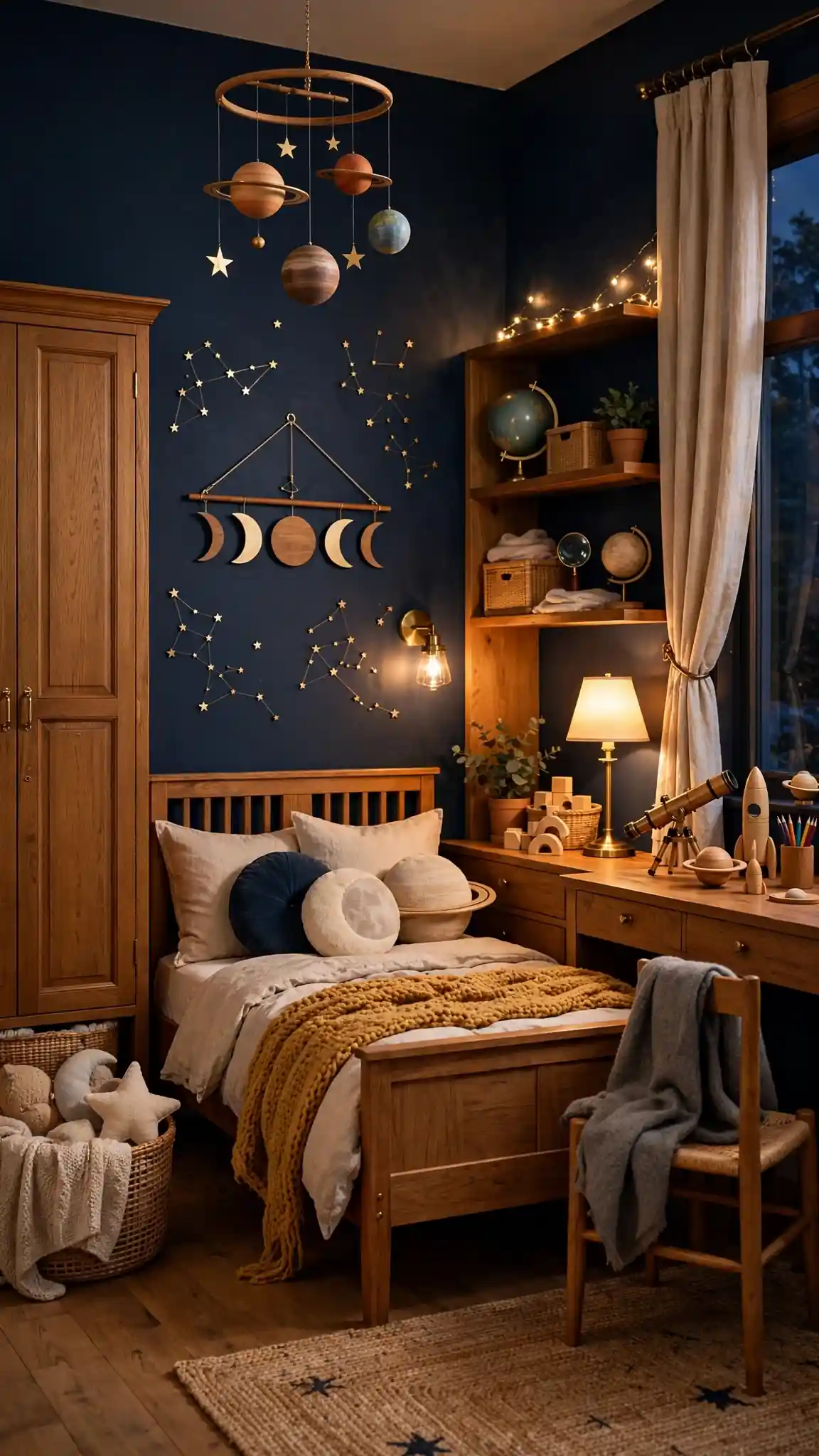
Design for the long orbit: keep navy walls, wood furniture, and warm lighting as permanent infrastructure, and let only the accessories change with age. A quality bed frame and dresser last from childhood through teens. Choose classic pieces rather than novelty kids furniture that gets outgrown. When tastes change, swap decals, bedding, and art instead of repainting. This approach saves thousands over the years. Pro tip: photograph the room at each stage; watching the theme mature alongside your child becomes one of your favorite keepsakes.
Conclusion
Warm space themed bedroom ideas prove the cosmos and coziness were always compatible: navy instead of black, brass and gold instead of chrome, amber glows instead of cold LEDs, and wood, knits, and sheepskins beneath the stars. Build the permanent layer first — walls, lighting, furniture — then let rockets, constellations, and collections evolve with your child from picture books to real telescopes. Keep the astronomy accurate enough to teach and the lighting warm enough to sleep under. The result is the rare themed room everyone loves for years: by day a calm, handsome bedroom; by night, a private observatory wrapped in a blanket.
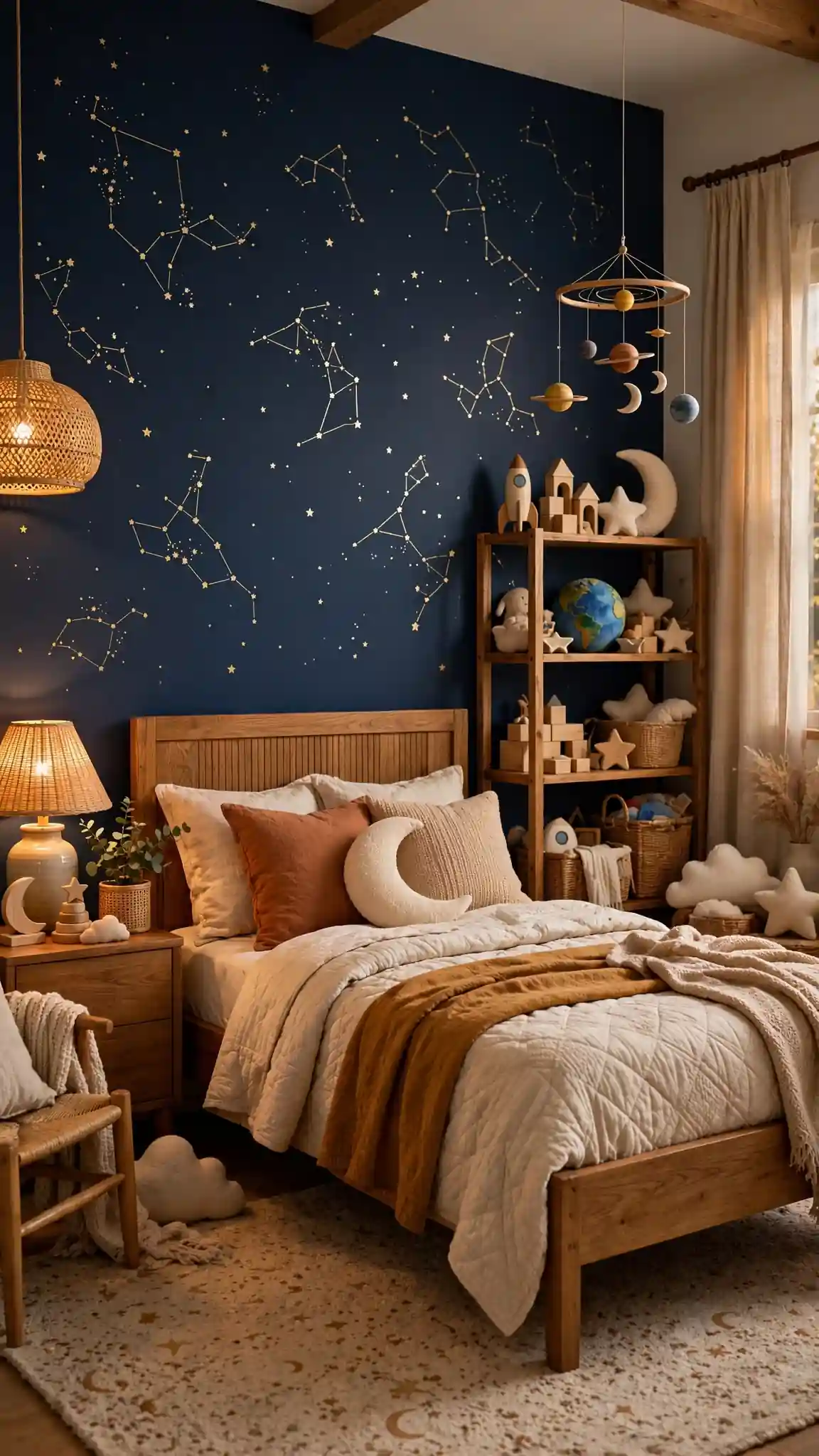
Warm space themed bedrooms prove the cosmos and coziness were always compatible. Navy instead of black, brass instead of chrome, and wood instead of plastic: these small warm choices transform a theme that could feel cold into a room kids never want to leave. Start with the walls and lighting, then layer in the details over time. The best space rooms grow with their astronauts, from toddler rocket nooks to teen minimalist retreats. Your mission, should you choose to accept it: pick one idea this weekend and launch. Pro tip: involve your child in every choice; a room they helped design is a room they will actually keep tidy.
FAQs
Parents ask the same practical questions about space themed bedrooms: which paint colors work, how to keep the theme from feeling cold, and what survives growing kids. The answers below cover the essentials, from projector settings to growth-proof planning. Use them as a quick reference whenever you shop, paint, or restyle. Bookmark this section and come back to it whenever you are ready for the next phase of the room.
Stick to the warm formula and the theme takes care of itself: deep navy or teal walls, warm metallics, real wood, and amber lighting. Buy quality for the big pieces and save on accessories that change with age. Involve your child in the choices for a room they will love longer. Revisit these answers yearly as needs evolve from toddler to teen.
What colors make a space themed room feel warm?
Deep navy, midnight teal, or plum walls with gold, brass, and copper accents, warm wood furniture, and amber 2700K lighting. Avoid pure black walls and cool-white or blue LEDs at bedtime.
Is a space theme good for sleep?
Yes, when lit warmly. Dimmable amber lights, warm-mode star projectors with timers, and gentle glow stars support wind-down, while bright blue galaxy lighting before bed can delay sleep.
How do I make a space room that grows with my child?
Keep walls, wood furniture, and lighting neutral-permanent, and put the theme in swappable layers: decals, bedding, posters, and collections. Upgrade from rocket nook to telescope station over the years.
What is the best space decoration on a budget?
Gold constellation decals on a navy wall, DIY-framed vintage NASA prints, and accurately arranged glow stars deliver the biggest effect for the least money.
Are glow-in-the-dark stars still stylish?
Yes, arranged as real constellations concentrated above the bed rather than scattered randomly. Charge them with warm lamplight during the bedtime story for a natural fade-out.






Leave a comment