


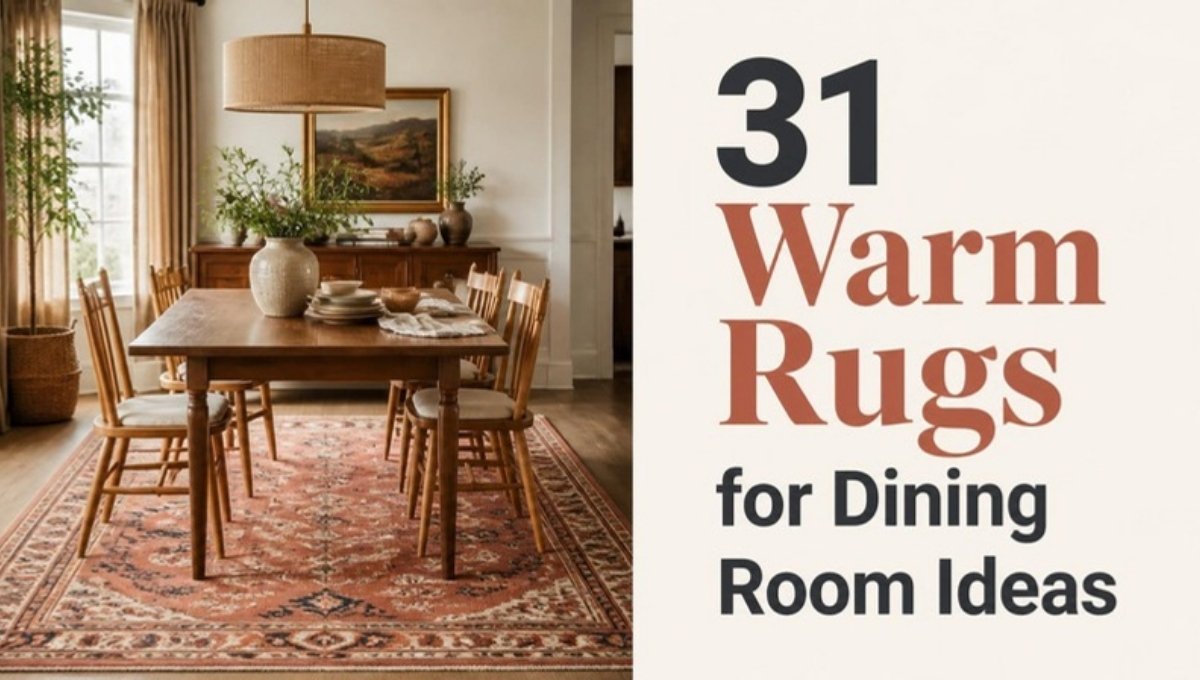
A rug under the dining table does more than look pretty. It defines the eating zone in an open-plan room, absorbs the hard echo that bounces between a timber floor and a glass-topped table, protects the floor from chair legs dragging twice a day, and adds the warmth and softness that a room full of hard surfaces desperately needs. The catch is that dining rooms are also where food lands, so the rug you choose has to survive olive oil, red wine and toddler enthusiasm while still looking good years later.
This guide gathers 31 warm rugs for dining room ideas, covering materials, weaves, colours, patterns, sizing and layering. You will find flatweave wool, washable performance rugs, jute and sisal naturals, vintage Persian and Turkish pieces, bold Moroccan patterns and practical indoor-outdoor options that hose clean. Each idea explains how the rug behaves in a real dining room — chair glide, stain resistance, pile height, cleaning — alongside the look it creates, so you end up with something beautiful that you do not immediately regret.
1. Low-Pile Wool Flatweave
A flatweave wool rug is the sensible starting point for most dining rooms. With virtually no pile, chairs slide over it without catching, crumbs vacuum away easily, and spills sit on the surface long enough to blot. Wool’s natural lanolin coating resists liquid absorption far better than cotton or viscose, buying you critical seconds after an accident. It is also naturally flame resistant and springs back from furniture compression. Expect a higher upfront cost that pays back over a decade of use.
2. Washable Performance Rug
Machine-washable rugs have transformed dining room flooring for families. Built from polyester or polypropylene in thin two-piece systems with a separate grip pad, the top layer lifts off and goes into a domestic washing machine. Designs have improved dramatically, with convincing vintage medallion and abstract patterns rather than obviously synthetic prints. They are lighter and less luxurious underfoot than wool, but for households with small children the ability to actually wash the rug outweighs everything else.
3. Jute Natural Fibre Rug
Jute brings organic texture, a warm honey tone and a relaxed feel that softens formal dining furniture. Its chunky braided or boucle weave adds visual interest without pattern, making it an easy partner for patterned curtains or bold chairs. Jute is softer than sisal but sheds more and stains readily, since the fibres absorb liquid quickly. It suits adult households and dining rooms where spills are unlikely, or works brilliantly as a base layer beneath a smaller decorative rug.
4. Sisal for Durability
Sisal is the toughest of the natural fibres, made from agave leaves and woven into tight herringbone, boucle or panama patterns. It handles heavy traffic and chair movement better than jute and holds its shape without rippling. The texture is firmer underfoot, which some find less comfortable barefoot but which makes chair movement effortless. Sisal marks with water, so treat it with a fibre sealant and blot rather than soak when cleaning.
5. Indoor-Outdoor Polypropylene
Indoor-outdoor rugs are the pragmatist’s choice. Solution-dyed polypropylene has colour locked into the fibre rather than applied to the surface, so it resists fading, mould and staining, and can be scrubbed with soapy water or hosed down outside. Modern versions convincingly imitate wool flatweaves, kilims and vintage patterns. They are the ideal rug for a dining room that opens onto a garden, or any household where a rug must genuinely survive daily life.
6. Vintage Persian Rug
An antique or vintage Persian rug is the most forgiving thing you can put under a dining table, because a hundred years of intricate pattern and softened colour disguise almost any mark. Hand-knotted wool on cotton foundation is extremely durable, and a low, worn pile suits chair movement well. Heriz, Tabriz and Kashan designs bring depth of colour that anchors a room. Buy from a reputable dealer and ask about the knot count and origin.
7. Faded Turkish Oushak
Oushak rugs offer softer, more muted palettes than typical Persians — dusty rose, pale gold, faded terracotta and washed blue — that suit contemporary interiors beautifully. The larger-scale, more open patterns feel less busy under a table than dense medallion designs. Their gentle colouring adds warmth without dominating, and the low pile of a genuinely aged piece is ideal for dining chairs. Overdyed versions in a single saturated colour offer a bolder modern alternative.
8. Moroccan Beni Ourain
The cream wool Beni Ourain with its irregular black diamond lattice brings undeniable warmth and softness. Its high shag pile is the main practical concern in a dining room, since chairs catch and crumbs sink in. It works best under round tables with fewer chairs, in adult households, or in dining areas used more for coffee and conversation than messy family meals. A shorter-pile Moroccan-style flatweave gives a similar look with far more practicality.
9. Kilim Flatweave
Kilims are woven rather than knotted, producing a flat, reversible rug with bold geometric patterns in warm reds, ochres, indigos and creams. The absence of pile makes them excellent for dining rooms, and their busy patterns hide crumbs and small marks admirably. Vintage Turkish and Persian kilims bring genuine character; new production versions offer larger sizes at lower prices. Their thinness means a good non-slip underlay is essential.
10. Warm Terracotta and Rust Tones
Terracotta rugs bring immediate warmth and pair naturally with timber tables, brass lighting and cream walls. The earthy orange-red reads as grounded rather than loud, especially in muted or clay-toned versions. It flatters warm evening light, which matters in a room used mostly at dinner. Rust also disguises the reality of dining — coffee, tomato sauce and red wine all fall within its colour family and simply disappear.
11. Deep Burgundy and Wine Red
Choosing a rug the colour of the thing most likely to spill on it is genuinely clever design. Burgundy, oxblood and wine-red rugs create a rich, enveloping atmosphere in formal dining rooms and pair beautifully with walnut furniture and gold accents. Traditional Persian and Bokhara designs use these tones extensively. In a room with pale walls and a light floor, a deep red rug provides the visual weight that stops the scheme feeling insubstantial.
12. Mustard and Golden Ochre
Mustard rugs bring sunshine into dining rooms that lack natural light, particularly north-facing spaces. The warm yellow works as a near-neutral against wood tones and pairs strikingly with deep blue, charcoal or olive walls. Mid century and Moroccan-inspired patterns often use ochre extensively. Because it is a light colour, choose wool or a stain-resistant synthetic rather than absorbent cotton, and consider a pattern rather than a solid field.
13. Chocolate and Coffee Brown
Brown has returned as a serious decorating colour, and it is exceptionally practical underneath a dining table. Chocolate, coffee and espresso tones disguise almost every food stain, hide pet hair from most breeds, and provide warmth without the boldness of red. A brown rug grounds a room with pale walls and creates deep, cosy contrast. Look for texture — high-low pile, boucle weave, subtle tonal pattern — so a dark solid does not read flat.
14. Cream and Ivory with Texture
An ivory rug makes a dining room feel light, calm and expansive, which is why designers keep specifying them despite the obvious risk. Make it viable by choosing wool with natural stain resistance, an all-over subtle texture that breaks up marks, or a washable construction. Reserve cream for dining rooms without young children, or accept that professional cleaning will be an annual expense. The visual payoff in a small or dark room is substantial.
15. Charcoal and Slate Grey
Charcoal is the most forgiving neutral, hiding dirt while reading as sophisticated rather than heavy. It grounds a dining room with light walls and pale timber, and provides a calm backdrop for colourful chairs or a statement pendant. Choose a grey with a warm undertone rather than a cold blue-grey, which can feel clinical alongside natural wood. Textured weaves and subtle patterns keep large expanses of grey from looking dull.
16. Striped Rugs
Stripes are the most underrated pattern for dining rooms because they add rhythm without visual noise. Running stripes along a room’s length elongates it; running them across widens a narrow space. Wide alternating bands feel bold and graphic, while fine multi-stripes read almost as texture from standing height. Striped flatweaves in wool or cotton also tend to be among the most affordable rug options in large sizes.
17. Checkerboard Pattern
The checkerboard rug has become a design signature, bringing graphic energy without the commitment of a checkerboard floor. In warm tones — cream and camel, ivory and rust, oat and chocolate — it reads as cosy rather than stark. Larger squares suit generous rooms; smaller checks work better in compact dining areas. The two-tone pattern is also remarkably good at disguising crumbs and light staining.
18. Subtle Tonal Damask
A tonal damask or medallion pattern in two shades of the same colour adds depth and formality without introducing new hues to your palette. It gives a dining room a considered, layered look while remaining quiet enough to sit under a strongly patterned wallpaper or bold curtains. Because the contrast is low, small marks disappear more readily than on a high-contrast design. It suits traditional and transitional dining schemes especially well.
19. Round Rug for a Round Table
Matching rug shape to table shape produces a satisfying visual logic and improves circulation, since there are no corners protruding into walkways. A round rug under a round or pedestal table softens a boxy room and works particularly well in square dining spaces. Size it so all chairs remain fully on the rug when pulled out — generally the table diameter plus at least 48 to 60 inches total.
Read More Blogs on: decormellow.com
20. Runner for Narrow Dining Spaces
In a long narrow dining room or a galley kitchen-diner with a bench-style table, a wide runner can work better than a conventional rectangle. It defines the zone without crowding the walkways on either side. This solution suits banquette arrangements especially, where chairs only pull out on one side and the full rug footprint is unnecessary. Choose a low-profile weave so the runner does not create a trip edge.
21. Oversized Rug Sizing
The most common dining rug mistake is buying too small. Chairs must remain entirely on the rug when pulled out, or they tip on the edge and catch every time. That means adding at least 24 inches, ideally 30, beyond the table edge on all four sides. For a standard six-seat rectangular table, that usually points to a 9 by 12 foot rug rather than the 8 by 10 most people instinctively choose.
22. Layering Over Jute
Layering a smaller decorative rug over a large jute or sisal base is a designer staple that solves two problems at once. The natural base provides scale, texture and coverage affordably, while the top rug adds colour, pattern and softness in the area that matters most. It also lets you use a beautiful vintage piece that is too small to work alone. Keep the base at least twelve inches wider on all sides.
23. High-Low Textured Pile
High-low rugs vary the pile height within a single design, creating carved patterns and shadow lines that add dimension without colour. The effect is subtle, tactile and works well in neutral schemes that need interest. In a dining room, keep the maximum pile height modest — under half an inch — so chair legs still move freely. The texture also disguises crumbs and light wear better than a uniform flat surface.
24. Boucle and Loop Pile
Loop pile constructions create a nubby, textural surface reminiscent of boucle upholstery, adding warmth and a slightly organic quality. In wool, loop pile is exceptionally durable and resists crushing under table legs. Avoid it in homes with cats, since claws catch in the loops and pull them. Natural undyed wool loop rugs, with their subtle cream-and-oatmeal variation, suit organic modern and Scandinavian dining rooms perfectly.
25. Cotton Flatweave for Budget and Washability
Cotton dhurries and flatweaves are lightweight, affordable and often machine washable in smaller sizes, making them a practical choice for casual dining areas. They come in an enormous range of colours and stripe patterns. Cotton absorbs liquid readily, so stains set faster than in wool, but the ability to wash the whole rug compensates. Expect a shorter lifespan and more frequent replacement than with wool.
26. Bamboo Silk and Viscose Accents
Bamboo silk and viscose add a lustrous sheen that catches light and gives a rug a luxurious, almost shimmering quality. They are best used as accent fibres blended into a wool base rather than as the entire pile, because viscose is weak when wet and shows watermarks permanently. A wool rug with subtle viscose highlights in the pattern gives dining rooms a touch of glamour with acceptable durability.
27. Antique Wash and Distressed Finishes
Distressed or antique-wash rugs are deliberately faded and worn to look decades old from the day they arrive. The muted, uneven colouring is exceptionally forgiving of real-world dining wear, since new marks read as part of the patina. These rugs bridge traditional and contemporary styles well, bringing pattern and history to a modern dining room without feeling stuffy or overly formal.
28. Bordered Rugs for Definition
A rug with a contrasting border frames the dining zone crisply and makes the arrangement look intentional, much as a mount frames a picture. A dark border on a light field reads tailored and traditional; a tonal border stays subtle. Borders also give you an easy way to pick up a colour from your chairs or curtains. In open-plan spaces the defined edge helps separate dining from living areas.
29. Non-Slip Underlay
A rug pad is not optional under a dining table. It stops the rug sliding when chairs are pushed back, prevents rippling that catches chair legs, adds cushioning that extends the rug’s life, and protects the floor beneath from abrasion and colour transfer. Choose felt-and-rubber pads for hard floors rather than cheap PVC mesh, which can degrade and mark timber finishes over time.
30. Seasonal Rug Swapping
Keeping two rugs and rotating them seasonally lets you enjoy a warm, heavier wool piece in winter and a light flatweave or natural fibre in summer. It also doubles each rug’s lifespan by halving its annual wear, and gives the dining room a genuine seasonal refresh for no additional cost after the initial purchase. Roll and store the off-season rug clean and dry, with the pile facing outward.
31. Custom Cut and Bound Carpet
Having broadloom carpet cut to your exact dimensions and edge-bound produces a made-to-measure rug at a fraction of custom rug prices. It is the best solution for awkward room shapes or unusually large tables where standard sizes leave chairs hanging off the edge. Choose a wool loop or low-pile carpet, and specify a cotton or linen binding tape, or a leather-look edge for a more premium finish.
Final Thoughts on Rugs for Dining Room Ideas
The right dining room rug is a negotiation between beauty and reality. Start with size, because a rug too small will annoy you every single day regardless of how good it looks — allow at least 24 to 30 inches beyond the table on all sides. Then choose a construction that suits your household: washable performance rugs and indoor-outdoor polypropylene for families, wool flatweaves and vintage Persians for longevity and character, jute and sisal for texture in low-risk rooms. Favour warm terracotta, rust, ochre, brown and burgundy tones, which hide spills naturally, and never skip the non-slip underlay.
For more inspiration, explore our 30 Smart Dining Room Table Decor Ideas and browse more home decor ideas.
Frequently Asked Questions About Rugs for Dining Room Ideas
What size rug do I need for a dining room?
Add at least 24 inches, ideally 30, beyond every edge of the table so chairs stay fully on the rug when pulled out. For a standard six-seat rectangular table this usually means a 9 by 12 foot rug rather than an 8 by 10.
What is the best rug material for a dining room?
Low-pile wool is the best all-round choice because it resists liquid absorption, cleans easily and lasts decades. For households with children or pets, machine-washable rugs and solution-dyed polypropylene indoor-outdoor rugs are more practical.
Should you put a rug under a dining table?
Yes, in most cases. A rug defines the dining zone, protects the floor from chair movement, and absorbs the echo created by hard floors and hard tabletops. Choose a low pile so chairs slide easily.
What rug colours hide food stains best?
Warm mid-to-dark tones — terracotta, rust, burgundy, chocolate brown and charcoal — hide spills most effectively. Multi-coloured patterns such as Persians, kilims and checkerboards also disguise marks far better than solid pale fields.
How do I stop a dining room rug from sliding?
Use a felt-and-rubber rug pad sized slightly smaller than the rug. This prevents movement when chairs are pushed back, stops rippling, cushions the pile and protects the floor beneath from abrasion.
Is a jute rug a good idea under a dining table?
Jute adds beautiful texture but absorbs liquids quickly and stains readily, so it suits adult households or low-spill dining areas. A more practical approach is to use jute as a large base layer beneath a smaller washable or wool rug.





Leave a comment