


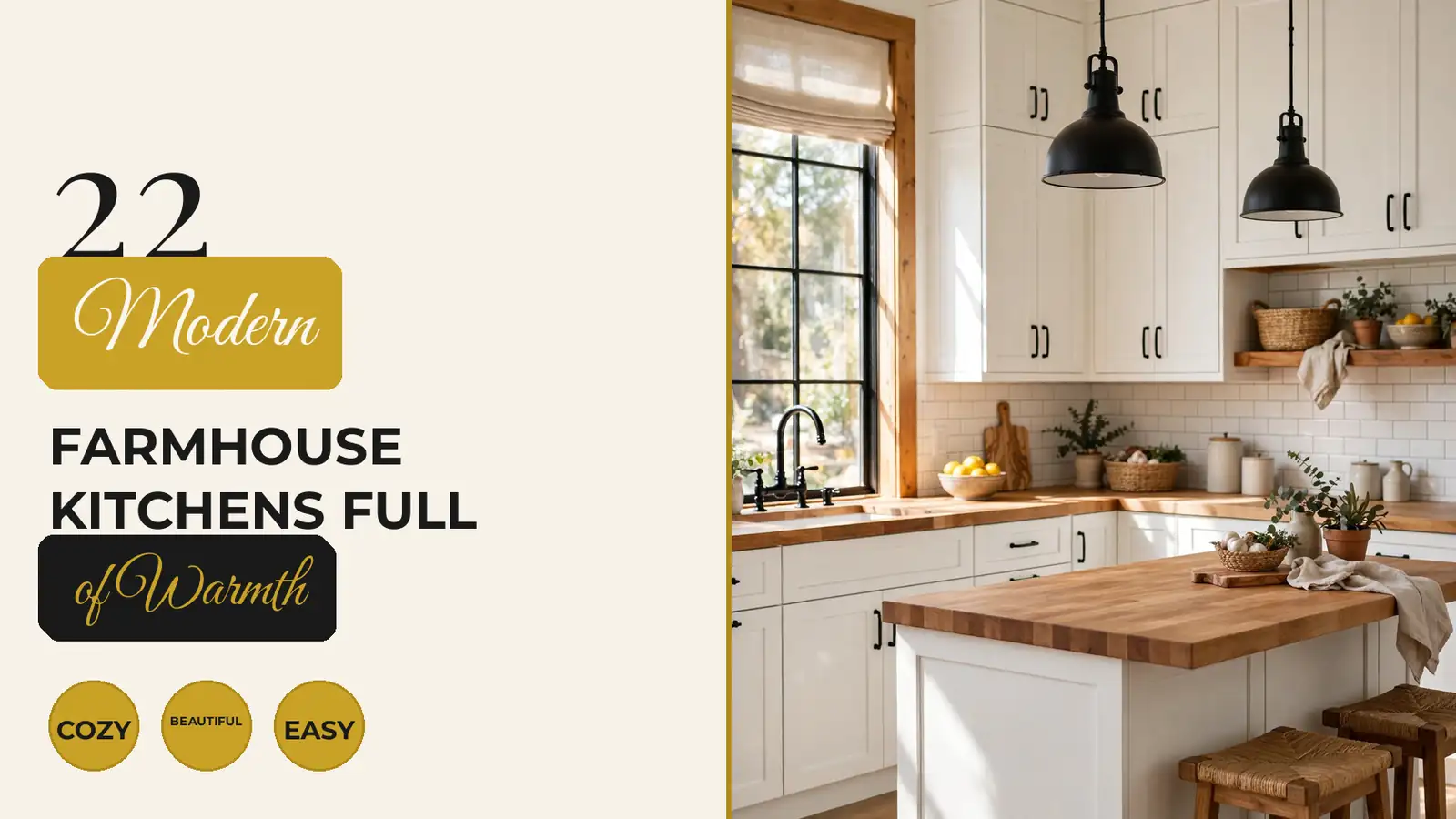
Modern farmhouse style combines the warmth and charm of a country kitchen with the clean lines and fresh feel of modern design. It is relaxed, welcoming and practical, which is why it remains one of the most popular kitchen styles for families.
These 22 modern farmhouse kitchens ideas cover cabinets, sinks, lighting, materials and decor to help you create the look. For related inspiration, see our white kitchen cabinets ideas and these open shelving kitchen ideas.
Key elements of modern farmhouse kitchens:
- Shaker cabinets in white, cream or soft color.
- A farmhouse or apron-front sink.
- Natural wood accents like beams, shelves or an island.
- Black or brass hardware and simple lighting.
1. White Shaker Cabinets
White Shaker cabinets are the foundation of almost every modern farmhouse kitchen because they deliver a clean, timeless look without feeling cold or sterile. The recessed center panel adds just enough detail to feel crafted, while the crisp white finish bounces natural light around the room and makes even a modest 10-by-12-foot kitchen feel larger. Budget-friendly ready-to-assemble options from IKEA’s SEKTION line or Home Depot’s Hampton Bay collection run about $150 to $300 per linear foot, so you get a semi-custom feel at stock prices. Pair them with warm wood accents and matte black hardware to give the space its signature warmth and character.

To keep white Shaker cabinets from looking flat, focus on texture and contrast around them. Install a wood range hood or butcher block countertop nearby so the white has a warm partner, and choose brushed or honed quartz counters rather than high-gloss finishes for a softer, more lived-in glow. If you already have white cabinets, refreshing the look can be as simple as swapping outdated knobs for oil-rubbed bronze cup pulls, which cost $3 to $8 each on Amazon. For a true farmhouse feel, leave one or two uppers as open shelves instead of closed doors, giving you a spot to display everyday dishes and greenery.
2. Farmhouse Apron Sink
A farmhouse apron sink is the single most recognizable feature of a farmhouse kitchen, with its deep basin and exposed front panel that extends past the cabinetry. The extra depth — typically 9 to 10 inches compared to a standard 6-to-8-inch sink — lets you soak roasting pans and stack dishes without cluttering the counter. Fireclay models from brands like Kohler or Blanco run $400 to $900 at Lowe’s and Home Depot, while budget-friendly stainless versions cost $250 to $450. The wide front looks best centered under a window, where daylight turns a daily chore into something almost pleasant.
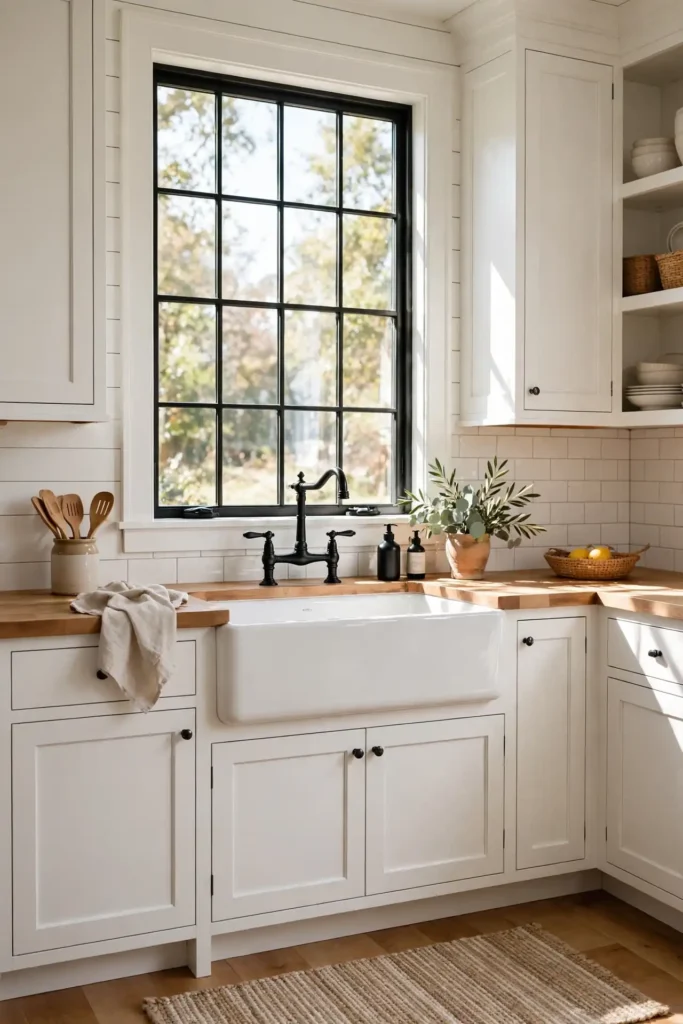
Before you buy, measure your base cabinet carefully: an apron-front sink needs a 36-inch sink base cabinet and usually requires trimming the cabinet face frame to fit. Professional installation adds $300 to $500 to the project, but it’s worth it since fireclay is heavy and the apron must sit perfectly level to look right. Pair the sink with a high-arc bridge faucet in matte black or unlacquered brass for authentic farmhouse character, and add a wire sink grid to protect the bottom from scratches. Keep the area under the window free of clutter so the sink becomes the kitchen’s visual anchor.
3. Wood Ceiling Beams
Exposed wood ceiling beams bring instant warmth and architectural history to a modern farmhouse kitchen, drawing the eye upward and making tall ceilings feel intentional rather than cavernous. Real reclaimed beams are gorgeous but heavy and expensive — expect $15 to $30 per linear foot plus structural reinforcement. Faux beams made from lightweight polyurethane or hollowed box-beam pine cost $5 to $12 per linear foot at Home Depot and install with simple brackets, giving you the same look in a weekend. Stain them a medium walnut or weathered gray to complement white cabinets and light floors.
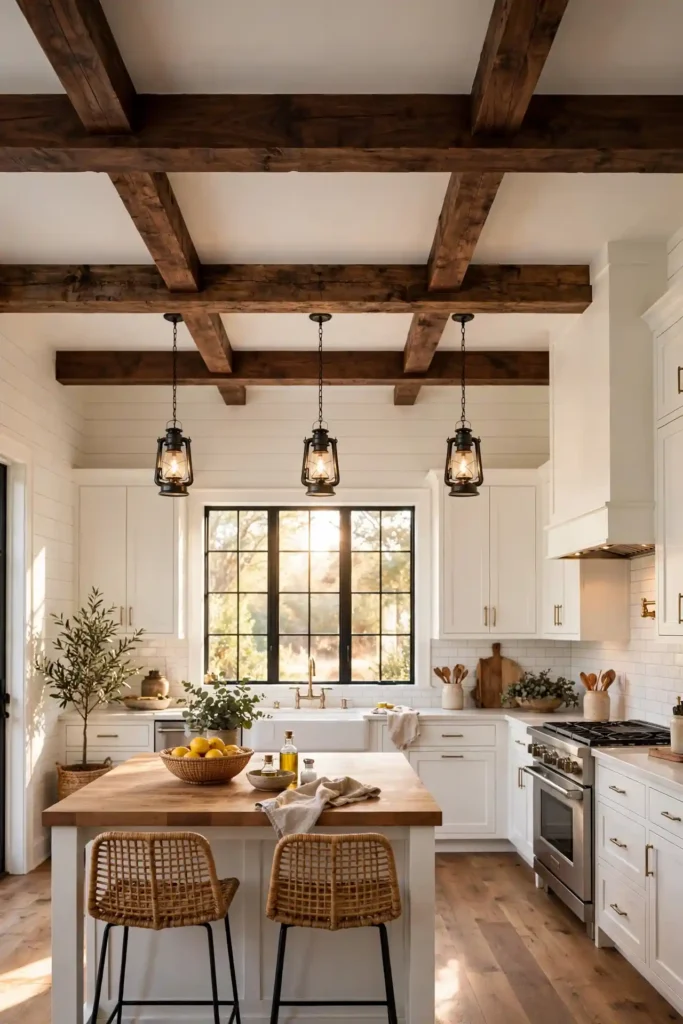
Beam placement matters more than most people realize. Run beams parallel to the longest wall to emphasize the room’s length, spacing them 4 to 6 feet apart so the ceiling feels rhythmic rather than crowded. In kitchens with ceilings under 9 feet, keep beams slim — 4-by-6 inches works well — so they add character without lowering the visual height. If your ceiling is flat drywall, painting the space between beams a warm white keeps things bright while the beams add contrast. Finish the look with one or two lantern-style pendants hung between beams over the island.
4. Butcher Block Island
A butcher block island adds warmth, texture, and a hardworking surface to a modern farmhouse kitchen in one move. Maple butcher block runs $40 to $80 per square foot at Home Depot and Lowe’s, making it far more affordable than marble or quartz, and its honey tones soften the look of white perimeter cabinets beautifully. You can food-prep directly on a properly oiled surface, and the inevitable knife marks and patina only add character over time. Choose a 1.5-inch-thick top for a chunky, furniture-like presence that anchors the center of the room.
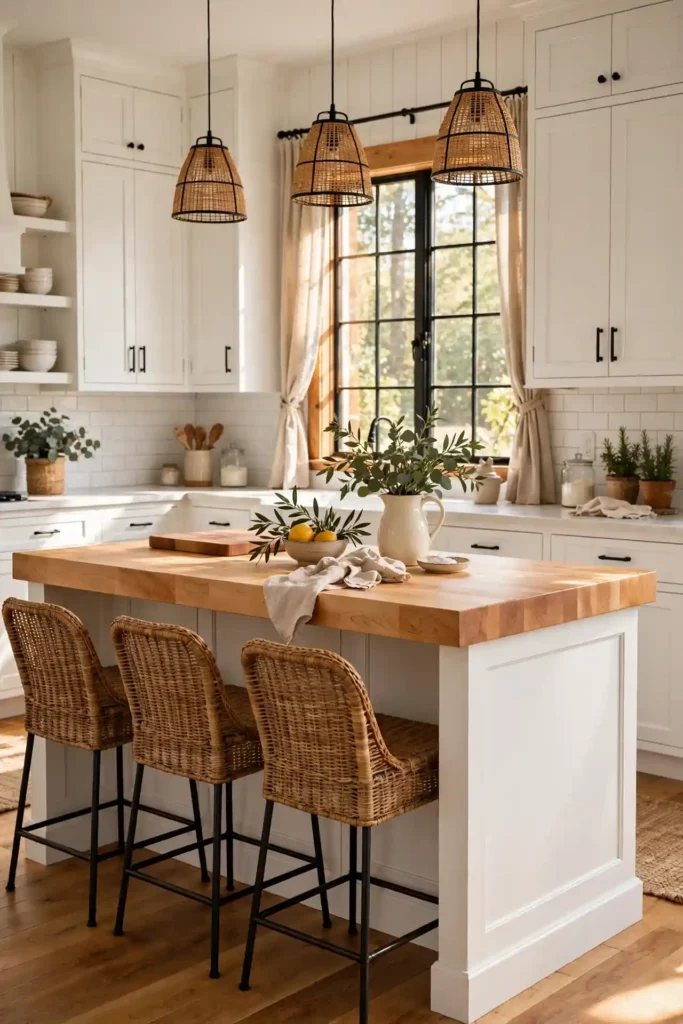
Maintenance is simpler than most homeowners fear. Oil the top monthly with food-safe mineral oil — a $12 bottle from Amazon lasts a year — and sand out stains or scratches once a year with 220-grit sandpaper. Pair the island with two or three woven or wood bar stools tucked under a 12-inch overhang for comfortable seating, and add a lower open shelf for cookbooks or baskets. If you worry about water damage near the sink, use butcher block on the island only and keep quartz or granite on the perimeter counters for the best of both worlds.
5. Black Hardware
Matte black hardware is the jewelry of a modern farmhouse kitchen, adding crisp contrast against white Shaker cabinets and warm wood tones. Bar pulls in lengths of 5 to 8 inches look modern yet timeless, and at $2 to $6 per pull on Amazon or at Home Depot, swapping hardware is the cheapest mini-makeover you can do. Use cup pulls on drawers and round knobs on doors for a classic farmhouse mix, keeping the finish consistent across every cabinet. Black hardware also echoes the look of lantern pendants and black window frames, tying the whole room together.

When choosing black hardware, pay attention to finish quality. True matte black or oil-rubbed bronze finishes resist fingerprints better than glossy black, which shows every smudge. Measure your existing screw-hole spacing before ordering — standard pulls come in 3-inch, 3.75-inch, and 5-inch center-to-center sizes — so replacements drop right into existing holes without drilling. For a cohesive look, match your faucet and cabinet hardware finishes; a matte black bridge faucet pairs perfectly with matte black pulls. If your cabinets are dark, switch to brass or champagne bronze instead so the hardware doesn’t disappear.
6. Open Wood Shelves
Open wood shelves replace a few upper cabinets with airy, display-friendly storage that feels relaxed and personal. Thick floating shelves in reclaimed oak or stained pine, typically 2 inches thick and 10 to 12 inches deep, cost $30 to $80 per shelf on Etsy or Amazon and install on hidden brackets rated for 50 pounds or more. Style them with everyday white dishes, clear glassware, and a few sprigs of greenery to keep them looking effortless rather than cluttered. They’re ideal flanking a range hood or beside a window where closed cabinets would block light.

The secret to open shelves that stay beautiful is editing. Limit each shelf to two or three groupings — a stack of bowls, a row of glasses, one small plant — and leave breathing room between items so the display reads as curated, not crowded. Keep a step stool nearby since the top shelf sits 66 to 72 inches off the floor, and choose dishwasher-safe everyday dishes so nothing gathers dust. If you’re nervous about dust, try open shelves in just one spot, like a coffee station, before committing to a full run. Pair them with under-shelf puck lights for a warm evening glow.
7. Subway Tile Backsplash
Classic white subway tile is a modern farmhouse staple because it’s affordable, timeless, and goes with everything. Standard 3-by-6-inch ceramic subway tile costs $2 to $5 per square foot at Home Depot and Lowe’s, and a typical 30-square-foot backsplash runs under $200 in materials. Lay it in a classic running bond pattern for a clean look, or choose a herringbone layout behind the range for extra personality. Handmade-look tiles with slight color variation, like those from Bedrosians or Fireclay Tile, add a truly artisan feel that beautifully elevates the whole kitchen.

Grout color changes the entire mood of a subway tile backsplash. Bright white grout creates a seamless, modern look, while warm gray or greige grout outlines each tile for a more traditional farmhouse feel — and hides kitchen splatter far better. Extend the tile all the way to the ceiling behind open shelves or the range hood for a high-end, custom look that costs little extra in materials. Seal the grout yearly with a $10 penetrating sealer to prevent staining, and keep a spare box of tile on hand in case a future repair is needed.
8. Shiplap Walls
Shiplap walls bring the cozy, cottage character of a farmhouse straight into the kitchen, adding texture that flat drywall simply can’t match. Authentic shiplap uses 6-to-8-inch-wide pine boards with a small reveal between them, but budget-friendly MDF or PVC shiplap panels cost $1.50 to $4 per square foot at Home Depot and install over existing drywall in a weekend. Paint it a warm white like Benjamin Moore’s White Dove for a soft glow, or leave it natural pine in a breakfast nook for extra rustic charm. One accent wall behind open shelves makes the biggest impact.

Placement is everything with shiplap. Use it on a single focal wall — behind the range, around a window, or as a backsplash alternative — rather than covering every surface, which can feel busy in a small kitchen. Run boards horizontally to make a narrow kitchen feel wider, or vertically to make low ceilings feel taller. In moisture-prone spots near the sink or range, choose PVC shiplap, which won’t warp or swell. Finish the edges with simple corner trim and caulk the seams for a polished, professional look that reads as custom millwork.
9. Lantern Pendants
Lantern-style pendants are the signature lighting of modern farmhouse kitchens, bringing a warm, welcoming glow and a touch of vintage charm over the island. Open-frame metal lanterns in matte black or aged bronze cost $60 to $150 each at Home Depot, Lowe’s, and Wayfair, and two or three hung 30 to 36 inches above the island countertop create a perfect focal point. Choose clear glass panels to show off Edison-style bulbs, which cast a warm 2700K light that flatters both food and faces. Dimmable fixtures let you shift from bright task lighting to a cozy evening mood.
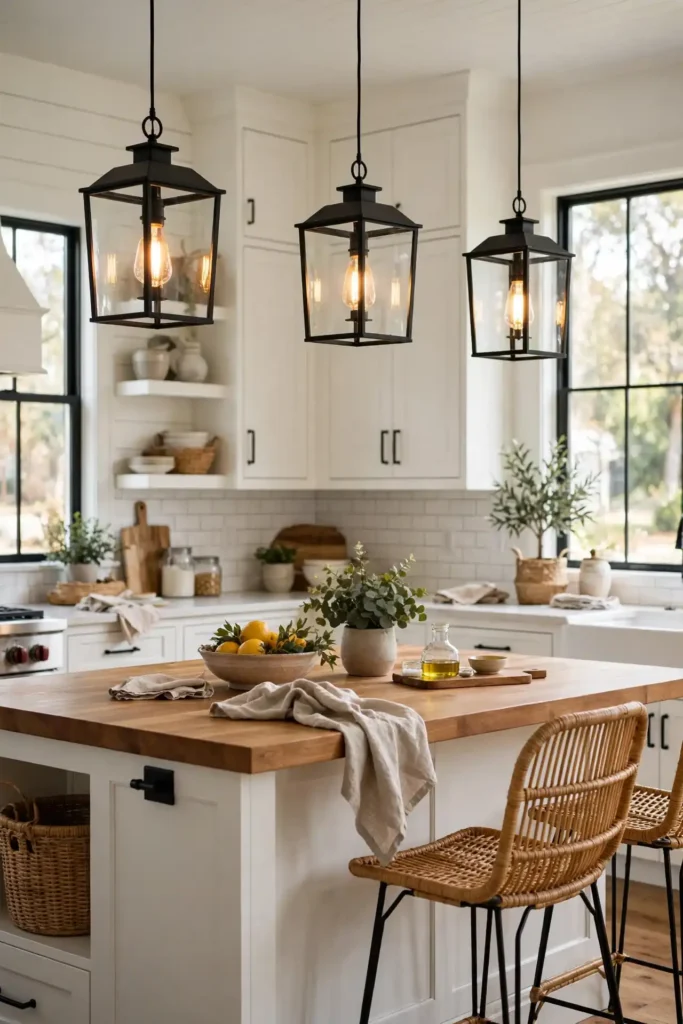
Size your pendants to the island for a balanced look. A good rule is that each pendant should be about one-third the width of the island section it hangs over — so a 6-foot island takes two 12-to-14-inch pendants or three 10-inch ones. Hang them with the bottom of the fixture 30 to 36 inches above the countertop so they light your work surface without blocking sightlines across the room. For a cohesive look, match the pendant finish to your cabinet hardware and faucet. If your ceilings are over 9 feet, add a downrod extension so the pendants sit at the right height.
10. Painted Island
A painted island in a contrasting color is the easiest way to add personality to an all-white farmhouse kitchen. Deep navy, forest green, or charcoal gray islands ground the room and create a furniture-like focal point, while softer sage green or dusty blue keeps things light and airy. A gallon of cabinet-grade paint like Benjamin Moore Advance costs about $50 to $70 and covers a standard island with two coats — the cheapest transformation in this whole list. Sand, prime, and use a foam roller for a smooth, brush-mark-free finish that looks professionally sprayed.

Choose your island color with the rest of the room in mind. Navy pairs beautifully with brass hardware and white marble-look quartz, while sage green loves warm wood floors and black accents. Before committing, paint a large foam board and live with it for a few days, watching how morning and evening light change the color. If resale worries you, stick to classic, muted tones rather than trendy brights — deep, dusty shades have staying power. Finish with a clear polycarbonate topcoat on high-touch edges to prevent chips, and touch up scratches yearly to keep it looking fresh.
11. Wide Plank Floors
Wide plank floors — boards 5 inches or wider — are a defining feature of farmhouse style, making the kitchen feel open, relaxed, and connected to the home’s history. Engineered oak in a natural or whitewashed finish costs $4 to $9 per square foot at Home Depot, Lowe’s, and Floor & Decor, while luxury vinyl plank that mimics wide oak runs just $2 to $4 per square foot and handles spills and pet claws beautifully. Choose a matte or low-sheen finish so the floor reads as authentic rather than glossy, and run the planks parallel to the longest wall to stretch the room visually.
In a busy kitchen, durability matters as much as looks. If you choose real wood, pick a harder species like white oak or hickory, which resist dents better than soft pine, and add felt pads to every chair leg. For families with kids and pets, waterproof luxury vinyl plank is the practical winner — it looks convincingly like wood but shrugs off dropped pots and muddy paws. Keep the stain tone consistent with your ceiling beams and island for a pulled-together feel. A simple routine of sweeping and damp-mopping with a pH-neutral cleaner keeps either option looking new for decades.
12. Vintage Runner
A vintage-style runner softens hard kitchen floors, adds pattern and color, and makes long hours at the stove easier on your feet. Authentic vintage runners are beautiful but pricey, so most homeowners choose vintage-look rugs from Ruggable, Loloi, or Revival, which cost $80 to $250 for a 2.5-by-8-foot runner and come in washable or low-pile weaves built for kitchen life. Look for faded Persian or Turkish patterns in warm reds, blues, and creams that hide crumbs and complement wood floors. A washable runner is a game-changer if you cook daily.
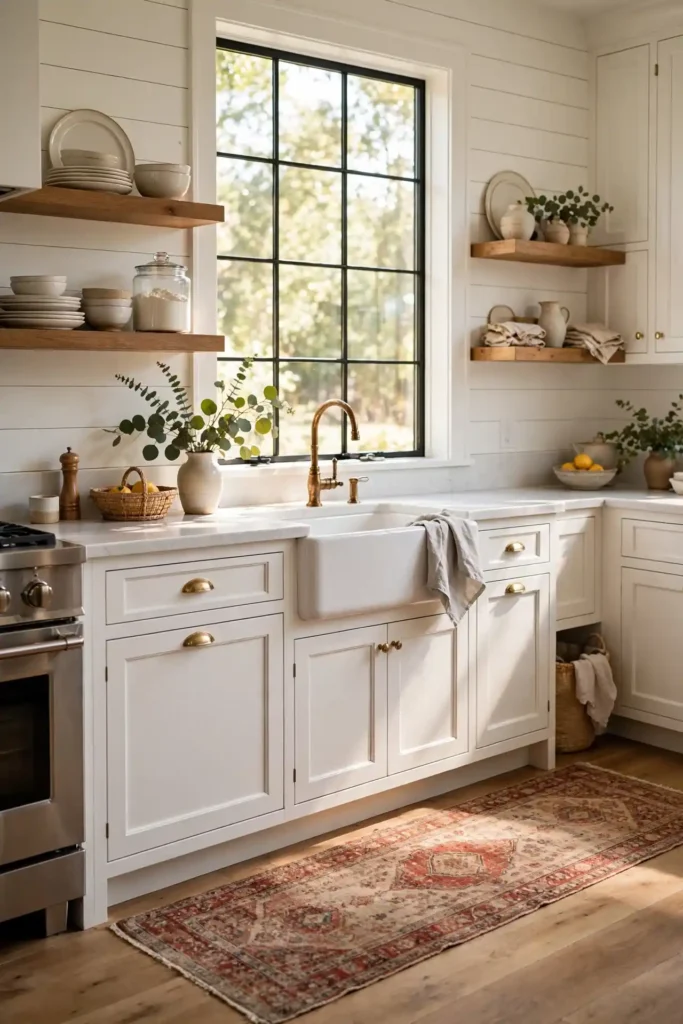
Size and placement make or break a kitchen runner. Choose a runner that spans most of the walkway — at least 6 feet long in a galley kitchen — leaving 3 to 6 inches of floor visible on each side. Place it in front of the sink or range where you stand longest, and always use a non-slip rug pad underneath to prevent sliding on tile or hardwood. Washable rugs from Ruggable go straight in the washing machine, while low-pile wool-look rugs just need regular vacuuming. Rotate the runner every few months so foot traffic wears it evenly and the pattern stays vibrant.
13. Brass Accents
Warm brass accents are the secret ingredient that keeps a modern farmhouse kitchen from feeling flat or one-note. Unlacquered brass faucets, cabinet knobs, and light fixtures develop a rich, living patina over time, adding depth that polished chrome can’t match. A solid brass bridge faucet runs $200 to $500 on Amazon or at Build.com, while brass cabinet knobs cost $3 to $8 each — an affordable way to warm up white or navy cabinetry. Brass pairs especially well with deep green or navy islands, where the golden tones practically glow against the dark paint.
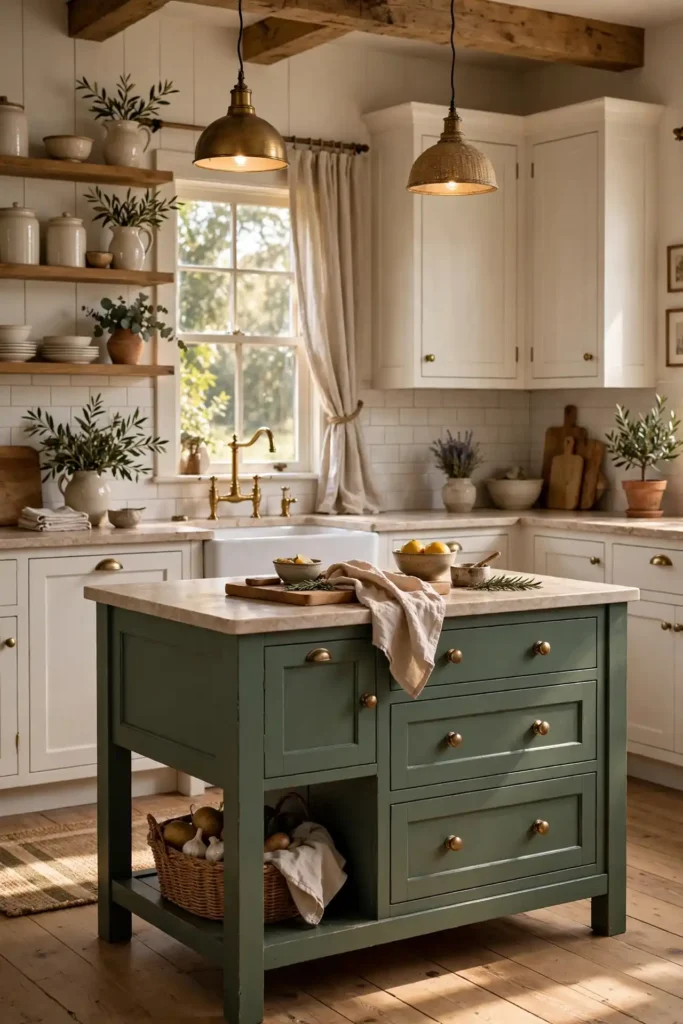
The key to brass is restraint: pick two or three spots — faucet, island pendants, and cabinet knobs, for example — and keep the finish consistent so it reads as intentional. Mix unlacquered brass, which ages naturally, with lacquered brass only if you want the aged look in one zone and a bright finish in another. If your kitchen already has matte black hardware, try brass just on the island or the range hood trim for a collected, layered feel. Clean unlacquered brass with a simple mix of lemon juice and baking soda when you want to brighten it, or let it darken for authentic vintage character.
14. Glass-Front Cabinets
Glass-front cabinets lighten up a wall of closed cabinetry and give you a built-in display case for your prettiest dishes. Replacing a few solid upper doors with glass inserts costs $50 to $150 per door through a local cabinet shop, or you can order glass-ready Shaker doors from IKEA or Barker Cabinets when planning a new kitchen. Keep the interiors painted the same white as the exteriors and add small LED puck lights so your dishes glow in the evening. They’re perfect flanking the range hood or beside the sink, where they break up long runs of white.
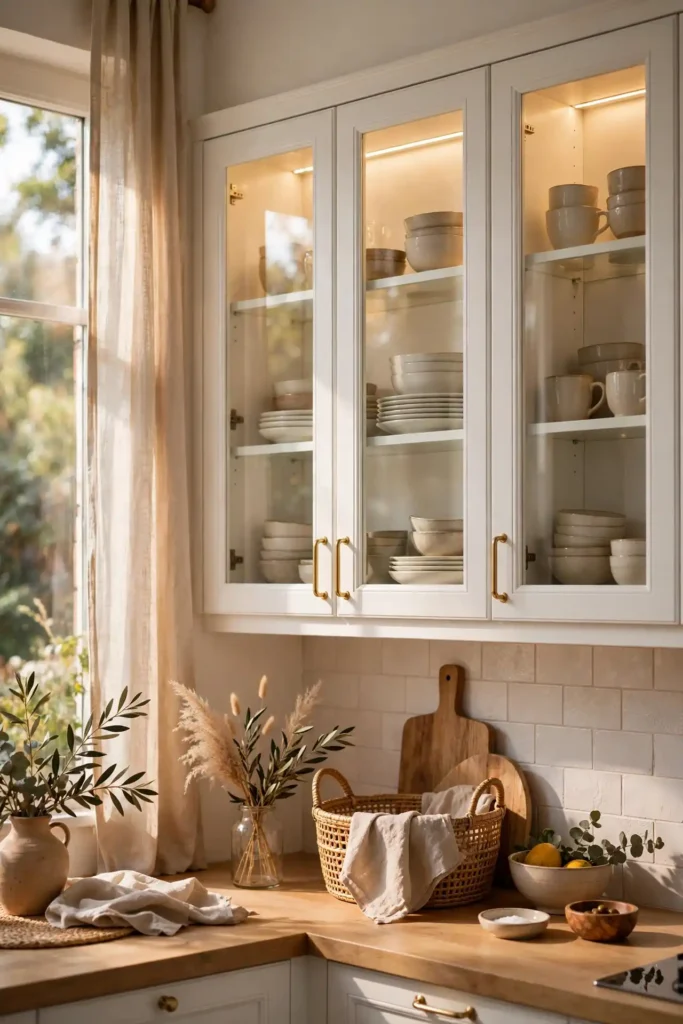
What you display matters more than the cabinets themselves. Stick to a tight color palette — all-white dishes, clear glassware, and maybe one accent color — and leave space between groupings so the shelves read as curated rather than crowded. Store everyday items you actually use so nothing sits gathering dust, and keep the glass clean with a quick weekly wipe using vinegar and water. If you worry about clutter showing, choose seeded or reeded glass, which blurs the contents while still letting light through. One or two glass-front uppers is plenty; a whole kitchen of them can feel busy.
15. Range Hood With Wood Trim
A range hood wrapped in wood trim turns a purely functional appliance into the star of a modern farmhouse kitchen. A simple white plaster or shiplap hood with a stained wood corbel trim or a chunky wood mantel shelf costs $300 to $800 in materials for a DIY build over a standard insert, while custom wood hoods from a cabinet shop run $1,500 to $3,000. The wood trim echoes ceiling beams and butcher block counters, tying the room’s warm elements together. Size the hood 6 inches wider than your range — 36 inches for a standard 30-inch stove — for proper capture and a balanced look.
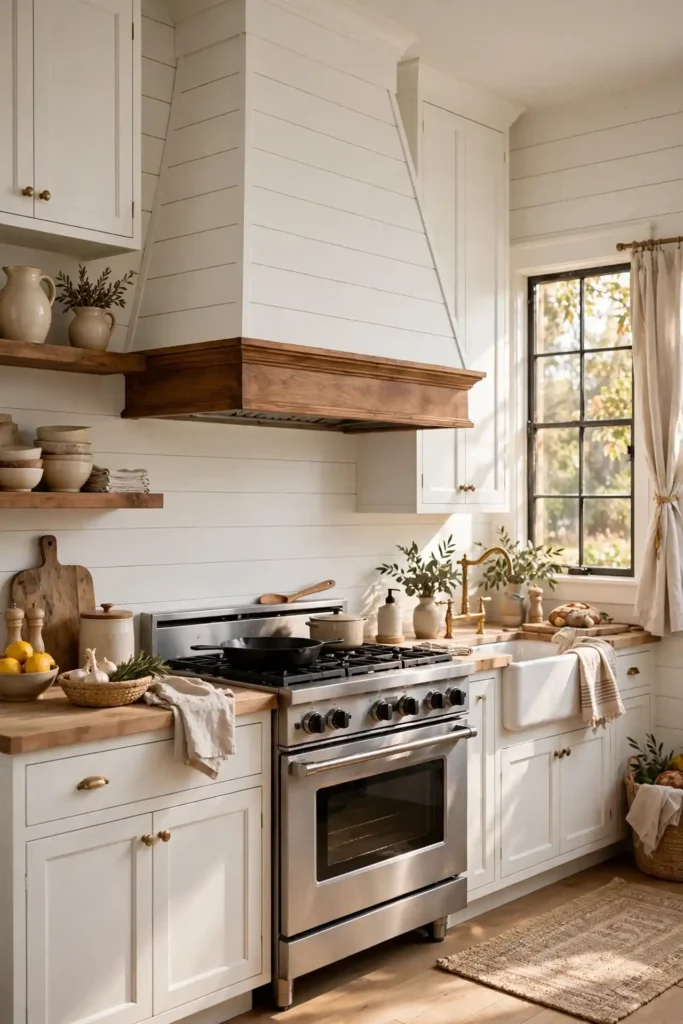
Building a wood-trim hood is a very doable weekend project if you’re comfortable with basic carpentry. Start with a ducted range insert sized to your cooktop’s BTUs — look for 300 to 600 CFM for most home ranges — then frame a simple box with plywood, clad it in shiplap or beadboard, and add a stained wood beam across the bottom as the mantel. Keep combustible wood trim at least 30 inches above a gas cooktop per most building codes. Finish with the same stain as your beams or island stools so the hood feels like part of a coordinated design, not an afterthought.
16. Farmhouse Table Nook
A farmhouse table nook turns an unused kitchen corner into the coziest seat in the house. A simple rectangular farmhouse table — $200 to $500 at IKEA, Target, or Facebook Marketplace — paired with a built-in or freestanding bench creates a casual spot for morning coffee, homework, and lingering dinners. Tuck the nook under a window for natural light, and choose a table 28 to 30 inches high with at least 24 inches of width per person so nobody feels squeezed. A round pedestal table works beautifully in tight corners where a rectangle won’t fit.
Comfort is what separates a nook people actually use from one that just looks pretty. Add 3-to-4-inch-thick bench cushions in a washable fabric like indoor-outdoor canvas, and toss on a couple of throw pillows in ticking stripe or buffalo check for farmhouse charm. Hang a small chandelier or a single lantern pendant 30 to 34 inches above the table for warm, intimate light, and keep a woven basket nearby for placemats and napkins. If space is tight, choose a bench with hidden storage inside the seat — perfect for table linens, board games, or kids’ art supplies.
17. Greenery and Herbs
Fresh greenery and potted herbs are the liveliest, cheapest way to warm up a modern farmhouse kitchen. A row of small terra-cotta pots with basil, thyme, and rosemary on the windowsill costs under $30 at Home Depot or Lowe’s and gives you fresh flavor within arm’s reach while you cook. Larger plants like a fiddle-leaf fig or olive tree in a woven basket fill empty corners and soften all the hard cabinetry lines. Even a simple eucalyptus sprig in a glass jar on the island adds freshness and a subtle, clean scent.

Choose plants that can handle real kitchen conditions — fluctuating heat, humidity, and sometimes dim corners. Herbs need 6 or more hours of bright light, so a sunny south-facing windowsill or a $25 LED grow light from Amazon keeps them thriving. Pothos, snake plants, and ZZ plants tolerate lower light and irregular watering, making them perfect for open shelves or the top of cabinets. Water herbs when the top inch of soil feels dry, and harvest regularly to keep them bushy. Group plants in odd numbers and vary the pot heights for a natural, collected look.
18. Woven Bar Stools
Woven bar stools — think rattan, wicker, or seagrass seats — add texture and relaxed warmth to a kitchen island in a way that upholstered or metal stools can’t. Counter-height stools with a 24-to-26-inch seat work for standard 36-inch counters, while bar height at 28 to 30 inches suits raised 42-inch bars. Sets of two run $150 to $350 at Target, World Market, and Amazon, making them an affordable style upgrade. The natural weave softens the hard lines of cabinetry and stone, and the open texture keeps a small kitchen feeling light instead of bulky.

When shopping for woven stools, check the frame as carefully as the seat. Solid wood or metal frames with a footrest hold up far better than all-rattan construction, especially in a busy family kitchen. Look for a seat depth of 16 to 18 inches so adults sit comfortably, and choose a backless or low-back design if you need to tuck stools fully under the island overhang. Wipe woven seats with a damp cloth and mild soap; avoid soaking them, which can loosen the weave. For a cohesive look, echo the natural fiber in a pendant light shade or a storage basket nearby.
19. Vintage Signs and Art
Vintage signs and farmhouse art give your kitchen personality and a sense of history that new decor can’t fake. Antique-style market signs, grain sack prints, and botanical illustrations in simple wood frames cost $15 to $50 at Hobby Lobby, Kirkland’s, or on Etsy, and one large piece over a console or beside the pantry makes an instant focal point. Look for pieces with warm, muted colors — creams, sage, faded reds — that echo your kitchen’s palette rather than fighting it. A vintage “Farm Fresh Eggs” or coffee sign above the coffee station feels perfectly at home.

Placement and scale matter more than the art itself. Hang one large piece — at least two-thirds the width of the furniture below it — rather than scattering many small frames, which can look cluttered in a working kitchen. Keep art away from the range and sink where grease and steam will damage it, and choose spots like the dining nook wall or the side of the pantry. Mix one vintage sign with a framed family recipe or botanical print for a collected, personal gallery. If you love the look but not the dusting, choose canvas prints, which wipe clean with a dry cloth.
20. Mix Metals
Mixing metals — like matte black hardware with a brass faucet, or stainless appliances with bronze lighting — is what makes a modern farmhouse kitchen feel collected rather than matchy-matchy. The designer rule is simple: pick one dominant metal for about 70 percent of the room, add a secondary metal for 20 percent, and let a third appear in small accents. Matte black and brass is the most popular farmhouse pairing, while polished nickel and oil-rubbed bronze gives a softer, more traditional feel. The contrast adds depth and keeps the room from looking like a showroom set.
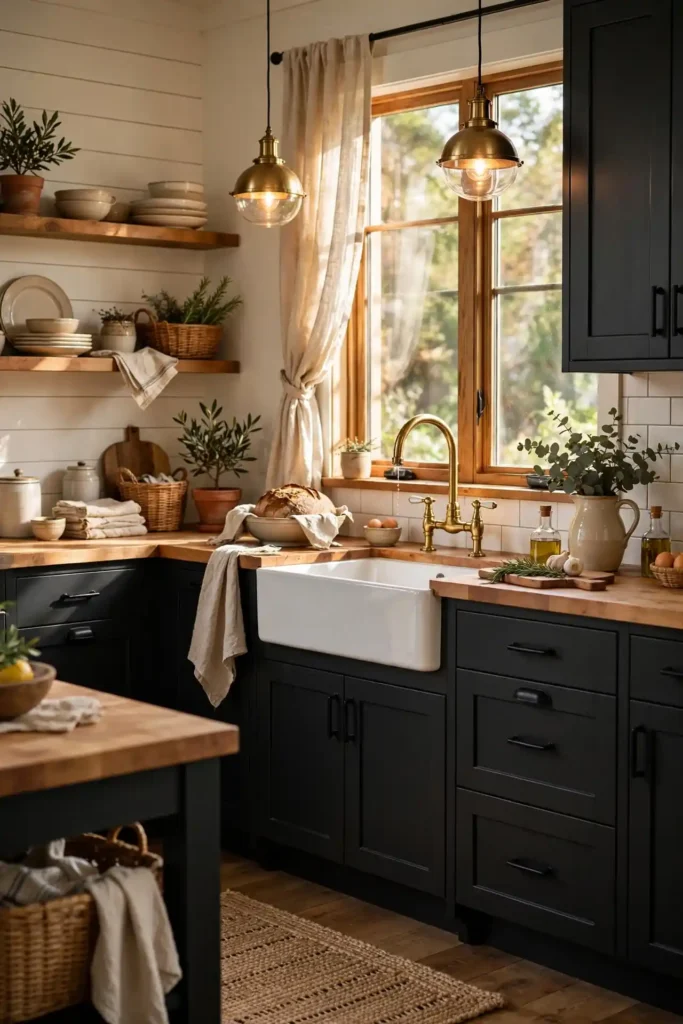
To mix metals successfully, repeat each finish at least twice so nothing looks like a mistake. If your faucet is brass, echo it in the island pendants or cabinet knobs; if your hardware is black, pick it up again in the range hood trim or bar stool frames. Keep appliances in one finish — stainless or black stainless — since they’re the biggest metal surface in the room. Avoid mixing more than three metals, which can feel chaotic. When in doubt, black acts as a neutral that pairs with almost anything, so it’s the safest metal to introduce first.
21. Soft Color Cabinets
Soft color cabinets — sage green, dusty blue, warm greige, or creamy mushroom — bring gentle personality to a farmhouse kitchen without the commitment of a bold hue. These muted tones read as neutrals, so they pair beautifully with white subway tile, butcher block counters, and brass hardware. Popular shades like Benjamin Moore’s Sage Tint, Sherwin-Williams’ Sea Salt, or Farrow & Ball’s French Gray cost about $50 to $70 per gallon in cabinet-grade formulas. Try the color on lower cabinets or the island first, keeping uppers white for a light, balanced look.

Before you commit to a soft color, test it in your kitchen’s actual light. Paint a large poster board and move it around the room for a few days — north-facing kitchens can make sage read gray, while warm afternoon sun brings out green undertones. Pair cool-toned cabinets like dusty blue with warm wood floors and brass to keep the room cozy, and match warm greige with black hardware for crisp contrast. If you’re repainting existing cabinets, thorough degreasing, sanding, and a bonding primer are non-negotiable for a finish that survives daily kitchen wear.
22. Keep It Uncluttered
A modern farmhouse kitchen only feels warm and welcoming when the counters stay mostly clear — clutter is the fastest way to kill the cozy vibe. Aim to keep 70 percent of your counter space empty, storing small appliances you use weekly (not daily) in a pantry or appliance garage. Corral daily essentials — olive oil, salt, a wooden spoon holder — on a single wood tray or cutting board so they read as one styled group instead of scattered items. Fewer things on the counter means easier wiping, better light, and a calmer room.
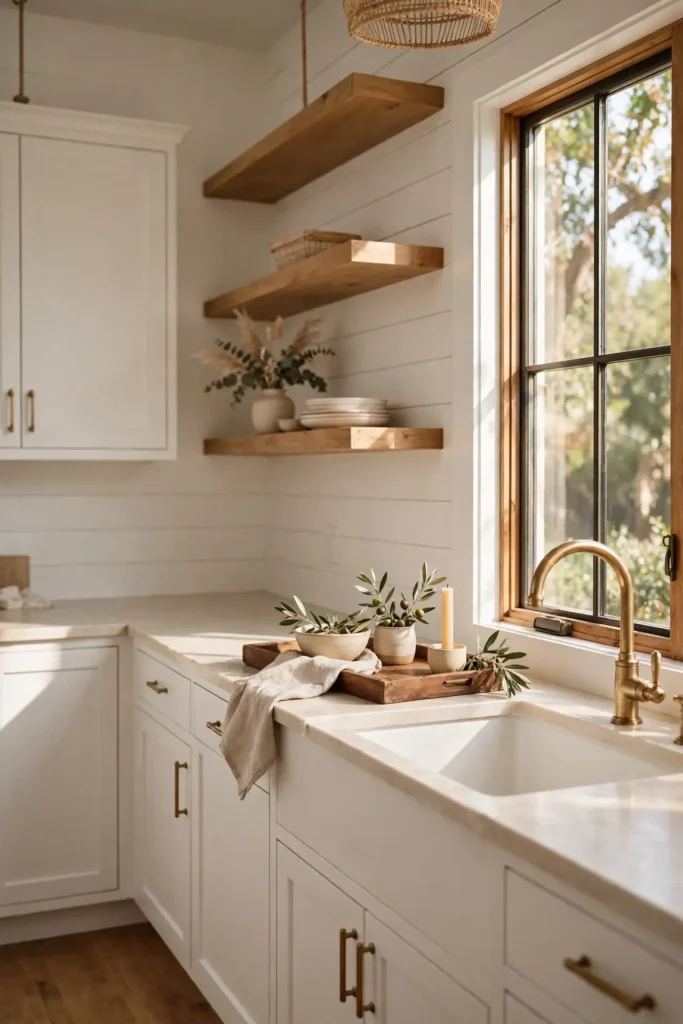
Smart storage is what makes uncluttered counters possible. Add drawer dividers for utensils, a pull-out trash cabinet to hide the bin, and a knife block that lives inside a drawer rather than on the counter. Use the insides of cabinet doors for spice racks and measuring cups, and keep a lidded basket on the island for mail and random items that tend to pile up. Do a five-minute evening reset — dishes in the dishwasher, counters wiped, tray straightened — and your kitchen will greet you with calm instead of chaos every morning.
Modern Farmhouse vs Traditional Farmhouse
Modern farmhouse and traditional farmhouse share rustic roots, but they feel quite different in practice. Traditional farmhouse leans heavily on distressed finishes, vintage finds, gingham and florals, and a collected-over-time look with lots of warm wood. Modern farmhouse keeps the warmth — the shiplap, the apron sink, the wood beams — but pairs it with cleaner lines, a tighter color palette of white, black, and natural wood, and contemporary touches like matte black faucets and streamlined Shaker cabinets. Think Joanna Gaines’ early work versus her newer, more edited Magnolia designs.

Choosing between the two comes down to how you live. If you love antiques, layered patterns, and a cozy, lived-in feel, traditional farmhouse will make you happiest — just edit regularly so it reads as charming rather than cluttered. If you prefer calm, open spaces with a few strong rustic accents, modern farmhouse is your style; it’s also easier to keep clean and tends to photograph better for resale. Most real kitchens land somewhere in between, and that’s fine — pick the wood tones and black accents of modern farmhouse, then layer in one or two vintage pieces for character.
Budget Tips for Modern Farmhouse Kitchens
You don’t need a $50,000 renovation to get a modern farmhouse kitchen — smart, targeted updates deliver most of the look for a fraction of the cost. Start with paint: a gallon of warm white cabinet paint ($50 to $70) and a weekend of work transforms dated oak cabinets. Next, swap hardware for matte black bar pulls at $2 to $6 each, then add a peel-and-stick subway tile backsplash for $5 to $8 per square foot. These three changes alone — paint, hardware, backsplash — can remake a kitchen for under $1,000 in materials.
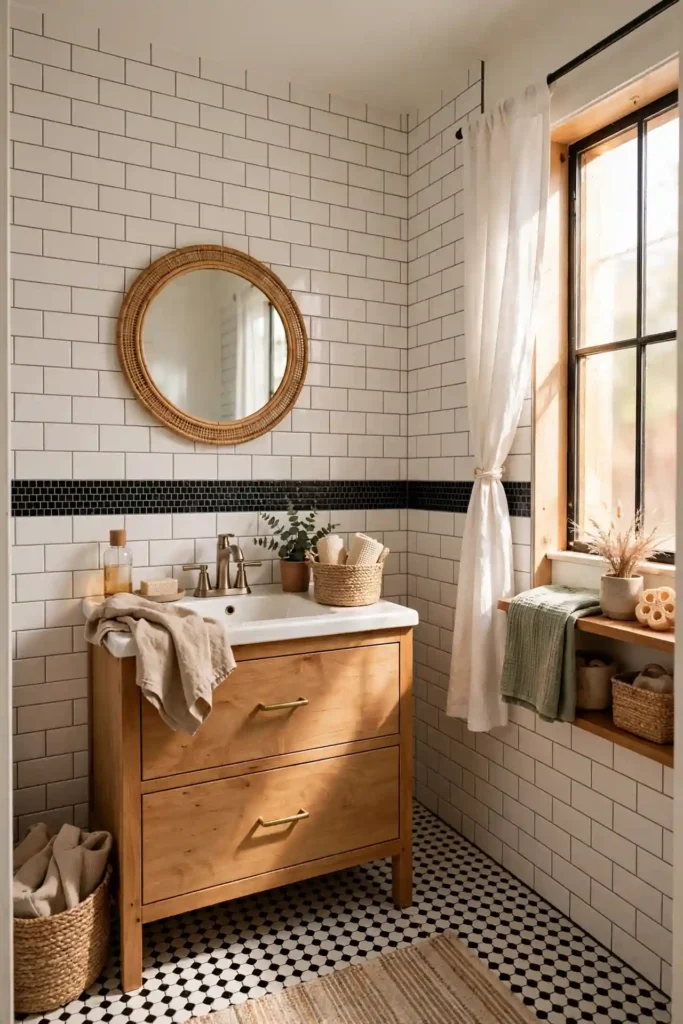
Spend your remaining budget where it shows most. A new apron-front sink ($250 to $450 for stainless) and a modern faucet ($100 to $200) update the hardest-working zone in the room, while open wood shelves ($30 to $80 each) replace dated uppers for very little money. Shop Facebook Marketplace, Habitat for Humanity ReStores, and IKEA’s As-Is section for a farmhouse table, vintage-look runner, and light fixtures at half the retail price. Save the big-ticket items — countertops, appliances, full cabinet replacement — for a later phase, and tackle the cosmetic wins first.
Choosing Countertops
Choosing countertops for a modern farmhouse kitchen means balancing looks, durability, and budget across three main contenders. Butcher block ($40 to $80 per square foot installed) brings unbeatable warmth and is the most authentically farmhouse choice, though it needs regular oiling. Quartz ($60 to $120 per square foot installed) in a marble-look pattern gives you the elegance of stone with zero sealing and excellent stain resistance — ideal for busy families. Honed granite ($50 to $100 per square foot) offers natural variation and heat resistance, but needs yearly sealing to prevent stains.
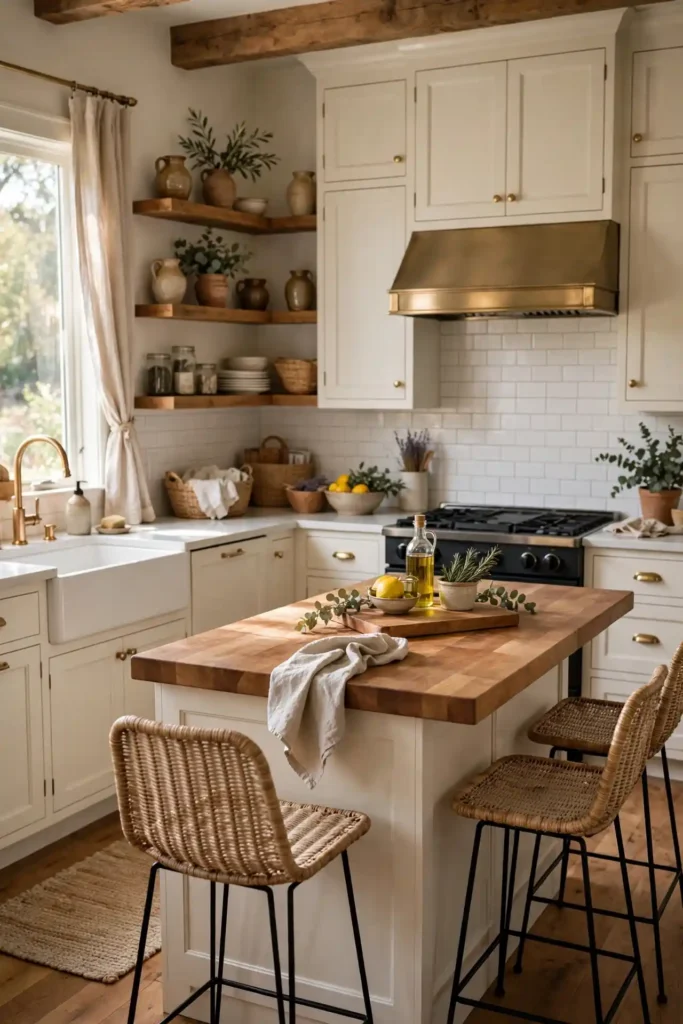
Match the countertop to how you actually cook. If you bake and roll dough weekly, butcher block on the island is a dream surface; if you have young kids and red-wine spills, quartz will save your sanity. Many farmhouse kitchens mix materials — quartz or granite on the perimeter for durability, butcher block on the island for warmth — which also breaks up the cost. Order samples and live with them for a week, testing for stains with coffee, turmeric, and tomato sauce. Whatever you choose, keep the edge profile simple — eased or half-bullnose — for an authentic farmhouse feel.
How to Plan Modern Farmhouse Kitchens Step by Step
Planning a modern farmhouse kitchen works best when you follow a clear order: layout first, then big surfaces, then details. Start by measuring your space and sketching the work triangle — sink, range, and refrigerator should total 13 to 26 feet apart for efficient movement. Decide whether you’re keeping your cabinet boxes (a paint-and-hardware refresh saves $10,000 or more) or replacing them, then choose flooring, since it runs under everything and sets the tone. Lock in your appliance sizes early, because a 36-inch range needs different cabinetry than a 30-inch one.
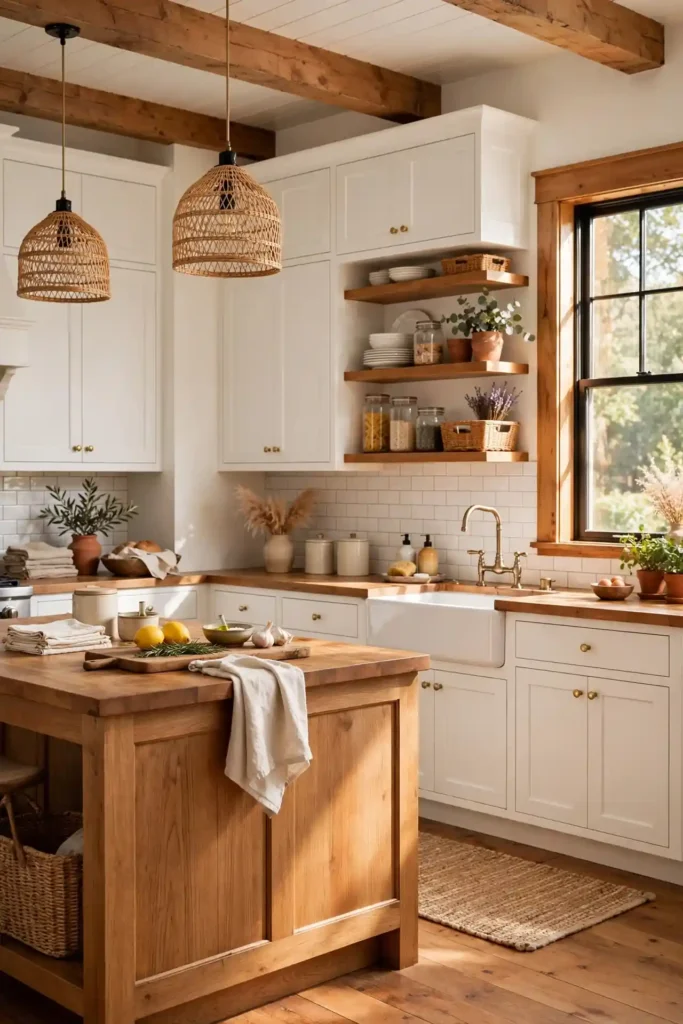
With the big decisions made, move to surfaces and fixtures in this order: countertops, backsplash, sink and faucet, lighting, then hardware and paint colors last, since paint is easiest to change. Get at least three quotes from licensed contractors for any plumbing, electrical, or cabinet work, and add a 15-to-20-percent contingency to your budget for surprises behind the walls. Order cabinets, countertops, and appliances 8 to 12 weeks before demo day to avoid delays. Finish by styling in layers — runner, greenery, art — only after the construction dust settles.
- Choose cabinet style and color.
- Select countertops and a farmhouse sink.
- Pick backsplash and flooring.
- Add lighting and hardware.
- Finish with wood shelves, textiles and greenery.
Final Thoughts on Modern Farmhouse Kitchens
A modern farmhouse kitchen succeeds when it balances clean, modern lines with the warmth of natural materials — and you don’t need to do everything at once to get there. Start with the highest-impact changes for your space: white Shaker cabinets, a contrasting island, warm wood floors, and matte black hardware carry about 80 percent of the look. Layer in texture with a vintage runner, woven stools, and fresh herbs, and the room will feel collected and personal rather than decorated from a catalog. Every small update moves you closer to the kitchen you want.
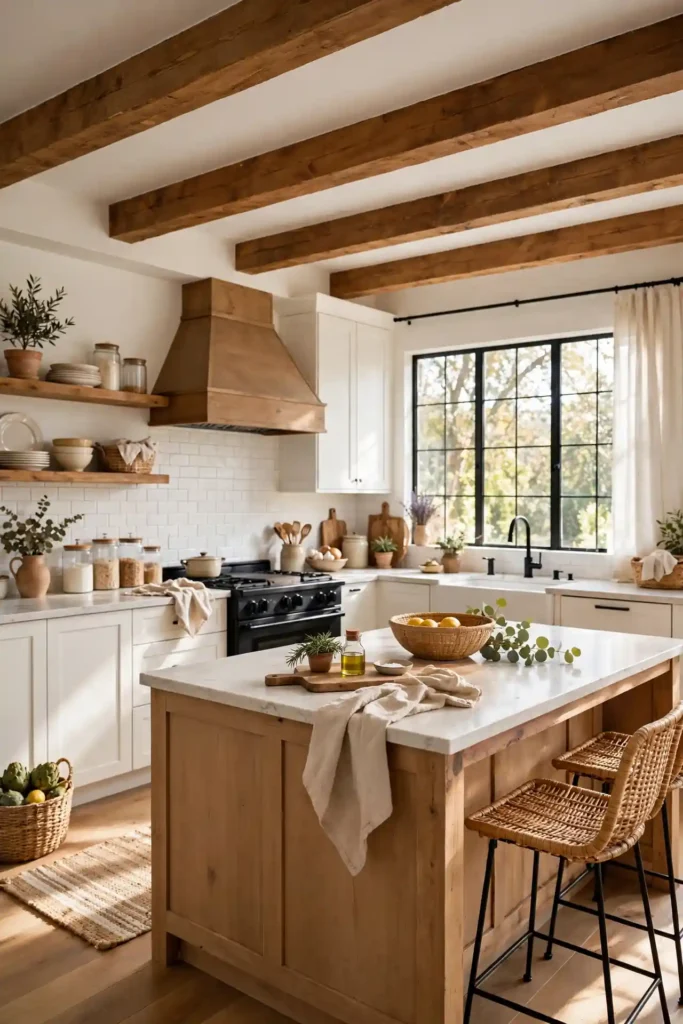
Remember that the best farmhouse kitchens are built over time, not installed in a weekend. Live with each change before adding the next, and let your kitchen collect pieces that mean something to you — a vintage sign from a flea market, a plant that finally thrives, a table where everyone gathers. Keep the palette tight (white, wood, black, plus one soft color) and the counters clear, and the style will stay timeless long after trends shift. Your kitchen should work hard and feel like home — that’s the whole point of modern farmhouse style.
Save these ideas and follow along for more kitchen inspiration.
Frequently Asked Questions About Modern Farmhouse Kitchens
What does a modern farmhouse kitchen cost? A cosmetic refresh — paint, hardware, backsplash, lighting — typically runs $3,000 to $8,000 in materials if you DIY, while a mid-range remodel with new stock cabinets, quartz counters, and appliances lands between $25,000 and $50,000. Full custom renovations with reconfigured layouts can exceed $75,000. How long does it take? Cosmetic updates take 2 to 4 weekends; a full remodel with contractors usually takes 8 to 12 weeks. Can I mix modern farmhouse with other styles? Absolutely — it pairs well with coastal, Scandinavian, and industrial touches.

What’s the most important element? If you can only change one thing, update the lighting and hardware — they’re the fastest, cheapest way to shift a kitchen’s style. Are white cabinets hard to keep clean? Not with a quality cabinet-grade paint and a simple wipe-down routine; matte and satin finishes hide smudges better than gloss. Is modern farmhouse going out of style? The core elements — Shaker cabinets, natural wood, quality materials — are classics that have lasted decades, though very trendy accents (like oversized “EAT” signs) may date. Stick to timeless pieces and your kitchen will age gracefully.
What defines a modern farmhouse kitchen?
Shaker cabinets, a farmhouse sink, wood accents, black or brass hardware and a clean, uncluttered look.
Are modern farmhouse kitchens still in style?
Yes, especially with warmer colors, natural wood and simpler styling.
What colors work in modern farmhouse kitchens?
White, cream, sage, navy, black and natural wood.
What lighting suits a modern farmhouse kitchen?
Black lantern pendants, dome lights and simple sconces.
How do I make a kitchen modern farmhouse on a budget?
Paint cabinets, add black hardware, open shelves and subway tile.





1 Comment