

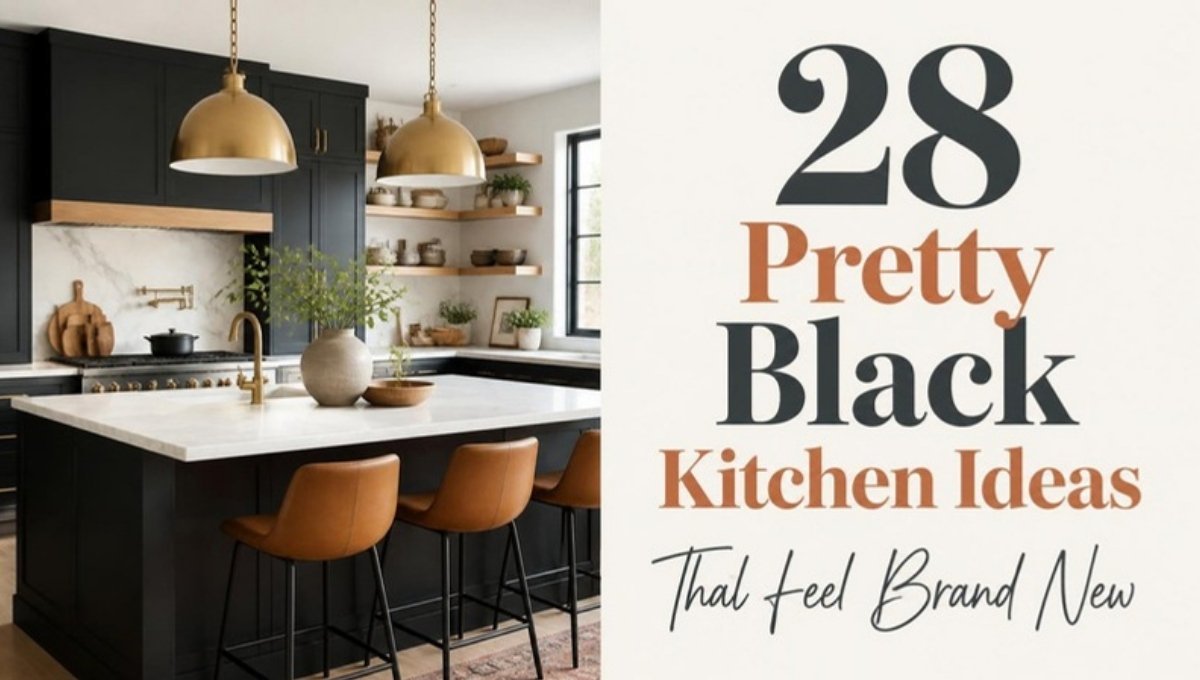
Black kitchens have shed their reputation as risky and become one of the most sophisticated choices available. What changed is how designers handle the color. Instead of a black box, today’s black kitchens use the shade strategically, on a single island, on lower cabinets, on hardware and window frames, always balanced against warm wood, natural stone, and generous light. Handled that way, black reads as depth and confidence rather than heaviness, and it makes everything around it look richer by contrast.
The other thing that has changed is finish. Matte, satin, and textured black surfaces have replaced the high-gloss lacquer of past decades, and they behave very differently in a real kitchen, hiding fingerprints better and absorbing light in a way that feels calm rather than severe. Below are twenty-eight black kitchen ideas that feel current, from full color-drenched schemes to small, low-commitment accents. Each one includes practical guidance on lighting, materials, and the pairings that keep a black kitchen feeling pretty rather than gloomy.
1. Choose a Matte Black Finish
Finish matters more than color in a black kitchen. Matte and low-sheen black absorb light softly, showing the shape of the cabinetry rather than a glare of reflections, and they feel far more contemporary than gloss. The trade-off is that some matte surfaces show oils from fingertips, so look for finishes specifically engineered to resist marking. Satin sits in a practical middle ground, offering a slight sheen that wipes clean easily while still avoiding the mirror-like quality that dates a kitchen quickly.
2. Pair Black Cabinets With Warm Wood
The single most reliable way to keep a black kitchen warm is to introduce real wood. White oak, walnut, or ash on open shelving, a section of cabinetry, or an island end panel provides the organic contrast that black alone lacks. The grain adds visual texture and the warmth stops the room from feeling like a void. Aim for roughly a quarter to a third of visible surfaces in wood, and keep the tone consistent throughout so the combination reads as deliberate design.
3. Add a Black Island as the Focal Point
If a full black kitchen feels like too much, a black island against light perimeter cabinets gives you all the drama with none of the risk. The island becomes an anchor that grounds the room and defines the working core of the kitchen. Pair it with a light stone or butcher block top for contrast, and repeat black once or twice more, in pendant lights or hardware, so the island does not read as an isolated element. This is the most popular black kitchen configuration for good reason.
4. Try Black Lower and Light Upper Cabinets
The two-tone approach places black on base cabinets, where it hides scuffs and daily wear, and keeps upper cabinets light so the room stays open and bright. This mirrors how we naturally read space, with weight at the bottom and lightness above, and it makes standard ceilings feel taller. Use white, cream, or a very pale greige above. The practical benefit is real too: base cabinets take the most abuse, and black conceals it far better than pale paint.
5. Use Brass Hardware for Warmth
Brass against black is one of the most flattering combinations in kitchen design. The warm metal catches light, punctuates the dark cabinet faces, and prevents the scheme from becoming monochrome and flat. Brushed or satin brass hides fingerprints better than polished and reads more current. Carry the finish through the faucet, cabinet pulls, light fixtures, and any open shelf brackets so the metal becomes a consistent thread. Even a small number of brass touches noticeably lifts a dark kitchen.
6. Add a White or Veined Marble Countertop
A light countertop is the clearest way to break up black cabinetry and give the eye somewhere to rest. Marble, quartzite, or a quality marble-look quartz with strong veining adds movement and a sense of luxury that plain surfaces cannot match. The contrast between dark cabinet and light stone creates a crisp horizontal line that defines the kitchen’s structure. If you prefer a quieter look, a soft honed white or pale greige stone delivers the same lift with less drama.
7. Install a Black Slab Backsplash
Running the same black material from countertop up the wall creates a seamless, monolithic effect that looks unmistakably custom. Soapstone, honed granite, and black quartz all work, as do large format porcelain panels at a lower price. With no grout lines, the surface is dramatically easier to clean than tile, which matters directly behind a cooktop. Pair with under-cabinet lighting so the wall does not disappear into shadow and the material’s subtle depth stays visible.
8. Use Black Fluted or Reeded Cabinet Fronts
Fluted and reeded cabinet doors add vertical texture that catches light and shadow, giving black cabinetry the depth that flat slab doors sometimes lack. Because the surface breaks light into fine lines, the color reads as rich rather than heavy. Use fluting on an island, a pantry front, or a bank of tall cabinets rather than everywhere, so the texture stays special. It suits both contemporary and transitional kitchens and photographs exceptionally well.
9. Add Open Wood Shelving
Replacing a run of black upper cabinets with thick wooden floating shelves lightens the visual weight considerably while adding warmth exactly where the eye lands. The gap between shelves lets the wall color show through, breaking up the mass of dark cabinetry. Style them sparsely, with a few ceramics, a stack of plates, and a plant, keeping roughly a third of the shelf empty. Practicality matters, so reserve open shelving for items you actually use daily.
10. Choose Black Stainless or Panel-Ready Appliances
Appliances can either disrupt or reinforce a black scheme. Black stainless steel blends into dark cabinetry rather than interrupting it with bright silver rectangles, while panel-ready appliances disappear entirely behind matching cabinet fronts. Either choice produces a far calmer, more architectural result than standard stainless. If replacing appliances is not in the budget, grouping existing stainless pieces together on one wall keeps the visual disruption contained to a single zone.
11. Add Statement Pendant Lighting
Over an island, pendants are where a black kitchen earns its personality. Choose fixtures in brass, opal glass, rattan, or a contrasting color so they stand out clearly against the dark backdrop. Scale generously, since undersized pendants look lost in a dark room. Hang the bottom edge roughly thirty to thirty-six inches above the countertop. Warm bulbs on a dimmer let the kitchen shift from bright working light to soft evening atmosphere.
12. Layer in Plenty of Task Lighting
Black absorbs light rather than reflecting it, so a dark kitchen needs meaningfully more illumination than a white one. Add under-cabinet LED strips along every work run, recessed lights positioned over the counters rather than the center of the room, and in-cabinet lighting for glass-front doors. Choose warm white around 2700K to 3000K with a high color rendering index so food and finishes look accurate. Good lighting is the single biggest factor in whether a black kitchen feels sophisticated or gloomy.
13. Use Black With Terracotta or Clay Accents
Warm earth tones sit beautifully against black. Terracotta pots, clay bowls, a rust-toned rug, or a run of glazed terracotta tile introduce warmth without the commitment of changing cabinetry. The color’s earthiness balances black’s coolness and creates a grounded, Mediterranean-influenced palette. Because these accents are usually accessories, they cost little and can be swapped seasonally, making them a low-risk way to experiment with how much warmth your kitchen needs.
14. Add a Black Range Hood as Sculpture
A custom black hood, whether plaster, metal, or clad in matching cabinetry, turns the cooking wall into an architectural feature. The strong vertical form draws the eye upward and gives the kitchen a focal point that appliances alone cannot provide. Shapes range from simple tapered forms to curved plaster surrounds. Keep surrounding cabinetry simple so the hood reads clearly, and ensure the extraction rating genuinely matches your cooktop rather than choosing on looks alone.
15. Try Black Soapstone Counters
Soapstone is a natural stone with a deep charcoal color, a soft matte feel, and subtle white veining that develops character with use. It is naturally non-porous, heat resistant, and does not stain the way marble does, which makes it exceptionally practical. It scratches more easily than granite, but scratches can be oiled or sanded out, and many owners come to appreciate the patina. For an all-black kitchen with real material depth, soapstone is hard to beat.
16. Add Black Window Frames
Painting or replacing window frames in black instantly ties a dark kitchen together and frames the outdoor view like artwork. The dark surround makes greenery and sky outside appear more vivid by contrast. This works particularly well in kitchens with light walls and a black island, where the window frames repeat the accent color at a different height. It is also one of the cheaper ways to introduce black if repainting existing frames is possible.
17. Use Black Grout With Light Tile
Reversing the usual approach, a white or cream tile backsplash with black grout creates a crisp graphic pattern that echoes darker elements elsewhere. The strong grid brings energy to a wall that would otherwise be plain, and dark grout stays looking clean far longer than white behind a cooktop. Keep the tile format simple, such as classic subway or a square grid, so the grout lines form a clear geometry rather than a busy mess.
Read More Blogs on: decormellow.com
18. Color-Drench the Entire Room
Painting cabinets, walls, ceiling, and trim in the same black creates an enveloping, jewel-box effect that feels dramatic and surprisingly cozy. Without contrasting trim lines, the room’s edges soften and the space reads as one continuous volume. This works best in kitchens with excellent natural light or in smaller kitchens where the intimacy is a feature. Add warmth through wood flooring, brass fixtures, and abundant layered lighting so the effect stays inviting.
19. Add a Marble or Quartz Waterfall Island
Running the countertop material vertically down the sides of a black island creates a striking frame of light stone around dark cabinetry. The waterfall detail reads as expensive and modern, and it protects the island’s vulnerable end panels from knocks and scuffs. Ensure the veining is matched at the mitred corner, which is what separates a well-executed waterfall from a mediocre one. Budget for the additional slab material and fabrication labor involved.
20. Use Black in a Small Kitchen Strategically
Black works in small kitchens, provided it is used with intent. Keep it to lower cabinets or a single wall, maximize reflective surfaces above with light counters and a glossy backsplash, and invest heavily in lighting. Handleless or slim-profile hardware keeps the visual field calm. The common fear that dark colors shrink small rooms is overstated: what actually shrinks a room is clutter and poor lighting, both of which are fixable.
21. Add Glass-Front Black Cabinets
Glass fronts break up a run of solid black doors and add depth by revealing the interior. Fluted, reeded, or antique glass softens the view so contents do not need to be perfectly styled, which makes them far more livable than clear glass. Light the cabinet interiors so the glass glows rather than reading as dark voids. Use them on upper cabinets flanking a window or on a single feature run rather than throughout.
22. Pair Black With Sage or Olive Green
Muted green is an unexpectedly natural partner for black. Sage on the walls or a run of green lower cabinets against black uppers creates a scheme that feels organic and considered rather than stark. The green softens black’s severity while remaining neutral enough to stay timeless. Add brass hardware and light wood to complete the palette. This combination has become a designer favorite precisely because it delivers depth without high contrast.
23. Add Textured Black Tile
Hand-glazed, crackled, or three-dimensional black tile brings surface variation that flat paint cannot achieve. The irregular glaze catches light differently across each piece, producing subtle shifts in tone that keep a dark wall interesting. Zellige in black is particularly effective behind a range. Because the surface is uneven, it hides splashes and everyday marks well. Use it on a defined area such as the backsplash so the texture reads as a deliberate feature.
24. Introduce Plants and Greenery
Living greenery is the cheapest and most effective softener in any black kitchen. The bright green of herbs, a trailing pothos, or a large potted olive tree pops vividly against dark cabinetry and adds the organic irregularity that manufactured surfaces lack. A window herb shelf is both decorative and useful. Choose simple terracotta or ceramic pots rather than ornate ones, and place at least two or three plants at different heights around the room.
25. Choose Handleless or Integrated Pulls
Removing visible hardware from black cabinetry produces a seamless, sculptural surface where the color and finish do all the work. Push-to-open mechanisms, routed finger channels, and slim integrated rails all achieve this. The result is clean and unmistakably modern, and it makes narrow kitchens easier to move through. If you prefer some hardware presence, long slim brass bars in a single continuous line across drawer fronts give definition without visual clutter.
26. Use a Light Floor for Balance
Flooring is the largest continuous surface in a kitchen and the easiest way to lighten a black scheme. Pale oak, light limestone-look porcelain, or a warm cream tile bounces light back up onto the cabinetry and prevents the room from feeling bottom-heavy. Avoid very dark flooring with black cabinets unless the room has abundant natural light. A mid-tone warm wood is the safest and most flattering choice for the majority of black kitchens.
27. Add Warm Textiles and Natural Fibers
Runners, seat cushions, linen tea towels, and woven baskets bring softness to a room dominated by hard surfaces. In cream, oatmeal, rust, or muted olive, these textiles warm the palette instantly and are easy to change with the seasons. A long runner along the main work aisle also improves comfort underfoot. Because textiles are inexpensive and non-permanent, they are the ideal place to test how much warmth your black kitchen actually needs.
28. Start Small With Black Accents
If a black kitchen feels like a large commitment, begin with the elements that are easy to reverse. Black cabinet hardware, a black faucet, black pendant lights, black bar stools, or a single painted pantry door all introduce the color at low cost and low risk. Live with the accents for a few months and see how the room feels. Many people find this is enough; others use it as a stepping stone to painting the island or the lower cabinets later.
Final Thoughts on Black Kitchen Ideas
Pretty black kitchens are built on balance rather than boldness. Choose a matte or satin finish, pair the black with warm wood and a light countertop, add brass hardware, and invest properly in layered lighting. Those four decisions handle the vast majority of what separates a striking black kitchen from a gloomy one. Start with a black island or lower cabinets if a full commitment feels daunting, and use plants, textiles, and warm metals to soften the scheme over time. Done thoughtfully, black is not a risk at all; it is one of the most enduring choices in kitchen design.
For more inspiration, explore our 26 Easy Kitchen Counter Decor Ideas and browse more home decor ideas.
Frequently Asked Questions About Black Kitchen Ideas
Are black kitchens still in style?
Yes. Black kitchens have moved from a bold trend to an established design choice, particularly in matte and satin finishes paired with warm wood and brass. The current preference is for strategic use, such as a black island or lower cabinets, rather than an all-black room.
Do black cabinets make a kitchen look smaller?
Not inherently. Poor lighting and clutter shrink a kitchen far more than color does. Use black on lower cabinets, keep uppers light, add strong under-cabinet and task lighting, and choose a pale floor and countertop, and a small black kitchen can feel both spacious and dramatic.
What countertop goes best with black cabinets?
White or light gray marble, quartzite, and marble-look quartz create the strongest contrast and the most classic result. Butcher block adds warmth, and black soapstone produces a rich monochrome effect. Avoid busy multicolored granite, which competes with the cabinetry.
Do black cabinets show fingerprints?
Glossy black shows fingerprints most, matte can show oils from skin, and satin generally performs best. Look for finishes specifically marketed as anti-fingerprint or fingerprint-resistant, which are now widely available and make a genuine practical difference in daily use.
What hardware looks best on black cabinets?
Brushed or satin brass is the most popular and flattering choice, adding warmth and visible contrast. Aged bronze and matte black create a subtler tonal look, while polished nickel gives a cooler, more traditional feel. Avoid high-polish chrome, which can look harsh against matte black.
What color walls work with black kitchen cabinets?
Warm whites, creams, and soft greiges keep the room bright and let the cabinetry stand out. Sage green, muted terracotta, and dusty blue all work as more colorful options. For a dramatic enveloping effect, painting the walls the same black as the cabinets is increasingly popular in well-lit kitchens.




Leave a comment