

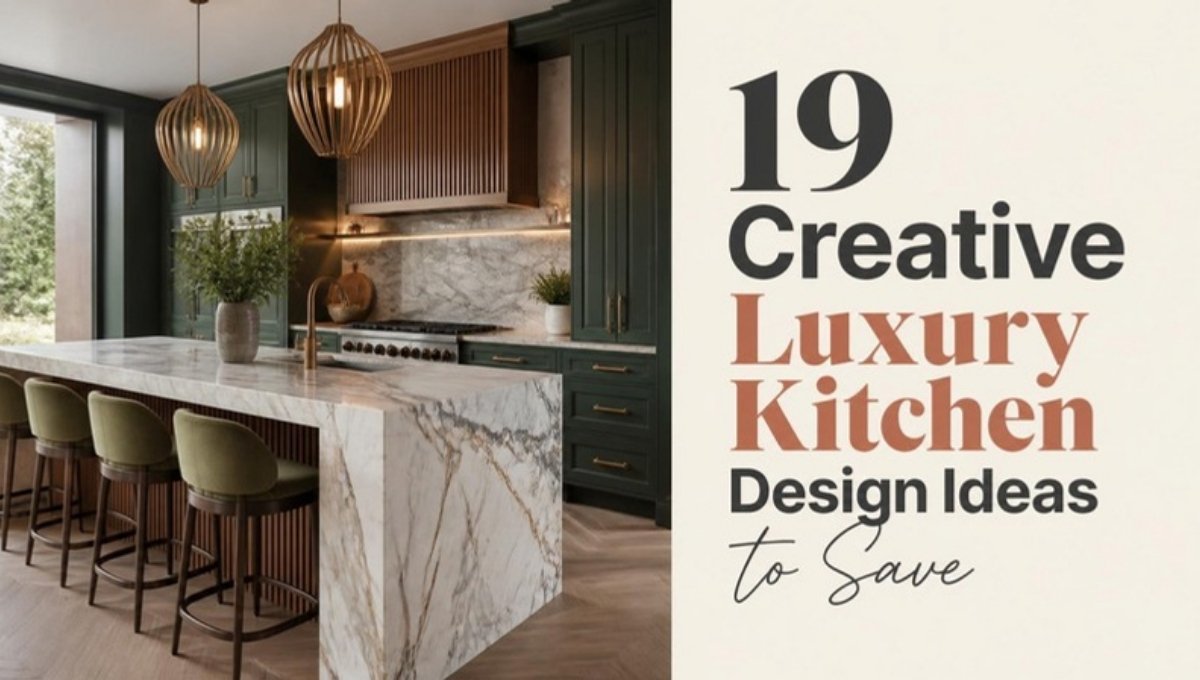
Creative luxury kitchen design designs go beyond expensive finishes: true luxury is the choreography of materials, light, proportion, and concealed function that makes a kitchen feel effortless, sculptural, and deeply personal. Today’s luxury kitchens hide appliances behind furniture-grade panels, stretch stone into waterfall islands and full-height walls, layer bespoke lighting like jewelry, and carve out secondary spaces — sculleries, coffee salons, walk-in pantries — that keep the showpiece pristine. Whether you are planning a full renovation or collecting inspiration for someday, these nineteen designs represent the ideas worth saving from the world’s most covetable kitchens.
The luxury language has shifted from gloss and bling toward quiet opulence: honed natural stone, fluted wood, bronze and unlacquered brass that patina, integrated everything, and palettes drawn from earth — taupe, bone, espresso, deep green. Investment flows into what hands touch daily (solid drawers, weighted taps, stone edges) and what eyes rest on nightly (lighting scenes, veined slabs, sight-lines). Each design below explains the creative move, the materials carrying it, and the practical thinking that keeps beauty cookable. Save the five that quicken your pulse; luxury begins as a folder before it becomes a room.
1. The Monolithic Stone Island
Luxury’s centerpiece: an island wrapped entirely in one dramatic stone — marble, quartzite, travertine — with waterfall edges cascading to the floor on both ends. The monolith reads as sculpture, its veining flowing uninterrupted across top and sides via book-matched slabs. Scale generously: luxury islands run three meters plus, seating four while hiding storage banks and appliance drawers within. Honed finishes over polished keep the stone touchable and current. Every luxury kitchen orbits its island; this design makes the island worth orbiting.
2. Fully Integrated Invisible Kitchen
The disappearing act: refrigeration, dishwashers, and even ranges concealed behind cabinetry panels matching the millwork, with pocket doors hiding entire working walls when entertaining. The kitchen presents as furniture — a paneled room that happens to cook. Handle-free fronts, push mechanisms, and appliance garages for small devices complete the illusion. Integration is luxury’s deepest signature because it purchases the rarest finish: visual silence. Guests ask where the kitchen is; that question is the design succeeding. It is one of the smartest moves in luxury kitchen design.
3. The Scullery: Back Kitchen Brilliance
Behind the beautiful kitchen, the working one: a scullery or back kitchen housing the second dishwasher, prep sinks, small appliances, and the honest mess of cooking, leaving the main space permanently composed. Even modest-footprint versions — a pantry corridor with counter and sink — transform how the show kitchen lives. The scullery is the luxury idea most worth stealing at any budget because it solves the eternal conflict: kitchens must both perform and appear effortless. Separate the verbs into rooms.
4. Full-Height Stone Feature Wall
Extend slab stone beyond the backsplash into an entire wall — floor to ceiling behind the range or framing shelving niches — turning geology into architecture. Dramatic quartzites and marbles perform at this scale like murals; lighter travertines wrap rooms in warm mineral calm. Integrate a stone shelf or mantel-style hood surround within the wall for layered depth. Where paint would do, luxury installs mountains. One stone wall recalibrates the entire room’s gravity.
5. Bespoke Fluted and Reeded Millwork
Custom cabinetry fronts in fluted, reeded, or slatted wood profiles cast fine shadow lines that shift with daylight — texture as ornament, entirely without decoration. Deploy fluting on island backs, tall unit faces, or range hood surrounds in walnut, oak, or lacquered color. The machined precision of repeating ridges signals bespoke craft instantly. Pair fluted wood with smooth stone for the material dialogue luxury kitchens speak. Flat doors furnish; fluted doors compose. Few details express luxury kitchen design as clearly as this.
6. Statement Range as Hearth
Position a professional statement range — enameled French, colored steel, or brass-trimmed — within a chimney-style surround or stone niche, restoring the hearth as the kitchen’s ceremonial heart. The range in racing green, oxblood, or matte black becomes the room’s jewelry, flanked by symmetry: paired sconces, twin shelf niches, balanced cabinetry. Cooking theater deserves a stage; this design builds one. Even minimalist kitchens grant the range its aria. It is one of the smartest moves in luxury kitchen design.
7. Layered Lighting Scenes Like Jewelry
Luxury lights in layers and scenes: sculptural pendants over the island, recessed wash on stone walls, under-cabinet task strips, interior cabinet glow behind glass, toe-kick floats, and a dimmer system blending them into presets — morning, cooking, dinner, midnight. Fixtures function as jewelry: bronze, alabaster, hand-blown glass. The costliest finishes fail under one flat ceiling light; modest rooms transcend under layered scenes. Light is the luxury multiplier applied to everything else.
8. The Coffee and Breakfast Salon
Dedicate a concealed alcove — behind pocket or bi-fold doors — to a full coffee salon: plumbed espresso machine, stone counter, cup drawers, pastry storage, warm internal lighting. Opened each morning like a boutique unveiling, closed to seamless millwork after. The salon elevates a daily ritual into ceremony while containing appliance clutter absolutely. Luxury identifies life’s repeated moments and builds them shrines; morning coffee earns the first one. In luxury kitchen design, this is where the budget pays off most.
9. Deep Green and Bronze Palette
The reigning luxury scheme: cabinetry in deep forest or bottle green, unlacquered brass or bronze hardware aging gracefully, warm stone counters, and oak or walnut accents. Green reads established, library-like, and botanically calm — luxury’s answer to white’s ubiquity. Bronze fittings darken and polish with touch, recording the kitchen’s use as patina. Add cream stone and aged mirror moments. This palette photographs like heritage and lives like comfort.
10. Hidden Walk-In Pantry Reveal
Behind what appears to be cabinetry, a full walk-in pantry: sensor-lit shelving, stone landing counters for appliances, wine storage, and grocery depth that keeps the main kitchen surface-bare. The concealed-door reveal — millwork swinging open to a lit room — delivers the estate-house delight guests remember. Pantries are luxury’s storage answer: not more cabinets, but a dedicated room wearing a cabinet’s disguise. Every saved design folder deserves one hidden door.
11. Sculptural Hood as Centerpiece
Commission the extraction hood as sculpture: hand-plastered curves, aged brass canopy, fluted timber surround, or stone-wrapped chimney rising as the sightline’s crown. The hood occupies the kitchen’s visual apex; luxury refuses to leave it as stainless afterthought. Custom hoods coordinate with island stone or range color, completing the hearth composition. Where builders install appliances, luxury installs monuments — the hood is the difference made vertical.
Read More Blogs on: decormellow.com
12. Tactile Hardware and Weighted Fittings
Luxury lives in the hand: solid bronze pulls with heft, knurled brass taps turning with weighted smoothness, leather-wrapped handles, drawer interiors in oiled oak. Specify unlacquered finishes that patina, articulating pot-fillers over ranges, and taps in aged brass or bronze as counter jewelry. These touchpoints cost fractionally yet register constantly — the daily haptic evidence of quality. Guests see the stone; owners feel the hardware. Design for both audiences. Keep it in mind as you plan your own luxury kitchen design.
13. Glass-Walled Wine Display
A temperature-controlled wine wall — floor-to-ceiling glass enclosure with bronze framing, backlit bottle display, and stone base — turns collection into installation. Position visible from dining and living sightlines as the kitchen’s glowing gallery edge. Even compact versions (a glazed under-stair nook, a single glass column) deliver the curated-cellar effect. Luxury displays its rituals; the wine wall exhibits patience, taste, and the evening’s promise in one lit case.
14. Travertine and Warm Mineral Revival
Travertine — the pitted, honey-cream Roman stone — leads luxury’s warm mineral turn: counters, islands, full walls, and shelf slabs in filled or naturally open finishes. Its tonal quietness ages beyond trend while texturing rooms that marble would formalize. Pair with bone-toned millwork, chrome or nickel for contrast, and linen textures. The travertine kitchen feels excavated rather than installed — luxury as archaeology, warmth as material fact. Few details express luxury kitchen design as clearly as this.
15. Double Island Choreography
Where space permits, two islands divide labor: one working (sink, dishwasher drawers, prep expanse), one social (seating, bar storage, display end). The pair choreographs traffic naturally — cooks own one, guests the other — while doubling stone drama. Align or offset per room proportion; unify material or contrast deliberately. The double island is luxury’s floor-plan flex, converting square footage into flow. Save this design against the someday house; it defines them. It is one of the smartest moves in luxury kitchen design.
16. Ceiling as the Fifth Elevation
Luxury designs overhead: timber-clad ceilings warming stone-heavy rooms, plaster coffers framing island pendants, painted ceiling color enveloping upward, or beams echoing millwork below. The ceiling completes material immersion — rooms wrapped, not just walled. Even flat ceilings join via color-drenching in the cabinetry shade. Standard kitchens stop at the cabinet tops; saved-folder kitchens continue to the last plane. Look up in every inspiration image; the ceiling is where luxury confesses.
17. Indoor-Outdoor Slide-Away Wall
Glazed walls sliding fully away merge the luxury kitchen with terrace kitchens, gardens, and pools — the island continuing its stone outdoors, weather permitting the room to double. Matching exterior counters, a pass-through window bar, or aligned flooring completes the continuity. Climate-blessed homes make this the defining gesture; others echo it with garden-facing glazing and window-backsplashes. Luxury’s final wall is optional; the design saves the view as a finish material.
18. Curated Open Display Moments
Within integrated seamlessness, deliberate openings: a stone-framed niche displaying ceramics, bronze-framed glass uppers glowing with glassware, floating oak shelves holding five perfect objects. Luxury curates its reveals — twenty percent display, eighty percent concealment — so each visible object reads chosen. Interior lighting makes niches nocturnal vignettes. The fully closed kitchen sterilizes; the fully open one clutters. Mastery is the ratio, and these moments are its proof. Few details express luxury kitchen design as clearly as this.
19. The Materials Story Discipline
The design securing all others: limit the kitchen to one coherent materials story — perhaps three stones’ worth of one quarry mood, two metals aging in the same direction, one timber family — repeated with discipline across island, wall, hardware, and lighting. Luxury fails through addition; every saved image that stuns operates on restraint. Write the story in five words (“honed travertine, bronze, smoked oak”) and audit every choice against it. Creative luxury is coherence, expensively kept.
Final Thoughts on Luxury Kitchen Design
Creative luxury kitchen design designs worth saving share a philosophy beyond budget: conceal the machinery, monumentalize the rituals, and let few materials speak at full scale. The monolithic island, stone feature walls, and sculptural hoods supply the drama; integration, sculleries, and hidden pantries purchase the silence around it; layered lighting scenes, weighted bronze hardware, and fluted millwork deliver luxury to the hand and evening eye. Palettes have warmed — greens, travertines, bone, and patina — and the ceiling, the coffee ritual, and the garden wall have joined the design brief. Save the designs that quicken your pulse, write your five-word materials story, and build toward it in phases: luxury is coherence over time, and every kitchen can begin keeping it today.
For more inspiration, explore our 26 Easy Kitchen Counter Decor Ideas and browse more home decor ideas.
Frequently Asked Questions About Luxury Kitchen Design
What defines a luxury kitchen today?
Quiet opulence: integrated hidden appliances, natural stone at scale, bespoke millwork, layered lighting scenes, and secondary spaces like sculleries and walk-in pantries — coherence and concealment over gloss.
What is the most worthwhile luxury kitchen feature?
The scullery or back kitchen: a working space hiding prep and mess so the main kitchen stays composed. Even small versions transform daily living and entertaining.
Which materials are trending in luxury kitchens?
Honed marble and quartzite, travertine, fluted oak and walnut, unlacquered brass and bronze, deep green cabinetry, and plaster or timber ceiling treatments.
How do luxury kitchens hide appliances?
Panel-ready refrigerators and dishwashers wear matching cabinet fronts, pocket doors conceal working walls and coffee stations, and appliance garages house small devices behind millwork.
Can I add luxury touches on a smaller budget?
Yes: upgrade to weighted brass hardware and taps, add dimmable layered lighting, create one stone or fluted feature moment, and impose a strict three-material palette — discipline reads as luxury.




Leave a comment