


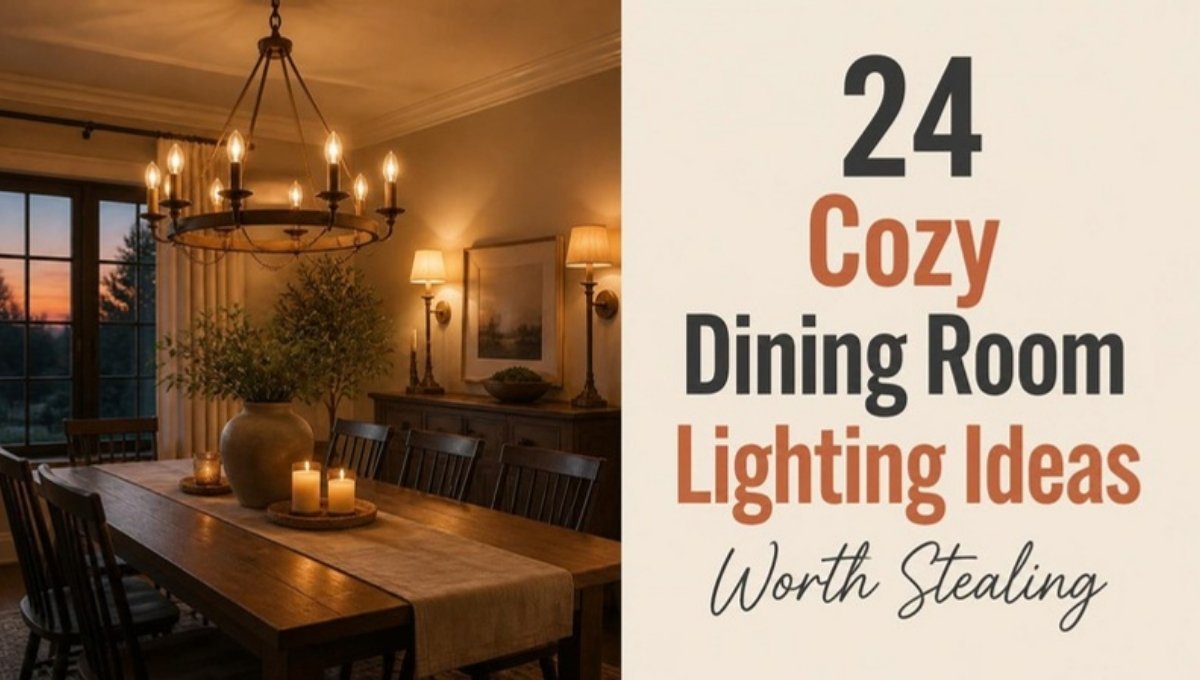
Lighting is the difference between a dining room people eat in and a dining room people stay in. Everything else — the table, the chairs, the rug, the paint — is fixed once installed, but light changes the mood of the same room several times a day. Bright and even for breakfast and homework, low and warm for a long dinner. Most dining rooms fail because they rely on a single overhead fixture doing all the work, producing flat, unflattering light that casts shadows on faces and makes the space feel like a waiting area.
These 24 cozy dining room lighting ideas cover the fixtures, layers and technical details that create genuine atmosphere. You will find guidance on pendant height and sizing, chandeliers, linear suspensions, wall sconces, picture lights, candlelight, dimming, colour temperature and the accent lighting that gives a room depth after dark. Each idea explains the effect it produces and how to specify it correctly, so you finish with a lighting scheme that flatters both your food and the people around your table.
1. Statement Chandelier Over the Table
A chandelier remains the most effective dining room fixture because it does two jobs: it lights the table and it declares the room’s identity. Crystal versions scatter sparkling light and suit formal spaces; sculptural metal or glass designs work in contemporary rooms. The key is scale — a fixture that is too small is the most common mistake. Aim for a diameter roughly half to two-thirds the table’s width, and never smaller than half.
2. Correct Pendant Hanging Height
Hang pendants and chandeliers 30 to 34 inches above the tabletop for a standard eight-foot ceiling. This sits the light source below eye level for seated diners, creating an intimate pool of light without glaring into faces or blocking sightlines across the table. For every additional foot of ceiling height, add roughly three inches to the drop. Getting this measurement right transforms a room more than changing the fixture itself. That is why it ranks among the most practical dining room lighting ideas in this guide.
3. Three Pendants in a Row
Over a long rectangular table, a row of three matching pendants distributes light more evenly than a single central fixture and creates satisfying rhythm. Space them evenly along the table’s length, typically 24 to 30 inches apart centre to centre, keeping the outer two at least six inches inside the table ends. Odd numbers look better than even. Individual pendants also suit tables used in sections for different activities.
4. Linear Suspension Fixture
A single linear or bar-shaped fixture gives the even coverage of multiple pendants with the cleaner look of one object. It suits long tables, kitchen islands doubling as dining, and contemporary rooms where visual simplicity matters. Choose a length roughly half to two-thirds of the table, and check whether the fixture directs light downward only or also washes the ceiling. Uplight components make a room feel considerably larger. That is why it ranks among the most practical dining room lighting ideas in this guide.
5. Opal Glass Globes for Soft Diffusion
Frosted or opal glass globes are the most flattering pendant type for dining, because the diffusing material eliminates the harsh point-source glare of a bare bulb. Light emerges evenly in every direction, softening shadows under eyes and cheekbones. A single oversized globe suits a round table; a cluster at varied heights adds contemporary interest. The simple sphere also stays stylistically neutral, surviving changes in surrounding decor. Of all the dining room lighting ideas here, this one offers some of the best value.
6. Warm Colour Temperature
Colour temperature matters more than most people realise. Specify 2700K for dining rooms, or 2400K for an even warmer, candle-like quality. Cool white light at 4000K and above reads clinical, makes food look unappetising and drains warmth from skin tones. Check the Kelvin rating on every lamp you buy, and ensure all fixtures in the room match, since mixed temperatures create an unsettling patchwork of colour.
7. High CRI Bulbs for Food and Faces
Colour Rendering Index measures how accurately a light source reveals colour compared with daylight. In a dining room this is genuinely important: low-CRI lamps make food look grey and skin look sallow. Choose lamps rated CRI 90 or above, and 95 plus if budget allows. The difference in how a roast dinner, a glass of wine and your guests’ complexions appear is immediately noticeable.
8. Dimmers on Every Circuit
Dimming is the single highest-value lighting upgrade in any dining room. It lets one fixture serve breakfast, homework, dinner parties and late conversation without compromise. Install dimmers on every circuit, not just the pendant, and verify that both the lamps and the driver are dimmer-compatible — mismatched LEDs flicker or buzz at low levels. Trailing-edge dimmers generally perform better with LED loads than older leading-edge types. It is a favorite among dining room lighting ideas because it works in so many homes.
9. Layered Three-Source Lighting
Professional lighting schemes always use at least three layers: ambient light for overall visibility, task light over the table, and accent light highlighting artwork, plants or architecture. Each layer sits on its own switch and dimmer. This is what allows a room to feel bright and functional at midday and intimate at ten at night. A single overhead source can never achieve both, no matter how good the fixture is.
10. Wall Sconces Flanking a Sideboard
Sconces mounted either side of a sideboard, mirror or artwork throw light at eye level, which is where cosiness actually lives. Because they light the walls rather than the floor, they make a dining room feel wider and warmer. Mount them roughly 60 to 66 inches from the floor, and choose fixtures with fabric or opal shades to prevent glare. Wired on a dimmer, they become the perfect low-level evening layer.
11. Picture Lights Over Artwork
A slim picture light above a painting or mirror creates a small, focused pool of warmth that draws the eye and adds depth to a dark wall. Even when the main lights are dimmed almost off, a picture light keeps the room feeling alive rather than gloomy. Battery-powered LED versions with remote controls now avoid the need for chasing cables into plastered walls, making this a genuinely easy retrofit. Keep it in mind as you shortlist dining room lighting ideas for your own space.
12. Candlelight as a Permanent Layer
No electric source replicates the quality of a real flame. Candles flicker at roughly the frequency the human eye finds most relaxing, and their extremely warm colour temperature flatters every skin tone. Group candles of varying heights along the table centre, or use taper candles in brass holders for a more formal look. Keep flames below or well above eye level so they never obstruct conversation across the table.
13. Table Lamp on the Sideboard
Placing a table lamp on a dining room sideboard is an underused trick borrowed from restaurant design. The low, warm pool of light at surface height adds instant intimacy and gives the room a residential softness that ceiling fixtures cannot. Choose a shade in linen or parchment for a warm glow, and fit a low-wattage lamp. On a dimmer or smart plug, it becomes the last light you turn off. Of all the dining room lighting ideas here, this one offers some of the best value.
14. Perimeter Downlights, Not Central Ones
Recessed downlights positioned directly above a dining table cast harsh shadows straight down onto faces. Instead, place them around the room’s perimeter to wash the walls, which reflects soft indirect light back into the space and makes it feel larger. Keep apertures small, at two to three inches, and always run them on a separate dimmer from the pendant so they can be dropped low at dinner. That is why it ranks among the most practical dining room lighting ideas in this guide.
Read More Blogs on: decormellow.com
15. Cove and Uplighting
Concealed LED strips hidden in a ceiling cove, above a cornice or on top of tall cabinetry wash light upward, producing indirect illumination with no visible source. The effect is soft, shadowless and remarkably cosy at low levels. It also makes ceilings appear higher because the brightest surface is overhead. Specify warm 2700K strips with a high LED density so the light reads continuous rather than dotted.
16. Rattan and Woven Pendants
Woven rattan, bamboo and seagrass shades cast patterned shadows across the ceiling and walls as light escapes through the weave, adding texture and movement that a solid shade cannot. The organic material immediately warms a room and suits coastal, boho and modern-organic dining schemes. Because the weave is open, pair it with a frosted or shaded bulb to control glare directly beneath the fixture.
17. Fabric Drum Shade Pendant
A large fabric drum shade diffuses light gently downward while glowing softly at the sides, producing one of the cosiest possible qualities of light. Linen, cotton and parchment shades in cream, oatmeal or soft grey add warmth and soften the hard edges typical of dining furniture. A drum shade also conceals the bulb entirely, eliminating glare across the table and giving a clean, calm silhouette. Of all the dining room lighting ideas here, this one offers some of the best value.
18. Sputnik and Multi-Arm Fixtures
Multi-arm sputnik and molecule-style fixtures distribute many small light sources across a wide area, producing even coverage and a sparkling, celebratory quality. Because each bulb is low wattage, the overall effect is gentle rather than harsh, especially with frosted or amber glass lamps. Brass finishes read warmer and more period-appropriate; black or chrome push the look contemporary. They suit rooms with generous ceiling height.
19. Vintage Edison and Amber Bulbs
Exposed filament lamps in amber or smoked glass produce a very warm, low-output glow that reads as pure atmosphere rather than functional light. They work best in clusters or in fixtures where the bulb is intentionally the decorative element. Because their light output is genuinely low, always pair them with another functional layer. Modern LED filament versions achieve the look with a fraction of the energy and heat.
20. Smart Lighting Scenes
Smart bulbs and switches let you save preset scenes — bright for cleaning, medium for family meals, low and warm for dinner — and recall them with one tap or voice command. The practical benefit is that you actually use your dimming range instead of leaving everything at full brightness. Choose systems that dim smoothly to one percent, since many cheap smart bulbs cut out abruptly at low levels. It is a favorite among dining room lighting ideas because it works in so many homes.
21. Adjustable Rise-and-Fall Pendants
A rise-and-fall or counterweighted pendant can be pulled low over the table for dinner and raised out of the way when the room is used for work or when the table is extended. This flexibility is particularly useful in multi-purpose dining spaces and small apartments. Mechanical pulley versions suit industrial and farmhouse schemes; modern cable systems keep the look minimal. It is a favorite among dining room lighting ideas because it works in so many homes.
22. Lighting Under a Banquette or Bench
Concealed LED strip beneath a built-in banquette seat or floating bench creates a soft floor wash that makes the seating appear to float and adds a low, atmospheric layer at ground level. It is especially effective in dining nooks and open-plan corners, defining the zone after dark. Use warm dimmable strip in an aluminium profile with a diffuser so individual LEDs are not visible.
23. Plants Uplit from Below
A small directional uplighter hidden in the pot of a large floor plant throws dramatic leaf shadows across the wall and ceiling, adding depth and organic pattern to a dining room at night. It costs very little, requires only a socket, and creates the kind of layered shadow play that makes a room feel professionally designed. Use a narrow beam angle and a warm lamp for the best effect. Keep it in mind as you shortlist dining room lighting ideas for your own space.
24. Mirrors to Multiply Light
A large mirror positioned to reflect a chandelier, a window or candlelight effectively doubles your light sources without adding a single fixture. Placed opposite a window it bounces daylight deep into the room; placed behind a sideboard with candles it multiplies flame. Antiqued or smoked mirror glass gives a softer, warmer reflection than clear, which suits cosy dining schemes particularly well.
Final Thoughts on Dining Room Lighting Ideas
Cozy dining room lighting comes down to four decisions made properly. Hang your main fixture at the right height and scale, choose warm 2700K lamps with a CRI of 90 or above, put every circuit on a dimmer, and build at least three layers so the room can shift from bright to intimate. Beyond that, the details that create real atmosphere are surprisingly cheap: a table lamp on the sideboard, sconces at eye level, a picture light on the artwork and real candles on the table. Light the walls rather than the floor, dim everything at dinner, and the room will do the rest.
For more inspiration, explore our 25 Fresh Dining Room Ceiling Ideas and browse more home decor ideas.
Frequently Asked Questions About Dining Room Lighting Ideas
How high should a light hang over a dining table?
Between 30 and 34 inches above the tabletop for an eight-foot ceiling. Add roughly three inches of drop for each additional foot of ceiling height. This keeps the fixture below eye level for seated diners without blocking conversation across the table.
What size chandelier do I need for my dining table?
Choose a fixture with a diameter roughly half to two-thirds the width of the table. For a 40-inch-wide table, that means a chandelier between 20 and 27 inches wide. Undersized fixtures are the most common dining room lighting mistake.
What colour temperature is best for dining room lighting?
2700K is the standard recommendation for dining rooms, with 2400K giving an even warmer, candle-like quality. Avoid anything at 4000K or above, which looks clinical and makes both food and skin tones appear unappealing.
How many pendants should I hang over a dining table?
One centred fixture works for round and square tables. For rectangular tables over six feet, use three pendants spaced 24 to 30 inches apart, or a single linear suspension. Odd numbers generally look better balanced than even ones.
Do I need recessed lights in a dining room?
They are helpful as an ambient layer but should be positioned around the room’s perimeter to wash the walls, not directly above the table where they cast harsh downward shadows on faces. Always put them on a separate dimmer from the main fixture.
How do I make dining room lighting feel cozier?
Dim everything, add light at eye level through wall sconces or a table lamp on the sideboard, use warm high-CRI bulbs, and include real candles. Lighting walls and artwork rather than the floor creates far more warmth than increasing overhead brightness.





3 Comments