

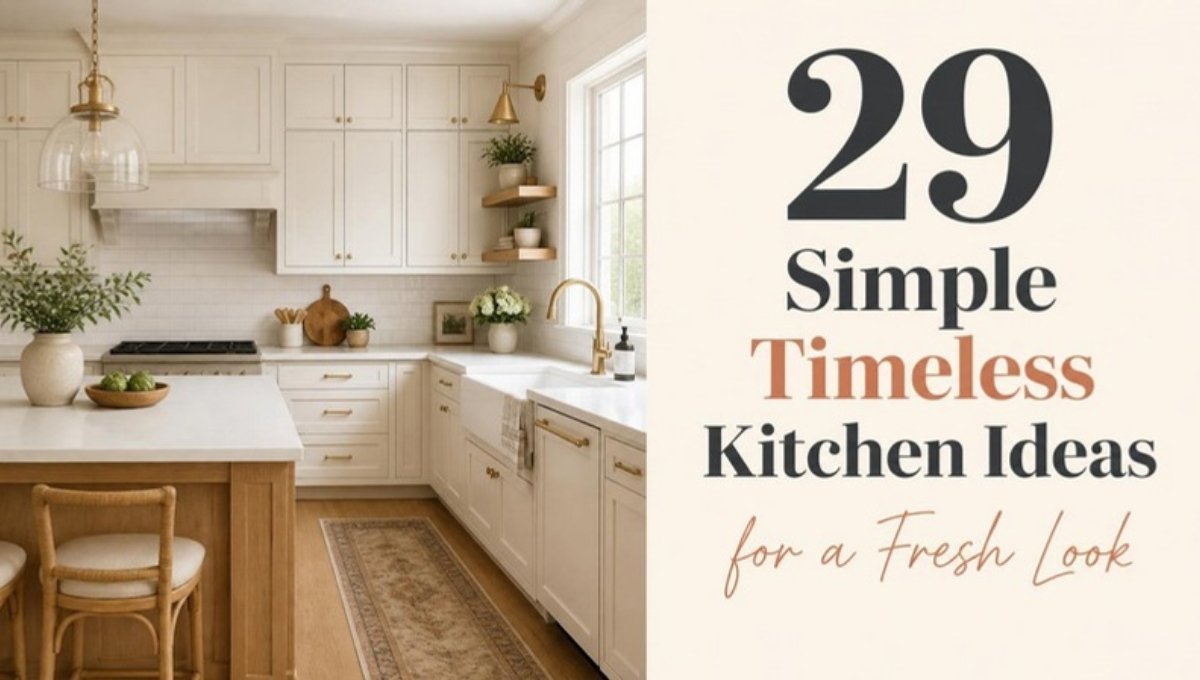
If you are looking for timeless kitchen ideas that actually work in a real home, this guide is for you. Most kitchens do not look dated because of their color. They look dated because of choices that were fashionable for a short window and structural to reverse: a specific door profile, an unusual layout, a heavily patterned stone, a hardware style tied tightly to one decade. Timeless kitchens avoid that trap by putting the money into things that do not go out of style, such as good layout, solid materials, proper storage, and quality lighting, and keeping the trend-driven decisions in places that are cheap to change later.
That principle is what this guide is built around. A simple, timeless kitchen is not a beige kitchen or a boring one. It is a kitchen where the bones are right and the personality comes from materials, proportion, and craft rather than from novelty. Below are twenty-nine ideas that consistently age well, covering layout, cabinetry, countertops, hardware, lighting, and the finishing details. Follow most of them and your kitchen should still look considered and current a decade after installation, with only paint and accessories needing occasional refreshment.
1. Get the Work Triangle Right First
No finish can rescue a kitchen that does not function. Position the sink, cooktop, and refrigerator so the distance between any two is roughly four to nine feet, with a total triangle perimeter under about twenty-six feet. Keep major traffic paths outside that triangle. In larger kitchens, think in zones instead: prep, cooking, cleaning, and storage. Getting this right costs nothing extra at the planning stage and determines how pleasant the kitchen is to use every single day for decades.
2. Choose Shaker Cabinet Doors
The Shaker door has survived more than two centuries because its simple recessed panel reads as neither traditional nor modern, which means it never falls out of favor. It works with any hardware, any color, and any style of home. Look for a clean, narrow frame profile, typically two to three inches wide, and avoid ornate inner beading or applied moldings that tie the door to a specific era. It is the safest cabinet decision available, and the most versatile.
3. Consider Flat Slab Doors for Modern Simplicity
If Shaker feels too traditional, a flat slab door is the other genuinely timeless profile, and it has been in continuous use since the mid twentieth century. With no frame or panel, the door becomes a plane of color or wood grain, which lets material quality speak. Slab doors are also markedly easier to clean than any profiled door. Choose a quality finish, whether painted, veneered, or laminated, since the flat surface shows imperfections clearly.
4. Stick to a Restrained Color Palette
Timeless kitchens rarely use more than three main colors. A typical formula is one cabinet color, one countertop tone, and one wood or metal accent, with everything else falling into supporting neutrals. This restraint is what makes a kitchen feel calm and intentional rather than busy. Bring in additional color through easily replaced elements such as bar stools, textiles, art, and dishware, where a change of mind costs very little to correct.
5. Choose Warm White or Off-White Cabinets
Off-white and warm white cabinetry has been popular for over a century and shows no sign of dating. It reflects light, works in kitchens of every size, and pairs with any countertop, floor, or hardware you may choose later. Avoid stark blue-toned whites, which can feel clinical, and very yellow creams, which tie the kitchen to a particular decade. A soft white with a slight warm undertone is the most flexible and forgiving choice available.
6. Add Natural Wood Somewhere
Every enduring kitchen has some real wood in it. Whether it is the floor, an island top, open shelving, a run of cabinetry, or simply the bar stools, wood provides warmth and natural variation that painted surfaces cannot. It also ages gracefully, gaining character rather than looking worn out. Choose a mid-tone warm wood such as white oak or walnut and repeat it at least twice in the room so it reads as a deliberate material choice.
7. Invest in Quality Countertops
Countertops take more abuse than any other surface and are among the most disruptive things to replace. Quartz offers the best combination of durability, stain resistance, and low maintenance. Quartzite and granite in quiet patterns perform well and look natural. Marble is beautiful but etches and stains, which suits some households and frustrates others. Whatever you choose, favor subtle movement over dramatic patterning, which is the most common source of regret a few years later.
8. Keep Backsplash Tile Simple
The backsplash is where trends concentrate and where regret accumulates fastest. Classic subway tile, a simple square grid, a plain slab, or handmade zellige in a quiet tone all age well. Elaborate mosaics, strong geometric patterns, and heavily colored feature strips tend to look dated quickly and are expensive to remove. Keep the tile calm and let hardware, lighting, and accessories carry any personality the kitchen needs.
9. Extend the Backsplash to the Underside of Cabinets
Running the backsplash all the way from countertop to the bottom of the wall cabinets, rather than stopping at a four-inch strip, looks properly finished and protects the wall from splashes. Behind the range, carrying it up to the hood or the ceiling makes the cooking wall a deliberate feature. The extra material cost is modest and the difference in how finished the kitchen looks is disproportionately large.
10. Take Cabinets to the Ceiling
Stopping wall cabinets below the ceiling creates a dust-collecting gap that adds nothing and instantly reads as builder-grade. Running cabinetry to the ceiling, or adding a trim panel to close the gap, gains valuable storage, draws the eye upward, and gives the kitchen an architectural, built-in quality. In rooms with high ceilings, use the top tier for seasonal and rarely used items and access it with a step stool.
11. Choose Timeless Hardware Shapes
Simple bar pulls, classic cup pulls, and round knobs have all been in continuous use for a very long time. Avoid highly stylized shapes, oversized novelty pulls, and finishes tied to a short-lived trend. Because hardware is inexpensive and easy to swap, it is the ideal place to update a kitchen later without touching anything structural. Brushed brass, aged bronze, matte black, and polished nickel all remain reliable choices.
12. Use a Farmhouse or Undermount Sink
A deep single-bowl undermount sink is the most practical choice for washing large pans and lets you sweep crumbs straight off the counter with no rim to catch them. An apron-front farmhouse sink adds character and has been in kitchens for centuries. Fireclay, stainless, and composite all wear well. Choose a bowl at least nine inches deep, and pair it with a faucet that has a genuinely useful reach and spray function.
13. Add a Practical Island With Seating
An island is timeless when it is properly sized rather than merely present. Allow at least forty-two inches of clearance on all working sides, forty-eight where two people pass. Provide twenty-four inches of width per seat and a twelve to fifteen inch overhang for comfortable legroom. An island that is too large for the room or too small to be useful is the most common kitchen planning error and cannot be fixed with finishes.
14. Prioritize Drawers Over Base Cabinets
Deep drawers give access to everything at once, while base cabinets with doors force you to kneel and reach into a dark cavity. Replacing lower doors with three-drawer stacks is one of the biggest quality-of-life improvements available in kitchen design, and it costs relatively little extra at the cabinet ordering stage. Fit heavy-duty soft-close runners rated for the weight of full pot drawers, and add internal dividers for organization.
15. Plan Storage Around What You Own
Timeless kitchens are uncluttered, and that requires storage designed around real contents rather than generic assumptions. Count your pans, measure your tallest bottles, and note where you actually want to reach for spices, oils, and boards. Then specify the cabinet interiors accordingly: pull-outs, tray dividers, deep drawers, and a dedicated bin cabinet. Storage that fits your habits stays tidy; storage that does not gets abandoned within months.
16. Add a Walk-In or Cabinet Pantry
Somewhere to put appliances, packaging, and bulk goods is what keeps countertops clear, and clear countertops are the defining visual quality of a timeless kitchen. A walk-in pantry is ideal, but a well-fitted tall cabinet with pull-out shelves works nearly as well in less space. Include an outlet inside if you want an appliance garage for the toaster and kettle, which removes two permanent objects from the worktop.
17. Choose Understated Flooring
Flooring is expensive and disruptive to change, so choose something quiet. Wide-plank oak, natural stone, and large format porcelain in a soft neutral all age extremely well. Avoid strong patterns, high-gloss finishes, and very dark or very light extremes that show every mark. A mid-tone warm floor hides dirt best and works with any cabinet color you might repaint to in future.
Read More Blogs on: decormellow.com
18. Layer Your Lighting Properly
Every enduring kitchen has at least three lighting layers: ambient from ceiling fixtures, task lighting over every work surface, and accent lighting for atmosphere. Under-cabinet strips are non-negotiable, since wall cabinets cast shadows directly onto the counters below. Put as much as possible on dimmers and use warm bulbs around 2700K to 3000K with a high color rendering index. Good lighting improves a modest kitchen more than expensive finishes improve a poorly lit one.
19. Keep Countertops Clear
Nothing dates a kitchen faster than clutter. Aim to have no more than three or four objects permanently on display, such as a wooden board, a crock of utensils, and a bowl of fruit. Everything else belongs behind a door. This single habit does more for how a kitchen looks in photographs and in daily life than any material upgrade, and it costs nothing but discipline and adequate storage.
20. Use Classic Subway or Zellige Backsplash Tile
Both of these tiles have decades or centuries of continuous use behind them, which is the best evidence of timelessness available. Subway offers crisp order at very low cost, while zellige adds handmade irregularity and depth. Choose one, keep the color quiet, and pay careful attention to grout tone. A mid-gray or tile-matched grout stays looking clean far longer than bright white and gives a softer, more considered finish.
21. Choose One Metal and Repeat It
Mixing metals can work, but sticking to one finish across faucet, hardware, lighting, and accessories is the reliably timeless approach. Consistency makes a kitchen feel designed rather than assembled. If you do mix, limit yourself to two finishes and give each a clear role, such as brass for lighting and hardware, black for the faucet and window frames. Repeat each at least twice so neither looks accidental.
22. Add a Window Above the Sink Where Possible
Natural light at the sink is one of those decisions no one ever regrets. It makes the most repetitive task in the kitchen far more pleasant and brings daylight into the working core of the room. If a window is impossible, install a good task light above the sink and consider a mirror, a piece of art, or a small shelf of plants to give the eye something to look at.
23. Use Simple Trim and Molding
Trim should support the room, not announce itself. A clean baseboard, a simple crown or a flat trim at the ceiling, and neat window casings in a profile matching the rest of the house all read as timeless. Heavy ornate moldings, dentil detailing, and corbels tie a kitchen firmly to a specific period. When in doubt, choose the plainer profile and let the cabinetry provide the architecture.
24. Add an Apron of Open Shelving
A short run of open shelving, whether one or two shelves beside a window or flanking the range, breaks up a wall of cabinetry and adds a human, lived-in quality. Keep it small and keep it edited: a few well-used bowls, glasses, and a plant. Because open shelving requires maintenance and discipline, limiting it to a defined area gives you the visual benefit without the daily burden.
25. Choose a Quiet Range Hood
A hood that is either fully integrated behind cabinetry or simple in form will always outlast an ornate one. A plain plaster surround, a clean metal chimney, or a hood hidden in a cabinet above the cooktop all work. Whatever the style, prioritize extraction performance and duct it externally where possible. A hood that looks beautiful but does not clear steam and grease will make the whole kitchen look tired within a few years.
26. Add a Wide Runner Rug
A long runner along the main working aisle adds warmth, texture, and comfort underfoot in a room that is otherwise all hard surfaces. Choose a flatweave in wool or a washable material, in a muted pattern or a simple stripe. Because rugs are easy to replace, they are an ideal place to introduce color and pattern without any long-term commitment. Size it to run most of the length of the aisle rather than floating in the middle.
27. Install Proper Ventilation and Outlets
Unglamorous infrastructure is what keeps a kitchen functional over decades. Plan outlets generously along backsplashes and in the island, add USB points where people actually charge things, and ensure the ventilation is genuinely sized for your cooktop. These decisions are cheap during construction and expensive afterward. A kitchen with too few outlets ends up with visible extension leads, which undermines every other design choice you made.
28. Use Cabinet Interiors Well
The inside of cabinets is where a kitchen quietly succeeds or fails. Add pull-out shelves in deep base units, vertical dividers for trays and boards, a drawer insert for cutlery and utensils, and a pull-out bin for waste and recycling. None of this is visible, and all of it determines whether the kitchen stays organized. Well-fitted interiors are among the highest-value upgrades available and are rarely regretted.
29. Let Personality Come From Accessories
Once the bones are right, personality should come from things you can change: art on the wall, a colorful runner, ceramic bowls, plants, cookbooks, and bar stools. This is the core principle of timeless design. Keep the permanent elements calm and neutral, then decorate freely on top. When your taste shifts in five years, you change a runner and some accessories rather than a kitchen, which is exactly the point.
Final Thoughts on Timeless Kitchen Ideas
Simple, timeless kitchen ideas come down to one rule: spend on what is hard to change and stay flexible on what is easy. Get the layout, storage, ventilation, and lighting right, choose Shaker or slab doors, a warm white or wood palette, quality countertops with quiet movement, and hardware in a classic shape. Keep the backsplash calm and the countertops clear. Then let color, pattern, and personality live in the accessories, rugs, and art, where changing your mind costs almost nothing. That balance is what produces a kitchen that still looks fresh a decade from now.
For more inspiration, explore our 26 Easy Kitchen Counter Decor Ideas and browse more home decor ideas.
Frequently Asked Questions About Timeless Kitchen Ideas
What makes a kitchen timeless?
Good layout, quality materials, ample well-designed storage, layered lighting, and a restrained palette. Classic cabinet profiles such as Shaker or flat slab, quiet countertops, and simple hardware age far better than trend-driven patterns, colors, and ornate detailing.
What kitchen cabinet color never goes out of style?
Warm white and off-white have been popular for over a century and remain the safest choice. Natural wood tones, soft greige, and muted deep green and navy have also demonstrated long-term staying power, particularly on islands and lower cabinets.
Is white subway tile still timeless?
Yes. Subway tile has been in continuous use since the early twentieth century, which is the strongest possible evidence of durability as a design choice. Vary the layout or grout color if you want a fresher take without giving up its longevity.
What should I spend the most money on in a kitchen?
Prioritize cabinetry construction, countertops, layout changes, plumbing, electrical, and ventilation, since these are the most disruptive and expensive to change later. Save on hardware, lighting fixtures, paint, and accessories, all of which can be updated cheaply as your taste evolves.
How do I make a kitchen look expensive on a budget?
Take cabinets to the ceiling, extend the backsplash to the underside of the cabinets, upgrade hardware and lighting, add under-cabinet task lights, keep countertops clear, and add one real wood element. These changes cost relatively little and consistently deliver the biggest visual improvement.
Are open shelves a timeless choice?
In moderation. A short run of open shelving beside a window or flanking a range has appeared in kitchens for generations and adds warmth. Replacing all upper cabinets with open shelving sacrifices significant storage and requires constant tidying, which makes it a lifestyle decision more than a design one.




Leave a comment