


Wallpaper can turn a dining room into the most memorable space in the house. Because dining rooms are used for gatherings and special meals, they are the perfect place for pattern, color and a little drama. The right dining room wallpaper sets the mood before the first course is served.
These 18 ideas range from elegant chinoiserie to lush botanicals and modern murals. For more inspiration, see our dining room wall decor ideas, our dining room painted ceiling ideas and these dining room decor ideas.
Tips for dining room wallpaper:
- Consider how the room looks at night under warm light.
- Pair wallpaper with wainscoting to protect lower walls.
- Choose washable papers near busy areas.
- Keep art and accessories simple to let the pattern shine.
1. Chinoiserie Wallpaper
Chinoiserie wallpaper brings old-world elegance to your dining room with hand-painted-looking scenes of blossoming branches, exotic birds, and distant pagodas. This classic Chinese-inspired style, popular since the 18th century, instantly makes a dining space feel like a special occasion. You can find authentic hand-painted panels from Gracie for thousands of dollars, or budget-friendly reproductions from Tempaper and Spoonflower for around $40–$80 per roll. Most chinoiserie patterns come on light backgrounds — cream, soft gold, or pale jade — so the room stays bright even with bold scenes covering the walls. Because the pattern is detailed and scenic, it works best on full walls rather than small accents, where the artwork can unfold completely.
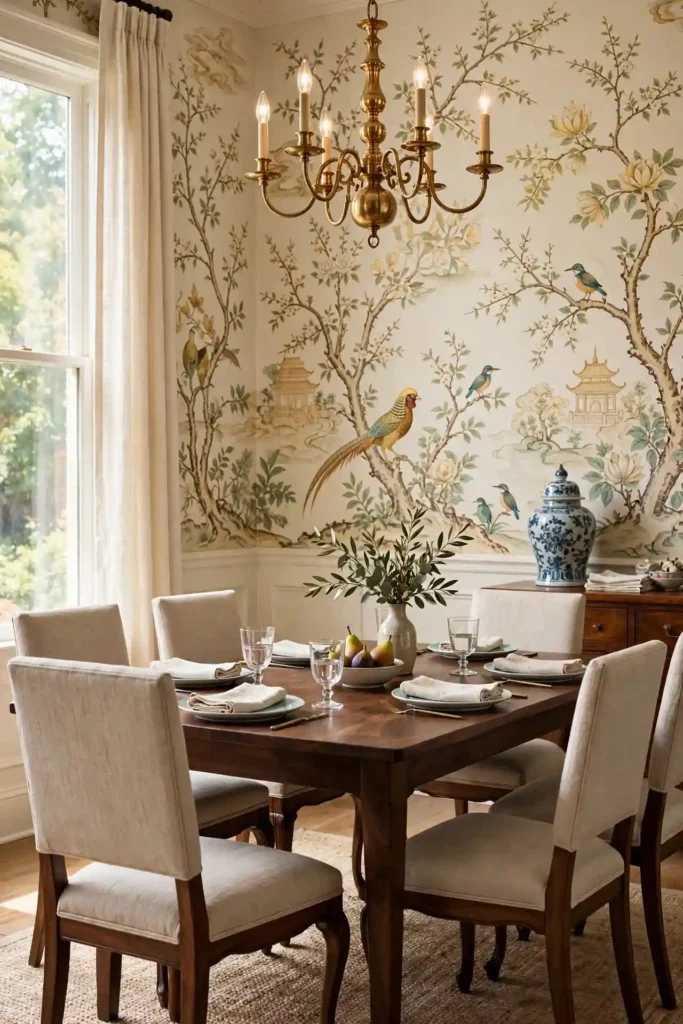
When you hang chinoiserie wallpaper, keep your furniture simple so the walls stay the star. A dark wood table, like a walnut or espresso finish, grounds the airy scenes beautifully, while upholstered chairs in solid linen add softness without competing. Measure each wall carefully in feet and inches, and buy 10–15 percent extra paper — scenic patterns have large repeats that create waste. Most rolls cover about 56 square feet, so a 12-by-14-foot dining room with 9-foot ceilings needs roughly 8–10 rolls. Hang it on the wall guests see first when they enter, ideally behind the buffet or sideboard. Pair it with a classic chandelier and minimal art, since framed pieces can fight the painted scenes.
2. Lush Botanical Prints
Lush botanical prints wrap your dining room in the feel of a conservatory, with oversized palm fronds, monstera leaves, and trailing vines printed at dramatic scale. These bold botanicals are one of the strongest wallpaper trends of 2026, and they suit dining rooms because the greenery reads as fresh and lively without overwhelming conversation. Peel-and-stick options from Chasing Paper or Tempaper cost about $50–$70 per roll and let renters join in, while traditional pasted papers from York Wallcoverings run $80–$150. Deep greens on dark backgrounds create a moody, restaurant-like atmosphere; lighter palm prints on cream feel airy and coastal. Either way, botanicals make the room feel alive year-round.
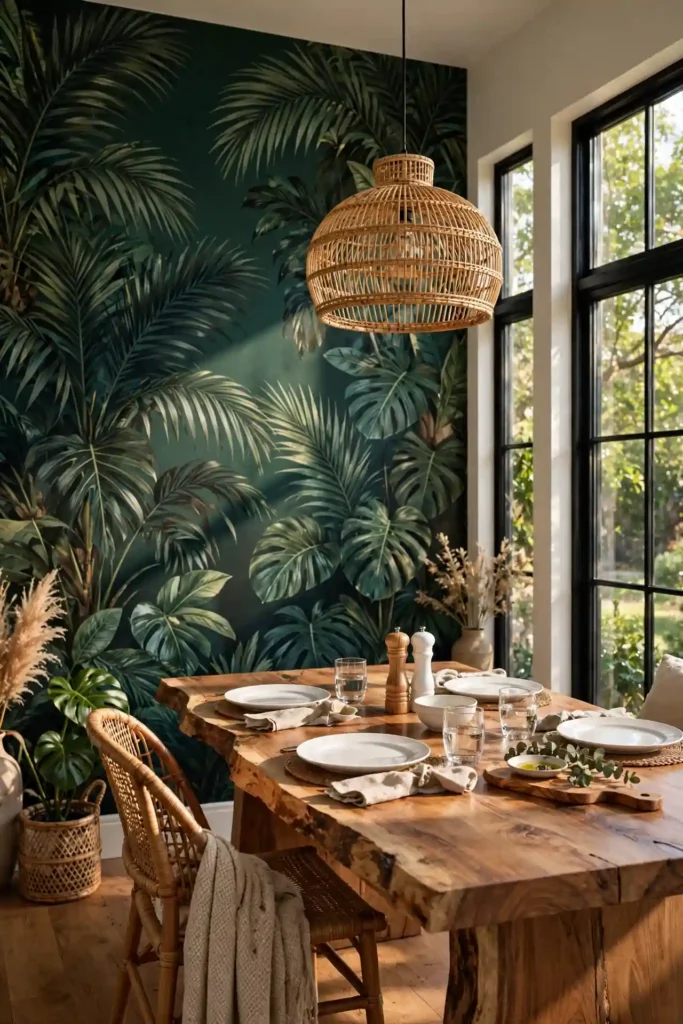
Style botanical wallpaper with natural materials to double down on the garden feel. A rattan or wicker pendant light, a live-edge wood table, and simple green plants echo the pattern without looking theme-y. Keep your table setting minimal — white dishes and clear glass let the walls do the talking. If the print is very large scale, install it on two opposing walls and leave the others solid in a pulled color like Sherwin-Williams Evergreen Fog (SW 9130). For a 12-by-14 room you will need around 9–12 rolls depending on repeat size, so order samples first from the manufacturer’s website — most brands ship 5-by-7-inch swatches for about $5.
3. Scenic Murals
A scenic mural turns your dining room wall into a floor-to-ceiling landscape — misty mountains, Tuscan vineyards, or a serene lake at dawn. Unlike repeating patterns, murals are printed as one continuous image sized to your exact wall, so there are no awkward seams cutting through the scene. Companies like Photowall and Murals Your Way print custom murals for roughly $8–$12 per square foot, with standard panels covering an 8-by-12-foot wall for about $500–$800. Because the image is so immersive, murals work beautifully behind a dining table, giving guests something gorgeous to look at over dessert.
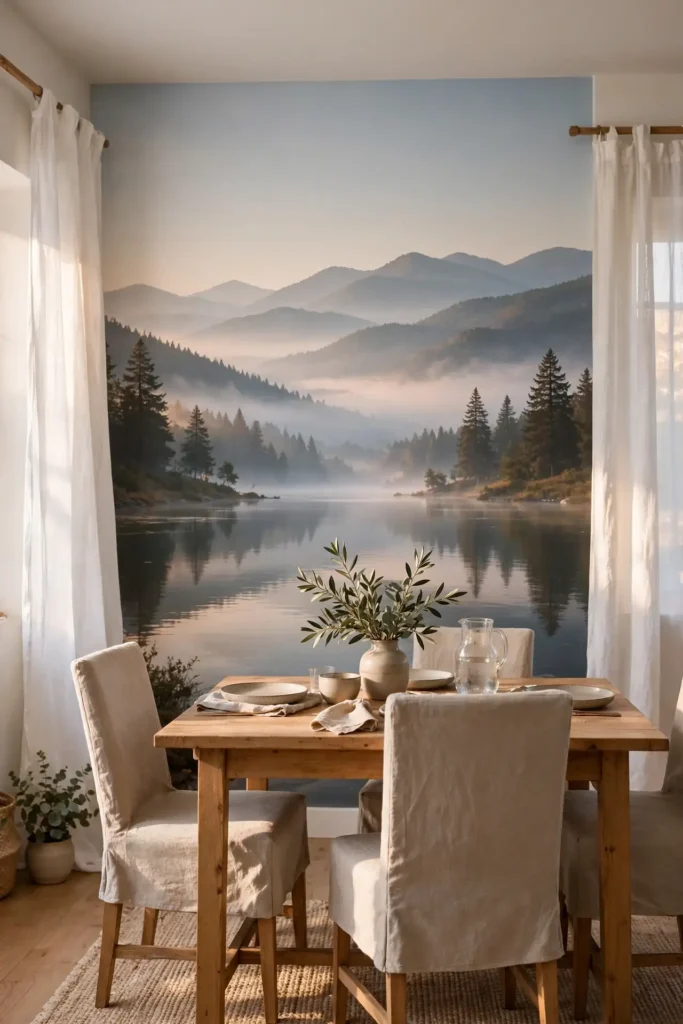
Ordering a scenic mural is easier than it sounds. Measure your wall height and width in inches, then order a panel a few inches larger in both directions — installers trim the excess at the ceiling and baseboard for a perfect fit. Choose scenes with the focal point at seated eye level, about 4–5 feet off the floor, so the view feels natural from your chairs. Keep the rest of the room quiet: solid upholstery, simple curtains, and one low centerpiece. Avoid competing artwork on the mural wall entirely. If you rent, look for removable mural panels from Tempaper that peel off cleanly when you move.
4. Grasscloth Texture
Grasscloth wallpaper gives your dining room the look of woven fabric on the walls — subtle, textural, and quietly luxurious. Made from natural fibers like sisal, jute, and hemp, it adds dimension that flat paint simply cannot match, and it never fights your artwork or table settings. Real grasscloth from Phillip Jeffries runs $150–$400 per roll, but excellent faux-grasscloth vinyls from Brewster or Graham & Brown cost $40–$70 and wipe clean. The weave catches light differently across the day, so walls feel warm and alive. It is a favorite of interior designers because it works with nearly every style, from coastal to traditional.

Grasscloth demands a smooth wall underneath, so skim-coat any texture before hanging — the thin material shows every bump. It also absorbs light, so pair it with a strong chandelier or layered sconces to keep the room from feeling dim. Because each panel is woven from natural fibers, expect slight color variation from roll to roll; buy all your rolls from the same dye lot. Plan on about one roll per 56 square feet, and hire a pro if you are new to wallpaper — grasscloth seams are trickier than printed paper. The payoff is a dining room that feels tailored, like a custom suit for your walls.
5. Classic Stripes
Classic stripes are the tailored suit of dining room wallpaper — crisp, timeless, and flattering in almost any home. Vertical stripes make low ceilings feel taller, which is a gift in 8-foot-ceiling dining rooms, while wide bands in tonal colors read as elegant rather than playful. Ralph Lauren and Farrow & Ball offer beautiful striped papers from $100–$200 per roll, and Target’s Opalhouse line has affordable striped options under $35. Stick to stripes 2–4 inches wide for a refined look; anything wider starts to read modern. A dining room in soft gray and white stripes feels instantly classic, like a private club dining hall.
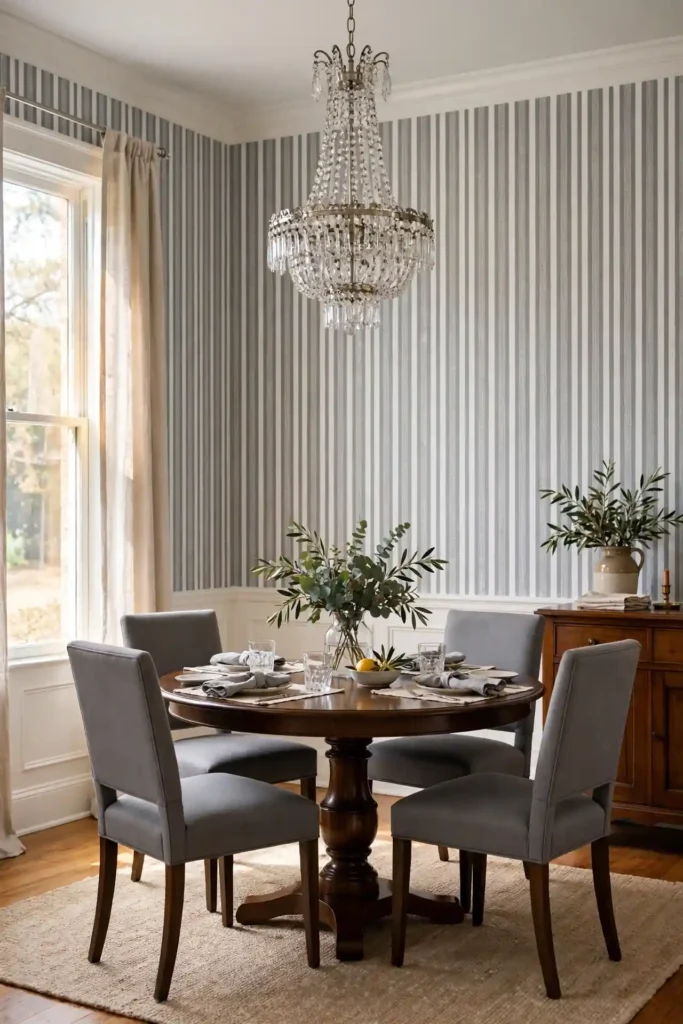
Stripes are forgiving to hang because pattern matching is straightforward — lines line up predictably, which saves paper and patience. Use them strategically: stripe the wall behind the sideboard and keep the rest solid, or run them around the whole room for a cocooning effect. Pair stripes with solid upholstery in one of the stripe colors to tie everything together. Avoid busy table linens; a simple runner in a solid hue works best. If your room is narrow, horizontal stripes on the end wall can visually widen it — just keep the ceiling solid white so the space does not feel closed in.
6. Dark Floral
Dark floral wallpaper — lush blooms on charcoal, black, or deep navy backgrounds — brings drama and intimacy to the dining room. It is the moody cousin of traditional florals, and it makes evening dinners feel like a candlelit restaurant. Ellie Cashman Design and House of Hackney create stunning large-scale dark florals for $150–$250 per roll, while Wayfair carries similar looks for $40–$80. The dark background recedes, making the room feel larger at night, and it hides scuffs better than light paper. This is a bold choice, but in a dining room — a space built for atmosphere — it absolutely shines.
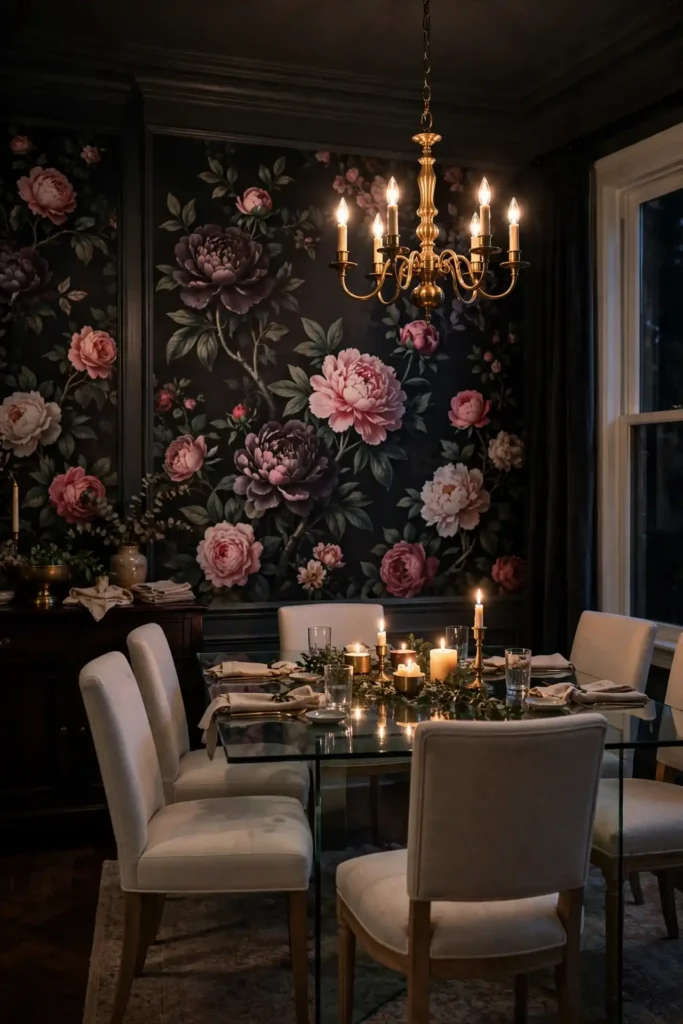
Balance dark floral walls with light and reflective surfaces. A glass or light-wood table keeps the room from feeling heavy, and brass or gold fixtures pop beautifully against dark backgrounds. Add a dimmer switch to your chandelier — bright overhead light flattens dark paper, while warm dimmed light makes the florals glow. Keep chair fabrics solid and light-colored to contrast the walls. If full walls feel like too much commitment, try the pattern on just the wall behind your buffet, or on the ceiling for a secret-garden effect. Either way, guests will remember this room.
7. Toile
Toile wallpaper, with its charming pastoral scenes printed in a single color on cream or white, gives your dining room a storybook French-country feel. The classic blue or black toile depicts shepherds, gardens, and village life in delicate line drawings that read as both traditional and fresh. Brands like Schumacher and Thibaut sell beautiful toiles for $120–$220 per roll, and Spoonflower offers thousands of independent designs from $60–$90. Toile works especially well in dining rooms because its fine lines add interest without shouting, letting conversation stay the focus. Pair blue toile with white wainscoting for a look that never ages.
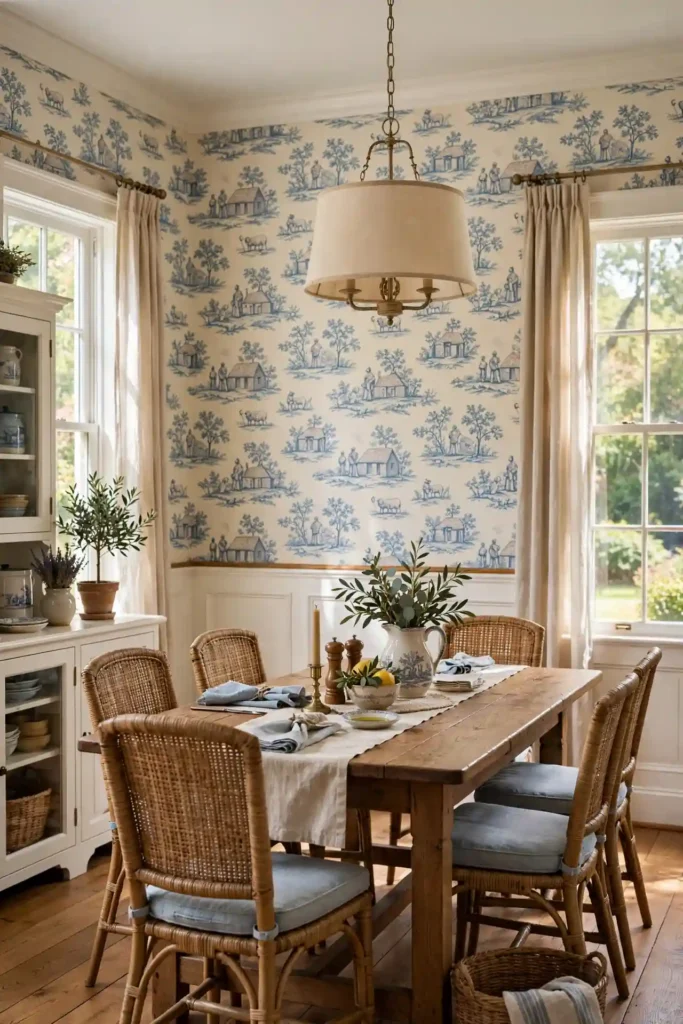
The scale of the toile scene matters more than the color. Small, dense toiles can look busy on full walls — save those for powder rooms — and choose medium or large scenes for a dining room so the drawings read clearly from across the table. Match your wainscoting paint to the background color of the paper for a seamless transition; Benjamin Moore White Dove (OC-17) pairs with most cream toiles. Hang toile above a chair rail at about 36 inches, or run it floor to ceiling in a smaller dining nook. Keep lighting warm and simple, like a classic drum-shade chandelier, so the delicate lines stay the star.
8. Geometric Patterns
Geometric wallpaper — hexagons, trellises, art deco fans, and crisp chevrons — brings energy and structure to your dining room. These patterns feel current and confident, perfect if your home leans modern or transitional rather than traditional. Kelly Wearstler’s collections and Hygge & West offer striking geometrics for $100–$180 per roll, while Home Depot’s NuWallpaper line has peel-and-stick geometrics under $40. Metallic gold geometrics on white create a luxe, light-reflecting backdrop for dinner parties, while bold navy and white chevrons feel graphic and fun. The key is choosing a scale that suits your room — small rooms want smaller repeats.
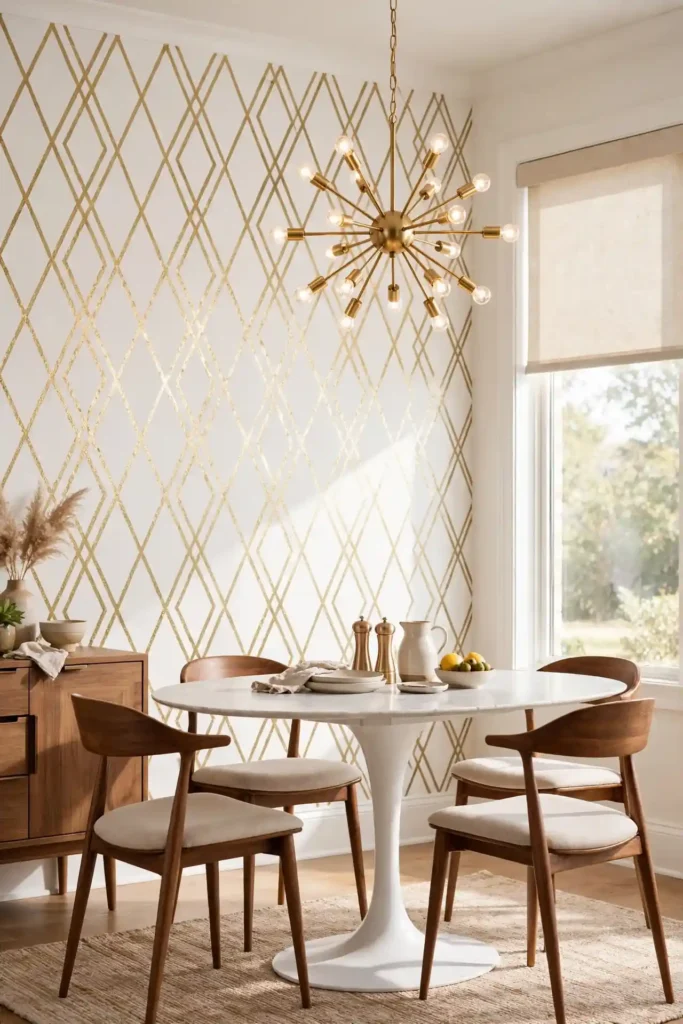
Geometrics pair best with clean-lined furniture: a simple pedestal table, streamlined chairs, and minimal window treatments. Let one pattern dominate — mixing two geometrics in one room almost always clashes. If your chairs have any pattern, keep the wallpaper more subtle, or vice versa. Art deco fan patterns look incredible with a sputnik-style chandelier, while hexagonal prints suit mid-century modern dining sets. Measure carefully, because geometric repeats can be large (18–24 inches), which increases waste. Buy 15 percent extra for patterns with repeats over 12 inches, and line up the design at eye level behind the table.
9. Metallic Accents
Wallpaper with metallic accents — gold leaf details, silver threads, or copper foils — catches candlelight and chandelier glow like nothing else, making it perfect for a dining room that hosts evening gatherings. These shimmering papers range from subtle champagne pinstripes to bold gold damask, and they instantly raise the room’s perceived luxury. York Wallcoverings and Graham & Brown offer metallic options for $60–$120 per roll. A metallic grasscloth or a cream paper with gold geometric lines gives you the glow without overwhelming the space. In daylight the metallics add warmth; after dark, they make the whole room sparkle.
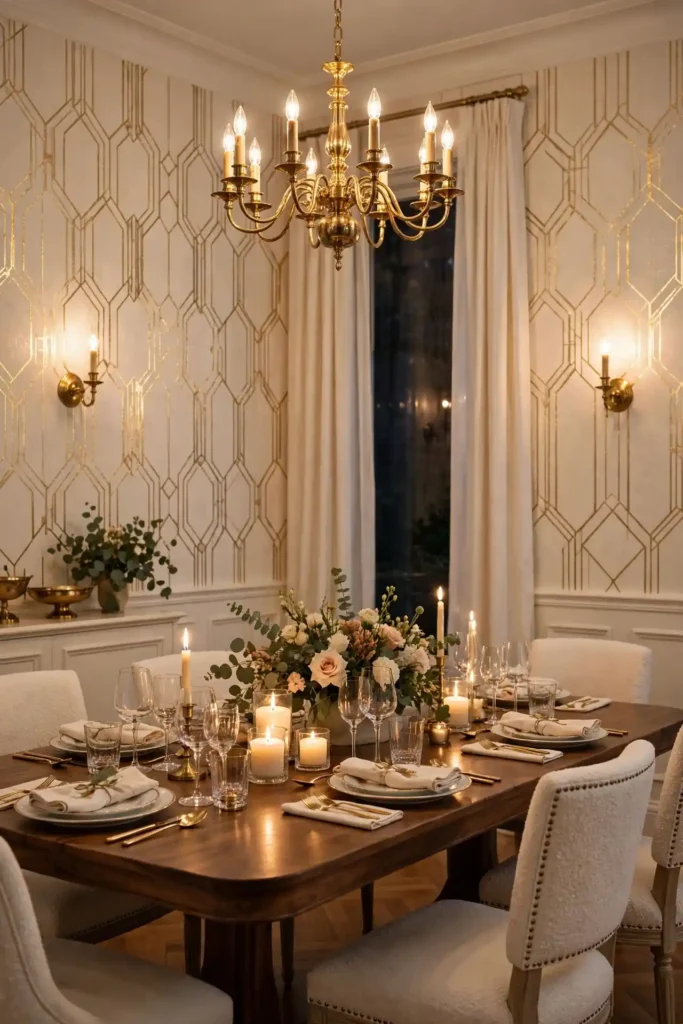
Metallic wallpaper loves layered lighting. Install a dimmer on your chandelier and add wall sconces or a picture light — multiple light sources make the metallic details dance. Keep other metals in the room consistent: if your paper has gold accents, choose brass fixtures and gold-framed art rather than mixing in chrome. The paper itself is usually wipeable, which helps in a dining room, but avoid scrubbing metallic inks. Hang metallic paper on the wall opposite windows to catch natural light during the day. One caution: metallic papers show wall imperfections, so prime and smooth walls thoroughly first.
10. Wallpaper With Wainscoting
Pairing wallpaper with wainscoting is a classic dining room move: the chair rail divides the wall, with crisp painted woodwork below and beautiful pattern above. This combination gives you the best of both worlds — durable, wipeable wainscoting where chairs bump the wall, and personality-packed wallpaper at eye level. Install wainscoting to about 32–36 inches high, paint it a solid like Sherwin-Williams Alabaster (SW 7008), and hang your pattern above. The two-tone look adds architectural interest even in newer homes, and it makes bold wallpaper feel grounded rather than overwhelming.
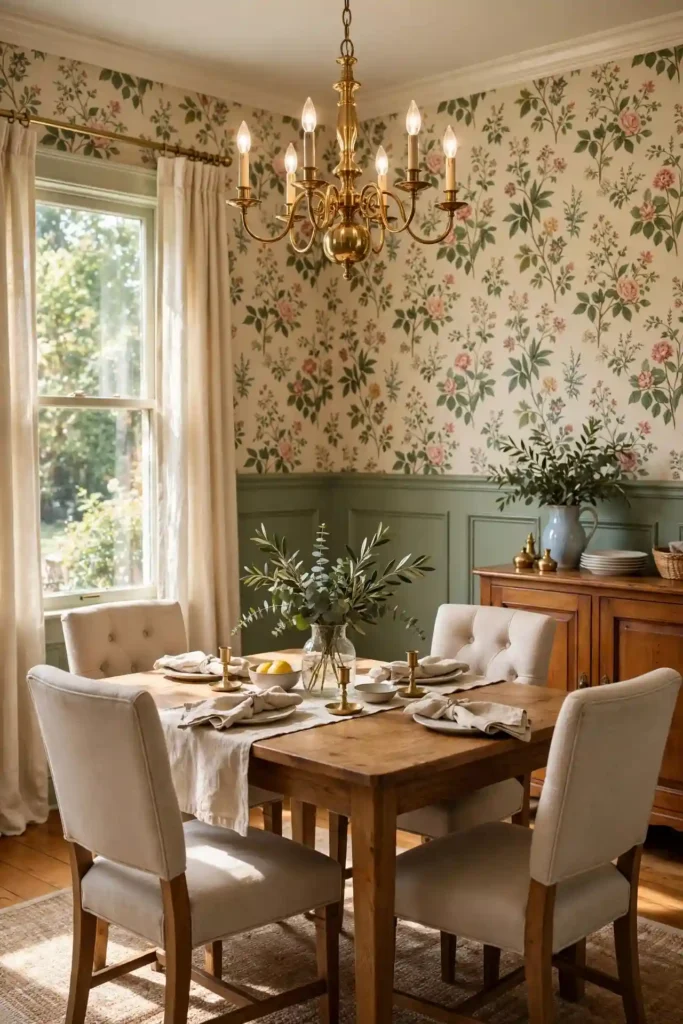
Coordinate the two elements by pulling one color from the wallpaper for the wainscoting paint. A sage green wainscot under a botanical paper, or navy under a blue-and-white pattern, looks intentional and custom. Use a chair rail cap at least 2.5 inches wide to create a clean dividing line, and caulk the top edge before painting for a crisp finish. If you are retrofitting wainscoting, MDF beadboard panels from Home Depot cost about $30–$50 per 4-by-8-foot sheet and install with construction adhesive. Hang the wallpaper first, then install the chair rail over its bottom edge to hide any uneven cuts.
11. Wallpapered Ceiling
Wallpapering the ceiling — the so-called fifth wall — is a designer trick that turns an ordinary dining room into something unforgettable. Guests rarely look up expecting pattern, so a ceiling in bold botanicals, stars, or soft metallics delivers a genuine wow moment. A tray or coffered ceiling works especially well, with the pattern set inside the recessed panels. Because ceilings get no wear, you can use delicate papers, and the job needs less paper than walls — a 12-by-14-foot ceiling needs about 4 rolls. Dark or patterned ceilings also make tall rooms feel cozier and more intimate.

Hanging paper overhead is a two-person job at minimum, so budget for professional installation — typically $500–$800 for a dining room ceiling. Choose patterns with non-directional designs, like scattered stars or all-over florals, since directional patterns look wrong from different seats. Keep walls quiet: solid paint in a color pulled from the ceiling paper. A statement chandelier still works on a patterned ceiling — just keep its canopy simple and hang it 30–34 inches above the table. Peel-and-stick papers make ceiling experiments less scary for commitment-phobes, since removal is straightforward.
12. Damask
Damask wallpaper, with its symmetrical, ornate medallion motifs, is the definition of traditional dining room elegance. This centuries-old pattern — originally woven into silk — brings formality and richness that suits holiday dinners and special occasions. Classic damasks from Brewster and Graham & Brown run $50–$100 per roll, with tone-on-tone versions (same color, different finish) offering a subtle, sophisticated look. A gray-on-gray or cream-on-cream damask adds texture without demanding attention, while a bold black-and-gold damask makes a dramatic statement. Damask loves traditional furniture: carved wood, upholstered chairs, and crystal lighting.
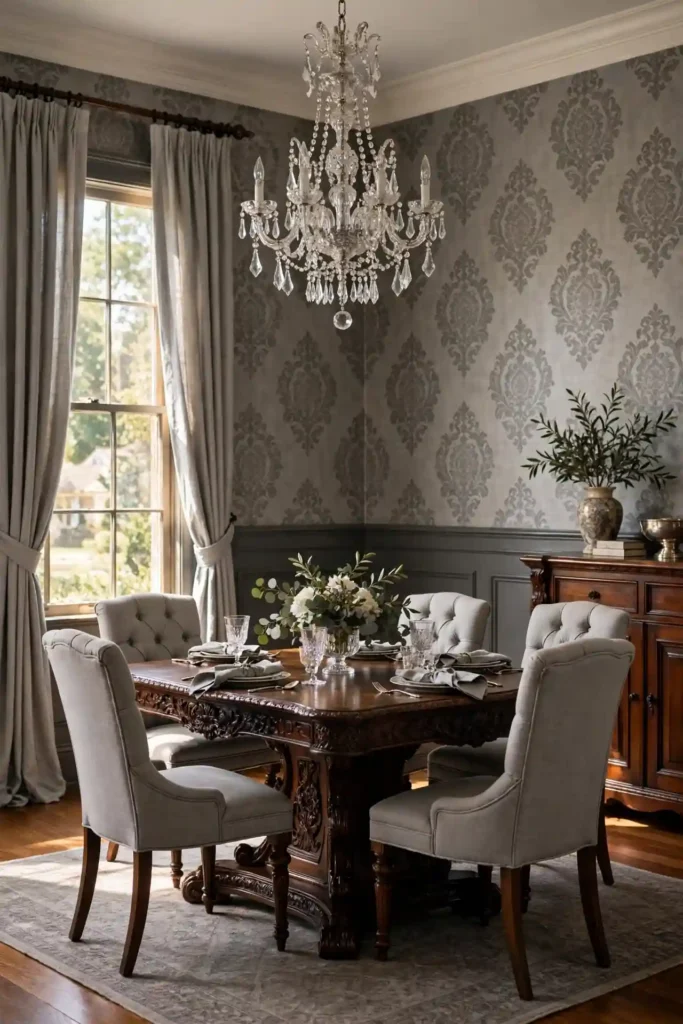
Scale is everything with damask. Large medallions (12 inches or more) suit spacious dining rooms, while smaller damasks work in cozier spaces — a big motif in a small room looks cramped. Tone-on-tone damask is the safest choice if you want elegance without risk; the pattern reveals itself as light moves across the wall. Pair damask with a classic crystal or brass chandelier and formal window treatments like lined drapes. Avoid mixing damask with other strong patterns — let it be the room’s single star. If you tire of the formality, a damask in a fresh color like soft blush modernizes it instantly.
13. Watercolor Patterns
Watercolor wallpaper looks like an artist painted directly on your dining room walls — soft washes of color, visible brushstrokes, and dreamy, blended edges. This artistic style brings a relaxed, creative energy that works beautifully in casual and coastal dining spaces. Anewall and Rebel Walls offer gorgeous watercolor murals and repeats for $90–$160 per roll. Abstract washes in blues and greens feel like the ocean at sunrise; soft floral watercolors feel romantic, fresh, and welcoming. Because the edges are intentionally blurred, watercolor patterns hide imperfect walls better than crisp geometrics do.

Style watercolor walls with simple, unfussy furniture — the paper is the art, so skip busy gallery walls. A light wood or white table, linen-upholstered chairs, and sheer curtains keep the mood airy. Pull one or two colors from the paper for your table linens or chair cushions to tie the room together. Watercolor papers are often non-woven and easy to hang, making them beginner-friendly; most are also easy to remove, which renters appreciate. Keep the lighting soft and diffused — harsh spotlights can create glare on the paper’s sheen. A paper lantern pendant or fabric drum shade is ideal.
14. Plaid or Check
Plaid and check wallpaper brings cozy, cabin-meets-country-club charm to your dining room. From classic tartan to modern, oversized buffalo check, these patterns feel warm and welcoming — perfect for rooms where family gathers for long, lingering meals. Buffalo check in black and white reads graphic and modern, while a muted green tartan feels traditional and woodsy. Chasing Paper and Spoonflower offer plaid peel-and-stick options for $40–$70 per roll. Plaid works year-round, not just at the holidays, especially in muted, versatile tones like gray, sage, navy, or warm tan on cream backgrounds.
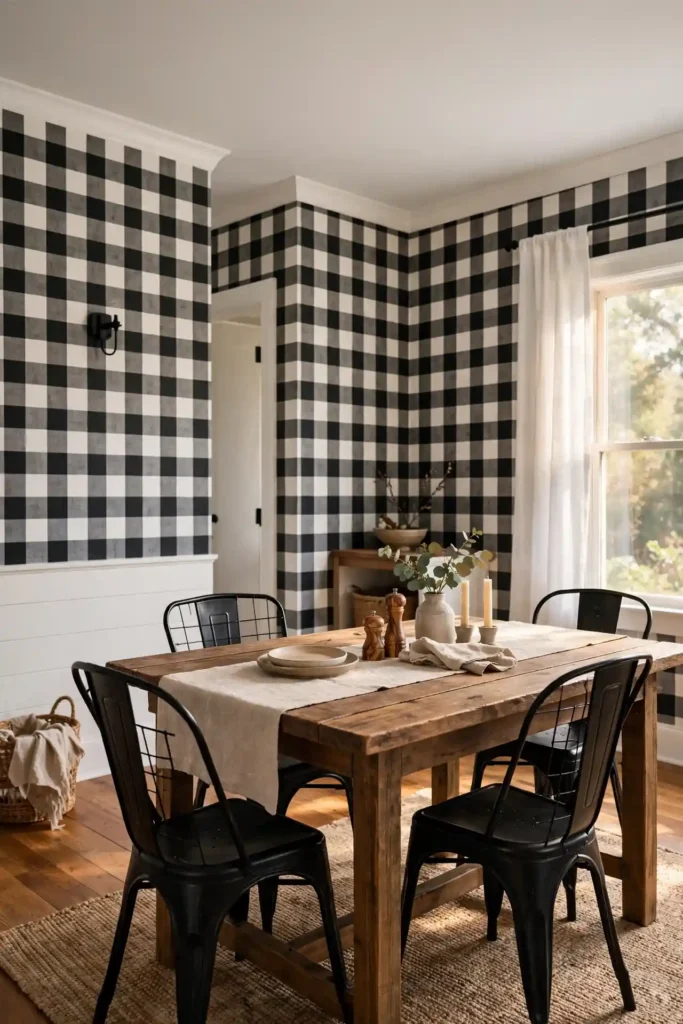
Plaid demands simple companions — it is already a strong pattern, so keep everything else quiet. Solid wood furniture, plain linen napkins, and minimal art let the checks shine. Match the plaid’s scale to your room: large buffalo checks suit big, open dining spaces, while smaller gingham-style checks work in breakfast nooks. Hang plaid on all four walls for a cozy lodge feel, or use it on one accent wall behind the table. If you go full tartan, paint the ceiling and trim crisp white to keep the room from feeling dark. Buffalo check pairs wonderfully with farmhouse tables and black metal chairs.
15. Blue and White Pattern
Blue and white wallpaper is a forever classic for dining rooms — think Chinese porcelain, Greek island houses, and coastal cottages all in one timeless palette. This color combination feels fresh, clean, and endlessly versatile, working with everything from traditional to coastal to modern farmhouse style. Thibaut and Schumacher offer beautiful blue-and-white patterns from $100–$200 per roll, while Target and Home Depot carry affordable versions under $40. Navy on white feels crisp and preppy; soft powder blue on cream feels calm and coastal. Either way, the palette never clashes with your dinnerware.

The beauty of blue and white is how easily it coordinates. White wainscoting below and blue-and-white paper above is a can’t-miss combination — paint the woodwork Benjamin Moore Chantilly Lace (OC-65) for a bright, clean line. Rattan chairs, a natural jute rug, and brass lighting complete the coastal-classic look. For a more formal feel, pair the paper with a dark mahogany table and crystal chandelier. Blue and white also photographs beautifully, which matters if you love hosting and sharing. Keep the ceiling white and the curtains simple — linen panels in solid white or natural let the pattern lead.
16. Textured Linen Look
Linen-look wallpaper gives your dining room the soft, woven texture of fabric without the cost or upkeep of real textile wallcovering. These papers mimic the subtle slubs and weave of Belgian linen, adding quiet dimension that makes a room feel finished and expensive. Faux-linen vinyls from York and Brewster cost $40–$80 per roll and are scrubbable — a real advantage in a dining room. The texture catches light gently, so walls look rich without any pattern competing with your art or table settings. Neutral linen-look papers in greige, oatmeal, or soft white work with literally any decor style.
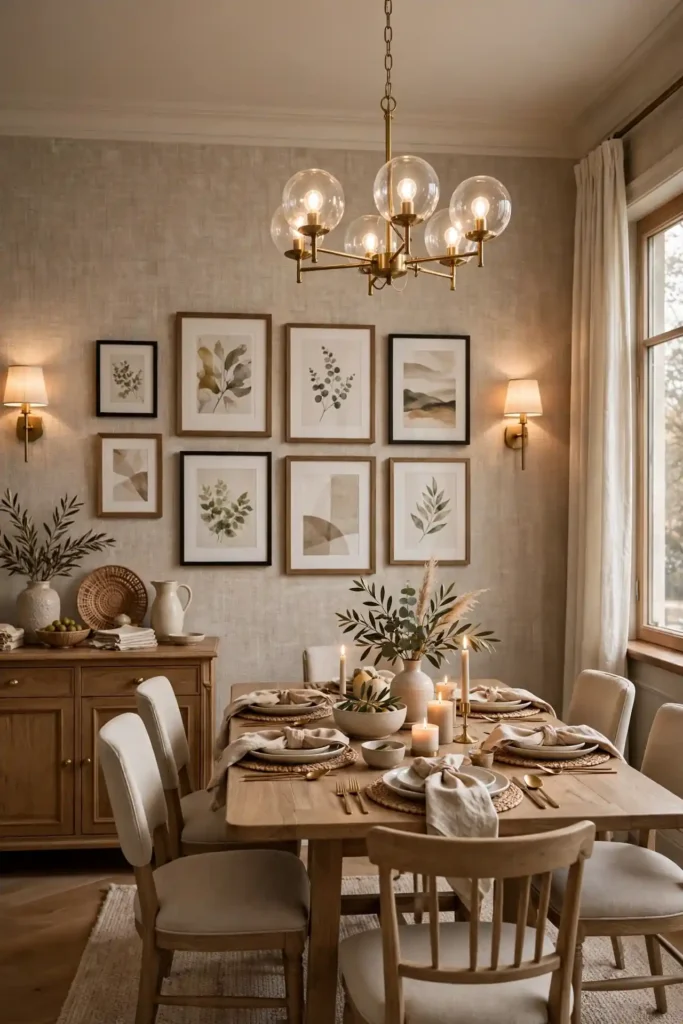
Use linen-look wallpaper as a sophisticated neutral base, then layer in color through art, chairs, and table linens. It is the perfect backdrop for a gallery wall or a statement chandelier, since it adds interest without visual noise. In open-concept homes, run the same linen paper through the dining area to define the space while keeping flow with the living room. Installation is beginner-friendly — the random texture means seams virtually disappear. For a 12-by-14-foot dining room, budget about 9 rolls at roughly $60 each, or $540 total. Pair it with layered lighting to show off the texture after dark.
17. Accent Wall Only
Using wallpaper on a single accent wall gives you all the drama with a fraction of the cost and commitment. In a dining room, the natural accent wall is the one behind the table or buffet — the surface guests face during the meal. One bold wall of chinoiserie, dark floral, or metallic geometric makes a stunning focal point, while the other three walls stay in a coordinating solid paint. You will need just 2–3 rolls for a single 12-foot wall, bringing material costs to $100–$300. It is also the easiest way to try a daring pattern without living with it on every surface.

Choose your accent wall deliberately: it should be the first wall you see entering the room, with no doors or awkward angles breaking it up. Paint the remaining walls in a color pulled from the wallpaper — take a sample to the paint store and have it color-matched. Hang any art on the solid walls only, never on the wallpapered one. A console table or buffet against the accent wall looks great, but keep its styling minimal so the paper stays the focus. If you rent, peel-and-stick paper makes the accent wall completely reversible. This approach also lets you go bolder than you would dare on four walls.
18. Coordinate With Lighting
Your wallpaper and lighting should be planned together, not as afterthoughts, because light completely changes how paper looks. Metallics and foils need multiple light sources to shimmer; dark papers need stronger illumination to avoid gloom; and textured papers like grasscloth come alive under angled light. Before you choose paper, note your dining room’s natural light — north-facing rooms get cool, dim light that flatters warm-toned papers, while south-facing rooms flood with sun that can wash out pale patterns. Bring home large samples and observe them at breakfast, lunch, and dinner under your actual lighting.

Match your fixture style to your paper’s personality. A crystal chandelier elevates traditional damask and toile; a modern sputnik fixture energizes geometric prints; a woven rattan pendant softens botanical papers. Always install a dimmer — it is the single cheapest upgrade, about $25–$40 for the switch plus installation, and it lets you tune the mood from bright family dinner to intimate gathering. Add wall sconces flanking a buffet to wash the wallpaper with warm light. Aim for layered light: chandelier plus sconces plus candles gives every wallpaper its best moment.
Choosing Dining Room Wallpaper Patterns
Choosing the right dining room wallpaper pattern starts with your room’s size, light, and the mood you want. Small dining rooms handle large-scale patterns surprisingly well — a big botanical or mural on one wall makes the space feel grander, not smaller. Dark rooms need light-reflecting papers like metallics or pale prints; bright rooms can handle moody dark florals. Consider your home’s overall style too: a modern farmhouse wants buffalo check or shiplap-adjacent textures, while a traditional colonial home calls for damask or toile. The pattern should feel like a natural extension of the rest of your house.
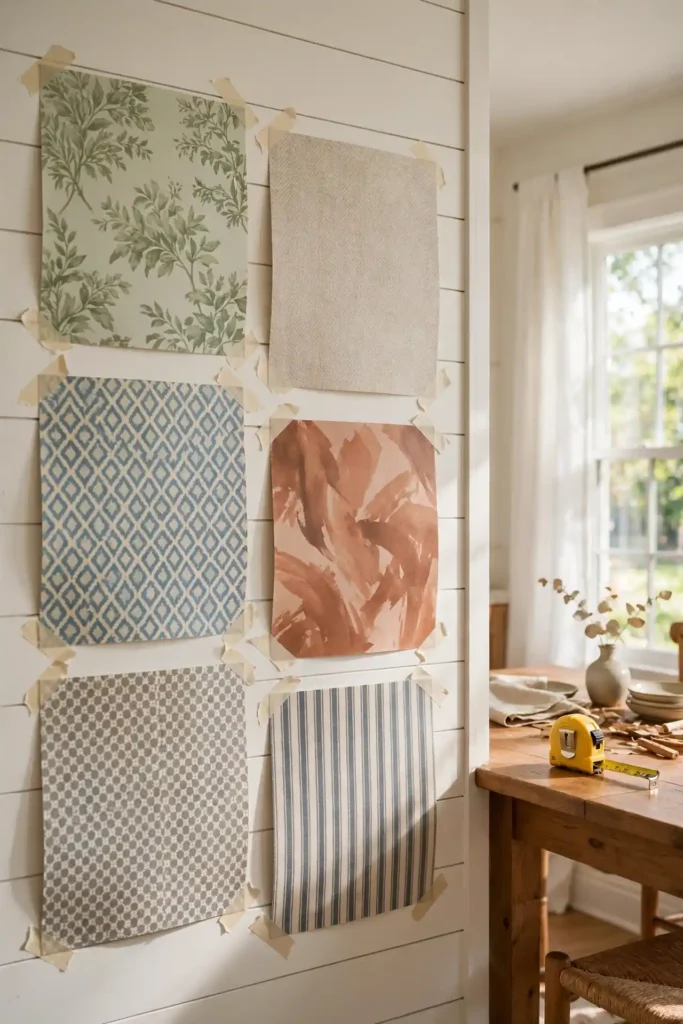
Always order samples before committing — most brands sell large swatches for $5–$10, and some credit the cost toward your order. Tape samples to the wall and live with them for at least three days, checking them in morning, afternoon, and evening light. Consider durability: vinyl and non-woven papers wipe clean and suit busy family dining rooms, while delicate grasscloth and hand-painted papers belong in formal spaces. Finally, calculate your true cost: paper plus adhesive, tools, and installation (pro hanging runs $300–$800 for a dining room). A $60 roll can become a $150-per-wall project once everything is included.
Consider the view from adjoining rooms. In open-plan homes, choose wallpaper that relates to the colors in the living room or kitchen so the spaces flow together.
Wallpaper and Wainscoting
Wallpaper and wainscoting are a match made in dining room heaven — the woodwork adds architecture and durability below, while the paper brings color and pattern above. This pairing works in both traditional homes, where it looks original to the house, and new builds, where it adds instant character. The classic formula: wainscoting or beadboard up to chair-rail height (about 36 inches), painted in a crisp white or a color pulled from the paper, with wallpaper running from the rail to the ceiling. It frames the pattern like art and protects walls from chair scuffs.
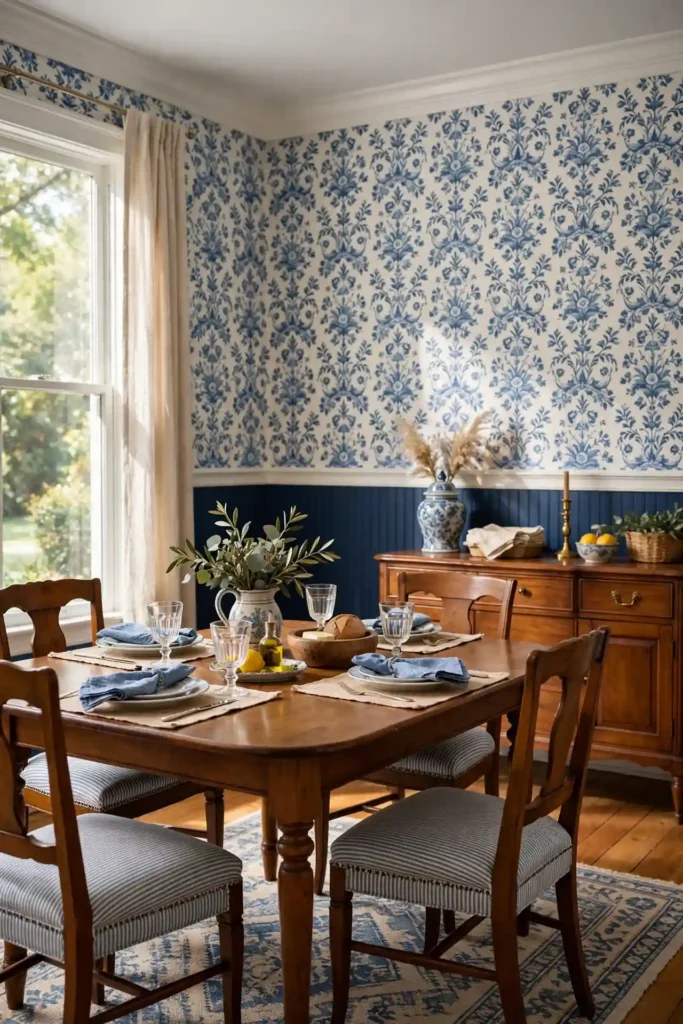
Get the proportions right for your ceiling height. In rooms with 8-foot ceilings, keep wainscoting at 32–34 inches so the wallpaper band above feels generous; with 9- or 10-foot ceilings, you can go to 40 inches. Paint the wainscoting in a satin or semi-gloss finish for wipeability — Behr and Benjamin Moore both make excellent trim paints around $40–$60 per gallon. For the wallpaper above, medium-scale patterns read best; tiny prints get lost and huge murals fight the horizontal rail line. Caulk the joint between the chair rail and wallpaper for a professional finish, and choose a rail profile at least 2 inches deep.
Lighting Wallpapered Dining Rooms
Lighting a wallpapered dining room is about showing off the paper while keeping the space comfortable for long dinners. Start with a chandelier hung 30–34 inches above the tabletop — this is the standard height that lights faces without blocking views. Add a dimmer switch so you can shift from bright homework sessions to candlelit dinners. For dark or metallic papers, add wall sconces on solid walls to bounce light around; picture lights over a buffet also wash the wallpaper with a warm glow. The goal is layered, adjustable light that flatters both the paper and your guests.

Choose bulb color carefully — it changes everything. Warm white bulbs (2700K) make most wallpapers look rich and inviting, while cool daylight bulbs (5000K) can make creams look dingy and blues look harsh. LED filament bulbs in a clear-glass chandelier add vintage charm and work with dimmers. Avoid a single harsh overhead light; it creates glare on metallic and vinyl papers. Instead, combine your chandelier with table lamps on a sideboard or buffet for a layered effect. If your paper has metallic accents, add lighting at two heights — sconces plus chandelier — so the shimmer reads from every seat.
How to Choose Dining Room Wallpaper Step by Step
Follow these steps to choose dining room wallpaper with confidence. Step one: measure every wall in feet and inches, noting doors, windows, and outlets — you will need these numbers for ordering. Step two: decide on coverage — full room, accent wall, or above wainscoting — since this determines how bold you can go. Step three: order samples of your top three patterns and tape them up for a few days. Step four: calculate rolls using the manufacturer’s coverage (usually about 56 square feet per double roll) and add 10–15 percent for pattern matching. Step five: choose your adhesive and tools, or book an installer.
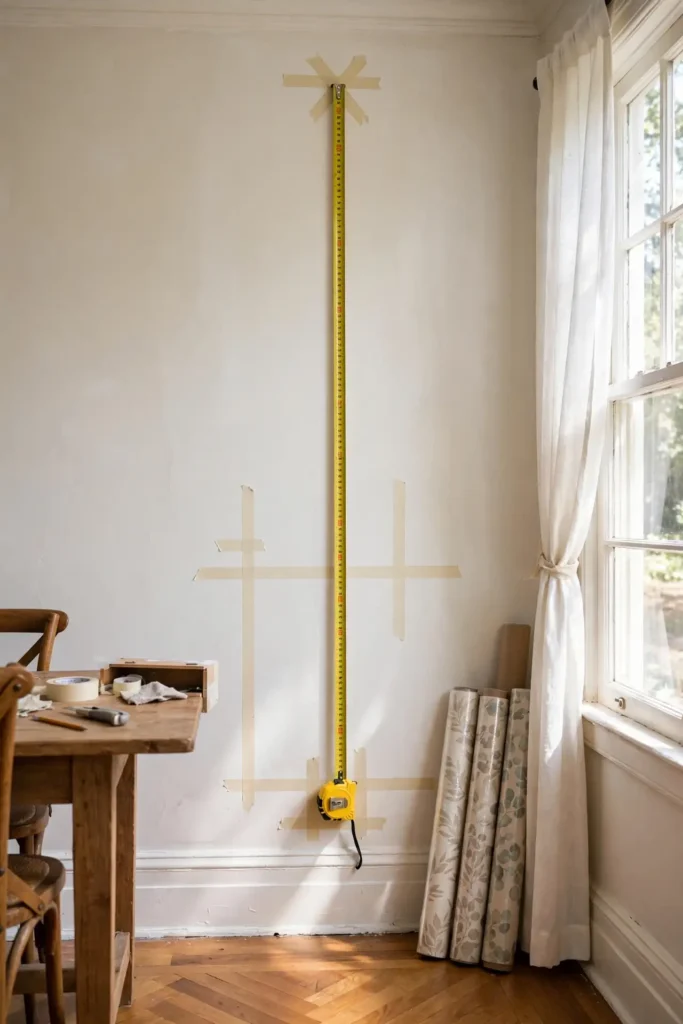
Step six is the final check before you buy: hold your sample next to your dining table, chairs, and flooring in the room’s actual light. Colors shift dramatically between a store and your home, so never skip this. Confirm the paper’s durability rating — look for scrubbable vinyl or non-woven in family dining rooms. Check the return policy before ordering; many wallpaper retailers charge restocking fees of 15–25 percent. Finally, schedule installation when you can clear the room for a day — furniture needs to move at least 3 feet from walls. Following this process takes the guesswork out and prevents expensive mistakes.
- Decide on full room, accent wall or ceiling.
- Choose a pattern based on room size and style.
- Order samples and view them at night.
- Measure and order extra rolls.
- Hire a professional installer for complex patterns.
Final Thoughts on Dining Room Wallpaper Ideas
The right dining room wallpaper does more than decorate — it sets the emotional tone for every meal you share there. Whether you choose the timeless elegance of chinoiserie, the cozy charm of buffalo check, or the drama of a dark floral, your walls become part of the gathering itself. Remember that dining rooms are ideal for bold choices: unlike a living room you stare at all day, the dining room is a destination space where pattern and color feel like an occasion. Do not be afraid to go bigger, darker, or more artistic than you would elsewhere in your home.
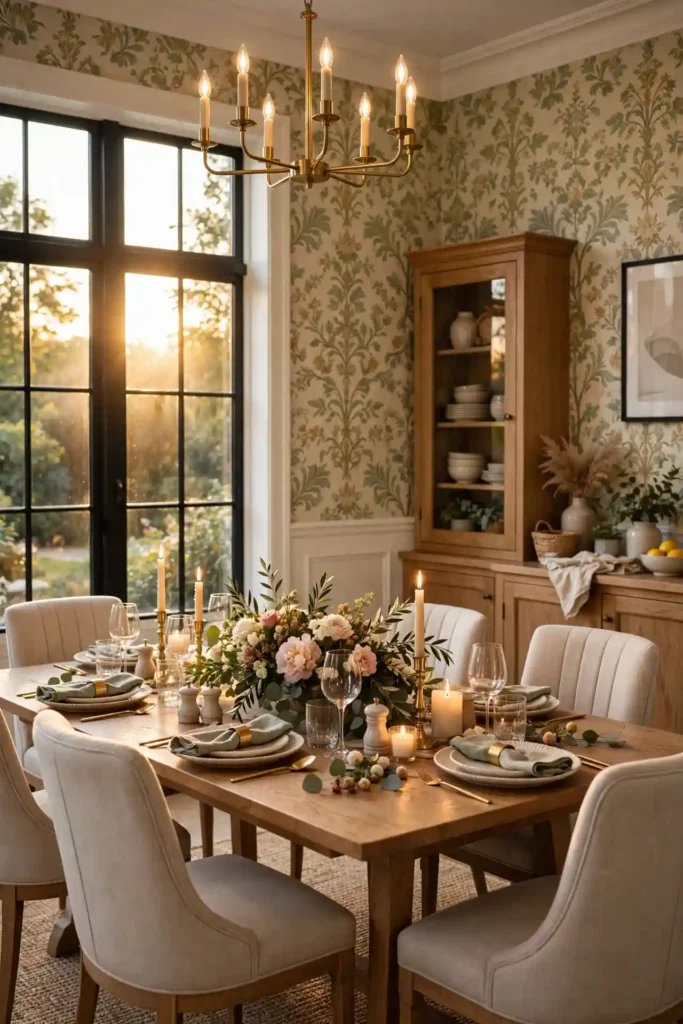
Start with samples, trust your instincts, and remember that most wallpaper today is removable or easy to change — this is not the permanent commitment it was in your grandmother’s era. Peel-and-stick options let you experiment freely, and even pasted papers come down cleanly with the right technique. Budget wisely: a single accent wall can transform the room for under $300, while a full-room designer paper might run $1,000 or more installed. Whatever you choose, your dining room will feel more intentional, more personal, and more ready for the people you love. That is what great wallpaper really does.
Save these ideas and follow along for more dining room inspiration.
Frequently Asked Questions About Dining Room Wallpaper Ideas
Dining room wallpaper raises the same questions for almost every homeowner: which patterns work best, how much it costs, and whether it is practical around food and kids. The short answers: medium-to-large-scale patterns suit dining rooms best, expect to spend $300–$1,500 depending on coverage and paper quality, and yes — modern vinyl and non-woven wallpapers wipe clean easily. Peel-and-stick options have made wallpaper renter-friendly and commitment-free. Below are the detailed answers to the most common questions, covering everything from measuring to maintenance, so you can move forward with total confidence.

The key takeaway is that dining rooms are among the best spaces in your home for wallpaper. They are destination rooms where bold pattern feels festive rather than overwhelming, and modern materials have solved the old worries about durability and removal. Take your time with samples, measure twice, and choose a pattern that makes you happy every time you sit down to eat. Whether you paper one accent wall or all four, the result is a dining room with personality, warmth, and style — a backdrop worthy of the meals and memories you will create there.
Is wallpaper a good idea in a dining room?
Yes. Dining rooms have low humidity and are perfect for bold patterns.
Should I wallpaper all walls or just one?
Both work; all walls feel immersive, one wall creates a focal point.
What wallpaper patterns suit dining rooms?
Chinoiserie, botanicals, murals, grasscloth and stripes are popular.
Can I combine wallpaper with paneling?
Yes. Wallpaper above wainscoting is practical and elegant.
Is wallpaper hard to remove?
Modern non-woven and peel-and-stick papers remove more easily.




Leave a comment