

A shower usually needs at least two tiles: one for the walls and one for the floor. Many also include a third for a niche or accent. Choosing combinations that work together is the key to a shower that feels cohesive and polished instead of busy.
These 24 shower tile combinations are proven pairings you can adapt to any bathroom. For more inspiration, see our bathroom tiles combination ideas and these walk in shower tile ideas.
Rules for shower tile combinations:
- Use small, slip-resistant tiles on the floor.
- Pair a busy tile with a simple one.
- Keep a shared color or undertone.
- Limit to three tiles per shower.
1. White Subway Walls With Marble Hex Floor
This classic pairing works in almost every American bathroom because it balances crisp, clean walls with a floor that adds just enough pattern to keep things interesting. Run glossy 3×6 white subway tile from floor to ceiling in a running-bond pattern with tight 1/16-inch joints, then anchor the room with 2-inch marble hexagons on the shower pan. You can source both at big-box prices — Daltile Rittenhouse Square subway runs about $3 to $4 per square foot at Home Depot, while Carrara hex mesh sheets cost roughly $9 to $12 per square foot at Floor & Decor. Seal the marble twice a year and you will get a timeless look that sells well when your home hits the market.
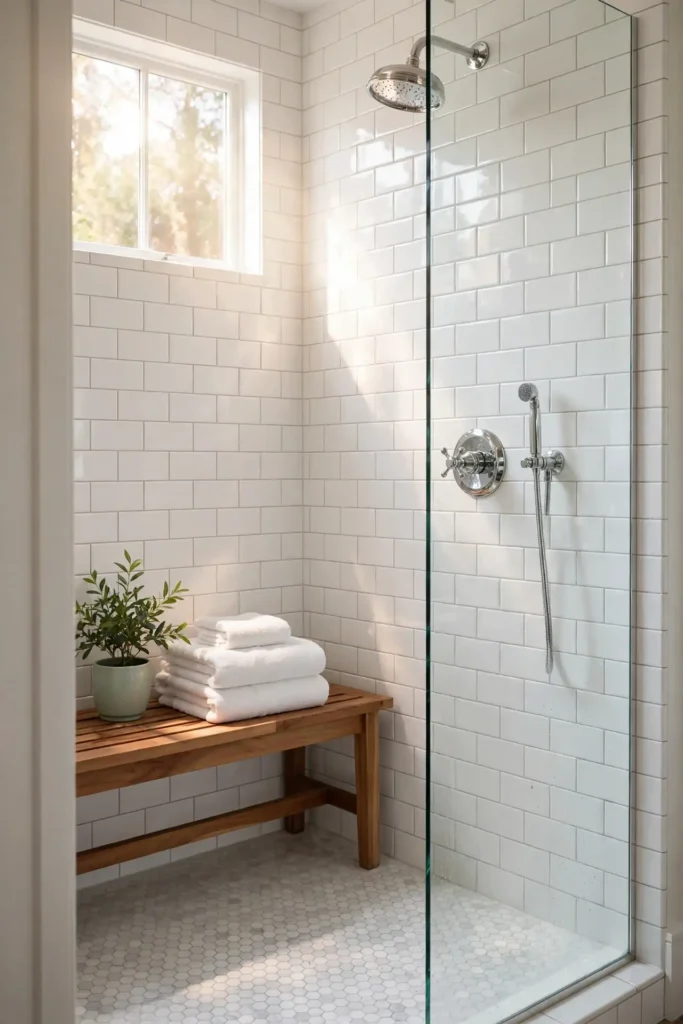
White subway walls make small showers feel twice as big because the glossy finish bounces light into every corner, which matters in bathrooms under 50 square feet. Keep the grout lines consistent with Mapei Flexcolor CQ in White, and choose a matching white Schluter edge trim so every transition looks intentional. For the hex floor, insist your installer uses a membrane like Schluter-Kerdi under the mortar bed, and slope the pan a quarter inch per foot toward the drain. If you want warmth, add a teak bench for about $60 on Amazon and pair the tiles with matte black fixtures from Delta’s Trinsic line, typically $400 to $600 for the full shower set.
2. Large Porcelain Walls With Pebble Floor
Oversized porcelain panels with a river-rock shower floor create a spa feeling that turns a master bath into a daily retreat. Choose 12×24 or 24×48 porcelain panels in a soft concrete or limestone look, installed with lippage-free clips and 1/16-inch joints, so the walls read as one calm, continuous surface. Then contrast that sleekness with natural pebble mosaic sheets — about $7 to $10 per square foot at The Tile Shop — set on a properly sloped mortar bed. Pebbles cushion bare feet and hide soap residue better than polished tile, which means less scrubbing on weekends. This combo photographs beautifully and fits modern farmhouse, coastal, and transitional homes across the US.
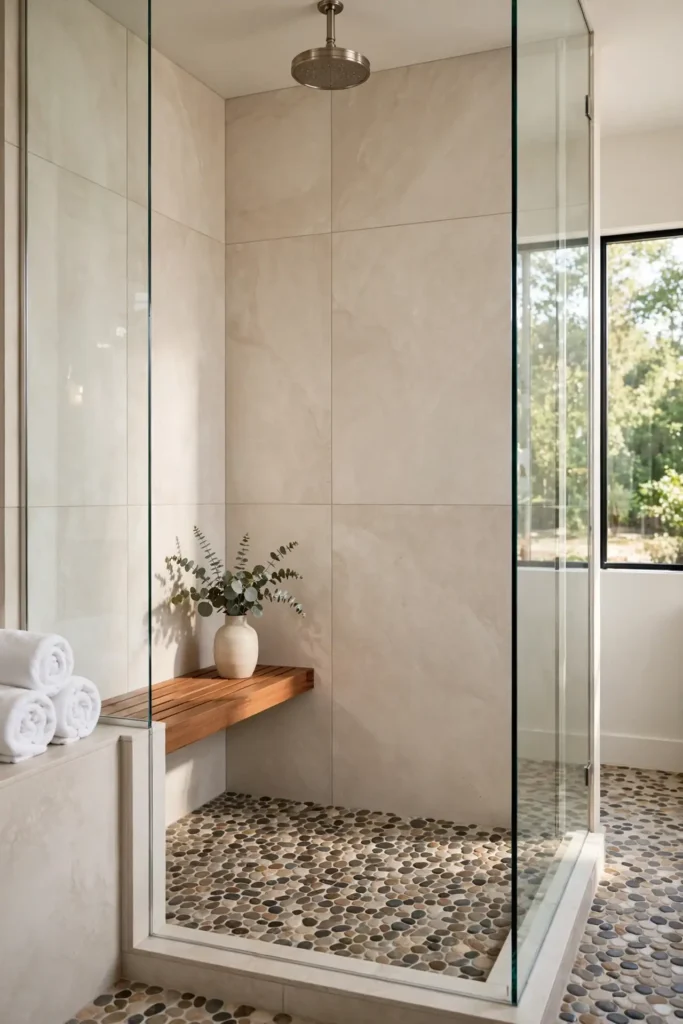
The practical win here is durability — porcelain is virtually stain-proof, and pebbles made from tumbled river rock shrug off the mineral deposits in hard water states like Texas and Arizona. Ask your contractor for epoxy grout such as Laticrete SpectraLOCK on the walls; it never needs sealing and resists the pink mildew that plagues humid climates. Keep the pebbles sealed yearly with a penetrating sealer like Miracle 511 to prevent water spots. Budget roughly $1,200 to $2,000 in tile for a standard 3×5-foot shower at these materials, plus $2,500 to $4,000 in labor depending on your metro area. The result feels like a boutique hotel you never have to check out of.
3. Green Zellige With White Penny Floor
Handmade-look green zellige with a classic white penny-round floor is the combination Pinterest cannot get enough of, and for good reason. Zellige’s imperfect, glossy surface catches light differently on every square, giving your shower walls a living, watery depth that flat ceramic never achieves. Pair a rich forest or emerald glaze — try Clé Tile’s zellige at about $25 to $35 per square foot, or save with Bedrosian’s Cloe line near $8 per square foot at The Tile Shop — with white 1-inch penny rounds on the floor. The tiny circles add texture underfoot and read timeless next to the artisanal walls, a look that suits craftsman bungalows and modern kitchens-turned-baths alike.
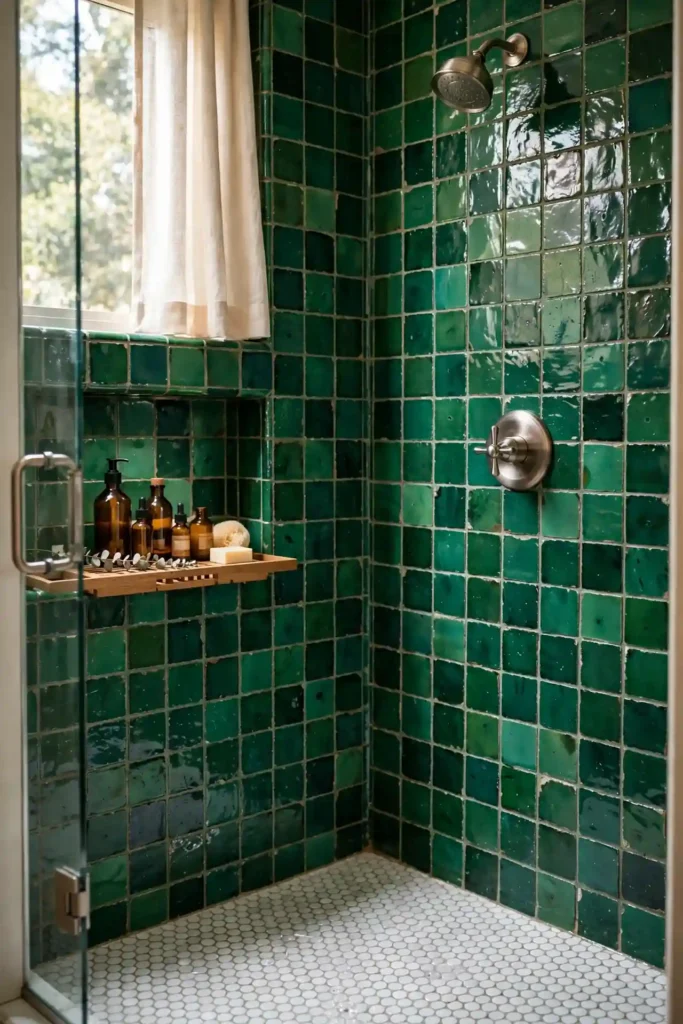
Zellige varies in thickness by design, so your installer should use a medium-bed mortar and grout with an unsanded product like Mapei Keracolor U in a soft white to avoid scratching the glaze. The penny floor’s many grout lines are your friend on the slope to the drain — all those joints make the mesh sheets conform beautifully and add serious slip resistance. Plan on sealing neither surface aggressively; a simple squeegee after showers keeps hard-water spots off the glaze in states like California and Nevada. Expect tile costs of $900 to $1,800 for a tub surround or walk-in shower, and pair it with brushed nickel fixtures and Sherwin-Williams Evergreen Fog on nearby walls for a pulled-together bath.
4. Black Hex Floor With White Walls
A bold black hex floor against clean white walls is the high-contrast classic that works in powder rooms and primary baths alike. The dark floor grounds the room and hides the everyday grime that shows instantly on light tile, which is a genuine blessing in high-traffic family bathrooms. Use matte black 2-inch hexagons — MSI’s options run about $4 to $6 per square foot at Home Depot — with a charcoal or black grout so the joints disappear into the pattern. Keep the walls simple with glossy white 3×6 subway or 4×4 squares to bounce light around, and the contrast will look sharp rather than heavy. It is the easiest way to make a small bathroom feel designed.
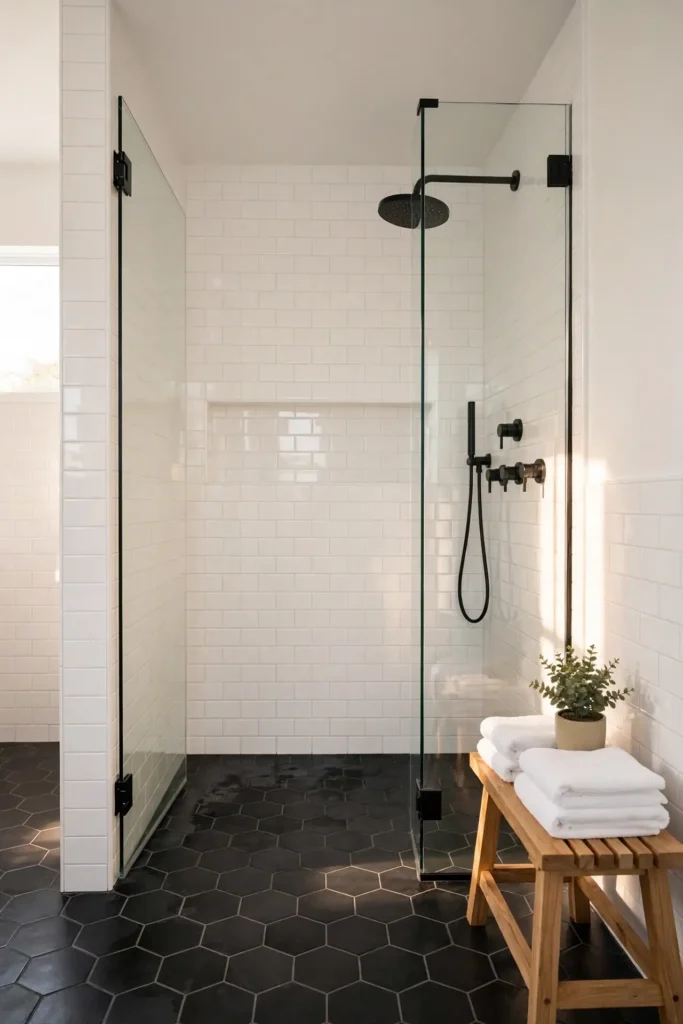
The trick to keeping this combo balanced is proportion: let the black live on the floor and maybe the niche back, but keep ceilings and at least one wall light so the room never feels like a cave. Pair it with matte black fixtures for a seamless modern look — Delta’s Trinsic shower trim kit runs about $180 to $250 at Lowe’s — or soften it with brushed brass pulls and a warm wood stool. Clean the black floor with a pH-neutral cleaner like Bona Stone Tile and Laminate spray; harsh bleach fades matte finishes over time. For drama, paint the vanity Benjamin Moore Wrought Iron and hang a round brass mirror, a pairing that photographs beautifully for resale listings.
5. Marble Walls With Matching Mosaic Floor
Slab-look marble walls with a matching mosaic floor is the five-star hotel formula, and it works beautifully in a US master bath when you pick materials that can handle real life. Use large-format porcelain that mimics Calacatta — 12×24 tiles from Daltile’s Marble Attache series cost about $5 to $8 per square foot — for the walls, then continue the same stone look with a coordinating 2-inch hex mosaic on the shower floor. Porcelain gives you the veining without marble’s etching and staining, which matters with American hard water and acidic shampoos. Carry the mosaic into the niche back for a custom detail that makes the whole shower feel intentional and expensive.

If you love real stone instead, budget for honed Carrara at $10 to $15 per square foot and commit to sealing it every six months with a penetrating sealer; wine, citrus, and harsh cleaners will etch polished marble fast. Either way, use a grout color matched to the lightest tone in the stone so joints disappear and the walls read as continuous slabs. Keep fixtures quiet — polished chrome or brushed nickel lets the veining be the star — and add layered lighting with a dimmable shower light, about $40 at Home Depot. This combination adds genuine resale value, especially in suburban markets where buyers expect a luxe primary bath.
6. Wood-Look Walls With Stone Floor
Wood-look porcelain walls with a natural stone floor bring the warmth of a cabin into a bathroom that still handles steam like a champ. Choose a porcelain plank in a weathered oak or walnut tone — Floor & Decor’s wood-look options run $3 to $6 per square foot — and install it vertically on the shower walls to draw the eye up and make low ceilings feel taller. Pair it with a slate or travertine-look stone floor in 12×24 tiles or pebble mosaics; the organic texture keeps the wood tones from feeling flat. This combo suits farmhouse, rustic-modern, and mountain homes beautifully, and it gives kids’ and guest baths a cozy, lodge-like character.
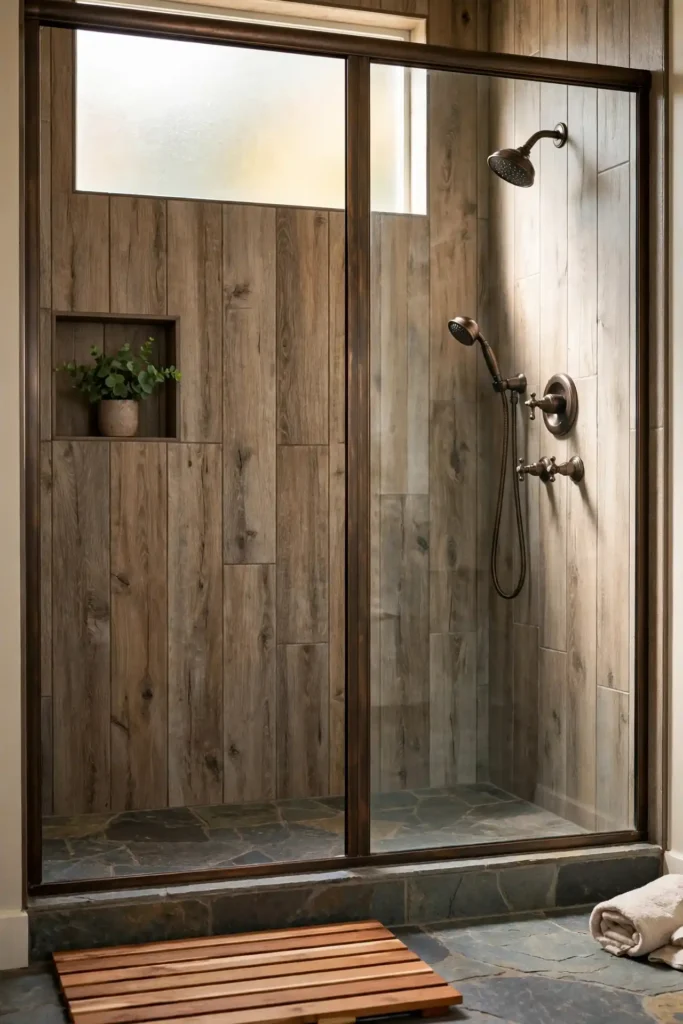
Real wood has no business in a shower, but porcelain planks are waterproof through and through, so you get the look with zero swelling or rot. Ask your installer to stagger the planks in thirds and use a grout color that matches the wood grain, which hides the joints and sells the illusion. Underfoot, pick a honed or tumbled stone finish — never polished — so wet feet grip safely; a stone-look porcelain paver at $4 to $7 per square foot is the budget-friendly move. Finish with oil-rubbed bronze fixtures and a cedar bath mat for about $35 on Amazon, and your shower will feel like a spa retreat tucked into the woods.
7. Vertical Stack Walls With Herringbone Floor
Vertical-stacked wall tile with a herringbone floor is a designer move that makes standard tile feel custom. Stack 3×12 or 4×16 tiles straight up the walls in a grid — no offset — using a handmade-look ceramic like the Bedrosian Cloe in white, about $8 per square foot, and watch the vertical lines stretch a standard 8-foot ceiling visually taller. Then turn the floor into the star with a herringbone layout in 2×8 or 3×12 tiles, which adds motion and craftsmanship underfoot. The herringbone takes more cuts and a skilled installer, so budget 15 to 20 percent more labor, but the finished look reads straight out of a design magazine.
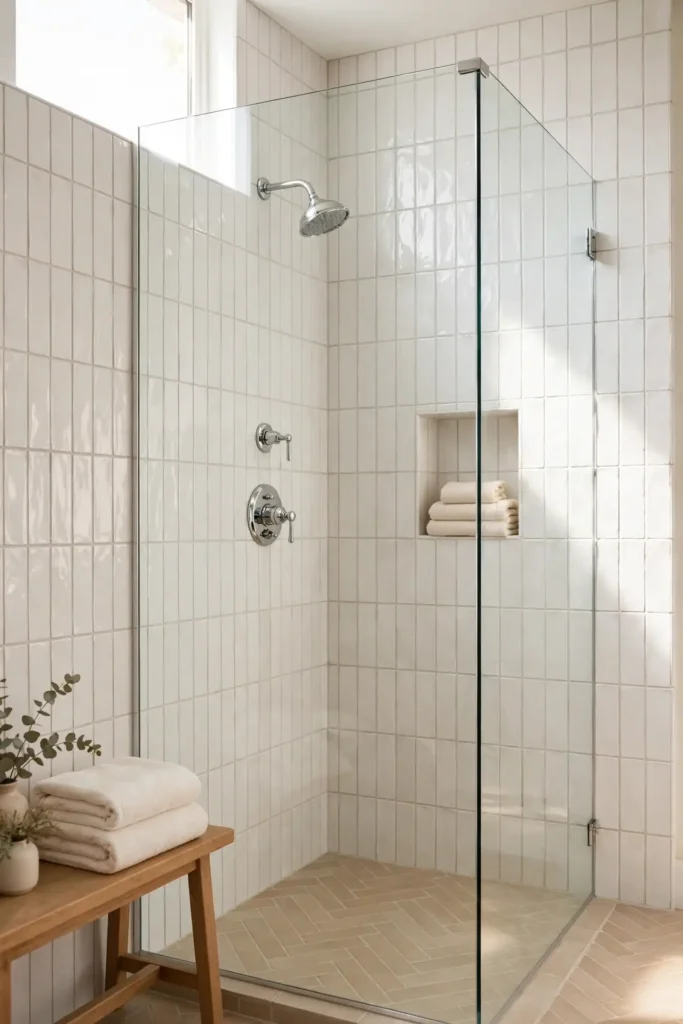
The key to this pairing is contrast in layout, not color — keep both surfaces in the same soft neutral family so the patterns complement instead of compete. A warm white stacked wall with a greige herringbone floor, grouted in Mapei Warm Gray, feels calm and current. Because herringbone’s many joints conform well to a sloped pan, it is genuinely practical on shower floors, and the small tiles give wet feet plenty of grip. Seal the floor yearly if you choose natural stone; porcelain needs no sealing at all. Pair with simple chrome fixtures and a frameless glass panel, and this combo suits everything from city condos to suburban new builds.
8. Terrazzo Floor With White Walls
A terrazzo-look floor with crisp white walls is the playful-meets-classic combo that has taken over American bathrooms in the last few years. Terrazzo’s confetti of marble, quartz, and glass chips adds energy and color without committing to a bold wall, and modern porcelain versions — like TileBar’s terrazzo looks at $9 to $14 per square foot — are waterproof, affordable, and far lighter than poured cement originals. Keep the walls in simple white 4×12 or large-format tile so the floor is the undisputed star. This pairing works in mid-century ranches, eclectic city apartments, and kids’ baths where a little personality goes a long way.
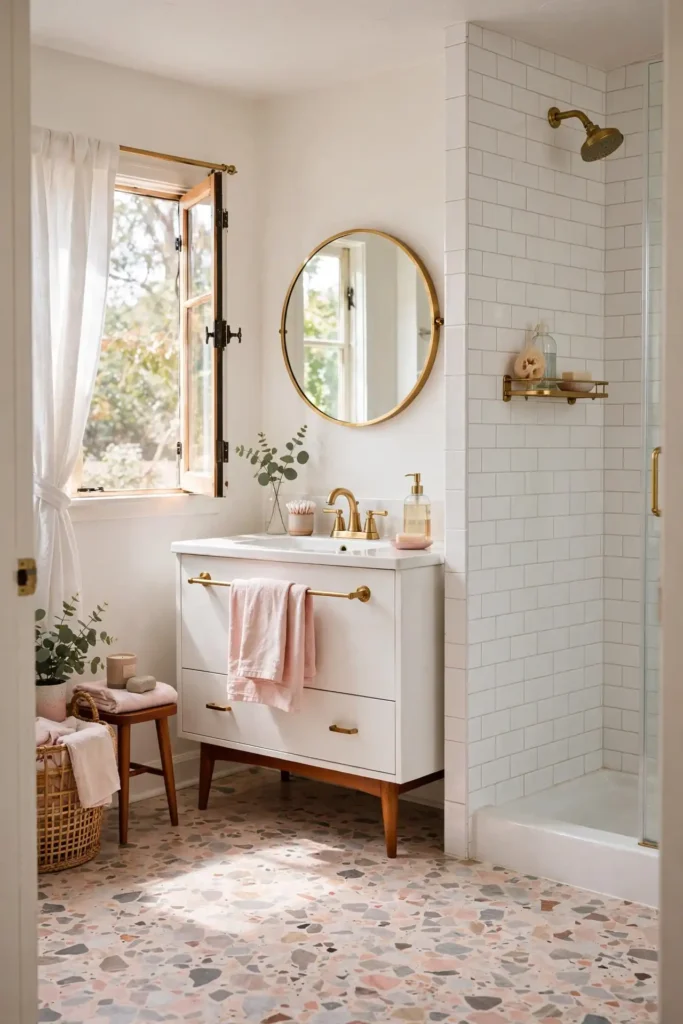
Because terrazzo contains many colors, pull one chip tone — say the soft blush or warm gray — and repeat it in towels, a bath mat, or the vanity paint color for a pulled-together look. On the floor, choose a matte or honed finish so wet feet stay planted; polished terrazzo can be slick. Grout in a light warm gray keeps the chips’ edges from looking harsh, and epoxy grout means the busy pattern never traps mildew. Budget around $800 to $1,400 in tile for a standard shower floor and curb. Add brass or matte black fixtures depending on your chip colors, and you will have a bathroom that feels joyful every single morning.
9. Blue Walls With White Floor
Deep blue walls with a white floor deliver coastal calm with real drama — think New England beach house meets modern spa. Run a rich navy or denim-blue tile floor to ceiling, like Daltile’s 4×12 in Midnight at about $4 to $6 per square foot, and balance it with a simple white hex or penny floor that keeps the room feeling fresh instead of heavy. Glossy blue tiles bounce shower light beautifully and hide water spots far better than white gloss. This combo suits coastal homes from Maine to Southern California, but it also gives landlocked bathrooms a vacation feeling that never gets old.

Keep the blue on the walls and the white on the floor — reversing it makes small bathrooms feel bottom-heavy. Pair the palette with warm brass or brushed gold fixtures; the metal’s warmth keeps navy from feeling cold, and a Delta Cassidy set in champagne bronze runs about $500 to $700. Use a light gray or white grout on the floor for easy cleaning, and a matching blue grout or tone-on-tone on the walls so the tile reads as one saturated surface. Add natural textures — a teak bench, woven hamper — and paint the vanity Benjamin Moore Hale Navy for a cohesive look buyers love.
10. Patterned Niche With Plain Walls
A patterned tile niche set into plain walls is the smartest way to get a designer moment without committing to pattern everywhere. Keep your shower walls in a quiet white or greige large-format tile, then line the back of the niche with a bold encaustic-look or zellige tile — you only need a few square feet, so you can splurge on a $15 to $25 per square foot statement tile from TileBar or Clé without blowing the budget. The niche becomes functional art that holds shampoo bottles and catches the eye. This trick works in rentals-turned-owned condos, spec homes, and any bathroom where you want personality on a budget.
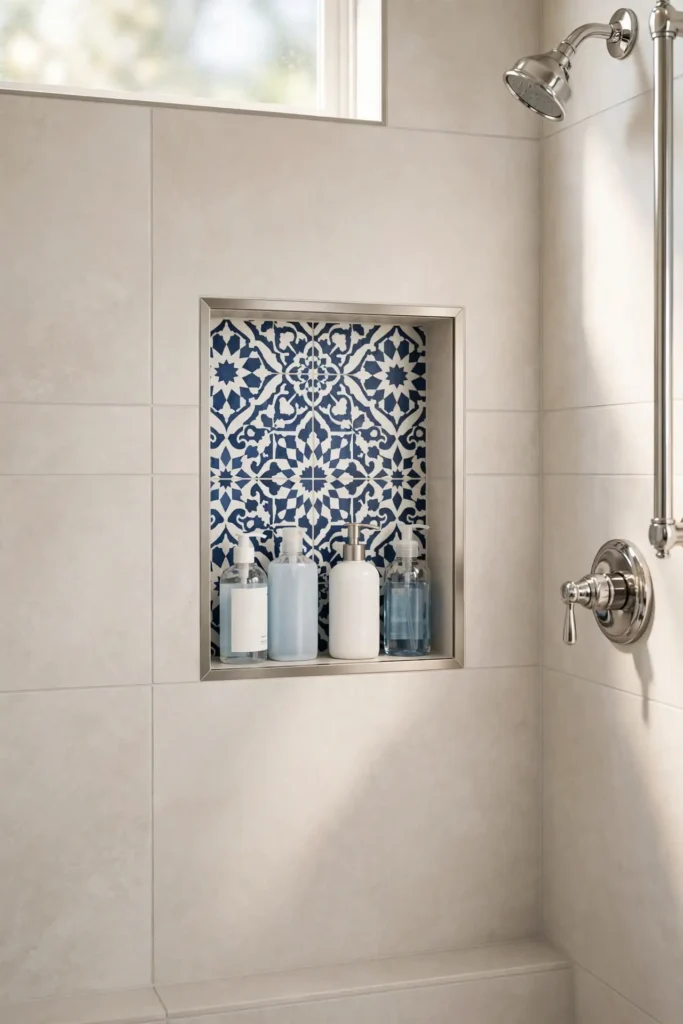
Plan the niche early — ideally 12 inches wide by 24 inches tall, centered at chest height — so your tile installer can waterproof it with the same Schluter-Kerdi system as the walls. A patterned back needs a simple shelf edge: use a matching Schluter trim in brushed nickel or matte black rather than a busy bullnose. Because the pattern lives in a small, contained rectangle, you can go as bold as you like: Moroccan stars, fish scale, even a mural-look tile. Then keep everything else quiet — plain floor, clear glass, simple fixtures — and the niche will read like a framed piece of art every time you step in.
11. Fish Scale Accent Wall
A fish scale — or mermaid — accent wall turns one shower wall into a piece of ocean-inspired art. These scalloped tiles, also called fan or scallop tiles, layer like scales and catch light in a way flat tile never can. Use them on the back wall of a walk-in shower or inside a tub surround, keeping the other walls in a coordinating solid — try Fireclay Tile’s scallops at $30 to $45 per square foot for the splurge, or Merola’s Artillo line near $10 at Home Depot. Soft sea-glass greens, pearly whites, and dusty blues are the timeless color bets. One wall is plenty; the pattern’s movement does all the talking.
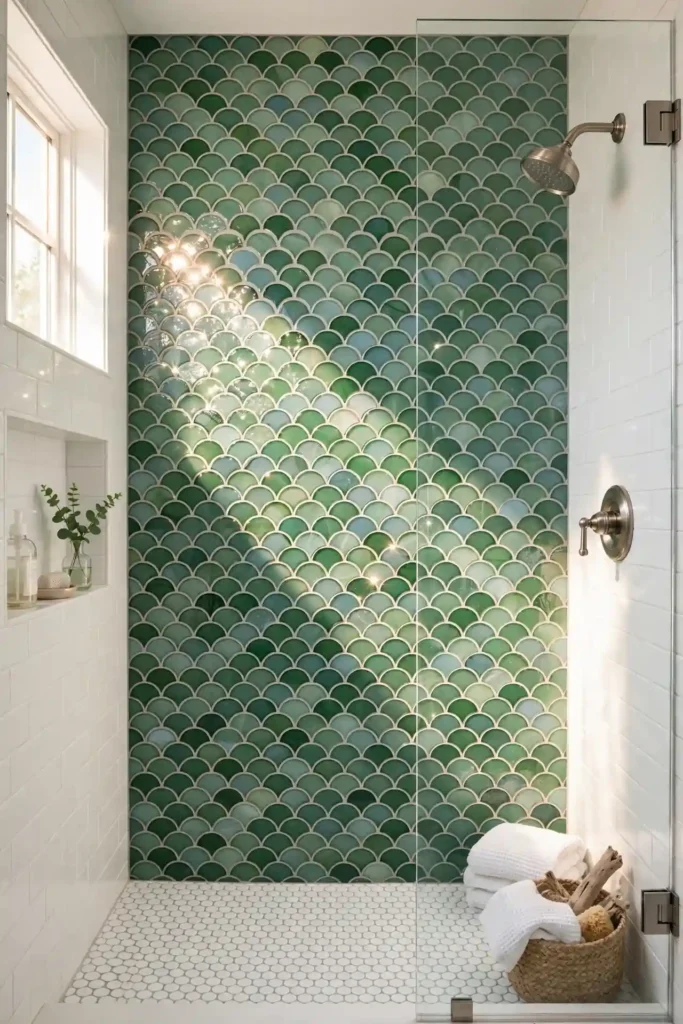
Fish scale tiles demand a patient installer because every scallop needs consistent spacing to keep the pattern crisp — budget about 20 percent more labor for the accent wall. Use a grout color close to the tile so the shapes stay soft and scalloped rather than grid-like; Mapei’s Frost or Warm Gray are safe bets. Pair the accent wall with a simple penny or hex floor in white or light gray so nothing competes with the scales. Finish with brushed nickel fixtures and a clear glass panel to keep sight lines open. In coastal markets from the Carolinas to California, this is the shower detail buyers photograph and remember.
12. Gray Walls With Charcoal Floor
Gray walls with a charcoal floor is the sophisticated neutral that never goes out of style in American bathrooms. Layer a mid-tone warm gray on the walls — Daltile’s 12×24 in a concrete look, about $3 to $5 per square foot at Lowe’s — with a deeper charcoal hex or 2×2 mosaic on the shower floor. The tonal shift adds depth without introducing a single bold color, which makes it perfect for resale: buyers read gray as clean, modern, and easy to live with. Keep the undertones consistent — warm with warm, cool with cool — or the combo can look muddy instead of layered.
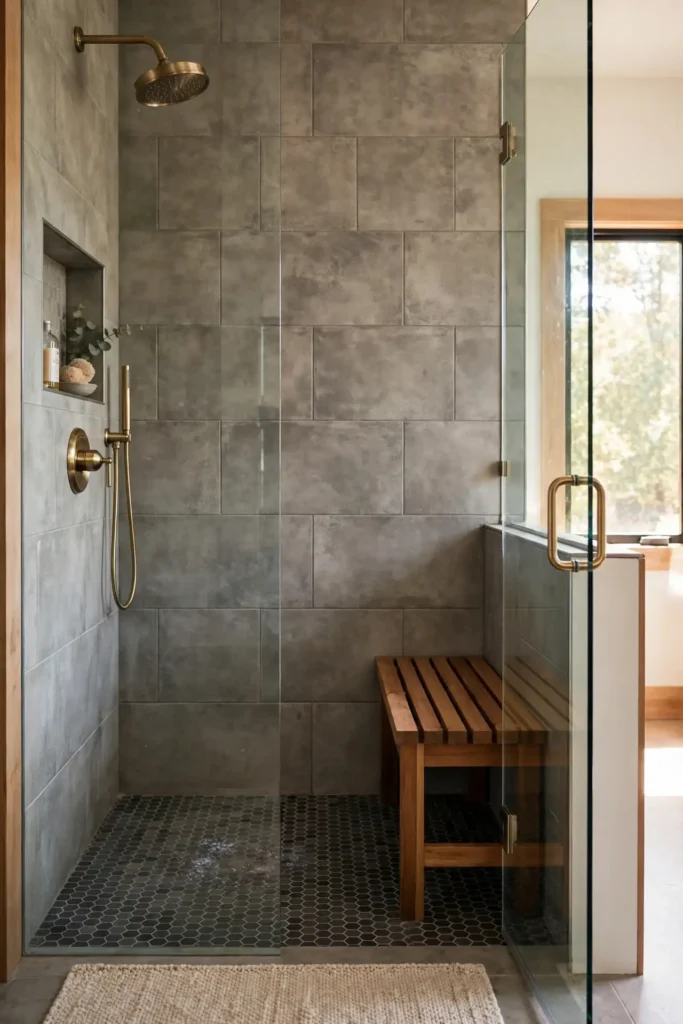
The risk with all-gray is flatness, so build in texture: a matte wall tile with a honed or slightly textured charcoal floor, plus a wood or woven accent, keeps the palette from feeling cold. Grout both surfaces in a matching gray — Mapei’s Pewter works on walls, Charcoal on the floor — so the installation reads seamless. Add warmth with brass fixtures or a teak bench, and paint the vanity Sherwin-Williams Urbane Bronze for a rich, grounded look. This combination costs roughly the same as any basic tile job, about $1,500 to $3,000 all-in for a standard shower, but it looks like a deliberate designer scheme.
13. Terracotta Floor With Cream Walls
Terracotta floors with cream walls bring sun-baked Mediterranean warmth into an American bathroom without feeling theme-y. Saltillo or terracotta-look porcelain on the floor — real Saltillo runs $4 to $7 per square foot, while porcelain versions cost about $3 to $5 at Floor & Decor — glows amber in natural light and hides dust beautifully. Pair it with creamy handmade-look wall tile in a soft ivory or warm white, installed in a stacked or running bond, so the walls stay quiet and let the floor’s color sing. This combo flatters Spanish-style homes, desert modern builds, and anyone who wants a bathroom that feels like golden hour.
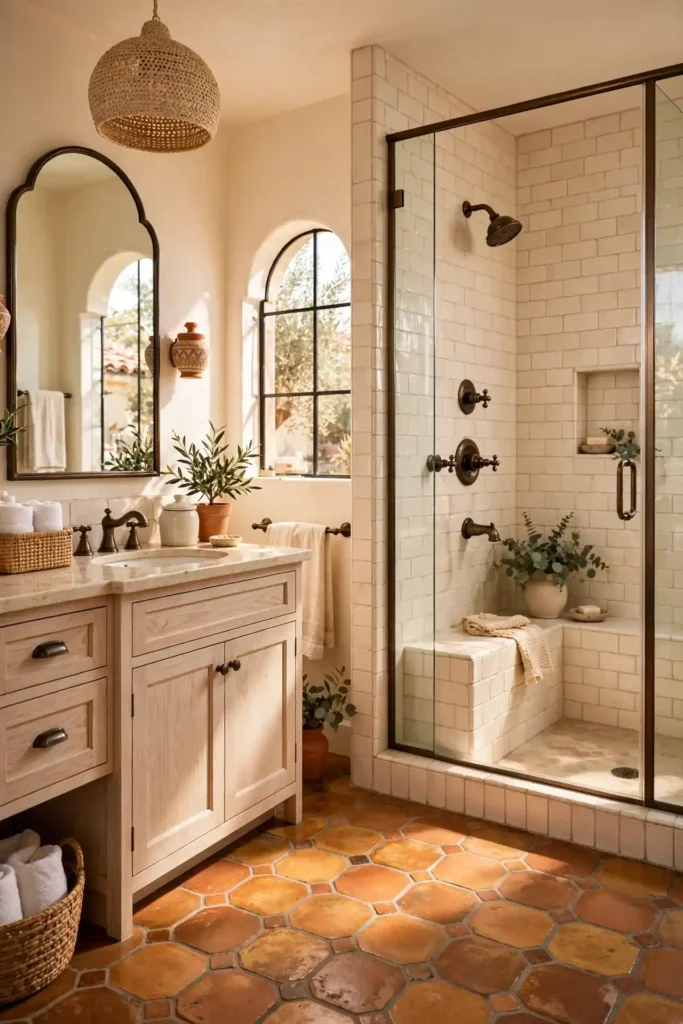
Real terracotta is porous, so seal it with three coats of penetrating sealer before grouting and reseal yearly — skip this and hard water will leave permanent rings. Porcelain lookalikes skip the maintenance entirely, which is why most busy families choose them. Grout the walls in a warm white like Mapei’s Biscuit so the handmade edges look soft, and use a sanded grout on the floor that matches the terracotta’s mid-tone. Finish with oil-rubbed bronze or matte black fixtures and a woven pendant light, and keep the vanity simple — white oak or painted Sherwin-Williams Accessible Beige lets the floor be the hero.
14. Slate Floor With Light Walls
A slate floor with light walls is the nature-lover’s shower: rugged underfoot, airy everywhere else. Natural slate’s cleft texture grips wet feet better than almost any tile, which makes it a smart pick for kids’ baths and aging-in-place remodels. Choose 12×12 or 12×24 slate tiles in a multicolor or black blend — about $5 to $9 per square foot at The Tile Shop — and seal them with an enhancing sealer that deepens the color. Keep the walls light and simple: glossy white subway or a soft greige large-format tile makes the dark floor feel intentional and keeps the room bright even without a window.
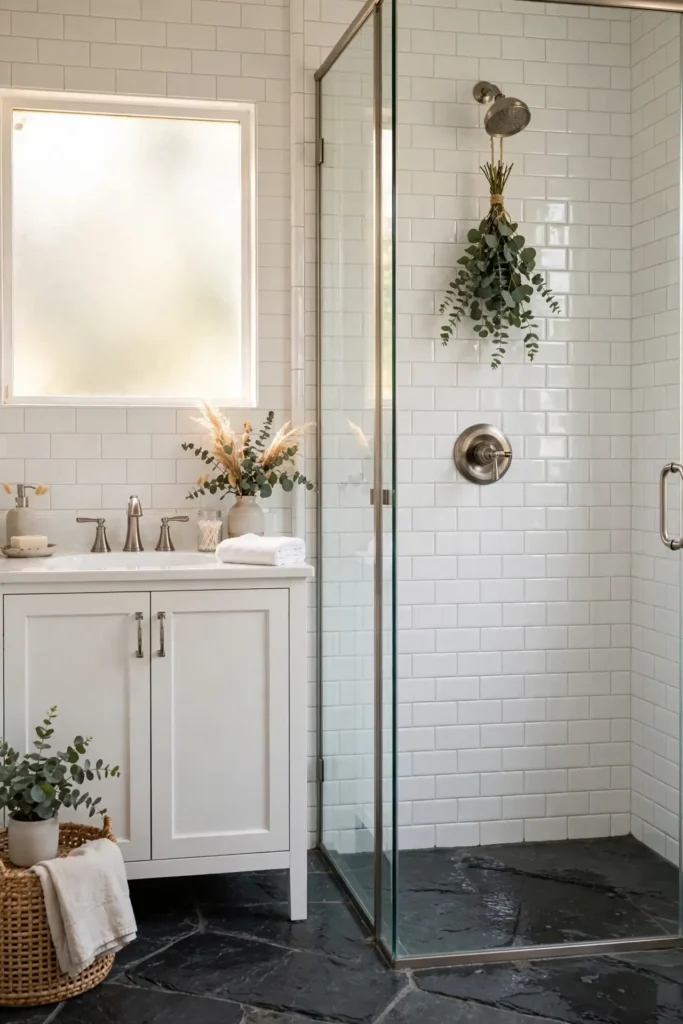
Slate varies from tile to tile, so have your installer dry-lay the floor and blend pieces from several boxes to avoid dark or light patches. The cleft surface hides soap scum and water spots, but it does need resealing every one to two years — set a calendar reminder. Grout in charcoal or a dark gray so joints vanish into the stone, and use the same membrane waterproofing under the mortar bed as any shower floor. Pair the look with brushed nickel or matte black fixtures and a simple white vanity; add a eucalyptus bundle on the showerhead for about $12 on Amazon and the whole bath smells like a forest spa.
15. Glass Mosaic Strip
A glass mosaic accent strip is the budget-friendly way to add sparkle and color to an otherwise simple shower. Instead of tiling a whole wall in expensive glass, run a horizontal or vertical band of glass mosaic — about $10 to $20 per square foot at Lowe’s or The Tile Shop — through field tile that costs a fraction of that. The glass catches light and adds depth, which is especially effective in windowless hall bathrooms. Place the strip at eye level as a chair-rail-height band, or run it vertically to make ceilings feel taller. It is a classic builder upgrade that still looks fresh today.

Keep the field tile quiet — white or light gray ceramic in 4×12 or 6×12 — so the glass band reads as jewelry, not noise. Choose a mosaic with mixed finishes, like frosted and iridescent chips, for maximum light play at a modest price. Your installer should use a white thinset behind glass mosaics so the mortar color doesn’t show through translucent tiles. Seal the surrounding grout lines with a penetrating sealer since glass itself needs none. Pair with polished chrome fixtures that echo the glass’s shine, and repeat one color from the mosaic in a hand towel or bath mat for a cohesive, finished look.
16. Black Walls With White Grout
Black walls with white grout make a graphic, grid-like statement that turns a shower into modern art. Use matte black 4×4 or 3×6 tiles — Daltile’s options run about $4 to $7 per square foot at Home Depot — and grout them in bright white with consistent 1/8-inch joints so every tile reads as a crisp square. The white grid keeps the black from feeling heavy and gives the whole shower a tailored, architectural look. This combo shines in powder rooms and guest baths where drama is welcome, and it pairs beautifully with white floors that bounce light back up into the dark walls.
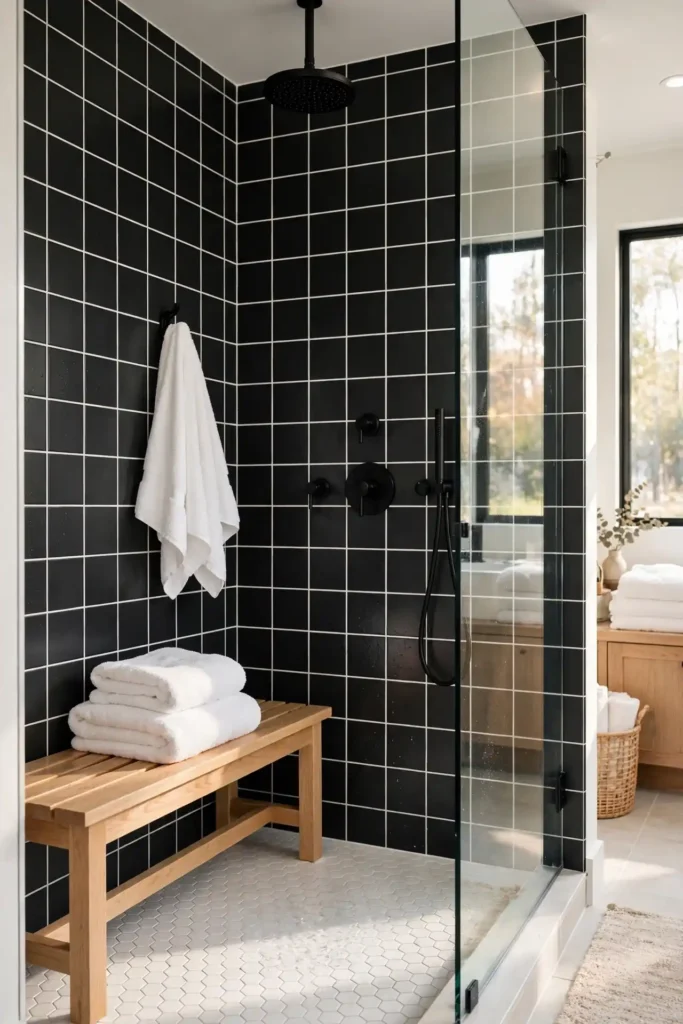
White grout on black tile shows every imperfection, so hire an installer who lasers their lines and uses tile spacers religiously — this is not the job for a first-timer. Seal the white grout with a grout sealer or choose a stain-resistant grout like Mapei Flexcolor CQ to keep the grid bright in a steamy shower. Keep fixtures bold and simple: matte black shower trim disappears into the walls for a seamless look, while brushed brass pops dramatically against the grid. Add a white oak bench and fluffy white towels, and the high-contrast palette feels like a boutique hotel in downtown Chicago or New York.
17. Blush Tile With Brass
Blush pink tile with brass fixtures is soft, warm, and quietly glamorous — the bathroom equivalent of a perfect nude lipstick. Choose a dusty rose or blush ceramic in 3×12 or 4×4 — Bedrosian’s Cloe in pink runs about $8 per square foot, or try Fireclay’s blush at $28 to $40 for the splurge — and let brass shower trim, about $450 to $650 for a Delta Trinsic set in champagne bronze, add the jewelry. The warm metal flatters pink undertones instead of fighting them. This combo suits primary baths, dressing-room-adjacent ensuites, and anyone who wants feminine without frilly.

Keep the floor quiet so the blush walls and brass can shine: a white or light gray hex, or a warm white penny round, works beautifully. Grout the blush tile in a matching soft pink-white like Mapei’s Avalanche so the walls read as one seamless blush surface rather than a grid. Add a marble-look threshold or bench top to bring in a cool counterpoint, and hang a round brass mirror over a white or light oak vanity. Paint adjacent walls Benjamin Moore Pink Damask at half strength or a warm white like White Dove, and the whole bath will feel like golden-hour light, all day.
18. Two-Tone Wall Tile
Two-tone wall tile — one color below, another above — gives your shower a custom, tailored look for the price of basic tile. Run a darker or bolder tile on the lower half of the walls and a lighter shade above, separated by a slim pencil liner or metal trim; a charcoal bottom with a white top is the classic, but navy over pale gray works too. This wainscot effect makes tall walls feel proportioned and hides the splash zone’s water spots on the darker tile. You will spend no more than a single-color job — roughly $3 to $6 per square foot for both tiles — but the result looks deliberately designed.

The dividing line is everything: set it at about 48 to 54 inches high, roughly chair-rail height, and cap it with a Schluter Jolly trim in a finish that matches your fixtures. Keep the two tiles the same size and finish — say 4×12 glossy in both colors — so the only change is color and the installation looks crisp. Grout each section in a matching tone so the color break stays clean. This combo is a resale darling because it feels custom without being taste-specific, and it works in every style from craftsman to contemporary. Add matching two-tone towels and the scheme feels complete.
19. Matching Floor and Wall Tile
Running the same tile on the floor and walls wraps your shower in one continuous material, which makes even a compact 3×5-foot shower feel larger and more serene. Choose a 12×24 or 24×24 porcelain in a concrete or stone look — about $4 to $7 per square foot — and use a coordinating 2×2 mosaic of the same series on the sloped shower floor so the color matches exactly. The unbroken surface reads calm and spa-like, with no visual seams to chop up the space. This is the go-to move in modern condos and small hall baths where every square inch of visual space counts.
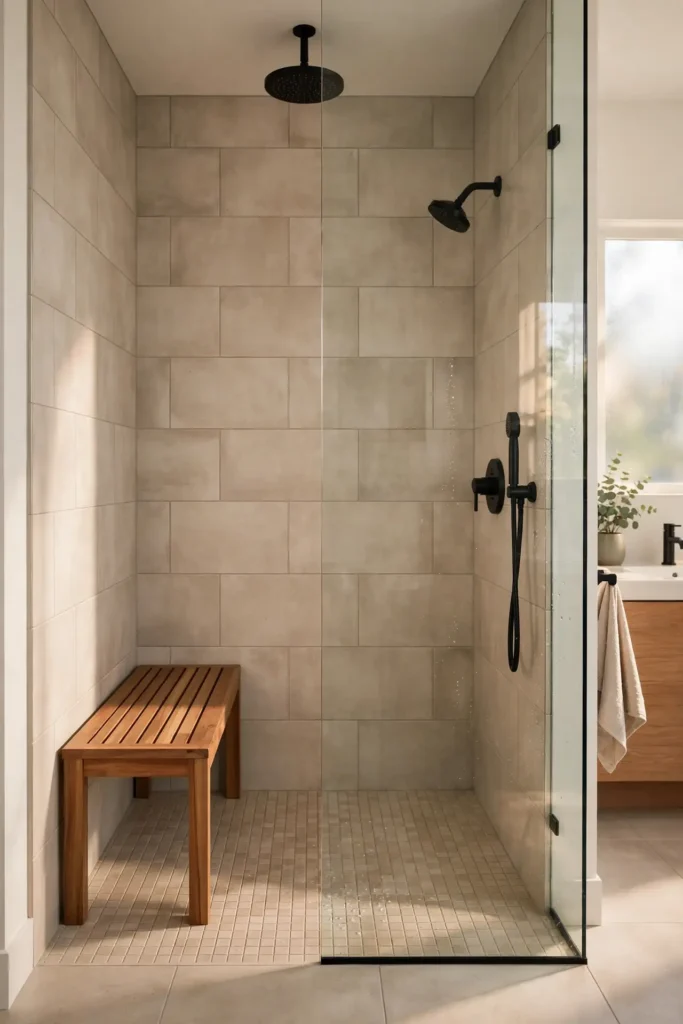
One material does not mean boring — vary the format and finish for interest. Try matte 12×24 on the walls with a honed 2×2 mosaic on the floor, or run the wall tile in a vertical stack while the floor stays in a simple grid. Keep grout tight at 1/16 inch and color-matched so the envelope feels seamless. Because everything coordinates automatically, fixture and vanity choices get easier: matte black, brushed nickel, or chrome all work. Budget roughly $1,000 to $1,800 in tile for a standard shower, and you will have a calm, cohesive bath that never looks dated — the safest long-term bet in this whole list.
20. Checkerboard Floor
A black-and-white checkerboard floor is the timeless showstopper that works in Victorian restorations, Parisian-style apartments, and modern farmhouses alike. Use 4×4 or 6×6 squares in honed marble or porcelain — porcelain checks run about $3 to $5 per square foot at Home Depot — set on the diagonal for extra drama or straight for a classic diner feel. Keep the shower walls simple and quiet: white subway or large-format white tile lets the floor be the star without visual competition. Few patterns have this much staying power, and buyers consistently photograph it first at open houses.

The classic checker uses 12-inch squares outside the shower and smaller mosaics inside, so plan a clean transition at the curb or glass line. Inside the shower, switch to 2×2 black-and-white mosaics of the same material so the pattern continues over the sloped pan safely — small tiles grip better and conform to the slope. Grout in white or light gray for the traditional look, and seal marble checks yearly. Pair with a pedestal or simple white vanity, polished chrome fixtures, and a clawfoot-style tub if you have one; the whole room will feel like a charming boutique hotel in New Orleans or Charleston.
21. Handmade Tile With Stone Floor
Handmade-look wall tile with a natural stone floor is the artisan pairing that makes a shower feel collected rather than decorated. Choose a zellige-look or hand-glazed ceramic — Clé Tile and Riad Tile sell authentic options from $20 to $40 per square foot, while Bedrosian’s Cloe delivers the look near $8 — in a soft white, sage, or clay tone, and let its uneven surface catch the light. Ground it with a tumbled travertine or slate-look stone floor that echoes the walls’ organic feel. The slight imperfections are the point: this combo celebrates craftsmanship and suits Mediterranean, boho, and modern organic homes.

Because handmade tile varies in thickness, your installer should sort tiles by depth and use a medium-bed mortar so faces sit flush — this is skilled-labor territory, so get three quotes. Seal natural stone floors with a penetrating sealer and reseal yearly; the handmade walls need only a good squeegee routine. Keep the palette earthy and the fixtures warm: unlacquered brass or oil-rubbed bronze, a teak stool, and a woven shade on the window. Paint the vanity a warm white like Behr Swiss Coffee and add handmade pottery for soap and cotton balls, and your shower will feel like a Moroccan riad crossed with a California bungalow.
22. Bold Accent Back Wall
A bold accent back wall turns the far wall of your shower into a focal point you see the moment you walk in. Go saturated — emerald green, cobalt blue, or dramatic black zellige — or go patterned with a large-scale floral or geometric tile, keeping the side walls and floor in quiet neutrals so the back wall owns the room. You only need tile for one wall, so this is where a $25 to $40 per square foot statement tile from Fireclay or Clé fits a normal budget. The trick is confidence: pick the tile you love most and let everything else support it.

Light the accent wall well — a recessed shower light or a skylight makes saturated glaze glow and patterned tile read clearly. Keep the side walls in a large-format neutral with minimal grout lines so they visually recede, and choose a floor that picks up one quiet tone from the accent tile. Fixtures should be simple: matte black or brushed nickel lets the wall be the jewelry. If you ever tire of the bold choice, repainting the vanity or swapping towels refreshes the room for under $200. In open-concept primary suites, this is the shower detail guests ask about — and the one that lands in real estate photos.
23. Minimal Monochrome
Minimal monochrome — one color, top to bottom — is the quiet-luxury shower that makes small bathrooms feel calm and expensive. Pick a single soft white, warm greige, or pale gray porcelain in a large format, 12×24 or bigger, and run it across walls and floor with tight 1/16-inch joints and color-matched grout. With no pattern or contrast to catch the eye, the room reads larger and the fixtures become the jewelry. This is the Scandinavian-influenced look dominating new American builds, and it is mercifully easy to clean since there are no busy grout lines trapping soap scum.

Monochrome only works when the details are perfect, so invest in installation: lippage-free leveling clips, perfectly plumb walls, and a linear drain — about $300 to $500 for a quality stainless model — keep the minimal look crisp. Add warmth through texture rather than color: a teak bench, a nubby bath mat, and brushed brass or matte black fixtures prevent the palette from feeling sterile. Choose a grout one shade deeper than the tile so joints don’t glow white and break the spell. The result is a serene, hotel-like shower that suits busy mornings and slow Sunday soaks equally well.
24. Coordinate Grout
Coordinating your grout — matching it to the tile or deliberately contrasting it — is the small decision with outsized impact on your shower’s final look. Match the grout to the tile for a seamless, high-end read: Mapei’s Keracolor in a tone pulled from the tile makes walls look like continuous stone. Or go bold with contrast — dark charcoal grout on white subway is the classic — knowing it will spotlight every tile edge, so your installer’s lines must be laser-straight. Either way, choose a stain-resistant grout like Mapei Flexcolor CQ or Laticrete SpectraLOCK so the color you pick is the color you keep.
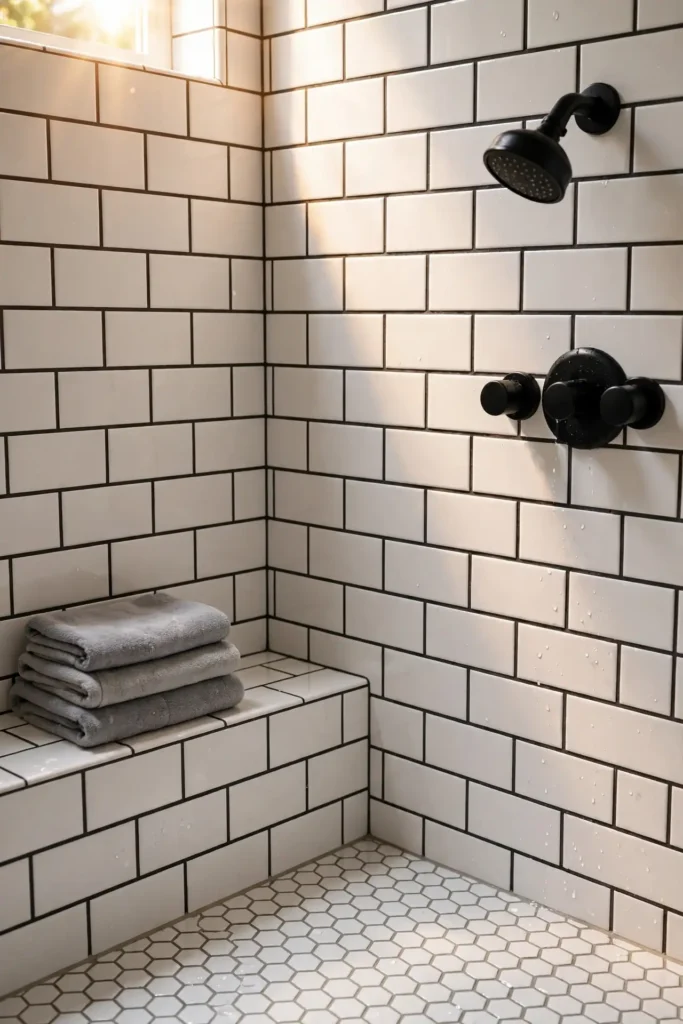
Test grout colors before you commit: buy three small bags, smear samples on a spare tile, and view them wet and dry in your bathroom’s light — grout dries noticeably lighter than it looks in the bucket. In showers, epoxy or high-performance cement grout resists the pink mildew and hard-water staining that ruins standard grout within a year. Budget about $50 to $100 extra for premium grout on a standard shower; it is the cheapest upgrade in the whole project. And whatever you choose, seal cement grout yearly with a spray-on sealer — five minutes of work that keeps your shower looking freshly installed.
How to Choose Shower Tile Combinations
Choosing a shower tile combination gets easy when you work in this order: floor first, then walls, then grout. Start with the floor because slip resistance and slope conformity limit your options — small mosaics, textured stone, or matte porcelain in 2×2 or hex formats are the safe bets. Then pick walls that contrast the floor in either scale or finish: large-format walls with mosaic floors, or glossy walls with matte floors. Finally choose grout to either disappear or make a statement. Bring home full-size samples and view them together in your bathroom’s actual light before ordering anything.

Set your budget before you fall in love: basic ceramic and porcelain run $2 to $6 per square foot, mid-range handmade-looks cost $8 to $15, and artisan tile climbs past $25. A standard tub surround needs about 70 square feet of wall tile; a walk-in shower needs 90 to 120. Order 10 to 15 percent extra for cuts and breakage, and buy all boxes from the same dye lot — check the numbers on the box ends. Photograph your finalists taped to the wall, then sleep on it: the combination you still love in the morning is the one. Most US tile shops offer free design help if you bring measurements.
Consider maintenance, too. Small floor tiles provide grip but more grout to clean. Large wall tiles reduce grout lines and are easier to maintain.
Safety and Function
Beautiful tile means nothing if the shower isn’t safe, so build function into every choice. Shower floors need real traction: look for tile with a DCOF rating of 0.42 or higher — the ANSI standard for wet areas — which includes most honed stone, textured porcelain, and small mosaics whose grout lines add grip. Slope the pan a quarter inch per foot toward the drain so water never pools, and consider a linear drain for curbless, wheelchair-friendly entries. If anyone in your home is over 65 or has mobility issues, these details aren’t optional; they’re what keep a pretty bathroom from becoming a hazard.
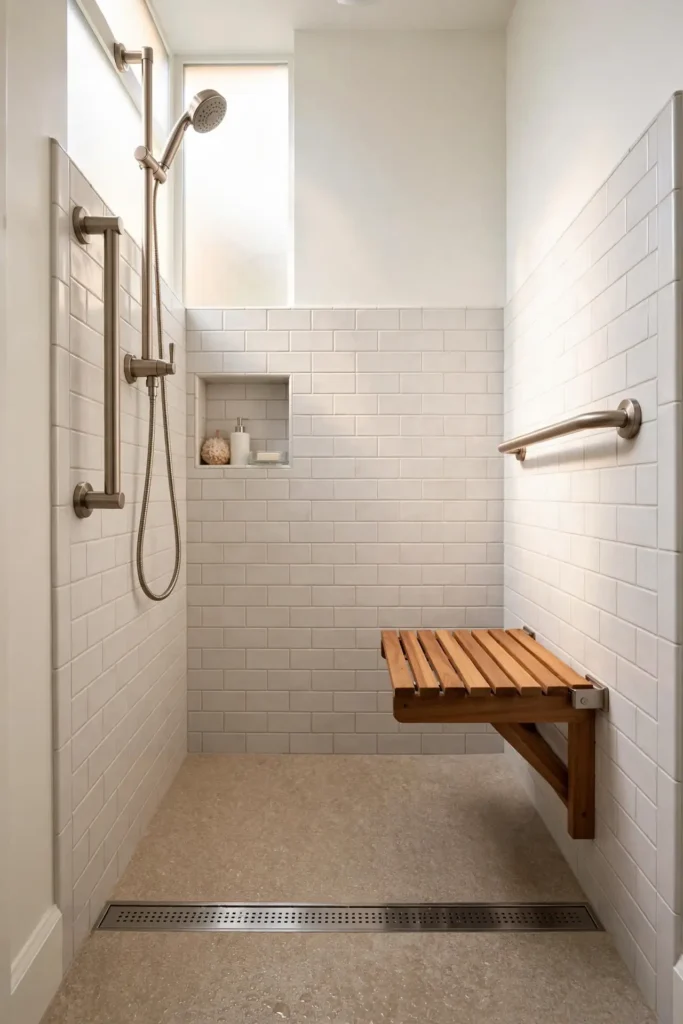
Add blocking behind the tile for future grab bars even if you don’t need them today — a 2×8 board between studs at 33 to 36 inches high costs almost nothing during a remodel and saves a fortune later. Choose a fold-down teak bench, about $150 to $250 on Amazon or at Costco, over a built-in corner seat if you want flexibility. Keep controls reachable from outside the spray: mount the valve on the wall opposite the showerhead or add a secondary control near the entry. And pick a handheld shower on a slide bar — Delta and Moen models run $120 to $200 — so kids, pets, and seated users all get an easy rinse.
Budget Tips
A gorgeous shower tile job doesn’t require a luxury budget — it requires smart allocation. Splurge where your eye lands: the back wall, the niche, or the floor, and save on the surrounding field tile with a $2 to $4 per square foot basic from Home Depot or Floor & Decor. A $25-per-square-foot statement tile covering just 10 square feet costs $250, while basic tile on the remaining 90 square feet at $3 costs $270 — a designer look for barely over $500 in materials. Keep layouts simple: straight stacks and running bonds cut faster than herringbone, saving $500 to $1,000 in labor.
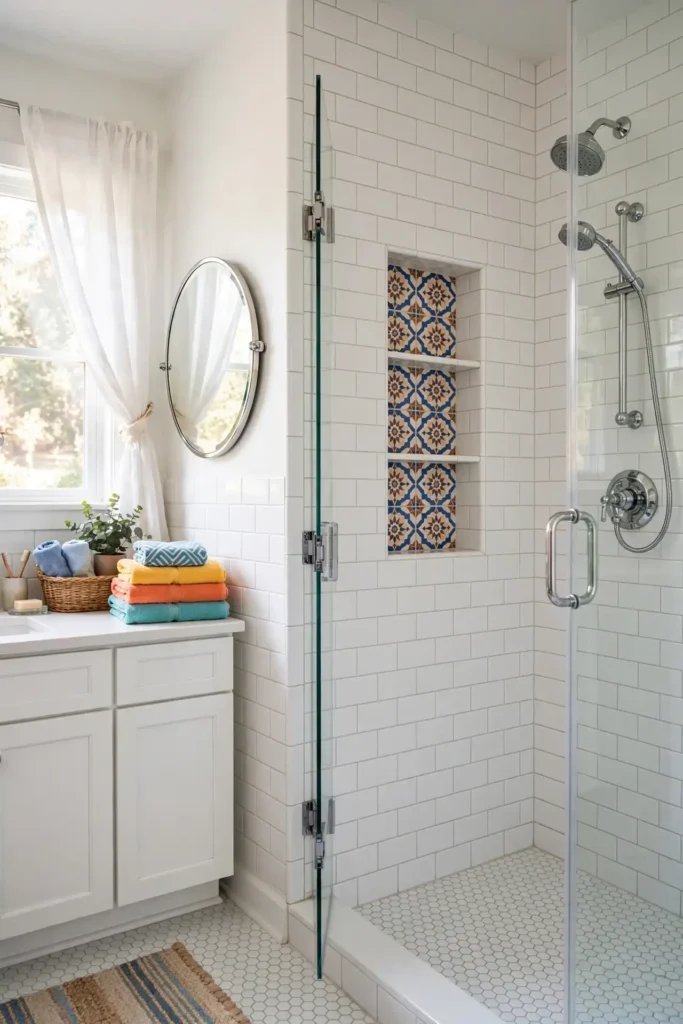
Shop the sales calendar: Floor & Decor, The Tile Shop, and Lowe’s run major tile promotions around Memorial Day, Labor Day, and Black Friday, with discounts of 20 to 40 percent. Check the clearance and overstock sections — discontinued lines often sell for half price and work perfectly when you need under 100 square feet. Buy your grout, thinset, and waterproofing membrane yourself rather than through the contractor’s markup; a Schluter-Kerdi kit for a standard shower costs about $400 to $600 retail. Finally, get three itemized quotes and ask each installer what layout changes would lower labor — sometimes switching one wall to large-format tile saves a full day’s work.
When it comes to shower tile combinations, the best results come from balancing style, comfort and everyday function.
How to Plan Shower Tile Combinations Step by Step
Plan your shower tile in five steps and you’ll avoid the expensive mistakes that derail remodels. Step one: measure everything — wall heights, widths, niche size, and the pan dimensions — and sketch it on graph paper or a free app like the Tile Calculator at Home Depot. Step two: choose your floor tile first for slip resistance, then walls for contrast. Step three: order full-size samples and tape them to the actual walls to check color in morning and evening light. Step four: confirm your waterproofing plan — Schluter, RedGard, or Wedi — with your installer before a single tile is ordered. Step five: order 15 percent extra and schedule delivery a week before demo ends.
Build a simple timeline: one week for samples and decisions, one to two weeks for tile delivery — artisan tile can take six to eight weeks, so order early — and one to two weeks for installation of a standard shower. Confirm lead times in writing before you pay deposits. Create a one-page spec sheet listing every tile name, size, grout color, trim finish, and fixture model, and give a copy to your installer and keep one yourself; this single page prevents most miscommunication. Photograph the waterproofing before tile goes up — if there’s ever a leak claim, those photos are gold. Then step back and let the pros work.
- Choose your statement tile.
- Select supporting wall and floor tiles.
- Check undertones and scale together.
- Plan layout patterns and grout color.
- Hire an experienced installer.
Final Thoughts on Shower Tile Combinations
The shower tile combinations that always work share one trait: contrast with intention. Pair large with small, glossy with matte, or patterned with plain, and the room gains depth without visual chaos. Every pairing in this list has survived years of real bathrooms, hard water, and changing trends — from classic white subway with marble hex to bold black walls with white grout — because each balances a quiet surface with a moment of interest. You don’t need the most expensive tile; you need the right relationship between the surfaces. Get the floor, walls, and grout talking to each other and the whole bath clicks.
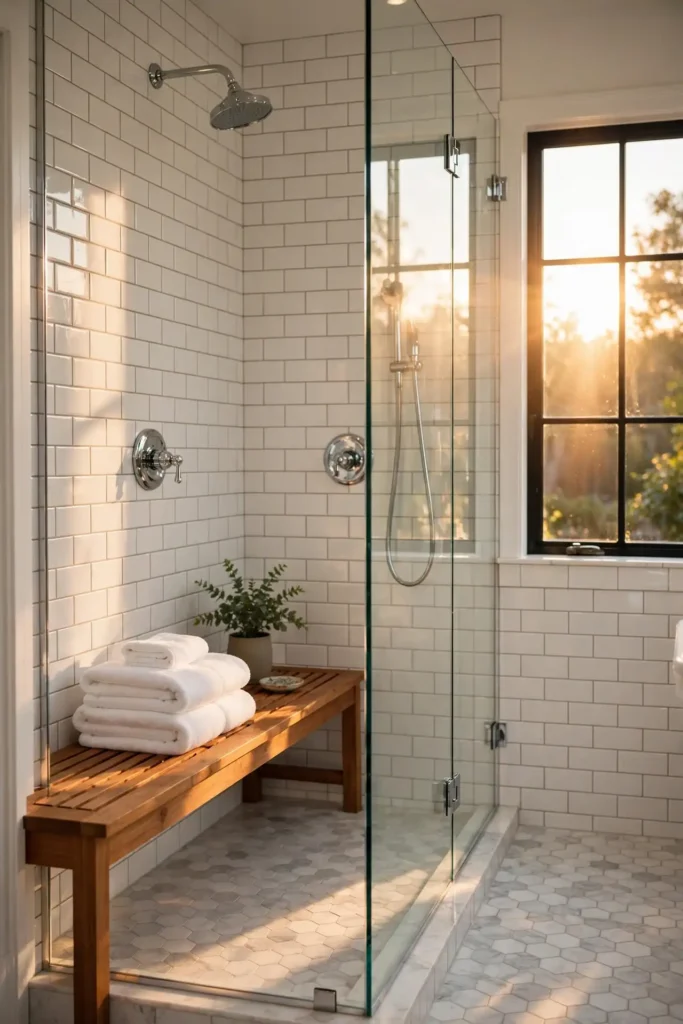
Start with the combination that made you stop scrolling, then adapt it to your budget and bathroom size using the tips above. Order samples this week — most US tile shops ship them free or for a few dollars — and tape them to your shower wall to live with the pairing for a few days. Take photos in morning and evening light, check the grout options, and confirm your installer’s waterproofing plan. A well-planned shower tile job lasts 20 years or more, so the week you spend deciding pays off every single morning. Your future self, stepping into that finished shower, will thank you.
Save these ideas and follow along for more bathroom inspiration.
Frequently Asked Questions About Shower Tile Combinations
You’ve now seen 24 shower tile combinations that work in real American bathrooms, from timeless white subway with marble hex to bold black walls with white grout. The throughline is simple: successful pairings balance contrast and restraint, pairing one statement surface with quieter companions so the room feels designed rather than busy. Whether your budget is $500 in basic porcelain or $5,000 in handmade zellige, the same rules apply — choose the floor for safety first, contrast scale or finish on the walls, and coordinate your grout with intention. Keep these principles handy as you shop samples and talk to installers.

The detailed answers to the most common questions — costs, grout choices, slip resistance, sealing schedules, and how to mix patterns safely — are covered in the FAQ block below, so use it as a quick reference while you plan. If you’re still deciding, revisit the combination that caught your eye and order full-size samples before committing; living with the tile for a few days in your own bathroom light prevents more regret than any article can. Pin your favorite pairings from this guide, share them with your contractor, and enjoy the process — choosing shower tile is one of the most satisfying parts of a bathroom remodel.
Should shower floor and wall tiles match?
They should complement each other but do not need to match.
How many tiles should a shower have?
Two or three types at most.
What is the best floor tile for a shower?
Small mosaics, pebbles or textured porcelain for grip.
Can I use large tiles on a shower floor?
Only with proper slope and a linear drain; small tiles are usually safer.
What grout color is best for showers?
Mid-tone grays hide stains and suit most tile colors.




Leave a comment