


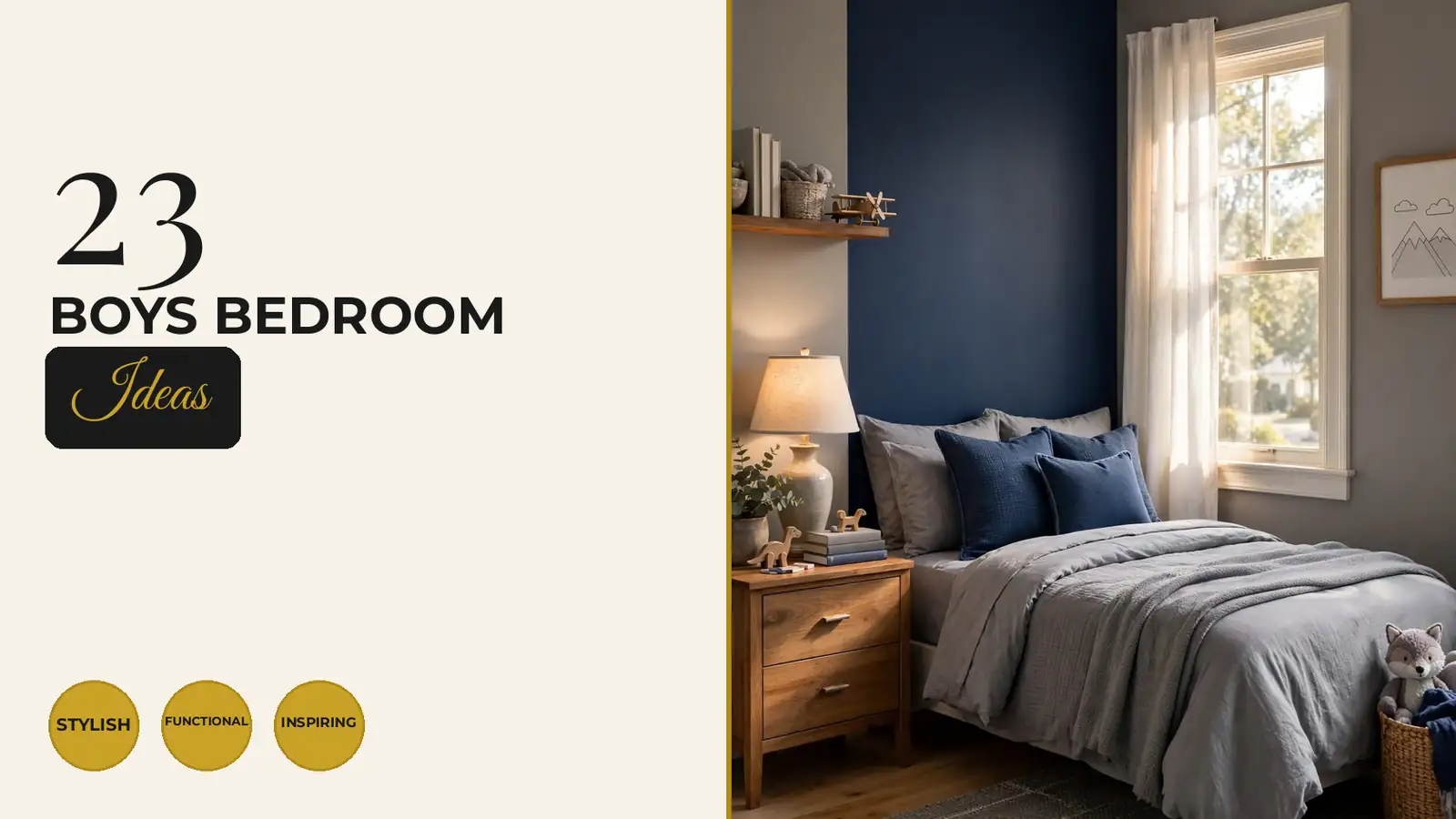
Boys aged 8 to 10 are in an exciting stage. They are developing strong interests, spending more time on homework and hobbies, and starting to want a say in how their room looks. A good bedroom for this age balances fun themes with furniture and colors that will still work as they move into the tween years.
These 23 boys bedroom ideas focus on flexible design, smart storage and personality. For more inspiration, see our kids room ideas and these 10 year olds room ideas.
Tips for a room that grows with him:
- Choose neutral or classic colors for walls and furniture.
- Express themes through bedding, art and accessories.
- Include a desk for homework and hobbies.
- Plan plenty of storage for collections and sports gear.
1. Navy and Gray Palette
Navy blue and gray is the classic boys bedroom color scheme that survives the leap from ages eight to eighteen, because it reads calm and grown-up rather than childish. Paint three walls a warm neutral gray such as Benjamin Moore Revere Pewter and make the fourth a rich navy accent with Sherwin-Williams Naval, which sells for roughly $55 to $65 per gallon at Home Depot. Finish the look with gray bedding from Target’s Pillowfort line for about $40 to $60, and repeat the navy in pillows, a desk chair, or a storage ottoman. You will love how the palette hides scuffs, makes a small room feel bigger, and instantly looks pulled together.
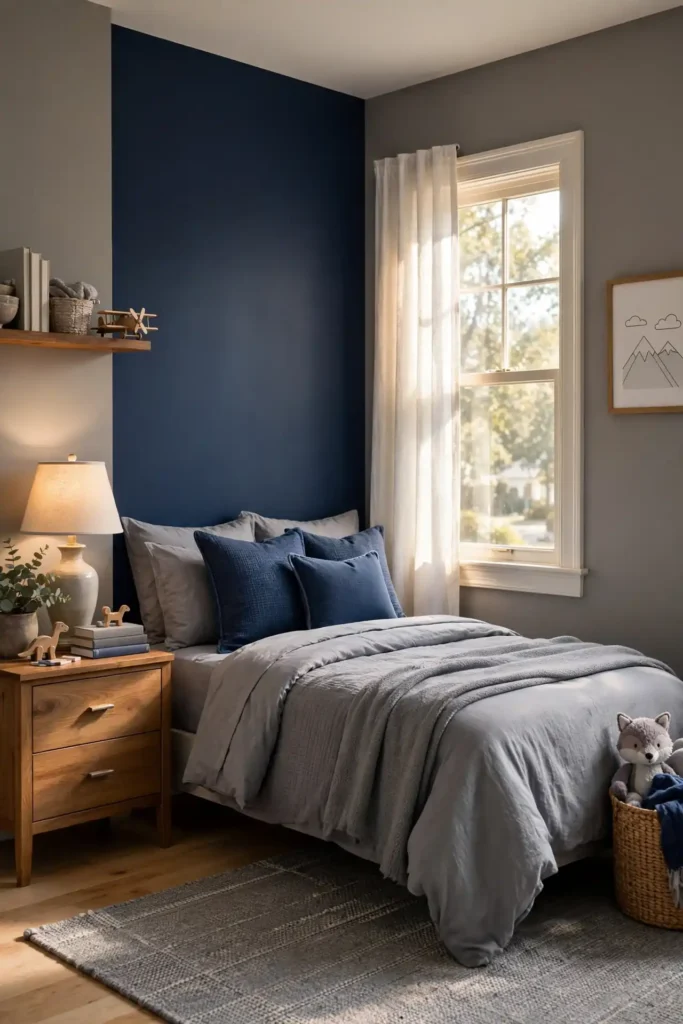
The biggest win with navy and gray is how easily you can refresh the room later without repainting a single wall. Hang sports posters at age nine, swap in music art at fourteen, and the backdrop still works beautifully. Choose an eggshell or matte sheen on the walls for a forgiving finish, and pick a washable latex so marker mishaps wipe away with a damp sponge. If the bedroom is under 120 square feet, keep the navy to one accent wall so it does not close the space in. Anchor it all with a 5-by-7-foot gray area rug from Amazon for about $70 to ground the bed and soften noise.
2. Loft Bed With Desk Below
A loft bed with a desk underneath is one of the smartest ways to double the floor space in a boy’s bedroom, especially in a 10-by-10-foot room where every inch counts. Twin-size loft beds with a built-in desk start around $250 to $400 on Amazon and at Target, and most leave about 55 inches of clearance below the mattress, which is plenty for an 8- to 10-year-old to sit and work. Make sure the model you choose is rated for at least 175 pounds and has full-length guardrails on the top bunk. Assemble it with a partner, tighten all bolts, and place the desk side near a window so homework gets natural light.
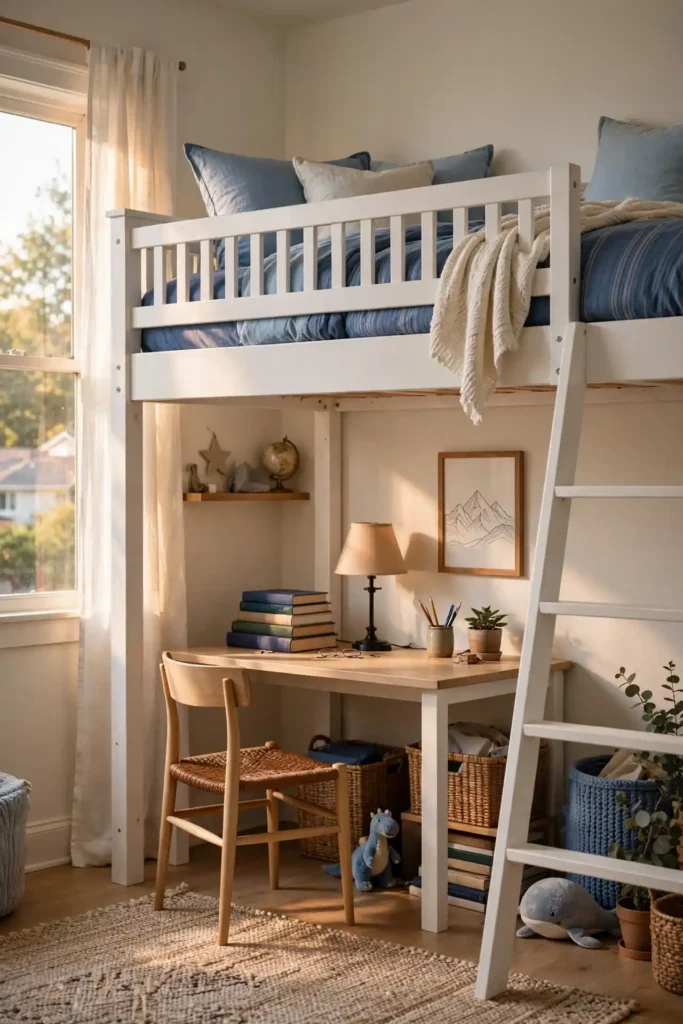
Before you buy, measure the ceiling height: you need at least 8 feet so your son can sit up in bed without bumping his head. If the ceilings are lower, a mid-loft around 50 inches tall is the safer pick. Add a clip-on LED lamp or stick-on puck lights under the top bunk for $15 to $25 from Home Depot so the desk zone doesn’t feel like a cave. A rolling caddy or small drawer unit fits perfectly beside the chair for pencils and notebooks. Choose a solid wood or heavy-duty metal frame over particleboard, since active boys climb hard and you want a frame that lasts into the teen years.
3. Bunk Beds for Sleepovers
Bunk beds turn an ordinary bedroom into sleepover headquarters, and for an 8- to 10-year-old boy that matters more than almost any other feature. A sturdy twin-over-twin bunk in solid pine runs about $300 to $500 at Target or Amazon, and models that separate into two single beds are the smartest investment because they adapt when the sleepover phase fades. Look for a frame certified to ASTM safety standards with a ladder that locks into place and guardrails on both sides of the top bunk. Keep the mattress under 8 inches thick on top so the rails stand at least 5 inches above it.
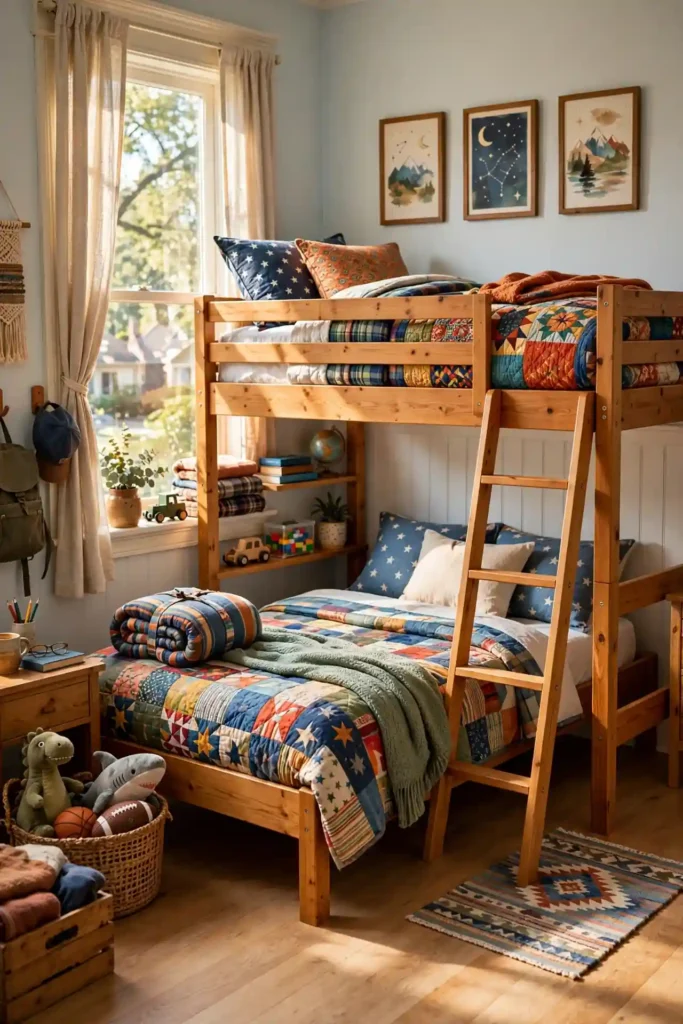
Safety setup takes thirty minutes and saves you real worry. Anchor the bunk to a wall stud with an anti-tip kit, which costs under $10 at Lowe’s, and place a soft 4-by-6-foot rug beside the ladder for nighttime climbs. Skip the fun but dangerous extras like slides or trampolines near the bed, and teach a simple rule: the top bunk is for sleeping, never jumping. If your son shares the room, a trundle drawer under the bottom bunk adds a third sleeping spot for about $80 without taking up floor space. Rotate and flip the mattresses twice a year so they wear evenly under active kids.
4. Sports Theme
A sports-themed bedroom lets your 8- to 10-year-old wear his pride on the walls, and it is one of the easiest themes to age up over time. Start with bedding in his team colors from Target for about $45 to $75, then add framed jerseys, pennants, and posters you can swap out as his interests change. Peel-and-stick wall decals of basketballs, soccer balls, or footballs cost $15 to $30 for a full set on Amazon and come off cleanly when he moves on to a new favorite. Paint the walls a neutral gray or white so the theme lives in the accessories, not the drywall.
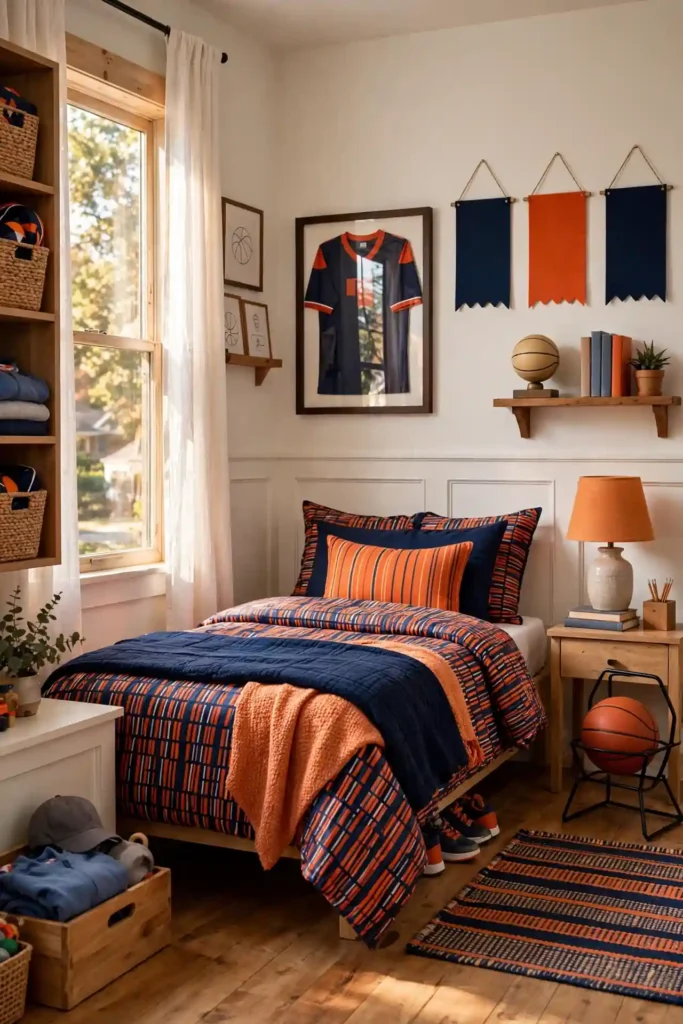
Function matters as much as looks in a sports room, so give equipment a real home instead of letting it pile up on the floor. A wall-mounted ball rack holds three balls for about $25 at Dick’s Sporting Goods, and a set of heavy-duty hooks from Home Depot keeps bats and gloves off the ground. If he plays basketball, an over-the-door mini hoop for around $30 delivers hours of play without the wall damage of a mounted backboard. Add a trophy shelf at eye level so his medals and ribbons stay visible. Keep memorabilia behind a simple rope barrier if he shares the room with a rambunctious younger sibling.
5. Space and Science Theme
Space and science themes spark genuine curiosity in 8- to 10-year-old boys while still looking sharp enough to last. Paint the ceiling a deep midnight blue or black using Behr’s Starless Night for about $45 a gallon at Home Depot, then stick on glow-in-the-dark stars for $12 a pack from Amazon. A telescope by the window, a solar-system mobile, and a bookshelf stocked with National Geographic Kids books turn the theme into something he actually learns from. Keep furniture in neutral wood tones so the room doesn’t feel like a costume set when the obsession cools.

Layer in the science angle with hands-on details that make the room interactive. Mount a magnetic whiteboard for $35 from Target where he can track the moon phases or sketch rocket designs, and add a constellation projector nightlight for about $25 that doubles as a bedtime lamp. Floating shelves can hold a rock collection, a model Saturn V rocket, and framed NASA posters you can download and print for under $20. Choose a dark navy duvet cover that hides grubby fingerprints and pairs with the ceiling. The theme works best when you leave one wall neutral for future swaps.
6. Adventure and Map Theme
An adventure and map theme feeds an 8- to 10-year-old boy’s imagination and works beautifully in warm, woodsy colors that age well. Hang a large world map poster or a peel-and-stick map mural for $30 to $60 from Amazon as the focal wall, and mark every place your family has visited with red pushpins. A compass-style wall clock, vintage-look suitcases stacked as a nightstand, and a khaki or forest-green quilt complete the explorer vibe. Paint the other walls a warm tan or cream like Sherwin-Williams Accessible Beige so the room stays bright.
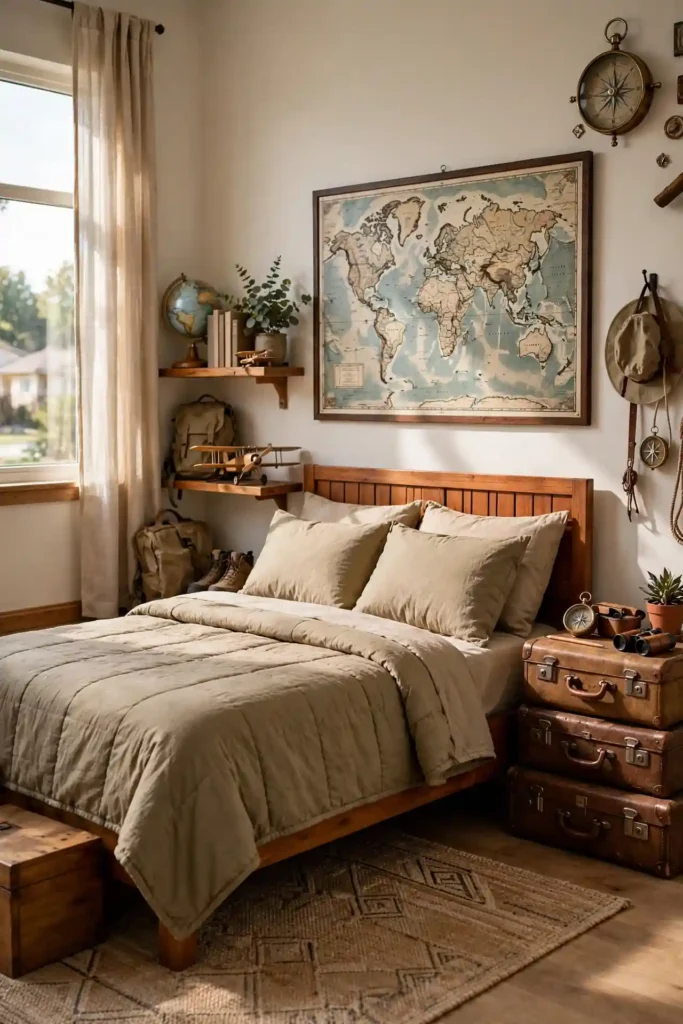
Make the theme participatory instead of just decorative. A cork board map where he pins postcards, ticket stubs, and photos from family trips costs about $20 and becomes his favorite wall within weeks. Add a safari-style tent or teepee reading corner for under $60 from Target, and store adventure books like the Who Was series on a low bookshelf nearby. Rope baskets from Home Depot corral shoes and toys while fitting the theme. Keep the map at his eye level so he can reach the pins himself, and update it together each year to make geography a family ritual.
7. Gaming Corner
A dedicated gaming corner gives your 8- to 10-year-old a defined place to play so controllers and headsets stop taking over the whole room. Set up a small 32- to 40-inch desk along one wall, pair it with an ergonomic chair from Amazon for $80 to $120, and mount the monitor on an adjustable arm so the screen sits at eye level. LED strip lights behind the desk cost about $15 and add the cool glow he wants without painting the room neon. Use a power strip with a flat plug so the desk sits flush against the wall.
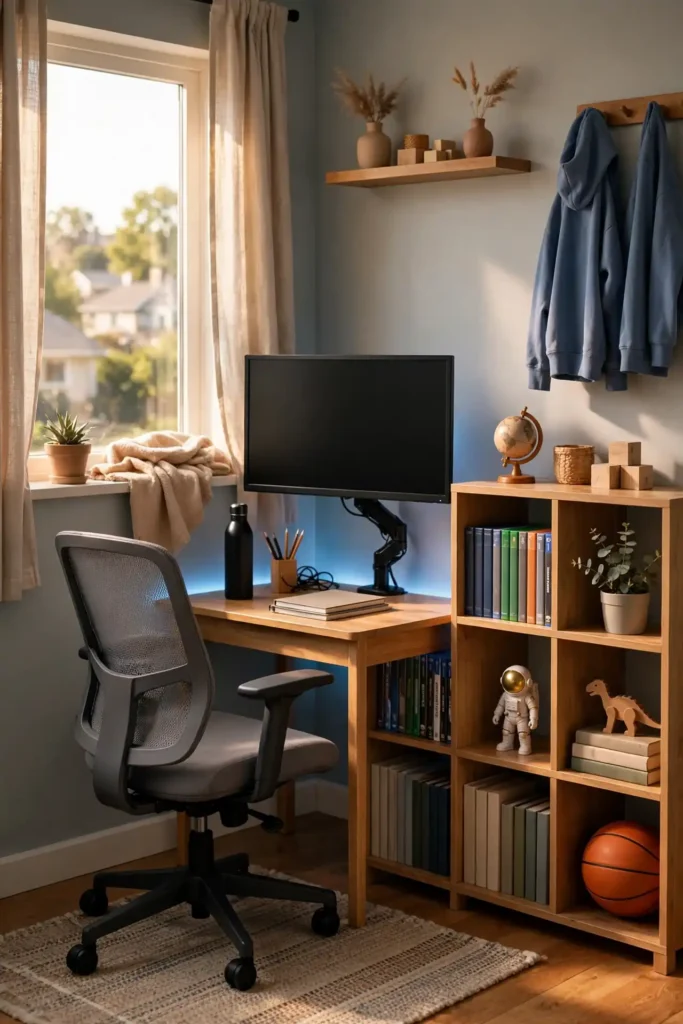
Set the ground rules and the layout together so the corner stays healthy, not just fun. Keep the gaming chair within view of the door rather than tucked in a dark corner, and set screen-time limits through the console’s built-in parental controls. A small set of cube shelves beside the desk holds game cases, charging cables, and a headphone hook for about $40 from Target. Choose a desk with a cable-management tray so cords don’t become a tangled hazard. When the room doubles as a homework zone, position the gaming setup away from the study desk so play and school stay visually separate.
8. Study Desk
A real study desk tells your 8- to 10-year-old that his schoolwork matters, and it keeps homework from migrating to the couch. A simple 40-inch wooden desk with two drawers costs about $90 to $150 at Target or Amazon, and it fits neatly into a corner without swallowing the room. Pair it with a chair that adjusts to his height so his feet rest flat on the floor, which keeps posture good during long reading sessions. Place the desk perpendicular to a window for the best natural light, and add a $20 clip-on LED lamp for evening work.

Organization is what makes a desk actually get used. Add a desktop organizer or a set of stackable trays for about $15 from Target to corral pencils, scissors, and notebooks, and mount a small corkboard or whiteboard above the desk for spelling lists and project deadlines. Keep a labeled bin beside the desk for library books and worksheets so nothing gets lost under the bed. Wipeable surfaces like laminate or sealed wood survive glue and marker accidents far better than raw wood. Let him choose one personal item for the desk, like a plant or a photo, so the space feels like his own.
9. LEGO Display Shelves
If your 8- to 10-year-old builds LEGO sets, those creations deserve display shelves instead of a dusty bin on the floor. Install two or three 24-inch floating shelves from IKEA’s LACK line at about $12 each, mounting them into wall studs with the included hardware so they hold real weight. Space the shelves 12 to 16 inches apart to fit tall builds like castles and rockets, and leave the bottom shelf low enough that he can rearrange his own displays. A simple gallery of finished sets becomes instant wall art with real personality.
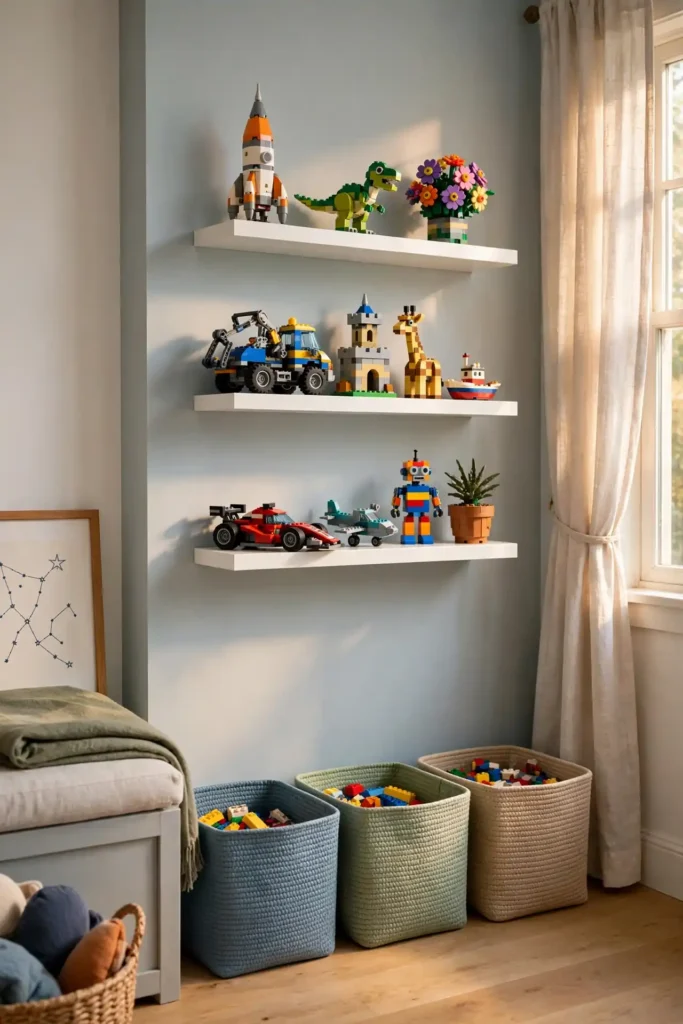
Protect the masterpieces while keeping the system kid-friendly. Place the most delicate builds on the highest shelf, out of reach of younger siblings or a bouncing basketball, and keep current works-in-progress on a low tray he can carry to the floor. Clear acrylic display cases for prized sets cost about $20 to $35 on Amazon and keep dust off detailed builds. Sort loose bricks by color in stackable bins from Home Depot so the next project starts with a search, not a scavenger hunt. Add a small step stool if the top shelf is above his reach, and dust the displays monthly with a soft brush.
10. Chalkboard or Whiteboard Wall
A chalkboard or whiteboard wall gives your 8- to 10-year-old boy a giant creative canvas that costs far less than you would expect. A gallon of chalkboard paint from Behr runs about $30 at Home Depot and covers one full accent wall with two coats, while a peel-and-stick whiteboard roll costs around $25 on Amazon and goes up in an afternoon with zero mess. Frame the area with simple trim molding so it looks intentional rather than unfinished, and keep a caddy of chalk or dry-erase markers in a wall-mounted holder beside it. The wall doubles as a study tool for math practice and spelling drills.

Choose chalkboard paint for a classic look that hides fingerprints better, or whiteboard for brighter colors and easier erasing with no dust. If you go the paint route, prime the wall first and let it cure for three full days before writing on it, or the chalk will ghost permanently. Mount a small tray or ledge at the bottom of the wall to catch markers and an eraser. For renters, the peel-and-stick whiteboard sheets remove cleanly when the lease ends. Teach him to erase at the end of each week so old drawings don’t stain, and keep a damp microfiber cloth nearby for quick cleanups.
11. Peel-and-Stick Wall Decals
Peel-and-stick wall decals are the renter-friendly secret weapon for boys bedrooms, letting your 8- to 10-year-old restyle his walls as often as his interests change. Full sets of dinosaurs, rockets, race cars, or sports graphics cost $15 to $35 on Amazon and apply in under an hour with nothing but a smoothing cloth. They stick best to smooth, eggshell-painted walls that have cured for at least 30 days, and they peel off cleanly when he outgrows them. Let him plan the layout on the floor first so he owns the design.

The trick to decals that look expensive instead of sticker-book is restraint and placement. Cluster them into one feature area above the bed or desk rather than scattering them across every wall, and leave breathing room between each shape. Oversized decals work better than dozens of tiny ones in a room under 150 square feet. If a decal bubbles during application, lift it gently and re-smooth from the center outward. Keep leftover decals on their backing sheets in a folder so you can repair or rearrange later. When it is time for a teen refresh, warm the decals with a hair dryer for ten seconds each and they release without pulling paint.
12. Rope or Nautical Details
Rope and nautical details bring a rugged, adventurous feel to a boy’s bedroom that reads classic rather than cartoonish as he grows. Wrap plain curtain rods with manila rope from Home Depot for about $10, swap standard drawer pulls for rope-handled ones at $3 to $5 each, and hang a porthole-style mirror for around $40 from Target. Paint the walls a crisp white with one navy accent wall in Sherwin-Williams Naval, and let natural wood tones in the furniture carry the coastal-cabin vibe. A striped navy-and-white duvet from Amazon for about $50 ties the whole look together.

Keep the nautical theme grounded with texture instead of theme-park props. A chunky jute rug in a 5-by-7-foot size costs about $60 at Lowe’s and stands up to rough play while adding warmth. Hang a wooden ship’s wheel or an anchor wall hook for backpacks and hoodies, spending $20 to $30 total. Avoid going overboard with plastic lobsters and cartoon pirates, which age out fast; instead, lean on stripes, brass details, and rope that still look good at fifteen. Add a woven storage basket for beach towels and sports gear. The palette of navy, white, and natural wood photographs beautifully and never really goes out of style.
13. Pegboard Storage
A pegboard wall turns clutter into a display your 8- to 10-year-old will actually use, because everything hangs in plain sight instead of vanishing into a drawer. A 4-by-8-foot sheet of pegboard costs about $25 at Home Depot, and a bag of assorted metal hooks runs another $15. Mount it with a 1-by-2-inch furring strip frame behind it so hooks have room to seat properly, screwing into wall studs for strength. Hang headphones, caps, sports gear, and art supplies in zones he can reach, and let him rearrange the layout himself whenever he wants a change.
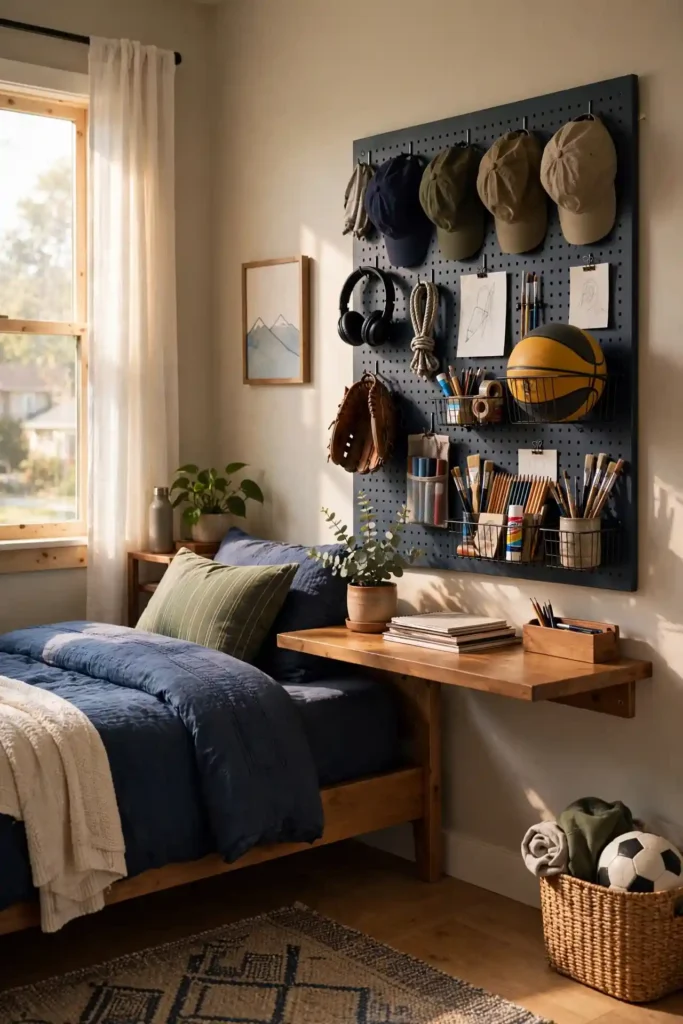
Pegboard shines when you match the accessories to his real stuff. Small wire baskets hold LEGO minifigures and trading cards, magnetic strips display drawings, and a clip-on cup keeps pencils off the desk. Paint the pegboard a bold color like Behr’s Graphic Charcoal before hanging it so it reads as intentional wall art, not garage storage. Keep heavier items like backpacks on hooks driven into studs, and lighter items on standard peg hooks rated for 5 pounds. Review the layout with him every few months and clear out what he has outgrown, so the board stays useful instead of becoming a cluttered catch-all.
14. Bookshelf Reading Nook
A bookshelf reading nook gives your 8- to 10-year-old a quiet corner that belongs entirely to him, and it encourages the reading habit right when chapter books get exciting. Tuck a low 3-foot bookcase from Target, about $50 to $80, into an unused corner or closet, and face the shelves outward so covers show like a bookstore display. Add a beanbag chair or a floor cushion for $30 to $40 from Amazon, a soft throw blanket, and a $15 clip-on reading light from Home Depot. Keep the shelves stocked with graphic novels, adventure series, and nonfiction about his current obsessions.
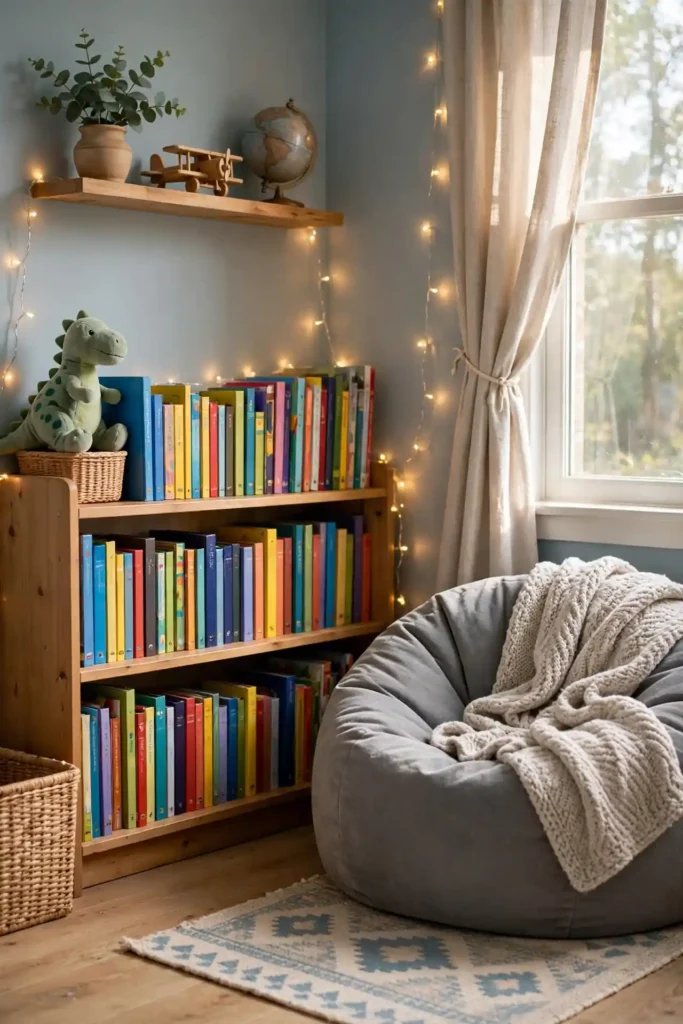
Make the nook feel separate from the rest of the room so it reads as a destination. A small 3-by-5-foot rug defines the zone for about $30, and a string of warm fairy lights for $10 from Target adds the cozy glow that makes kids linger. Let him choose the books on the forward-facing shelf each month so the collection stays fresh and personal. If floor space is tight, mount two floating shelves at his sitting height instead of a full bookcase. Add a simple book-return basket so finished books make it back to the shelf instead of piling up on the bed. The nook costs little but gets used daily.
15. Under-Bed Storage
Under-bed storage is free square footage most boys bedrooms waste, and for an 8- to 10-year-old it can swallow an entire toy collection. Flat rolling bins that fit a standard 7-inch bed clearance cost about $20 to $30 each at Target, and a set of three holds out-of-season clothes, LEGO sets, and board games. Measure the exact clearance under the bed frame before you buy, since some platform beds sit as low as 5 inches. Label each bin with a picture or word label so he can find and return things without dumping everything out.
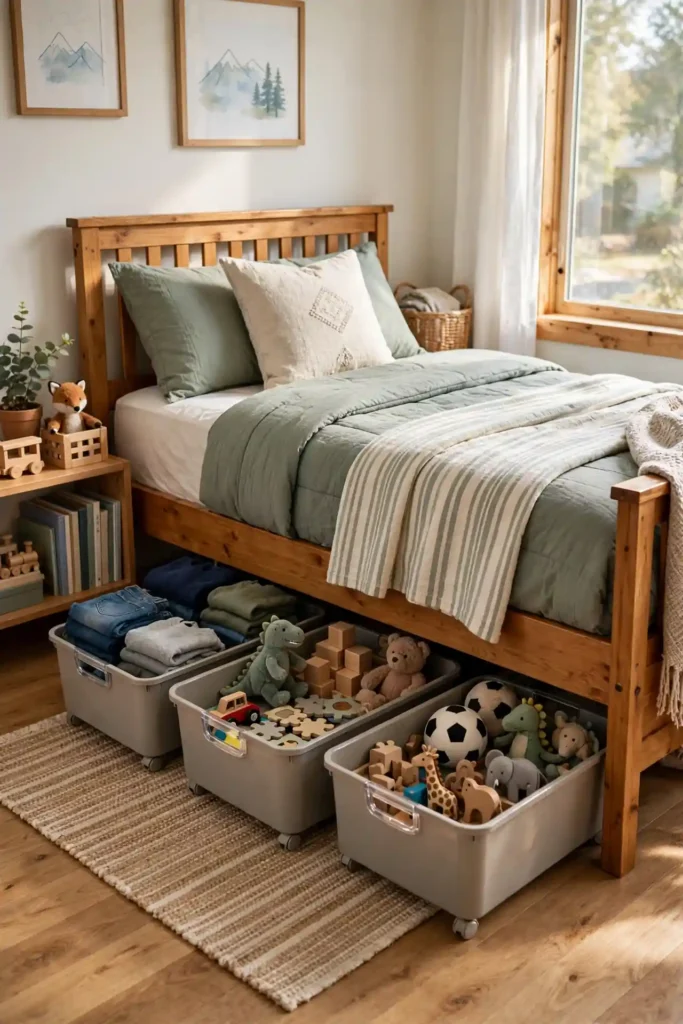
If your bed frame sits too low for bins, risers are the $15 fix from Amazon that add 5 to 8 inches of clearance in minutes. Choose bins with lids to keep dust out and wheels that roll smoothly on carpet or hardwood. For a built-in look, swap the frame for a captain’s bed with drawers, which starts around $350 at Target and eliminates the need for bins entirely. Teach a simple rule: one bin per category, and when a bin overflows it is time to donate something. Vacuum under the bed monthly when you rotate the bins, because dust bunnies multiply fast in forgotten corners.
16. Basketball Hoop
An indoor basketball hoop is pure joy for a sporty 8- to 10-year-old, but the key is choosing one that protects your walls and doors. Over-the-door mini hoops with foam padding cost $25 to $40 on Amazon and hang without screws, while a freestanding adjustable hoop for the driveway runs $150 to $300 at Dick’s Sporting Goods. For indoor play, use a soft foam basketball, about $10, so missed shots don’t dent drywall or knock over lamps. Set a clear rule that the hoop is for gentle shots, not slam dunks, and the privilege sticks around.
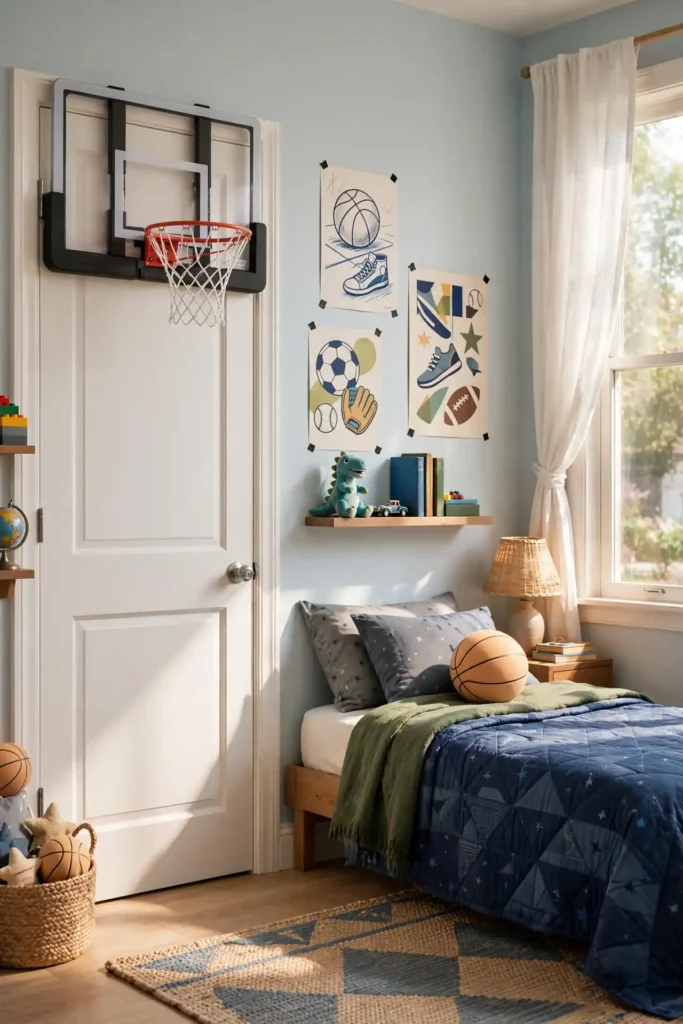
If he is serious about the game, invest in the outdoor setup and keep the bedroom hoop as a fun extra. A 54-inch adjustable in-ground or portable hoop from Home Depot costs $300 to $500 and adjusts from 7.5 to 10 feet as he grows. Mount a ball storage rack inside the bedroom closet door for about $20 so the outdoor ball doesn’t roll around the room. Add a small whiteboard beside the indoor hoop where he can track his free-throw streak. Check the over-the-door padding monthly, since foam compresses over time and metal brackets can mark the door finish.
17. Industrial Style
An industrial-style bedroom gives your 8- to 10-year-old a cool, grown-up look with exposed materials that only get better with wear. Paint the walls a warm gray like Behr’s Intellectual for about $45 a gallon at Home Depot, and choose a metal-frame bed with a distressed wood headboard for $250 to $400 from Amazon. Black metal shelving, Edison-bulb string lights for $20, and a vintage-look area rug in charcoal tones complete the loft vibe. The style hides scuffs and dings beautifully, which is exactly what an active boy’s room needs.
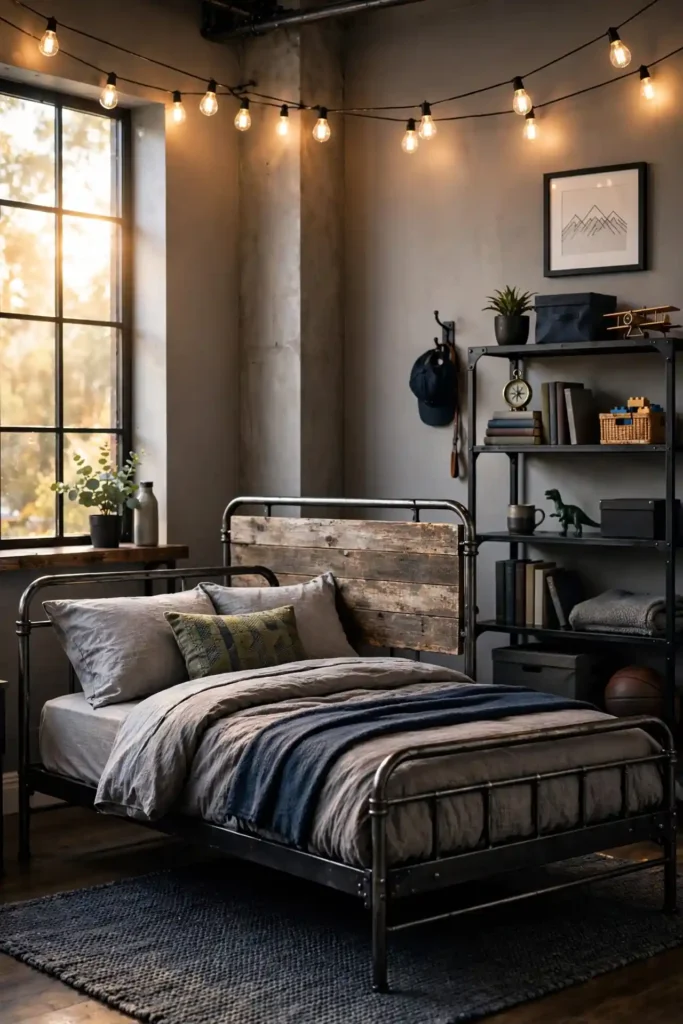
Build the industrial look with affordable, hard-wearing pieces rather than expensive replicas. Pipe-style clothing racks cost about $60 on Amazon and hold tomorrow’s outfit plus a backpack, doubling as open closet storage. A metal locker-style dresser from Target runs $120 to $180 and survives years of rough handling. Add a corkboard framed in black metal for posters and tickets, and use galvanized bins from Lowe’s at $8 to $12 each for toy storage. Keep lighting warm with 2700K bulbs so the metal and gray don’t feel cold. The aesthetic transitions seamlessly into the teen years with just a bedding swap.
18. Camping Theme
A camping-themed bedroom brings the outdoors inside and gives your 8- to 10-year-old a sense of adventure every single night. Set up a canvas teepee tent in the corner for $50 to $80 from Target as a reading hideout, and dress the bed in a plaid flannel comforter from Amazon for about $60. Paint the walls a forest-inspired green like Sherwin-Williams Retreat on one accent wall, keeping the others warm white. Hang a string of lantern-style lights for $25 and lean a pair of old wooden skis or hiking poles in the corner for authentic texture.

Layer in the details that make the theme feel like a real basecamp. A faux-fur throw, a tree-stump side table for about $40, and framed national-park posters you print at home for under $20 add depth without clutter. Store sleeping bags and flashlights in a large canvas duffel or wooden crate beside the bed so backyard campouts start in minutes. A constellation projector nightlight for $25 doubles as the campfire glow at bedtime. Keep the color palette to greens, browns, and creams so the room still looks great when he is twelve and the tent comes down but the vibe stays.
19. Personalized Name Art
Personalized name art makes your 8- to 10-year-old’s bedroom feel unmistakably his, and it is one of the cheapest ways to add big impact. Large wooden or metal letters spelling his name cost $5 to $10 each at Hobby Lobby or on Amazon, and mounting them above the bed or desk takes twenty minutes with picture-hanging strips. For a custom look, order a name print in his favorite theme — dinosaurs, space, sports — from an Etsy seller for $25 to $45, then frame it in a simple $15 frame from Target. The piece becomes an instant focal point guests notice.
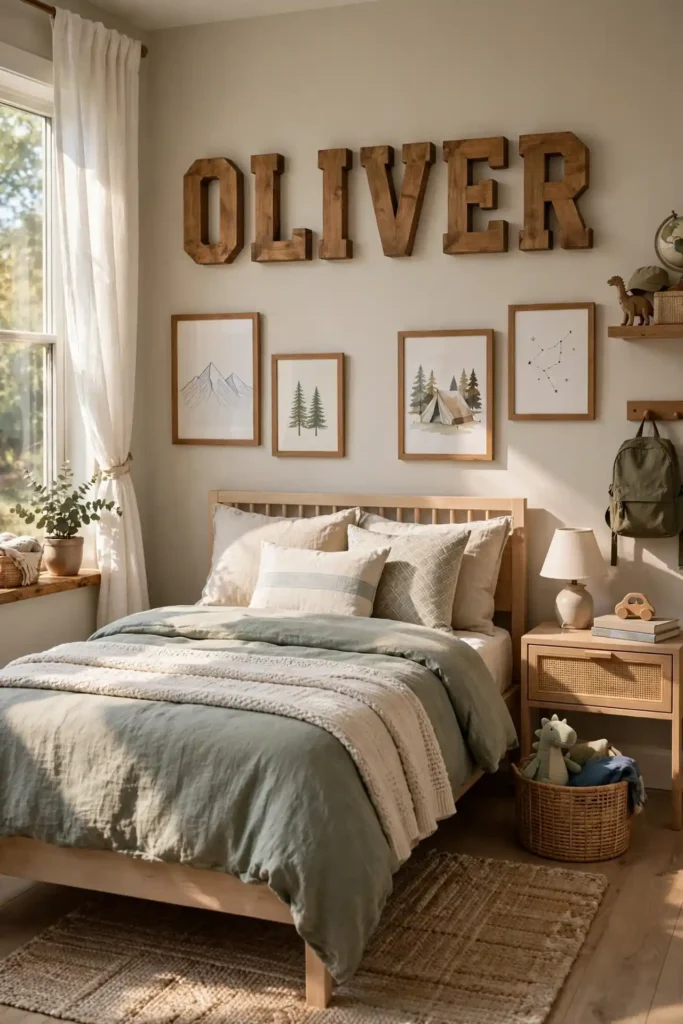
Choose name art that can evolve with him so it doesn’t feel babyish by age eleven. Block letters in matte black, brushed metal, or natural wood age far better than cartoon fonts, and a gallery-style framed print swaps easily when interests change. If you rent, use Command strips rated for the weight instead of nails. Let him pick the finish and placement so the ownership is real. Pair the name art with one or two coordinating pieces, like a monogram throw pillow for $20, rather than plastering his name on everything. One strong personalized statement beats a room full of monograms.
20. Gallery of Achievements
A gallery wall of achievements shows your 8- to 10-year-old that his efforts are worth celebrating, and it costs almost nothing to create. Gather ribbons, medals, certificates, team photos, and standout school projects, and arrange them in matching frames from the Dollar Tree or IKEA at $2 to $5 each. A simple grid layout on the wall above his desk keeps the display tidy, or use a long picture ledge from Target for $25 that lets him swap items in and out himself. Include effort-based wins like a most-improved certificate alongside the trophies.

Keep the gallery fresh so it motivates instead of gathering dust. Rotate the display each season, moving older items into a memory box and promoting new wins to the wall, and let him curate what goes up. Mix in a few action photos from games or recitals printed at 5-by-7 inches for about 50 cents each at a local drugstore. Use removable hanging strips so frames come down cleanly when interests shift. Add one empty frame labeled for his next goal, which turns the wall into a quiet motivator. The whole project takes an afternoon and delivers pride every single day.
21. Blackout Curtains
Blackout curtains are one of the highest-impact upgrades for a boy’s bedroom, especially for 8- to 10-year-olds who need solid sleep during long summer evenings. True blackout panels block 99 percent of light and cost $25 to $45 per pair at Target or Amazon for standard 84-inch lengths. Measure the window first and choose panels at least 4 inches wider than the frame on each side so light doesn’t leak around the edges. Hang the rod 4 to 6 inches above the window frame and let the curtains fall to the floor for the best seal.
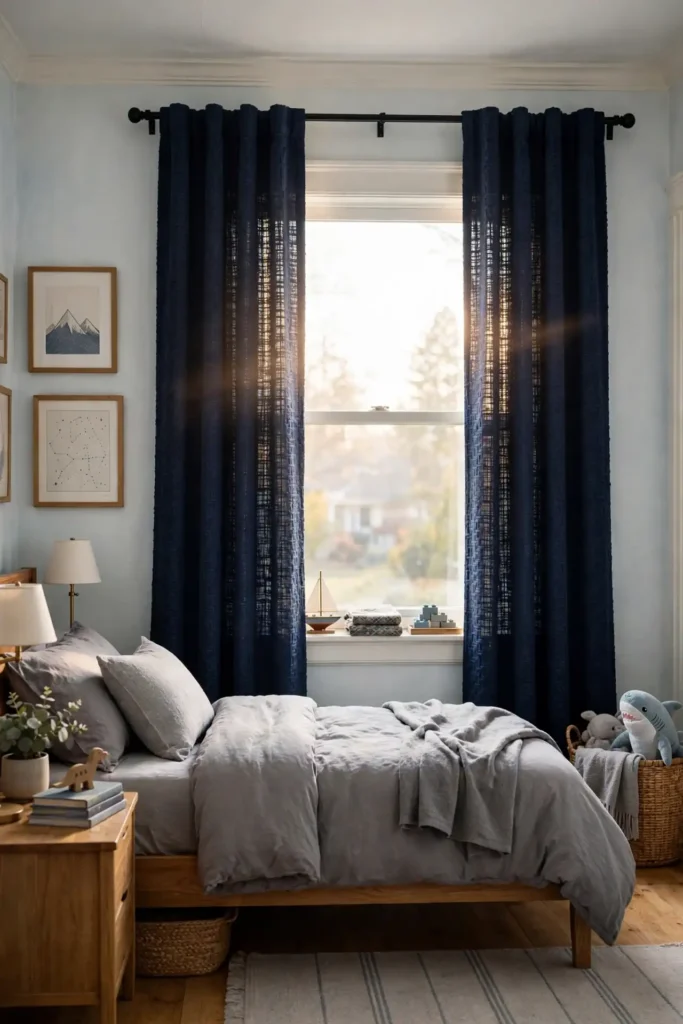
Look for triple-weave blackout fabric, which blocks light without the stiff rubber backing that cracks over time, and choose a color that works with the room like navy, charcoal, or gray. If your son likes a theme print, layer sheer patterned curtains in front of plain blackout panels so the look stays fun while the function stays serious. Wash the panels twice a year on gentle cycle to keep dust down, and check that the rod brackets are anchored into studs since blackout curtains run heavier than sheers. Better sleep means better mornings, and this $40 upgrade pays off every single night.
22. Durable Rug
A durable rug is non-negotiable in a boy’s bedroom, where floors take a beating from toy cars, cleats, and wrestling matches. Low-pile rugs with a tight weave handle the abuse best, and a 5-by-7-foot size from Rugs USA or Amazon costs $70 to $120 in kid-friendly patterns. Choose polypropylene or nylon fibers, which resist stains and clean with a simple blot and resist fading in bright sunlight, over wool or shag that trap crumbs and LEGO pieces. Darker patterns or busy geometrics hide the inevitable juice spill far better than a solid light color.

Set the rug up for a long life with a few smart moves. Place a $20 non-slip rug pad underneath from Home Depot to prevent bunching and add cushioning for floor play. Vacuum weekly with the beater bar on to pull out embedded crumbs, and treat stains immediately with a mix of dish soap and warm water before they set. Keep the rug at least 6 inches away from the door swing so the edge doesn’t curl. If the room has hardwood, the rug also protects the finish from chair legs and dropped toys. Pick a pattern he likes now in colors that work later, and the rug can easily last five years.
23. Let Him Help Choose
Letting your 8- to 10-year-old help choose his bedroom decor is the difference between a room he tolerates and a room he loves. Offer him real choices within your boundaries: pick three paint colors you can live with and let him choose the winner, or narrow bedding to four options and let him make the final call. Kids this age crave autonomy, and a room they helped design gets treated with noticeably more care. Take him to Target or Home Depot to see swatches in person, because colors look wildly different on a screen.
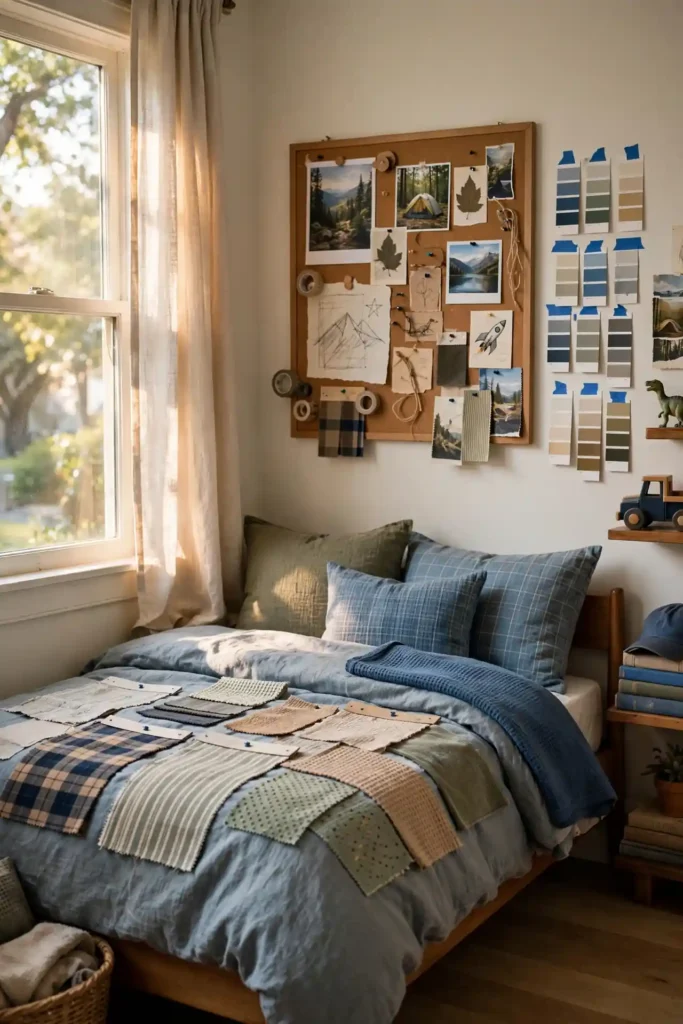
Structure the choices so you stay sane while he stays empowered. Give him full control over low-stakes items like posters, throw pillows, and desk accessories, and keep veto power over big-ticket pieces like the bed frame and paint. Set a clear budget up front — say $300 for accessories — and let him prioritize within it, which sneaks in a great money lesson. Shop together on a Saturday morning when neither of you is rushed, and photograph the final picks so returns are easy. When friends compliment the room, the pride on his face will tell you the collaboration was worth every compromise.
Balancing Themes and Longevity
Balancing a fun theme with longevity is the central challenge of decorating for an 8- to 10-year-old boy, since his passions can flip in a single school year. The proven formula is simple: keep the expensive, permanent elements neutral and put the theme in the cheap, swappable layers. That means gray or white walls, a classic bed frame, and solid wood furniture, with dinosaurs or race cars living in bedding, decals, and posters that cost under $100 total to replace. When the obsession fades, you refresh the accessories instead of repainting the room.

Test every theme purchase against the five-year question: will this still look okay when he is thirteen? A navy comforter passes, a cartoon-character bed frame does not. Spend your real money on quality foundations — a $400 solid wood bed, a $150 dresser — and keep theme spending to the $20-to-$50 range per item. Involve him in the plan by explaining the strategy in kid terms: the room is a stage and the theme is the costume, which can change for every show. Photograph each version of the room so you both remember the fun phases, and donate outgrown decor while it still has life in it.
Storage for Active Boys
Storage for active boys has to be fast, tough, and dead simple, because an 8- to 10-year-old will not maintain a complicated system. Open bins beat lidded boxes every time: a 9-cube organizer from Target costs about $60, and fabric bins at $8 each from Amazon swallow sports gear, action figures, and art supplies in seconds. Label each bin with a picture label for younger readers or a word label for confident readers. Place the system where the mess happens — balls near the door, art supplies near the desk — so cleanup takes under five minutes.
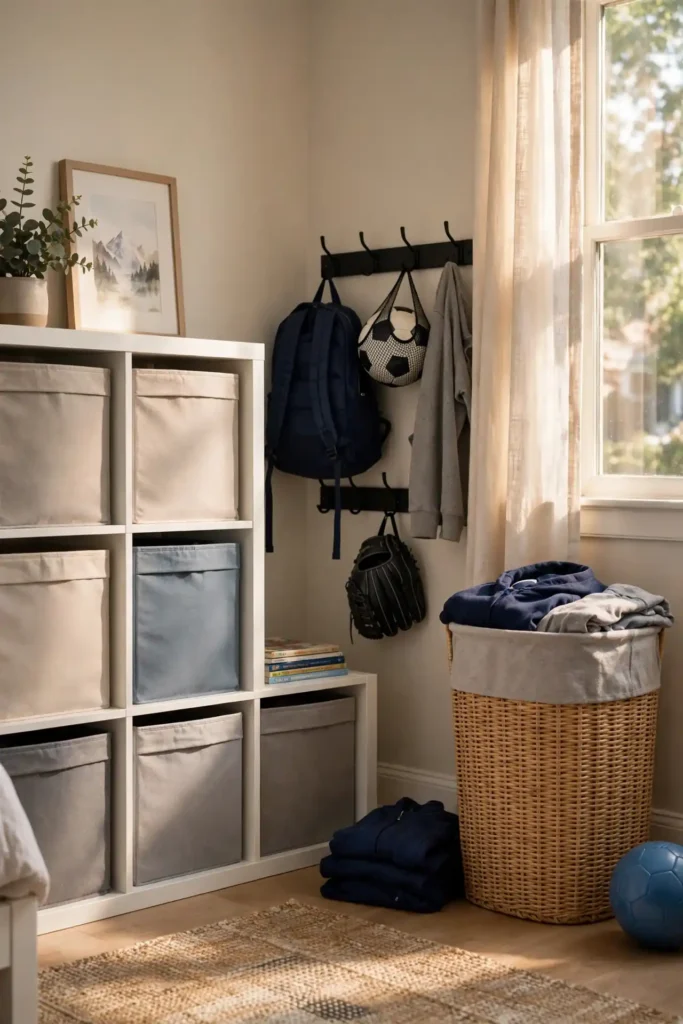
Build the storage around his actual habits instead of an idealized version of tidiness. A tall laundry hamper beside the bed for $20 from Target catches the daily uniform pile, and a wall-mounted hook rail at $15 from Home Depot keeps backpacks and jackets off the floor. Use one large rolling cart for project supplies that move around the room. Purge together every three months using the keep-donate-trash method, and cap each category at one bin so collections can’t sprawl. The goal isn’t a showroom; it’s a room he can reset himself in ten minutes before friends come over.
Creating a Study Zone
Creating a study zone separate from the sleep and play areas helps your 8- to 10-year-old switch into focus mode, even in a small bedroom. Carve out a corner with the desk facing a wall rather than the bed or window, which cuts visual distractions dramatically. A room divider screen for $40 to $60 from Amazon, or even a tall bookcase turned sideways, marks the boundary clearly. Add a desk lamp with adjustable brightness for $25 from Target and a comfortable chair, and keep the zone stocked with sharpened pencils, paper, and a calculator so there’s no excuse to wander.

Protect the study zone’s purpose with a few firm rules. No toys, gaming devices, or phones live in the zone during homework hours, and the desk gets cleared completely each evening so tomorrow starts fresh. A small analog clock on the desk for $12 teaches time management better than a phone timer. Post a simple homework checklist on the wall — unpack bag, check planner, finish work, pack for tomorrow — so the routine runs itself. Keep a file box for graded papers and permission slips beside the desk to end the morning scramble. Consistency matters more than square footage.
When it comes to boys bedroom ideas, the best results come from balancing style, comfort and everyday function. Use this list as your go-to guide for boys bedroom ideas, and start with the ideas that fit your space best. Save this guide on boys bedroom ideas so you can come back to it when you are ready to update your home.
How to Plan Boys Bedroom Ideas Step by Step
Planning a boys bedroom makeover goes smoothly when you work in a clear order instead of buying decor on impulse. Step one is measuring: record the room’s length, width, ceiling height, and window and door positions on a simple sketch. Step two is setting a budget with real numbers — $500 for a refresh, $1,500 for new furniture — and listing must-haves before nice-to-haves. Step three is choosing the color palette and the big pieces like the bed and dresser. Step four is layering in theme accessories, storage, and lighting. Do the steps in order and the room comes together without costly do-overs.

A few practical details make the plan actually work. Shop the big pieces first at stores like IKEA, Target, or Amazon, and check delivery times before you promise your son a reveal date. Paint before furniture arrives so you aren’t cutting in around a bed frame. Involve your 8- to 10-year-old at the accessory stage, not the foundation stage, so his input shines where change is cheap. Photograph the empty room and each step of progress for a fun before-and-after. Finally, schedule the makeover over a single weekend if you can — momentum beats perfection, and he will remember the project as much as the result.
- Talk with him about interests and colors.
- Choose a neutral base and durable furniture.
- Plan sleep, study, play and storage zones.
- Add themed bedding, art and decor.
- Personalize with achievements and collections.
Final Thoughts on Boys Bedroom Ideas
The best boys bedroom ideas for ages 8 to 10 share one trait: they respect who he is right now while leaving room for who he is becoming. You don’t need a designer budget or a Pinterest-perfect reveal to get it right. A comfortable bed, a desk that invites homework, storage he will actually use, and walls that reflect his current passions are the whole formula. Spend where it lasts, save where it swaps, and let his personality lead the theme. The rooms kids remember fondly aren’t the flawless ones — they’re the ones that felt like theirs.
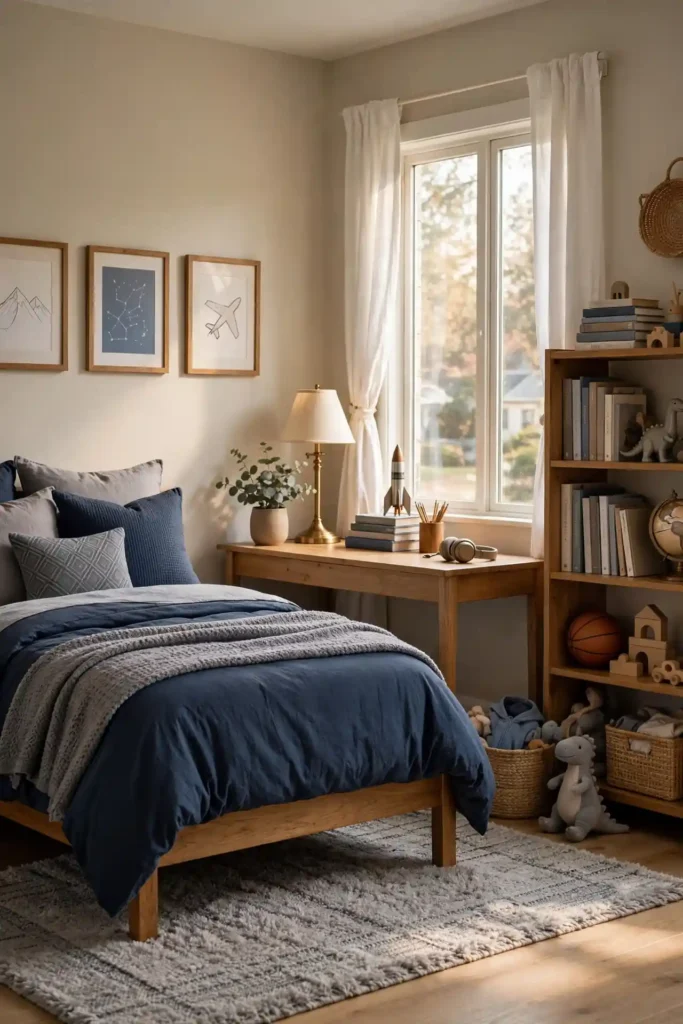
Start this weekend with the single change that bugs you most, whether that’s the toy explosion, the too-small desk, or the babyish walls. One $50 to $100 project — new bedding, a fresh coat of paint on one wall, a set of storage bins — builds momentum for the bigger wins. Revisit the room together each year on his birthday and ask what still works and what feels babyish now. That annual check-in keeps the space growing with him instead of freezing in time. However you design it, build a room that says you see him, and the rest takes care of itself.
Save these ideas and follow along for more kids room inspiration.
Frequently Asked Questions About Boys Bedroom Ideas
Parents ask the same smart questions when planning a boys bedroom for ages 8 to 10, and the answers below cover the decisions that matter most. You’ll find guidance on budgets, color choices that last, the right bed for the room size, and how to handle themes that change faster than the seasons. Each answer gives you a concrete starting point — real price ranges, specific products, and simple rules of thumb — so you can plan with confidence instead of guessing. Read through them before you shop, and you’ll avoid the most common and most expensive mistakes.
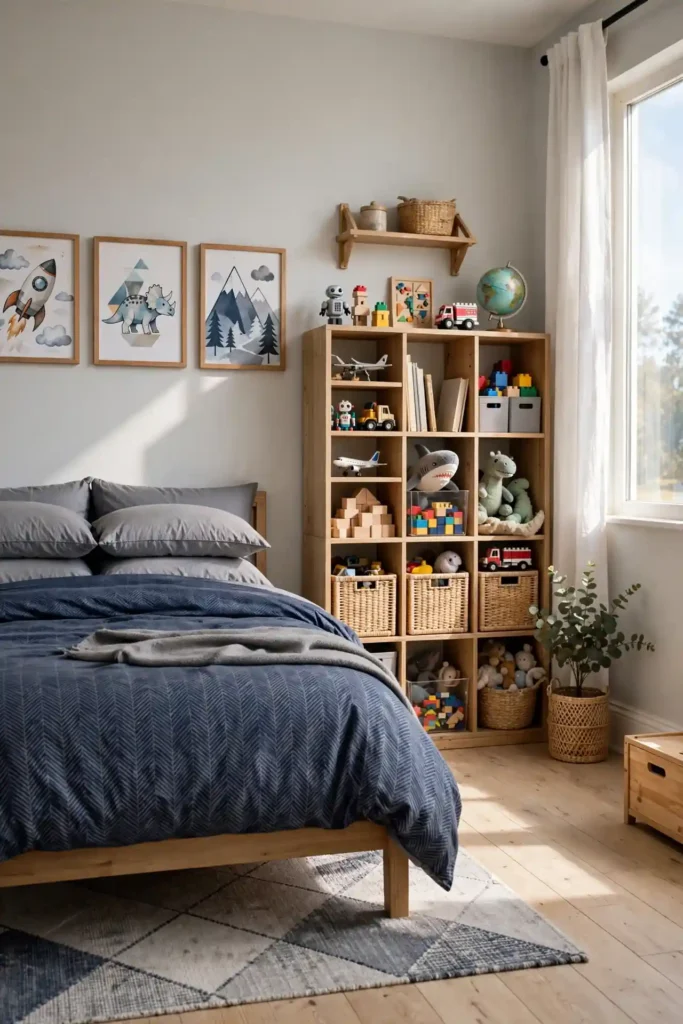
Remember that no FAQ can replace knowing your own kid, so use these answers as a launchpad rather than a rulebook. If your son is a reader, weight the budget toward the reading nook; if he’s an athlete, the sports storage matters more than the gallery wall. The detailed FAQ block below covers timing, safety, and small-room solutions, and every recommendation links back to the ideas above. Bookmark this page and revisit it each year together with your son — the questions stay the same, but your answers will evolve right along with him.
What colors are best for a boy’s bedroom?
Navy, gray, green, white and blue are versatile and grow with kids.
How do I make a boy’s room fun but not babyish?
Use grown-up colors and express themes through bedding and art.
What furniture does an 8 to 10 year old need?
A bed, desk, chair, dresser and plenty of storage.
Are loft beds safe for 8 year olds?
Most loft beds are suitable for ages 6 and up with guardrails.
How do I organize a boy’s bedroom?
Use labeled bins, shelves for collections and hooks for bags.






Leave a comment