


Green is having a moment in kitchens, and for good reason. It feels fresh, natural and calming, and it pairs beautifully with wood, white, brass and stone. Painting your walls green is an easy, affordable way to bring this trend into your home without replacing cabinets.
These 18 green kitchen walls ideas cover sage, olive, forest and other shades, with tips on pairing and finishes. For more green inspiration, see our green kitchen cabinets and these sage green bedroom ideas.
Tips for green kitchen walls:
- Use a washable satin or eggshell finish.
- Consider cabinet color and countertop undertones.
- Test samples in morning and evening light.
- Balance with natural wood and warm metals.
1. Sage Green Walls With White Cabinets
Sage green walls paired with white cabinets are the safest entry point into green kitchen walls, and they photograph beautifully because the contrast is crisp without being cold. You want a sage with gray undertones — think Sherwin-Williams Clary Sage or Benjamin Moore Saybrook Sage — so the color reads sophisticated rather than nursery-sweet. In a kitchen with north-facing windows, the gray keeps it from turning blue; in warm south-facing light, it deepens into a calm herb tone. White shaker cabinets bounce the light back, which matters because sage can flatten a dim room. Finish the look with warm wood cutting boards and matte black hardware to keep it from feeling sterile.

Your painting process is straightforward but prep matters on kitchen walls, where grease builds up near the range. Start by washing walls with a TSP substitute like Krud Kutter from Home Depot (about $12 for a 32-ounce spray), then prime with a stain-blocking primer since sage over a dark previous color can take three coats otherwise. Two gallons of Sherwin-Williams Emerald Interior in satin run roughly $180 and cover a standard 10×12 kitchen with two coats. Satin is the sweet spot — it wipes clean but doesn’t flash imperfections the way semi-gloss does. Keep a small sample jar for touch-ups around high-traffic doorways.
2. Olive Green Walls With Wood Cabinets
Olive green walls with wood cabinets lean earthy and grounded, a combination that works especially well in ranch homes and craftsman bungalows across the US. You get depth from the olive — Benjamin Moore’s Tate Olive or Behr’s Royal Orchard both have that warm, golden-green base — while medium-toned woods like white oak or walnut keep the room from feeling dark. The trick is balance: if your cabinets are dark walnut, choose a lighter olive and bright countertops; if your cabinets are pale oak, you can push the olive deeper. Under-cabinet lighting is nearly mandatory here because olive absorbs light, and a $40 LED strip kit from Amazon changes everything.
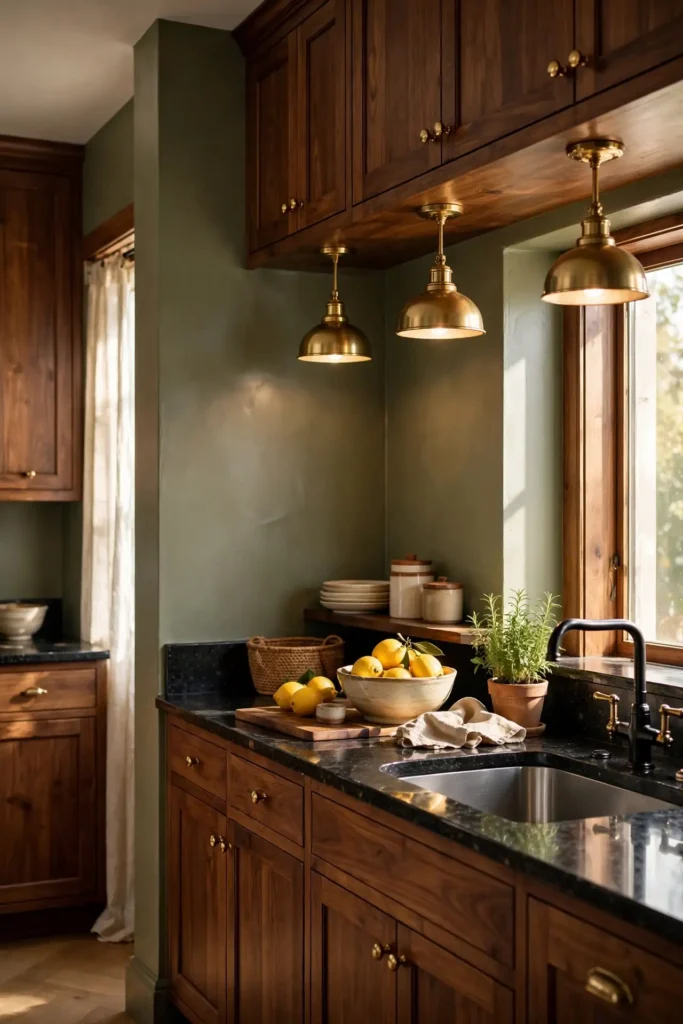
Styling around olive and wood is where this green kitchen walls idea earns its warmth. Swap shiny fixtures for brushed brass or aged bronze — a set of four brass cup pulls costs around $25 at Lowe’s — and bring in textiles with mustard, terracotta, or cream patterns to echo the olive’s yellow undertone. Avoid cool grays; they fight olive’s warmth. If you’re renting or commitment-shy, peel-and-stick olive wallpaper from Target ($35 a roll) gives you the same effect on one wall without paint. Seal any painted wall near the stove with an extra coat of satin so splatters wipe off.
3. Forest Green Walls for Drama
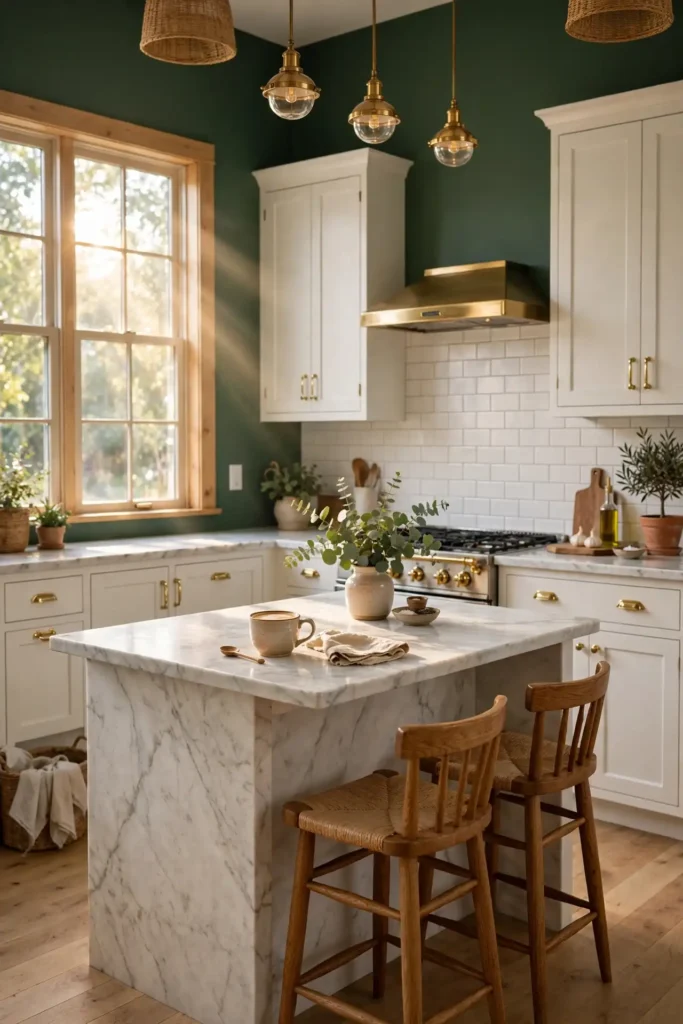
Forest green walls turn an ordinary kitchen into something cinematic, and this is the green kitchen walls idea for anyone tired of safe neutrals. Colors like Benjamin Moore Essex Green or Sherwin-Williams Ripe Olive read nearly black in low light and glow like deep velvet by day. You need commitment: forest green demands at least two walls or a full room to work — a single small accent can look accidental. The payoff is a kitchen that feels like an expensive cocktail bar. Pair it with light marble or white quartz countertops so the room still breathes, and let brass or gold hardware act as jewelry against the dark.
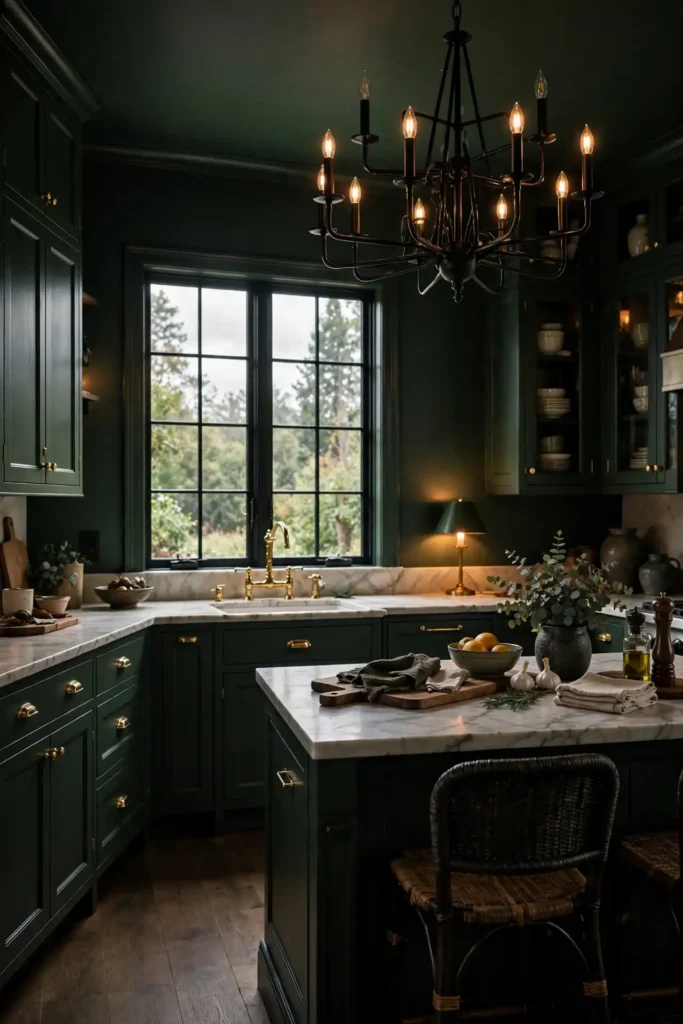
Light is the make-or-break variable with forest green. Kitchens with one small window will swallow this color, so add layers: a pair of $60 brass pendants over the island from Wayfair, under-cabinet LEDs, and if possible a daylight-bulb (5000K) under-cabinet upgrade so prep areas stay functional. Flat paint will look chalky; use eggshell at minimum, satin if your walls take abuse. A gallon of Behr Marquee in satin costs about $48 at Home Depot and covers roughly 400 square feet — budget two gallons for a medium kitchen. Let each coat cure fully, because dark colors telegraph roller marks more than light ones.
4. Mint Green for Retro Charm
Mint green walls channel 1950s diner charm and cottage sweetness at once, which is why this green kitchen walls idea keeps resurfacing on Pinterest. You want a true pastel mint — Sherwin-Williams Mint Condition or Benjamin Moore Mint Chip — rather than anything leaning aqua, which reads bathroom, not kitchen. Mint loves white: white cabinets, white appliances, white beadboard ceilings. Chrome or brushed nickel hardware
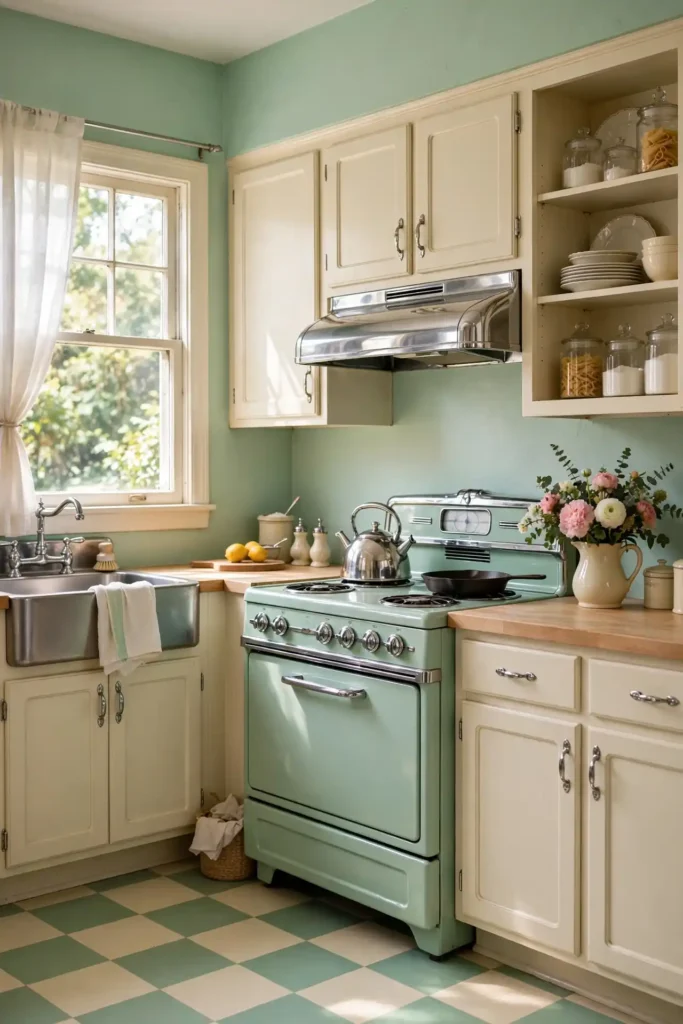
Decorating around mint is about restraint so the color stays charming instead of sugary. Limit yourself to two accent colors — cherry red for full retro, or butter yellow and navy for a softer vintage feel — and let the mint dominate. A vintage-style mint refrigerator runs $2,000-plus, so the budget move is painting an existing fridge with appliance epoxy or simply letting the walls carry the theme while appliances stay white. Open shelving with white dishes extends the palette without adding cost. Use semi-gloss on trim and doors for that classic wipeable diner shine, and keep wall paint at satin so the finish reads soft.
5. Green Walls With Black Cabinets
Black cabinets against green walls create a high-contrast, editorial look that works far better in real kitchens than most people expect. The green keeps black cabinets from feeling funereal, and the black keeps the green from reading twee. You want a mid-tone or deep green — think Sherwin-Williams Pewter Green or Benjamin Moore Caldwell Green — because pale greens can’t hold their own against black. Matte black shaker fronts are the safest choice; they hide fingerprints better than glossy fronts and pair naturally with the matte quality of most wall paints. Add a light wood or white countertop so the room doesn’t close in.
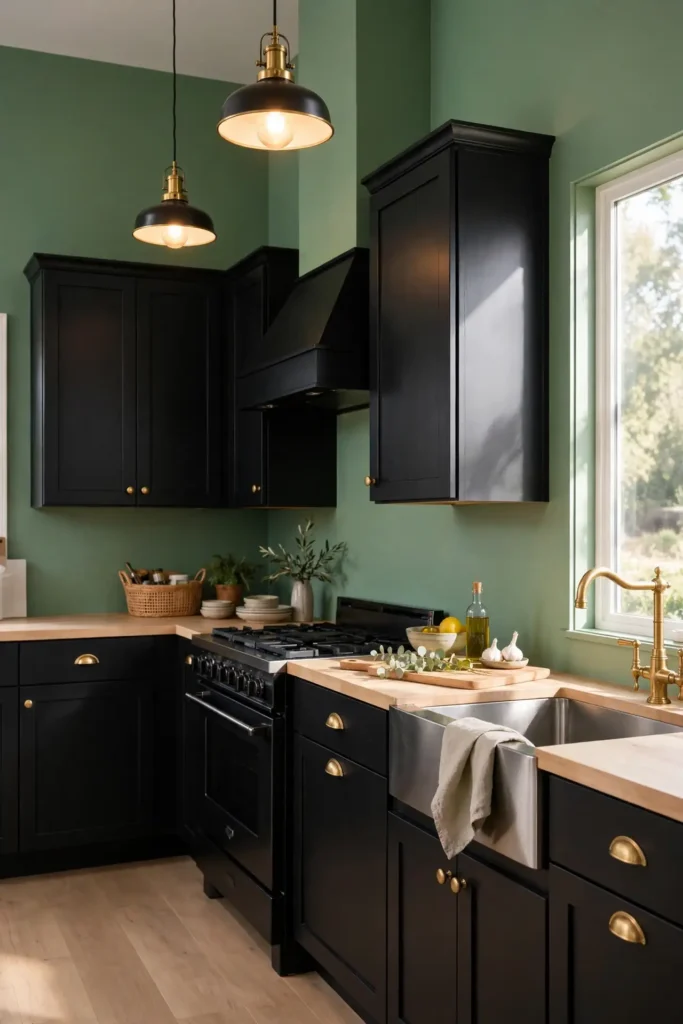
The risk with this pairing is a kitchen that feels heavy, so your lighting plan has to be deliberate. Aim for three light sources minimum: recessed cans or a pendant grid for general light, under-cabinet strips for task light, and something warm and low (a plug-in sconce or picture light) for evening. Brass hardware bridges the two dark tones beautifully — black and brass is a classic restaurant-kitchen combo for a reason. If your kitchen is under 150 square feet, keep the green on two walls max and paint the rest a warm white like Benjamin Moore White Dove, so the black cabinets stay the star.
6. Green Walls With Brass
Green and brass is the combination that made green kitchens famous, and it works because warm metal against cool green creates instant richness. Whatever your green — sage, olive, hunter — brushed or unlacquered brass fixtures, faucets, and cabinet pulls will elevate it. You don’t need to re-plumb the kitchen: a brass-look faucet from Amazon runs $120 to $200, and swapping cabinet pulls is a Saturday project at about $4 per pull from Lowe’s. Keep the brass finish consistent — mixing polished, brushed, and antique brass in one room looks accidental — and let it repeat at least three times (faucet, pulls, pendant) so it reads intentional.
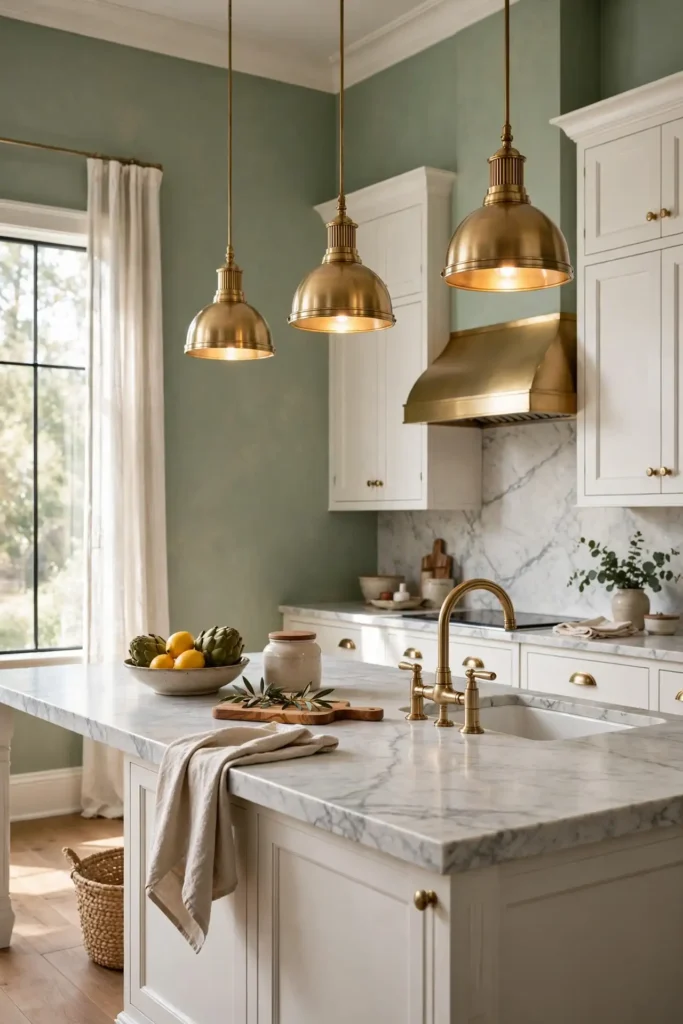
The shade of green you pair with brass matters more than people admit. Yellow-leaning greens like olive and sage sing with brass because they share warm undertones; blue-leaning greens like emerald or teal can make brass look orange by comparison. If your walls already skew blue-green, switch to polished nickel instead — same warmth, no clash. For a renter-friendly version, brass-finish adhesive film on cabinet hardware and a brass table lamp on the counter give you the glow without permanent changes. Wipe unlacquered brass with a soft cloth only; harsh cleaners strip the living finish that makes it beautiful.
7. Green and Pink
Green and pink is the color pairing borrowed from gardens, and in kitchens it lands somewhere between playful and sophisticated depending on the shades you choose. The grown-up version pairs a deep botanical green — Sherwin-Williams Evergreen Fog or a rich forest tone — with dusty blush pink in textiles, artwork, or a single painted piece like a vintage hutch. The garden logic is real: pink sits opposite green on the color wheel, so each makes the other look more vivid. Keep the pink to 10 to 20 percent of the room so the kitchen still reads green, not candy.
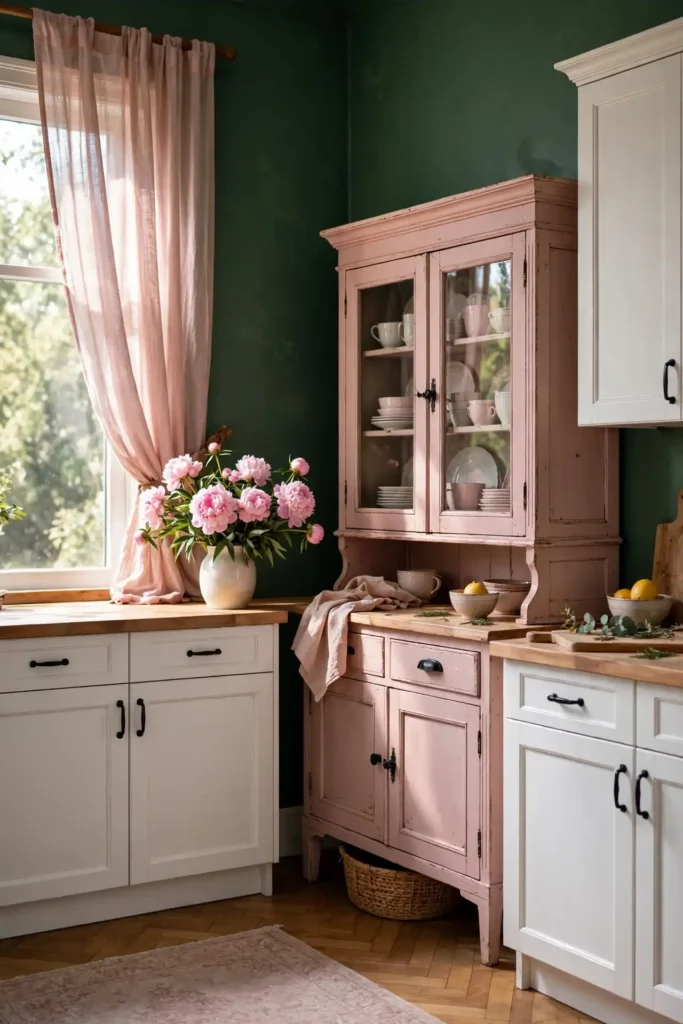
If you want the pairing to feel modern rather than cottage, anchor both colors with black or charcoal: black window frames, a charcoal runner, matte black hardware. That graphic edge stops the pastels from floating. Budget-friendly ways to test the combo include blush linen café curtains ($30 a pair at Target), a pink Le Creuset-style Dutch oven on open shelving, and framed botanical prints with pink florals. For paint, Farrow & Ball’s Setting Plaster is the designer favorite, but Behr’s Pink Damask is a $40-a-gallon dupe at Home Depot. Start with accessories you can return before committing a wall to pink.
8. Green With Terracotta
Green walls with terracotta accents channel the American Southwest and Mediterranean courtyards at once — earthy, sun-warmed, and deeply livable. The green should lean warm: olive, moss, or a yellow-based sage like Behr’s Back to Nature. Terracotta enters through tile, pottery, and textiles rather than a second paint color, which keeps the scheme from feeling busy. A terracotta runner, a cluster of unglazed clay pots, and a few rust-colored linen napkins are enough. If your floors are already Saltillo tile or warm wood, you’re halfway there — the terracotta is built in, and the green walls complete the palette.
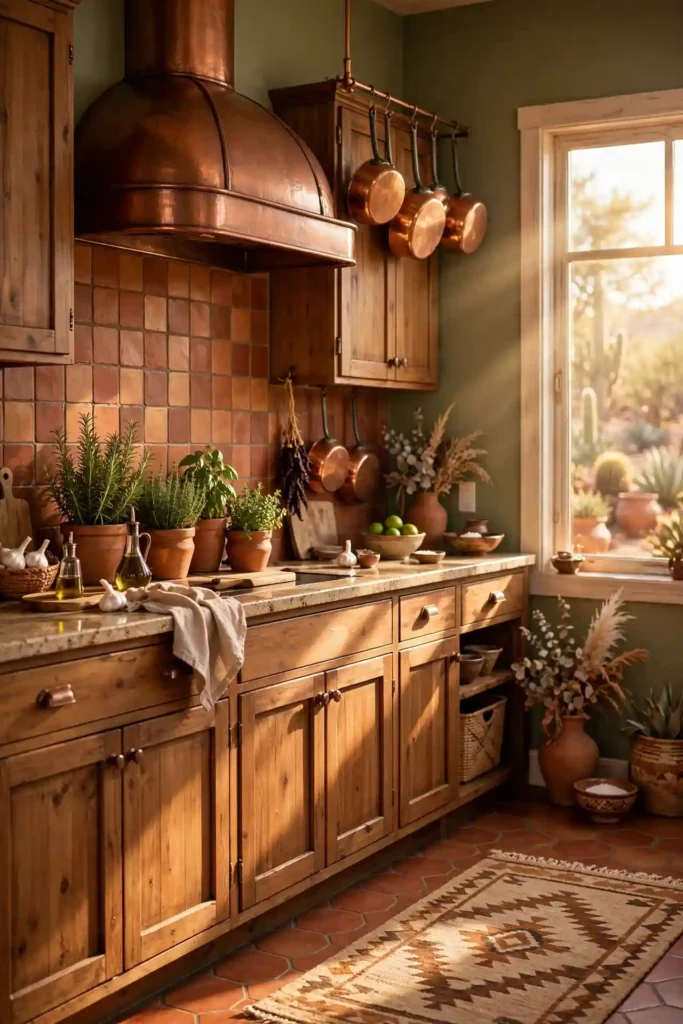
This pairing shines in kitchens that get strong natural light, because warm sun makes both colors glow; in a dim kitchen, choose lighter versions of each. For a bigger commitment, a terracotta zellige-look backsplash from a big-box store runs $8 to $15 per square foot and transforms green walls completely. Keep metals warm — brass, copper, or oil-rubbed bronze — since chrome will look icy against the clay tones. Plants are the natural bridge: a terracotta pot holding a trailing pothos ties wall color and accent together for under $25. Seal terracotta tile near the range with a penetrating sealer so cooking splatter doesn’t stain.
9. Two-Tone Green Walls
Two-tone green walls — a darker green below and a lighter green above, split by a chair rail or a clean painted line — add architecture to flat drywall and make ceilings feel taller. The classic split is at 36 inches, but in kitchens the backsplash and counters interrupt the wall, so measure from the floor to just below your wall cabinets and split there instead. You want the two greens from the same color family, two to three shades apart on the same paint strip: Sherwin-Williams Retreat below and Sea Salt above, for example. Same undertone is non-negotiable; mixing a yellow-green with a blue-green across the line looks like a mistake.

The dividing line is where this idea succeeds or fails. A chair rail (about $1.50 per linear foot in primed pine at Lowe’s) gives you a crisp edge and covers the seam, while a taped line is free but demands a steady hand and fresh painter’s tape pulled at a 45-degree angle while the paint is still tacky. Paint the darker color first, let it cure 24 hours, then tape and cut in the lighter shade above. The lower wall takes the most abuse, so use satin or semi-gloss there even if the upper wall is eggshell. Wainscot-height beadboard painted the darker green is the farmhouse version of the same trick and hides scuffs beautifully.
10. Color-Drenched Green Kitchen
Color drenching — painting walls, trim, ceiling, and sometimes cabinets in one green — is the boldest of these green kitchen walls ideas, and it’s the one designers say photographs best because the room becomes one seamless envelope. You need a green with enough complexity to carry it: Sherwin-Williams Evergreen Fog or Benjamin Moore Backwoods have gray and yellow notes that keep a full room from feeling flat. Use the same sheen strategy the pros use — flat or matte on the ceiling, eggshell on walls, satin on trim and cabinets — so the single color still has depth through finish variation.

Before you commit, test the drench in the room’s actual light at three times of day, because a green that looks perfect at noon can go swampy under warm evening bulbs. Paint large foam boards and move them around rather than painting test squares on the wall — dark colors need scale to judge. Budget-wise, drenching uses more paint than you think: a 12×14 kitchen with cabinets can take four to five gallons, roughly $200 to $250 in Behr Marquee from Home Depot. The payoff is a kitchen with zero visual clutter, which makes even builder-grade cabinets look custom. Add one contrasting element — a white range, brass faucet, or oak stools — so the eye has somewhere to land.
11. Green Walls With Open Shelves
Green walls with open shelves are a natural match because the shelves break up the color and give you a stage for styling. You hang wood or white floating shelves directly on the green — two 36-inch shelves with hidden brackets run about $60 at Target — and the dishes, glassware, and plants you display become part of the color story. White ceramics pop against mid-tone greens; amber glass and wood tones glow against deep greens. Keep the shelf styling to two-thirds full so the green still shows between objects; a crowded shelf hides the wall color you painted.
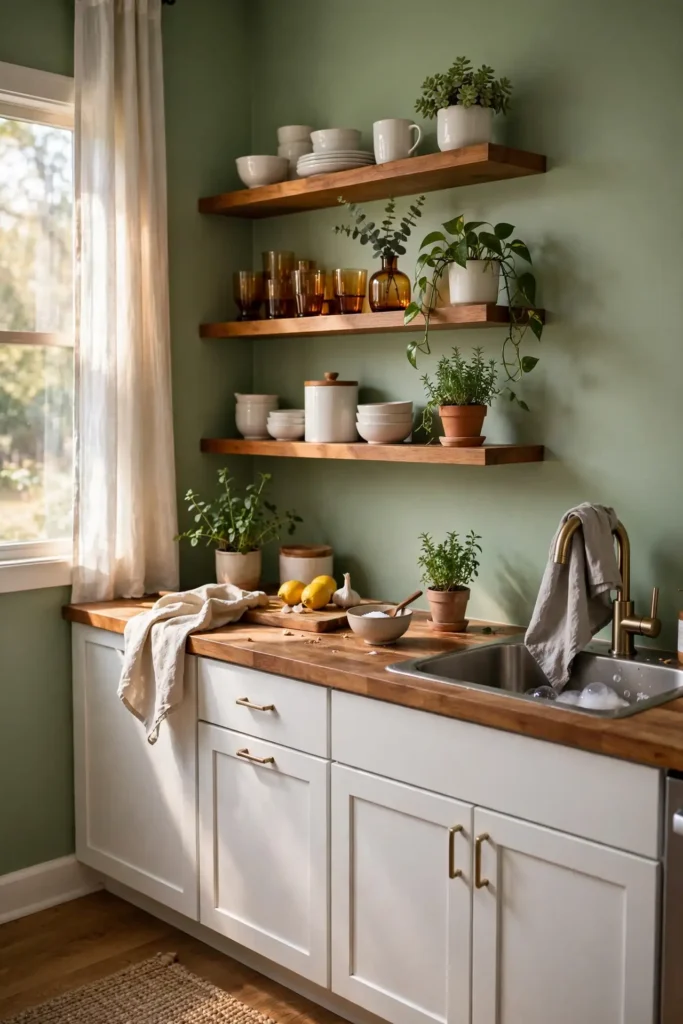
There are practical rules that keep open shelves from becoming a greasy mess. Don’t hang them directly over the range — cooking residue lands on everything within about four feet — and choose a satin or semi-gloss wall paint behind shelves so you can wipe the wall down. Dust the shelves monthly; in a kitchen, “dust” is half cooking film. If you love the look but dread the maintenance, do one run of open shelves on a single wall and keep the rest closed — you get the styled moment without the upkeep everywhere. Style with everyday items you actually use so the shelves stay in rotation and never look staged.
12. Green Walls With Marble
Green walls with marble is the luxury pairing — veined white marble or marble-look quartz against deep green reads like a boutique hotel. You don’t need real Calacatta: marble-look quartz from a fabricator runs $60 to $100 per square foot installed versus $150-plus for natural stone, and it never etches from lemon juice. The green should go deep enough to contrast — forest, hunter, or a dark olive like Benjamin Moore Essex Green — because pale greens get washed out by busy veining. A marble backsplash running full height behind the range, with the green wrapping the remaining walls, is the money shot.

Keep the rest of the palette quiet so the marble stays the star. Polished nickel or chrome hardware echoes the stone’s cool veins; save brass for a different green. One slab remnant from a stone yard — often $200 to $400 — can cover a small backsplash or a pastry station, which is how you get the look on a budget. Seal natural marble annually with an impregnating sealer ($20 at Home Depot) and wipe spills fast, because tomato and wine stain. If even quartz is out of reach, marble-look peel-and-stick tile at $5 per square foot from Amazon gives you the veining on a rental-friendly budget.
13. Green Limewash
Green limewash gives kitchen walls a soft, cloudy, Old World texture that flat paint can’t touch — the finish has movement, like plaster, with lighter and darker clouds of color. You buy it as a specialty paint: Portola Paints and Kalklitir both sell green limewash in the US, roughly $80 to $120 per gallon, and one gallon covers about 200 square feet because you apply it thin in crisscross strokes. Choose a mid-tone sage or olive; limewash mutes color, so your sample will dry lighter and softer than it looks wet. The texture hides imperfect drywall, which is a genuine bonus in older homes.

Application is different from regular paint, so follow the method. You work in random X-shaped strokes with a large block brush, keeping a wet edge, and you do not roll — rolling destroys the cloud effect. Two coats minimum, and you must seal it: limewash is essentially crushed limestone, and an unsealed kitchen wall will mark if you look at it wrong. Use the manufacturer’s recommended topcoat or a clear matte sealer, especially behind the sink and range. It’s not the paint for a rental, and it’s not wipeable like satin latex, but for a dining nook wall or a range alcove it delivers a finish no standard paint can.
14. Green With Butcher Block
Green walls with butcher block countertops are the warmest combination on this list — wood counters soften green walls the way nothing else does. The green can go anywhere from pale sage to deep forest; butcher block’s honey tones flatter all of them. You have two routes: real butcher block from Lumber Liquidators or Home Depot at $200 to $400 for a standard 8-foot run, which you oil monthly with food-safe mineral oil, or butcher-block-look laminate at a third of the price with zero maintenance. Either way, the wood brings a handmade warmth that balances green’s coolness.
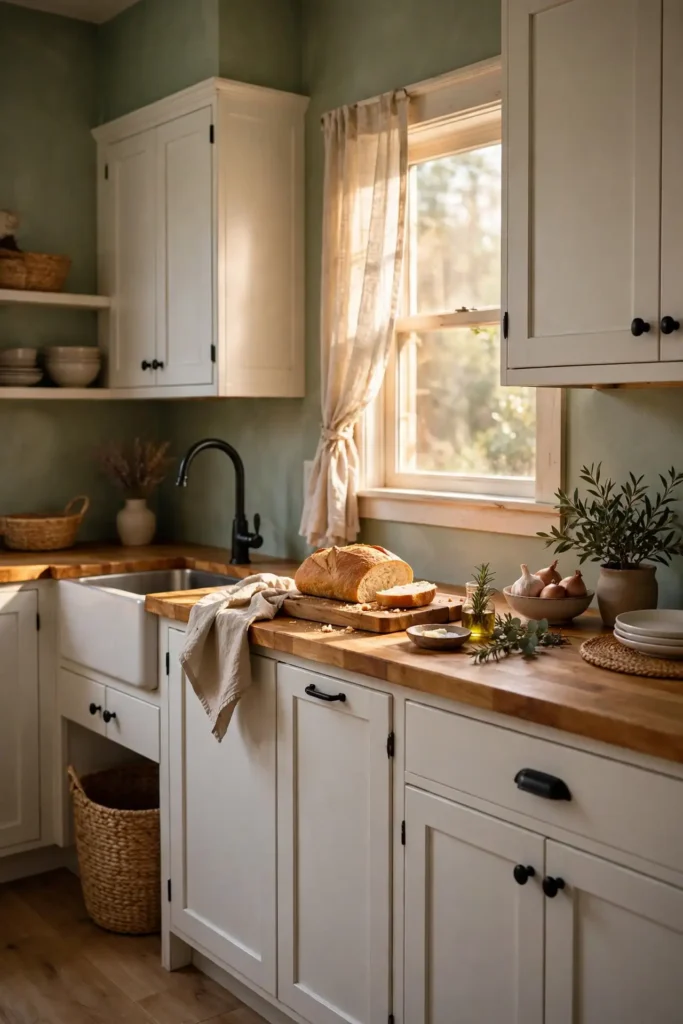
Maintenance is the honest part of this pairing. Real butcher block near the sink needs oiling every three to four weeks — a $10 bottle of mineral oil from Amazon lasts months — and you should never let water pool on it. Sand out stains with 220-grit paper and re-oil; the counter heals like wood does. Keep cutting boards on the counter rather than cutting directly on it unless you love the patina of knife marks. Style the green walls above with simple white or cream ceramics and one trailing plant, and let the wood be the texture star. Avoid dark stains on the block; natural or light finishes keep the kitchen feeling airy.
15. Green Walls With Plants
Green walls with plants double down on the botanical feeling — the wall color becomes a backdrop that makes every leaf look more vivid. This works with any green, but mid-tone sages and olives are the most forgiving because they sit close to actual foliage colors. You want a mix of heights: a tall fiddle-leaf fig or olive tree in the corner ($60 to $120 at a local nursery or IKEA), trailing pothos on top of cabinets, and small herbs on the windowsill. The herbs earn their keep — basil, thyme, and rosemary in $4 terracotta pots from Lowe’s give you cooking ingredients and styling in one.
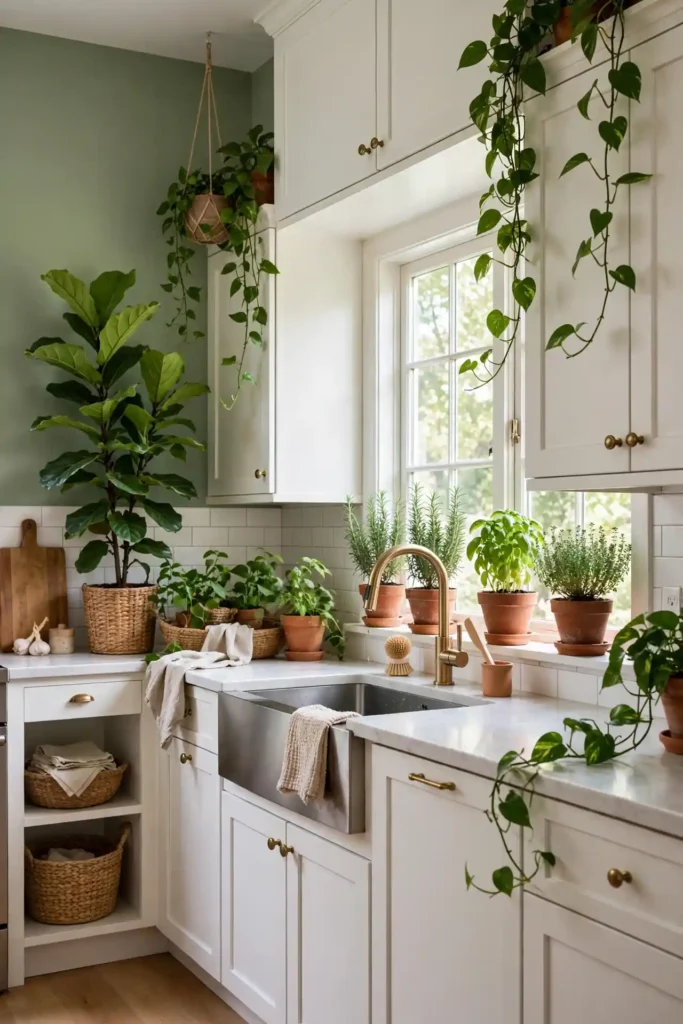
Plant care in a kitchen has one big advantage: humidity from cooking. Most houseplants love it. The challenge is light and grease — keep plants out of the direct splatter zone near the range, and wipe leaves monthly with a damp cloth so they can photosynthesize. If your kitchen is dark, choose low-light champions like snake plants and ZZ plants rather than fighting nature. Hanging planters from a ceiling hook keep counters clear; a $15 macramé hanger from Target holds a pothos that will trail two feet in a year. Group plants in odd numbers — threes and fives — for a styled look rather than a scattered one.
16. Green Accent Wall
A green accent wall is the commitment-phobe’s entry to green kitchen walls: one wall in a rich green, the rest in warm white, and you get the drama at a fraction of the paint and courage. The best accent wall is the one you see first when you walk in — usually the range wall or the wall behind open shelving — because it anchors the room’s focal point. Go bolder than you think: Benjamin Moore Hunter Green or Sherwin-Williams Cascades on one wall reads intentional, while a timid mid-green can look like you ran out of paint. One gallon covers a standard 8×10 wall with two coats, about $45 to $60.
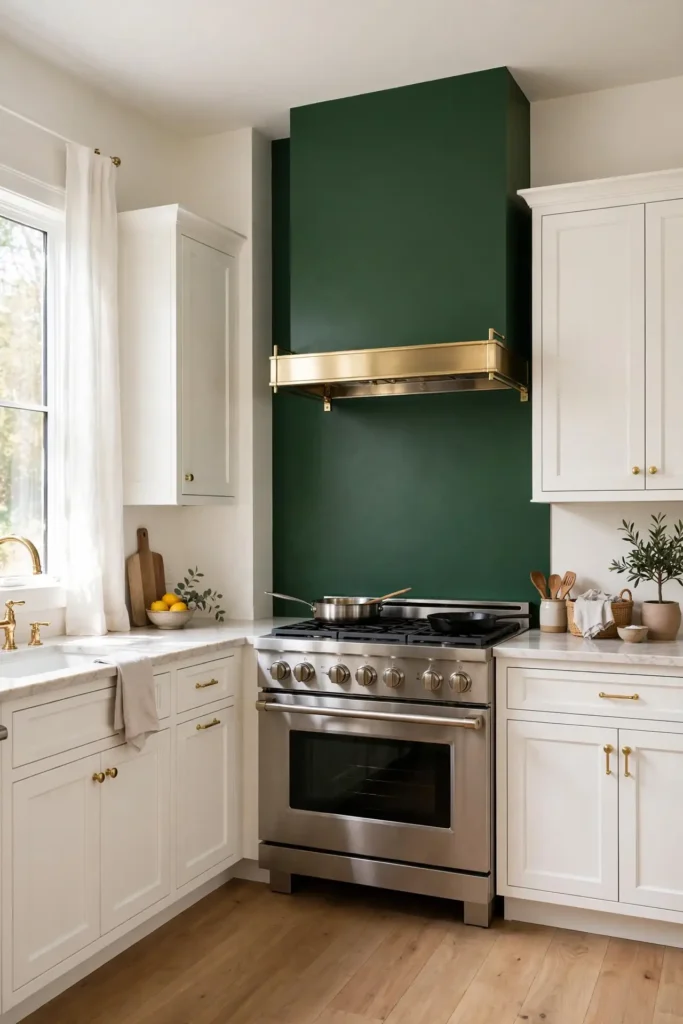
The supporting walls matter as much as the accent. Choose a warm white with a hint of cream — Benjamin Moore White Dove or Sherwin-Williams Alabaster — so the transition feels soft, not stark. Paint the ceiling the same warm white to keep the room feeling tall. Edge the accent wall with crisp lines: tape with FrogTape, seal the tape edge with a thin bead of the base color first, then paint the green over it for razor-sharp lines. If you tire of it, repainting one wall is a $50, one-afternoon project. That’s the whole point — an accent wall is a reversible experiment, not a marriage.
17. Green Walls With White Tile
Green walls with white tile is the classic farmhouse-kitchen formula — the tile keeps the green crisp and the whole room easy to clean. Run classic 3×6 white subway tile as the backsplash from counter to upper cabinets (about $3 to $6 per square foot at Home Depot), and let the green paint carry every wall above and around it. The white tile acts as a visual break so even a deep green never overwhelms, and its gloss bounces light around the work zones where you need it most. Dark grout makes the tile graphic and hides stains; light grout keeps it soft and seamless.
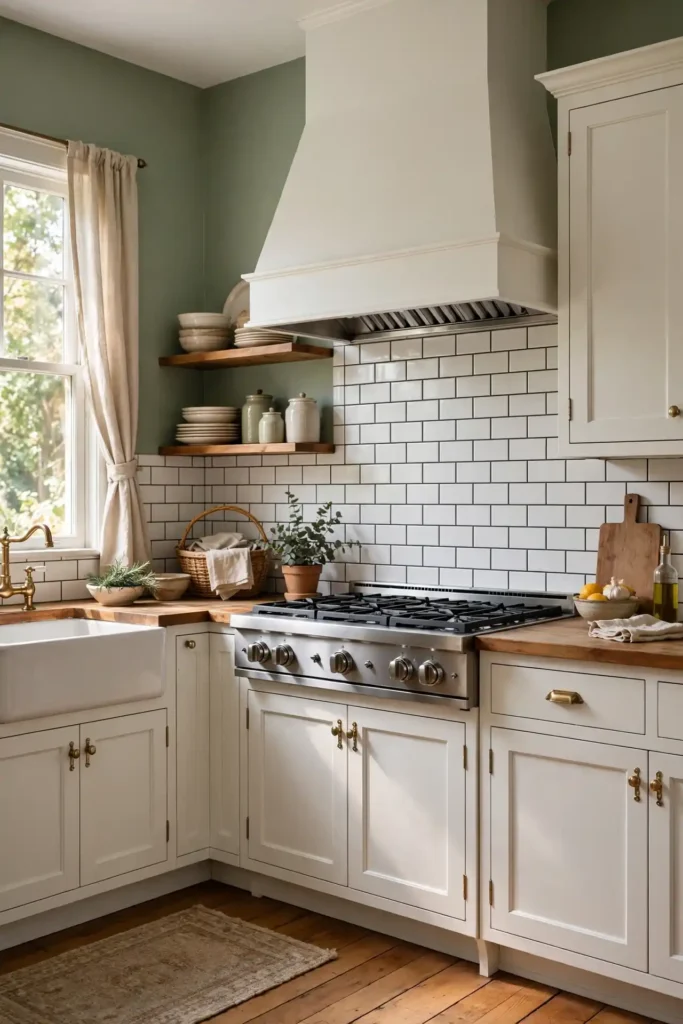
Your green can be any depth here because the tile does the heavy lifting on brightness — sage for calm, forest for drama, olive for warmth. Extend the tile behind open shelves and around windows for a custom, high-end feel; tile running to the ceiling behind a range hood is the detail that makes a kitchen look designed. Budget tip: tile the backsplash yourself over a weekend — a basic wet saw rents for about $60 a day from Home Depot — and spend the savings on the green paint in a quality line like Benjamin Moore Regal Select. Seal grout annually with a $15 penetrating sealer so tomato sauce and turmeric don’t leave souvenirs.
18. Layer Shades of Green
Layering shades of green — sage walls, olive textiles, forest in the artwork, a jade vase — creates a tonal kitchen with the depth of a designed space and none of the matchy-matchy risk. The rule is three to five greens that share an undertone: all warm (yellow-based) or all cool (blue-based), never mixed. Start with your wall color as the base, then add one shade darker and one shade lighter through accessories. A $25 olive linen runner from Target, forest-green dinnerware from IKEA, and a sage potted plant give you three layers for under $75 without touching a paintbrush.
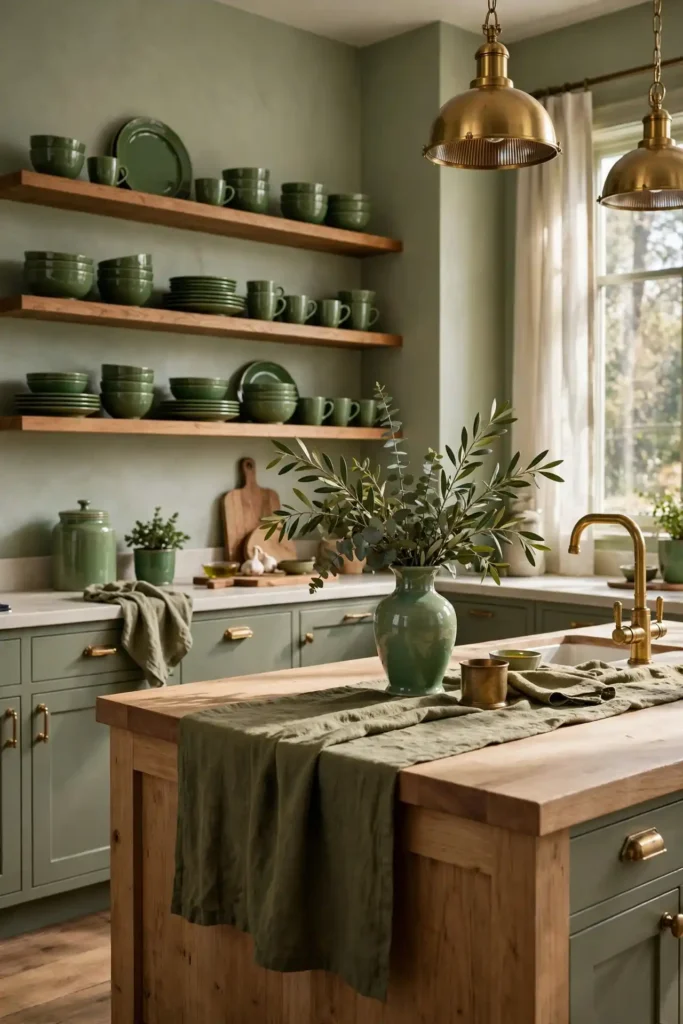
The undertone discipline is what separates layered from chaotic. Hold every candidate fabric and object against your wall paint in daylight before buying — warm greens next to cool greens will fight, and you’ll feel it even if you can’t name it. Wood tones and brass act as neutrals that bridge the layers; white dishes give the eye a rest. If you’re starting from scratch, pull your palette from one paint strip — Benjamin Moore’s Historical Colors greens, for instance — and shop within it. Photograph the room in black and white on your phone: if the greens separate into distinct grays, your layering has depth; if they blur together, add a darker accent.
Choosing the Right Shade of Green Kitchen Walls
Choosing the right shade of green kitchen walls starts with your light, not the paint chip. North-facing kitchens get cool, blue-gray light that turns warm greens muddy — pick a green with yellow or gray balance like Sherwin-Williams Clary Sage. South-facing kitchens get warm golden light that intensifies yellow greens — lean cooler, toward Benjamin Moore’s Beach Glass or a gray-green. East light is bright and warm in the morning, west light is golden in the afternoon; both shift through the day. The only reliable test is painting large swatches — at least 2×2 feet — on foam board and living with them for 48 hours.
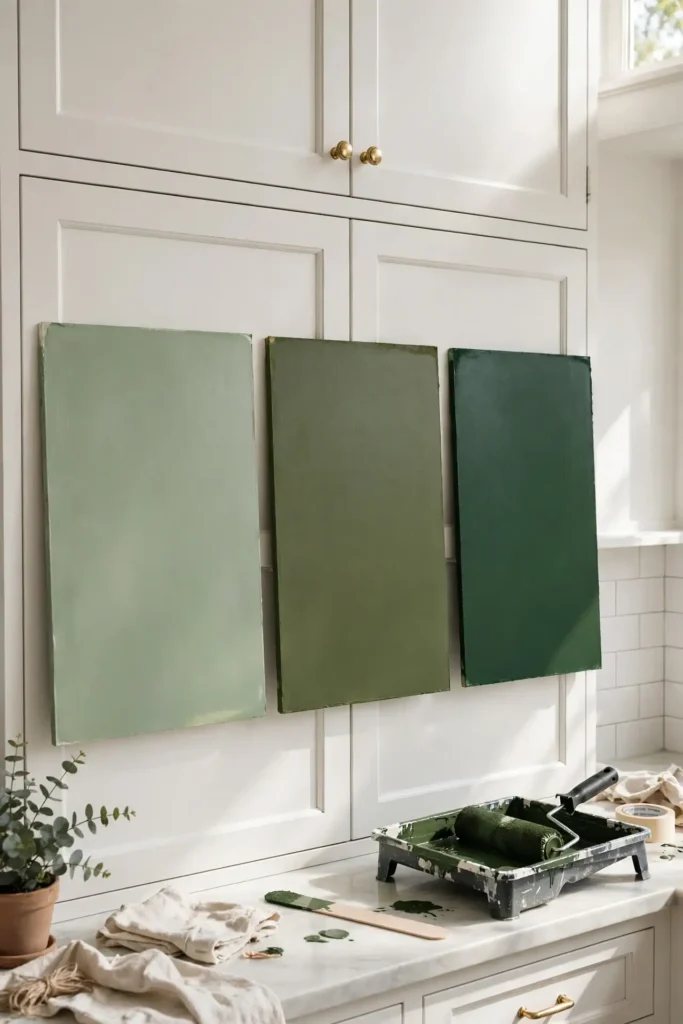
Your fixed elements vote too. Pull the undertones from your countertops, flooring, and backsplash: if your granite runs warm beige, your green needs warmth; if your tile is cool gray, your green needs gray. Cabinets matter most — white cabinets accept any green, wood cabinets demand undertone matching (warm wood with warm green), and existing colored cabinets narrow you to complementary shades. Buy sample quarts ($6 to $10 each at Lowe’s) rather than tiny swatch stickers; you need real paint on a big board. And check the color at night under your actual bulbs — a green that glows at noon can go murky under 2700K lighting.
Pairing Green Walls With Cabinets
Pairing green walls with cabinets is a two-color equation where one of them should always be quieter than the other. White cabinets let any green shine and are the zero-risk choice — they reflect light, which deep greens desperately need. Wood cabinets add warmth and work beautifully with olive and sage, but match undertones: honey oak wants yellow-based greens, while gray-washed wood wants gray-based greens. If your cabinets are already a color — navy, black, or even green — keep the walls lighter than the cabinets or match the wall to the cabinet’s undertone family so the room feels intentional rather than accidental.
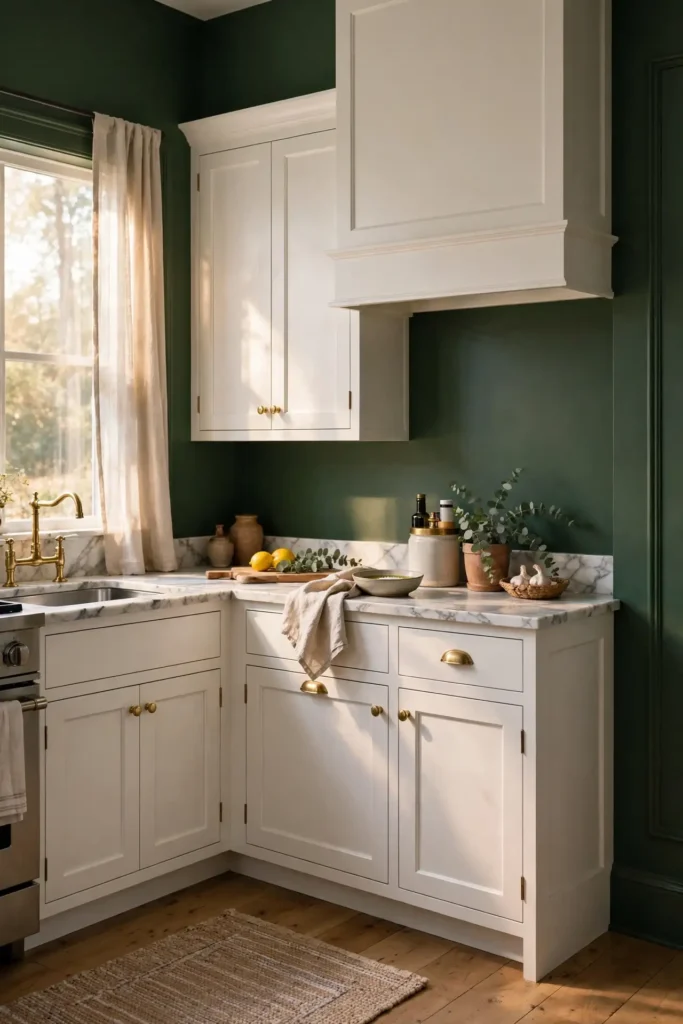
The 60-30-10 rule keeps the pairing balanced: 60 percent dominant (usually walls or cabinets), 30 percent secondary, 10 percent accent in hardware, textiles, or lighting. With green walls and white cabinets, the green is your 60 — repeat it nowhere else except maybe a plant, and let brass hardware be the 10. With green walls and wood cabinets, the wood is warm enough to count toward the 60, so keep countertops and backsplash neutral. If you’re painting cabinets to match new green walls, use a dedicated cabinet paint like Benjamin Moore Advance ($30 a quart) — wall paint on cabinets chips within a year in a working kitchen.
Styling a Green Kitchen
Styling a green kitchen is about letting the walls be the statement and keeping everything else in a supporting role. Start with the surfaces you touch daily: swap in wood cutting boards, a stoneware utensil crock, and linen towels in cream or natural flax — about $40 total at Target — and the kitchen instantly feels curated. Metals should repeat: if your faucet is brushed nickel, your cabinet pulls and pendant should be too, or switch everything to brass for warmth. One metal, used three times, reads designed; three metals used once each reads cluttered. Keep small appliances to one color family — all white, all stainless, or all black.
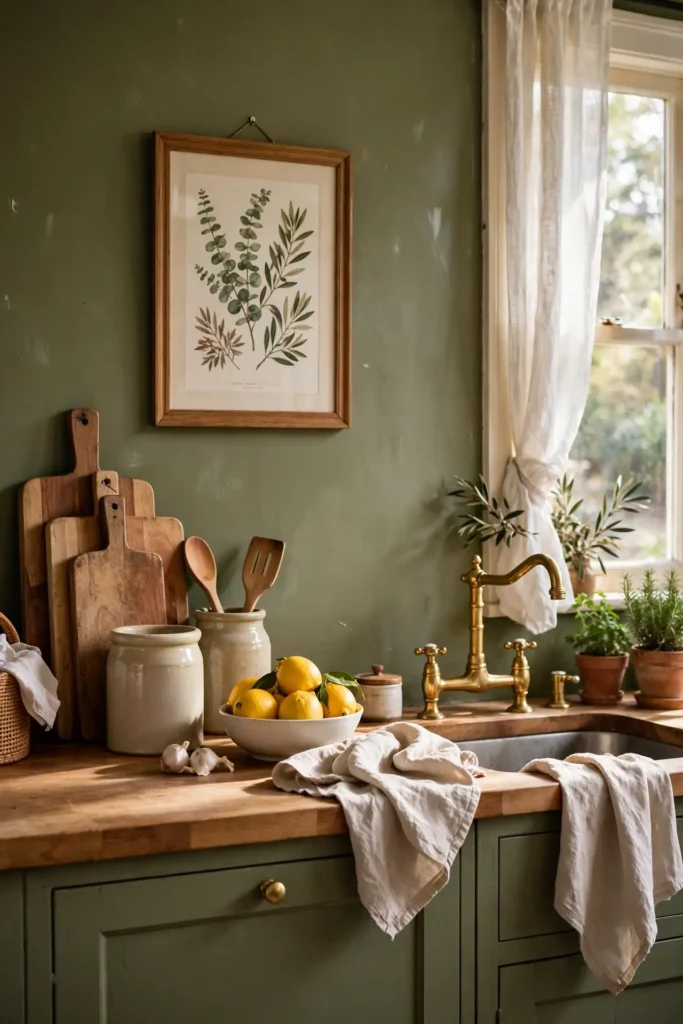
Art and open storage are where personality enters. A single large framed print with green and cream tones over a coffee station, or a row of amber glass bottles on a shelf, adds depth without competing. Plants are nearly mandatory — green walls make foliage look intentional rather than random. Edit ruthlessly: green walls amplify visual noise, so corral the clutter into a tray or basket and leave 30 percent of your counter clear. Seasonal swaps are cheap styling wins — a bowl of lemons in summer, a eucalyptus wreath in fall — that keep the kitchen feeling fresh against the permanent green.
How to Paint Green Kitchen Walls Step by Step
Painting green kitchen walls is a weekend project if you prep properly — and prep is 70 percent of a good paint job. Day one: clear the counters, remove outlet covers, and wash every wall with a degreaser like TSP substitute (kitchens hold years of cooking film). Fill nail holes with spackle, sand smooth with 120-grit, and caulk the gaps where trim meets wall. Tape edges with FrogTape, lay canvas drop cloths — plastic sheeting slips — and prime any patched spots or dark previous colors with a stain-blocking primer. Good prep takes three to four hours for an average kitchen and saves you from a third coat.
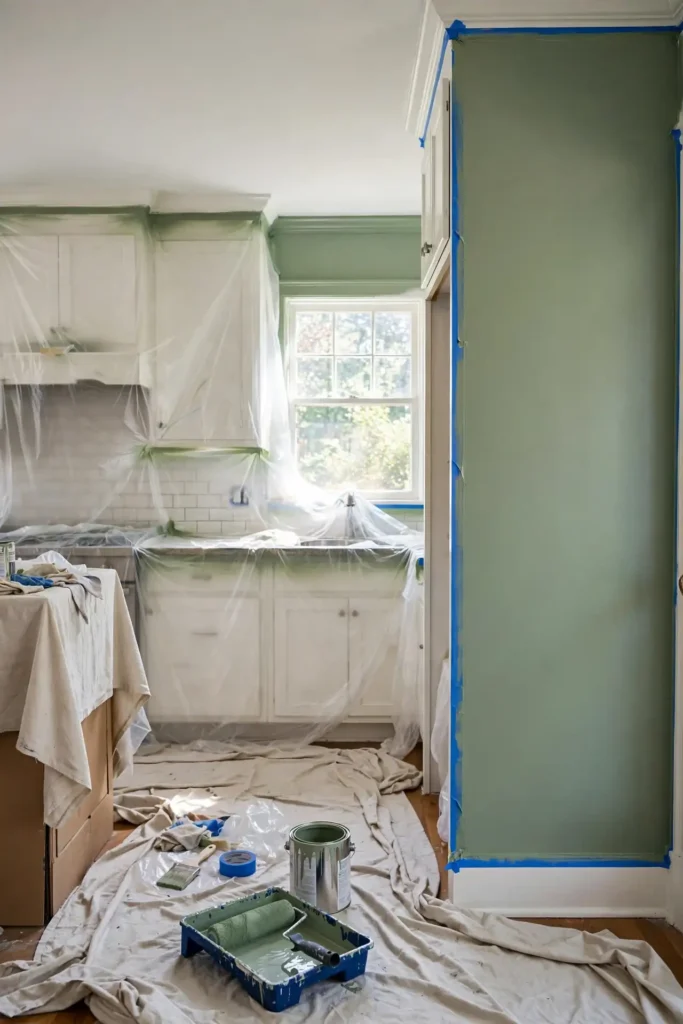
Day two is paint day. Cut in the edges with a 2.5-inch angled brush, then roll the walls with a 3/8-inch nap roller in W-patterns, working in 4-foot sections and keeping a wet edge. Two coats of a quality paint like Sherwin-Williams Emerald or Behr Marquee in satin — about $45 to $95 per gallon at Home Depot — cover most greens over primer. Wait the full recoat time on the can (usually 2 to 4 hours) between coats; rushing causes flashing. Pull tape while the final coat is still slightly tacky, at a 45-degree angle, for the sharpest lines. Ventilate well, replace outlet covers after 24 hours, and keep a labeled sample jar for future touch-ups.
- Choose a shade based on light and cabinets.
- Test samples on several walls.
- Clean and prep walls, repairing any damage.
- Apply primer and two coats of washable paint.
- Style with wood, brass and greenery.
Final Thoughts on Green Kitchen Walls
Green kitchen walls work because green is the color our eyes are literally built to see best — it’s restful, natural, and it flatters both food and faces. Whether you choose a whisper of sage or a full forest drench, the shade you pick should make you happy every single morning, because the kitchen is the room you use most. Start where your courage is: an accent wall if you’re cautious, a full room if you’re certain. Either way, test big swatches in your actual light, match your undertones, and buy the better paint — the $20-per-gallon difference disappears when the job lasts a decade.
The biggest mistake is overthinking the “rules” and underthinking the feeling. Pinterest-perfect kitchens fail when they don’t suit the people cooking in them, and a green that makes your heart lift beats a “correct” green every time. If you paint it and hate it, repainting a kitchen costs under $200 and one weekend — there is no permanent mistake here. So pick the green that caught your eye in the first place, gather your supplies from Home Depot or Lowe’s on Saturday morning, and start. Your future self, making coffee in a kitchen that finally feels like yours, will thank you.
Frequently Asked Questions About Green Kitchen Walls
Green kitchen walls raise the same practical questions again and again: which shade won’t date, whether dark green shrinks a small kitchen, and how the paint holds up to real cooking. The short answers are reassuring — sage and olive have stayed popular for a decade because they behave like neutrals, dark greens work in small kitchens when lighting is layered, and a quality satin paint wipes clean for years. The FAQ block below covers each question in detail, from choosing undertones to matching cabinets and keeping the finish fresh.

If you’re still deciding, remember that green is one of the most forgiving wall colors you can choose. It pairs with white, wood, black, brass, and marble; it suits farmhouse, modern, and traditional kitchens alike; and repainting is cheap if your taste changes. Browse the ideas above, save the ones that make you pause, and test two or three swatches on foam board before you commit. The right green is the one that looks good in your light, with your cabinets, at 7 a.m. on a Tuesday — not just in a styled photograph.
Is green a good color for kitchen walls?
Yes. Green feels natural, calming and pairs well with many materials.
What cabinets go with green kitchen walls?
White, wood, black and even green cabinets all work.
What paint finish is best for kitchen walls?
Satin or eggshell is washable and durable.
What shade of green is best for a kitchen?
Sage, olive and forest green are the most popular.
Does green make a kitchen look smaller?
Light greens feel airy; dark greens feel cozy but need good lighting.




Leave a comment