

White cabinets are a blank canvas, and the backsplash is where you can add personality. The right tile can make a white kitchen feel warm, bold, classic or modern. Because white goes with everything, the options are almost endless, which is exciting and a little overwhelming.
These 22 kitchen backsplash with white cabinets ideas cover classic, textured, colorful and patterned tiles. For more white kitchen inspiration, see our white kitchen cabinets ideas and these kitchen backsplash ideas.
Choosing a backsplash for white cabinets:
- Match the white of the tile to the cabinet undertone or choose contrast.
- Consider the countertop pattern before choosing a busy tile.
- Grout color changes the look dramatically.
- Take tile to the ceiling behind open shelves or the range.
1. Classic White Subway Tile
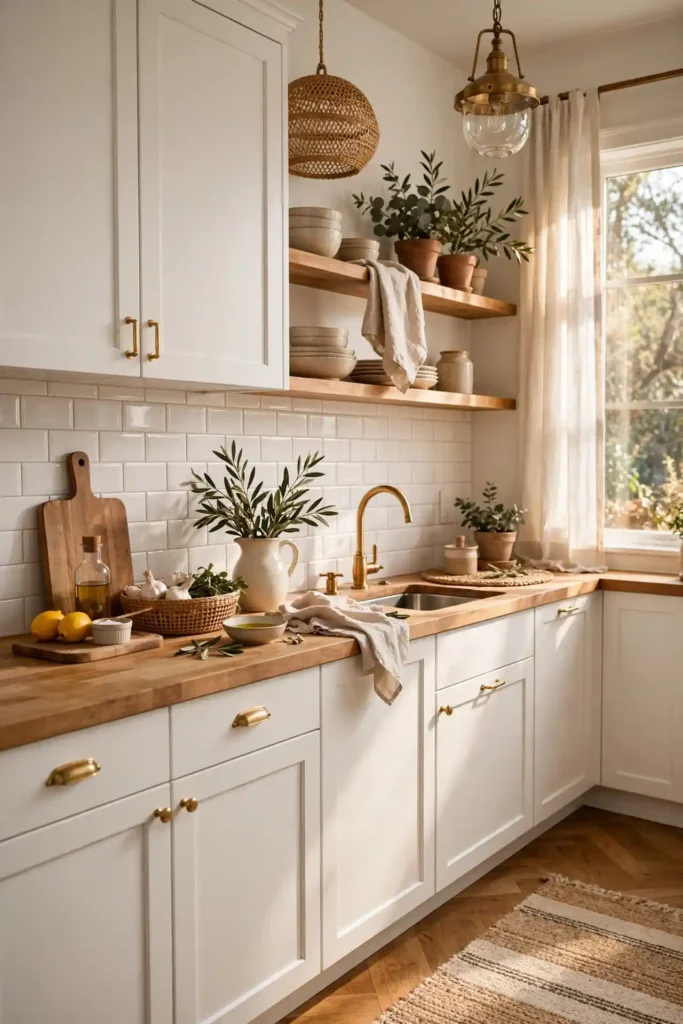
Classic white subway tile is the safest, most timeless choice you can pair with white cabinets, and it never looks dated. The standard 3-by-6-inch ceramic tile laid in an offset brick pattern adds crisp texture to an all-white kitchen without competing with your cabinetry. It works because the glossy glaze bounces light around the room, making smaller kitchens feel brighter and more open. White-on-white can feel flat, so this combination relies on the shadow lines between tiles to create subtle depth and interest. It suits every style from farmhouse to contemporary, and resale buyers love it because it reads clean and neutral. If you want a kitchen that still looks fresh in ten years, this is your anchor choice.
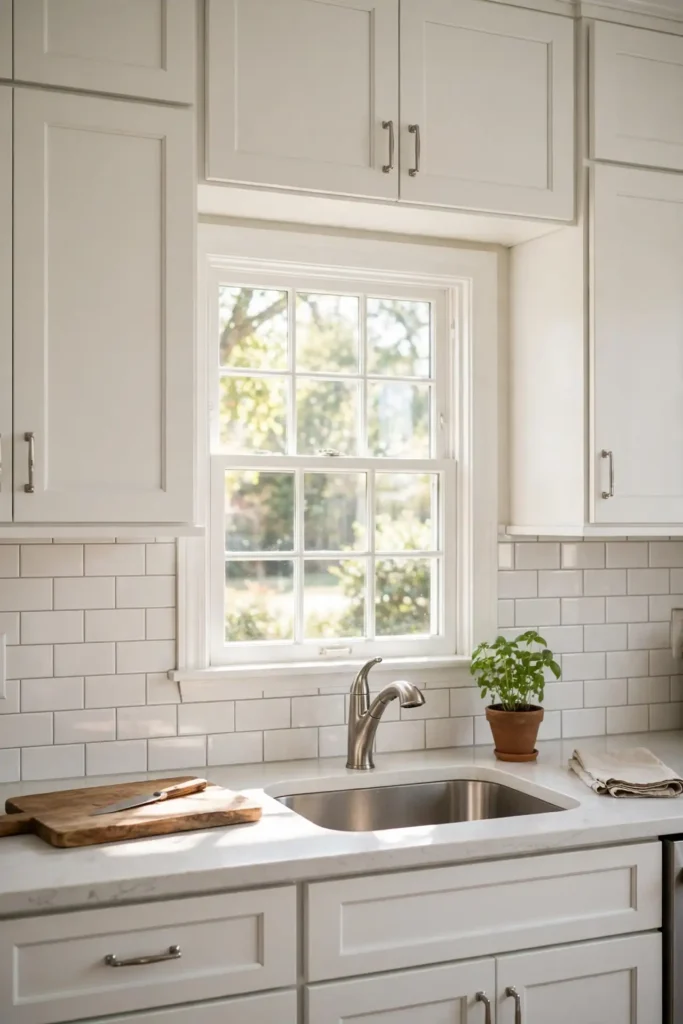
You can install white subway tile yourself over a weekend with basic tiling tools and a $30 tub of premixed thinset. Ceramic subway tile costs $2 to $8 per square foot at Home Depot and Lowe’s, and Daltile’s Rittenhouse Square line is a reliable midrange pick around $5 per square foot. The big decision is grout color: bright white grout keeps the look seamless and minimal, while light gray or warm gray grout defines the pattern and hides stains near the stove. Seal the grout once a year with a penetrating sealer. Pair this backsplash with butcher-block or light quartz counters for a warm contrast, or keep everything white for a crisp, airy space.
2. Zellige Tile
Zellige tile brings handcrafted character to a white kitchen in a way no machine-made tile can match. Each Moroccan-style square is handmade, so the glaze pools, crackles, and shifts in tone, giving you a wall that shimmers as light moves across it. Against white cabinets, a glossy white or pearl zellige backsplash feels luxurious and organic at the same time, adding texture without introducing a competing color. It works beautifully in coastal, Mediterranean, and modern farmhouse kitchens. The uneven surface catches natural light and creates a soft glow that flat ceramic tiles cannot replicate, so your kitchen feels warm rather than sterile.
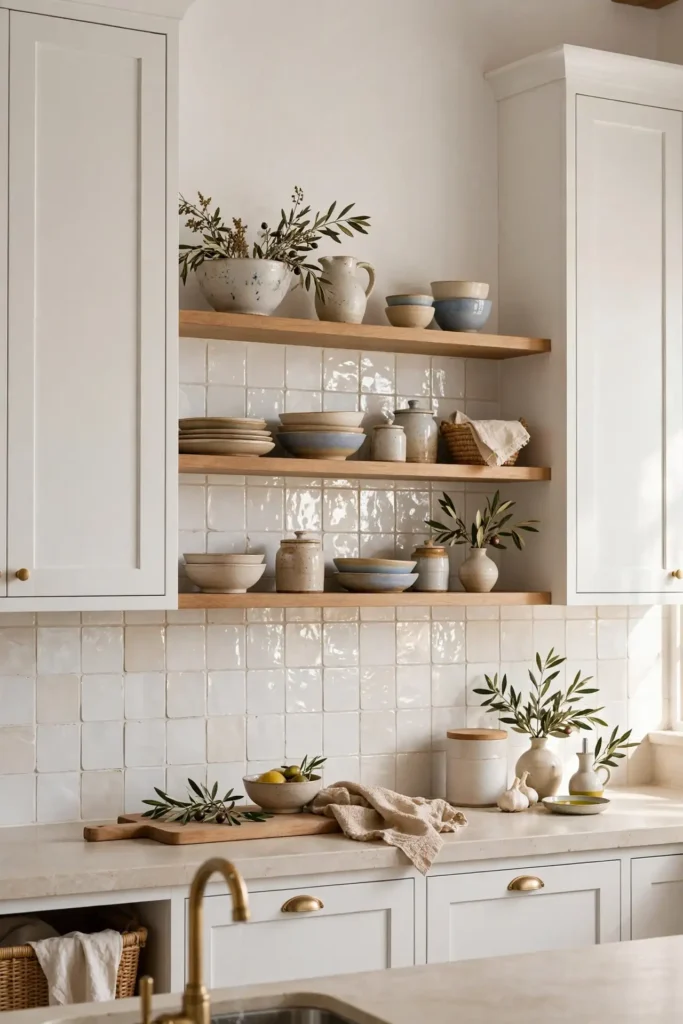
Real zellige runs $25 to $60 per square foot from specialty suppliers like Riad Tile and Zia Tile, so budget accordingly and order 15 percent extra for cuts. Many US homeowners choose zellige-look ceramic from Floor & Decor for $8 to $15 per square foot instead, which delivers the handmade feel without the fragile, uneven installation. Install it with tight 1/16-inch joints to let the glaze edges touch, and skip contrasting grout since it fights the artisan look. Use a white or color-matched grout and seal it well. Keep counters simple, like honed marble or white quartz, so the tile stays the star.
3. Marble Slab Backsplash
A marble slab backsplash turns your white kitchen into a seamless, high-end statement with almost no grout lines. Instead of individual tiles, a full 2-centimeter or 3-centimeter slab runs from countertop to upper cabinets, wrapping the range wall in one continuous piece of veined stone. Against white cabinets, the soft gray and gold veining of Carrara or Calacatta marble adds movement and luxury while staying firmly neutral. This look works best in transitional and traditional kitchens where you want elegance without busy patterns. It also makes cleaning easier because there are almost no grout joints to scrub behind the cooktop.

Expect to pay $60 to $120 per square foot installed for a marble slab, since the stone alone runs $40 to $80 and fabrication is the real cost. Bookmatching two slabs behind the range creates a dramatic mirrored vein pattern that becomes the kitchen’s focal point. Marble etches and stains, so ask your fabricator for a penetrating sealer and wipe up lemon juice, wine, and tomato sauce quickly. If you love the look but fear maintenance, a marble-look quartz slab costs $50 to $90 per square foot installed and needs zero sealing. Pair with honed marble or quartz counters and polished nickel hardware for a cohesive, classic finish.
4. Herringbone Pattern
Herringbone is the pattern upgrade that makes even plain white tile look custom and designer-chosen. Laid at a 90-degree zigzag, the tiles create a sense of movement that draws the eye along the wall and adds energy to a calm white kitchen. With white cabinets, a white or soft gray herringbone backsplash feels fresh and modern without adding color, while a natural stone herringbone in marble or travertine adds warmth. This pattern shines in transitional and contemporary kitchens, and it is especially effective behind a range hood or on a narrow wall where the geometry becomes a focal point.
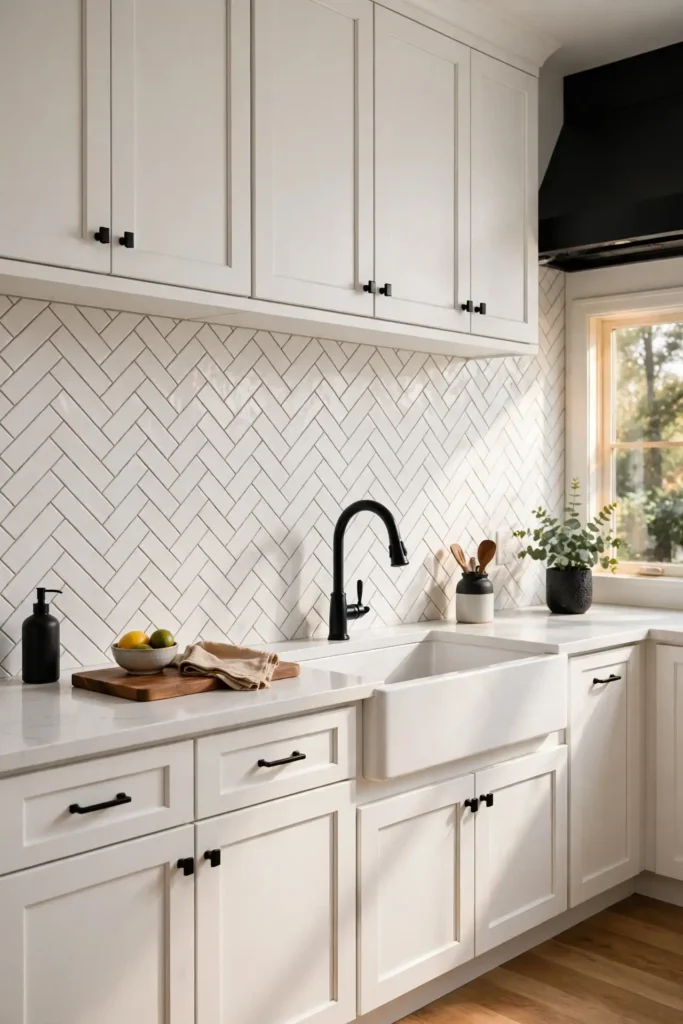
Herringbone installation is trickier than a basic offset pattern, so expect labor to run 30 to 50 percent higher if you hire it out. You will also waste more tile, so order 15 to 20 percent extra. Standard 2-by-6-inch or 3-by-12-inch tiles from Daltile or Jeffrey Court cost $5 to $12 per square foot, and the pattern itself makes budget tile look expensive. Use 1/16-inch joints and a grout color close to the tile so the zigzag reads as texture rather than a busy grid. Practice the layout on the floor first, and keep counters and hardware quiet so the pattern carries the design.
5. Green Tile
Green tile is the color move that keeps a white kitchen calm while adding real personality. Deep emerald or forest green tiles create a rich, moody contrast against white cabinets that feels both classic and current, while soft sage or sea-glass green keeps the mood light and coastal. Green works because it is a natural, grounding color that pairs effortlessly with brass hardware and warm wood tones. It fits farmhouse, traditional, and cottage kitchens especially well, and it photographs beautifully for resale listings. A full green backsplash makes a statement, while a green accent behind the range gives you color without committing the whole wall.
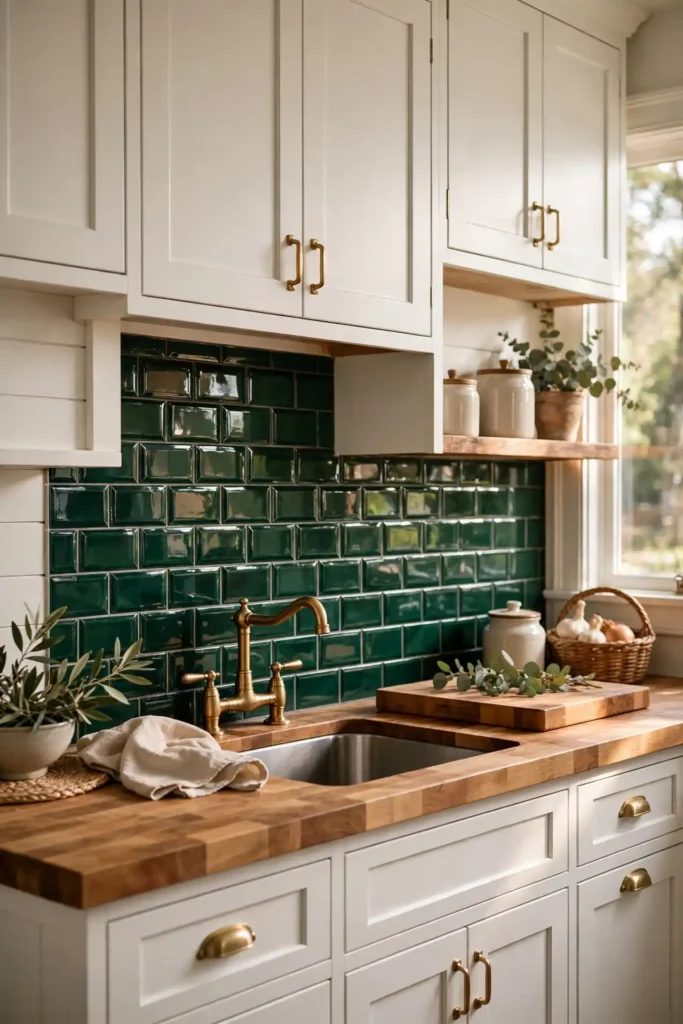
Glossy green ceramic subway or square tiles run $6 to $15 per square foot at Floor & Decor and Home Depot, with Jeffrey Court’s artisan lines offering rich color variation. For a budget version, paint a section of backsplash in a deep green like Sherwin-Williams Evergreen Fog using tile-rated primer and paint. Use white or light gray grout to keep green tile fresh, and pair it with butcher-block or light oak counters to warm up the palette. Brass or champagne bronze faucets and pulls complete the look. Avoid green with cool gray counters, which can make the combination feel flat and disconnected.
6. Blue Tile
Blue tile gives a white kitchen the relaxed feel of the coast or the depth of a classic library, depending on the shade you choose. Navy and indigo tiles create dramatic contrast against white cabinets, turning the backsplash into a bold focal point that still feels timeless. Lighter tones like dusty blue, denim, or aqua keep the space airy and work beautifully in coastal and cottage kitchens. Blue works so well because it is universally flattering, hides splatter better than white, and pairs with nearly every metal finish. It is one of the few colors that feels both traditional and current at the same time.
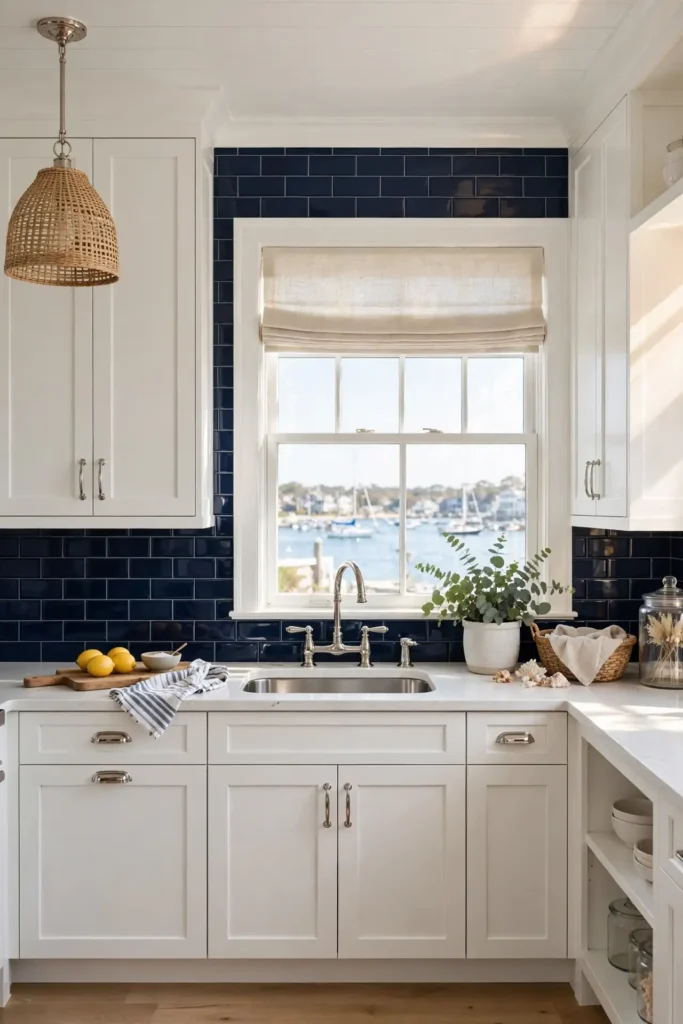
Glossy blue ceramic and porcelain tiles cost $6 to $16 per square foot, with Daltile and Bedrosians offering strong navy and coastal-blue lines. A 4-by-12-inch blue subway tile in an offset pattern is a safe, classic application, while handmade-look blue zellige adds artisan texture. Pair navy with polished nickel or chrome hardware and white quartz counters for a crisp nautical feel, or pair it with brass and warm wood for a richer traditional look. Use light gray grout to soften the edges, and keep upper walls light so the blue does not darken the room.
7. Patterned Cement Tile
Patterned cement tile turns your backsplash into the artwork of the kitchen. These tiles carry bold geometric or floral motifs in colors like blue, charcoal, and cream that pop dramatically against white cabinets. Because white cabinetry is visually quiet, it lets the pattern be the star without any competition, and the room feels curated rather than chaotic. Patterned tile works best in farmhouse, Spanish, and eclectic kitchens where personality matters more than minimalism. It also hides cooking splatter far better than plain white tile, which is a practical bonus behind a busy range.
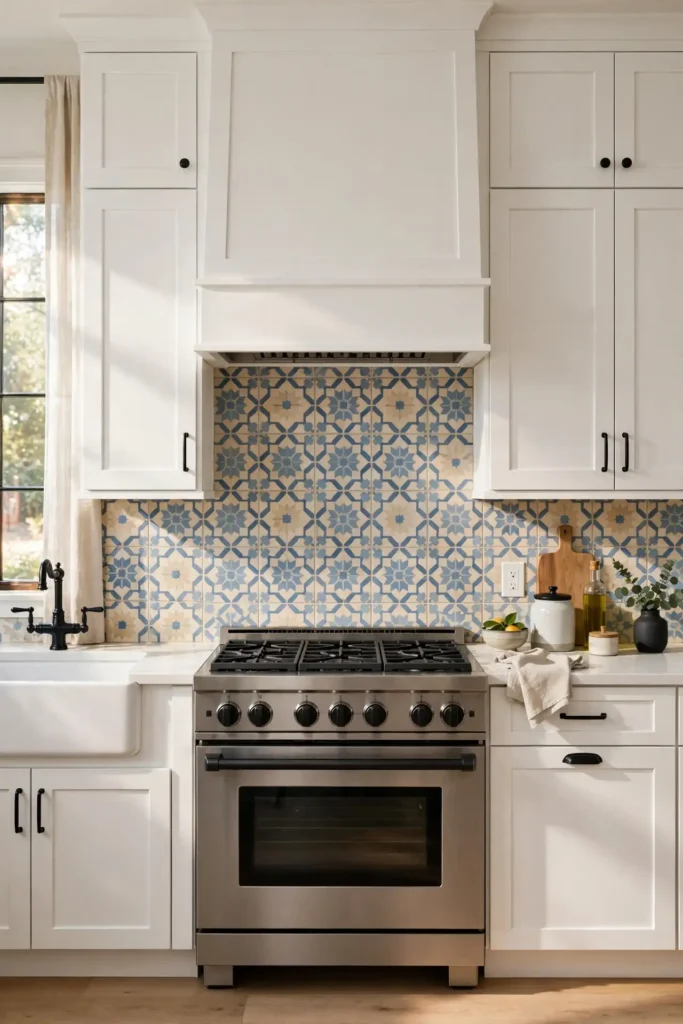
True cement tile costs $10 to $25 per square foot and needs sealing before and after grouting, so many US homeowners choose patterned porcelain from Floor & Decor at $4 to $9 per square foot, which needs no sealing at all. Keep the pattern contained: use it behind the range or on one accent wall, and use a simple solid tile or plaster on the remaining walls. Order 15 percent extra and dry-lay the pattern on the floor to plan the motif flow. Pair with simple counters like white quartz and matte black hardware so the tile stays the hero. Too much pattern everywhere will overwhelm the space.
8. Vertical Stack
Vertical stack is the modern layout that makes ordinary tile look fresh and architectural. Instead of the classic horizontal offset, rectangular tiles are stacked in straight columns running floor to ceiling, which draws the eye upward and makes your kitchen feel taller. Against white cabinets, a vertical stack in white, cream, or pale gray tile adds quiet structure without introducing color, and the crisp vertical lines feel current and clean. This layout works in modern, Scandinavian, and transitional kitchens, and it is especially flattering in kitchens with low ceilings because the vertical rhythm adds perceived height.
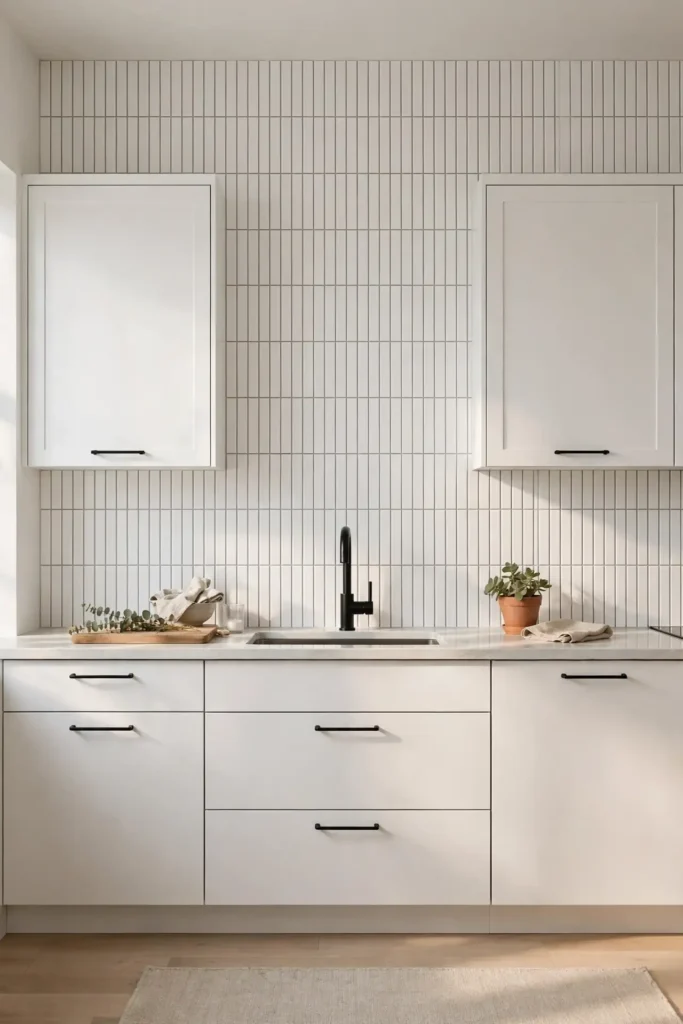
Installation is straightforward since the grid is simple, and standard 3-by-12-inch or 4-by-12-inch tiles cost $4 to $12 per square foot at Home Depot and Lowe’s. The straight grout lines are more visible than in an offset pattern, so use a grout color close to the tile and keep joints tight at 1/16 inch. For extra impact, run the vertical stack all the way to the ceiling behind the range hood, creating a tiled chimney effect. Pair with flat-front white cabinets, minimal hardware, and light counters for a calm modern look. Avoid busy counters like heavy granite, which compete with the strong linear pattern.
9. Hexagon Tile
Hexagon tile adds playful geometry to a white kitchen without committing to a loud color. The honeycomb shape creates a graphic, modern pattern that feels fresh against the clean lines of white cabinets, and it works in sizes from tiny 1-inch mosaics to bold 8-inch hexes that read like modern art on the wall. White or marble-look hexagons keep the palette calm and classic, while a colored or ombre hexagon floor-to-wall treatment makes a stronger statement. Hexagon tile suits modern, mid-century, and Scandinavian kitchens, and the small mosaic format grips well on curved or uneven walls.

Hexagon mosaic sheets cost $8 to $20 per square foot at Floor & Decor, Lowe’s, and Home Depot, with marble hex running higher at $18 to $35. Installation takes longer than square tile because of the many cuts and grout lines, so hire a patient installer or budget extra time. Choose grout carefully: white grout on white hexes keeps things seamless, while gray grout outlines every honeycomb and adds graphic punch. Grout lines are plentiful, so seal them well in a hardworking kitchen. Pair white hexes with butcher-block counters and black hardware for contrast, or keep it all light for an airy Scandinavian feel.
10. Terracotta Tile
Terracotta tile brings warm, sun-baked earthiness that keeps an all-white kitchen from feeling cold. The natural clay tones range from soft peach to deep rust, and the handmade surface variation gives every tile its own character. Against white cabinets, terracotta adds Mediterranean warmth and pairs beautifully with wood beams, open shelving, and aged brass. This look thrives in farmhouse, Spanish, and Tuscan-style kitchens, and it makes the space feel inviting and lived-in rather than showroom-perfect. The matte, chalky surface also hides splatter and fingerprints far better than glossy white tile.
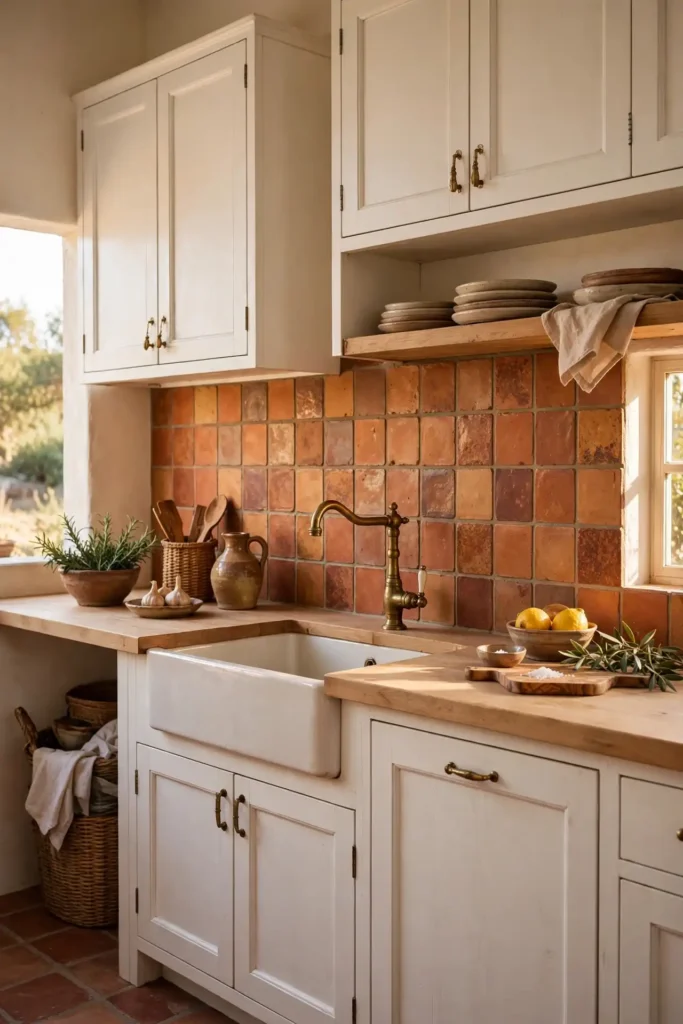
Genuine terracotta runs $8 to $20 per square foot and must be sealed well since it is porous, so order from specialty suppliers or Floor & Decor’s artisan lines. Terracotta-look porcelain at $5 to $10 per square foot gives you the warmth without the sealing and staining worries. Lay it in a simple offset or stacked pattern to let the color and texture speak, and use a grout color close to the tile to keep the surface reading as one warm field. Pair with honed butcher-block or light travertine counters and oil-rubbed bronze or black hardware. Keep wall paint warm white, since cool white can clash with the clay tones.
11. Black Tile
Black tile is the boldest move on this list, and it turns a white kitchen into a high-contrast showpiece. Glossy black subway tile against white cabinets creates a crisp tuxedo look that feels graphic and modern, while matte black zellige adds moody, artisan depth. Black works because white cabinets provide the bright balance that keeps the dark tile from overwhelming the room, and the contrast makes both elements look more intentional. This pairing shines in modern, industrial, and transitional kitchens, and it is a favorite in homes where the owner wants drama without a full black kitchen.
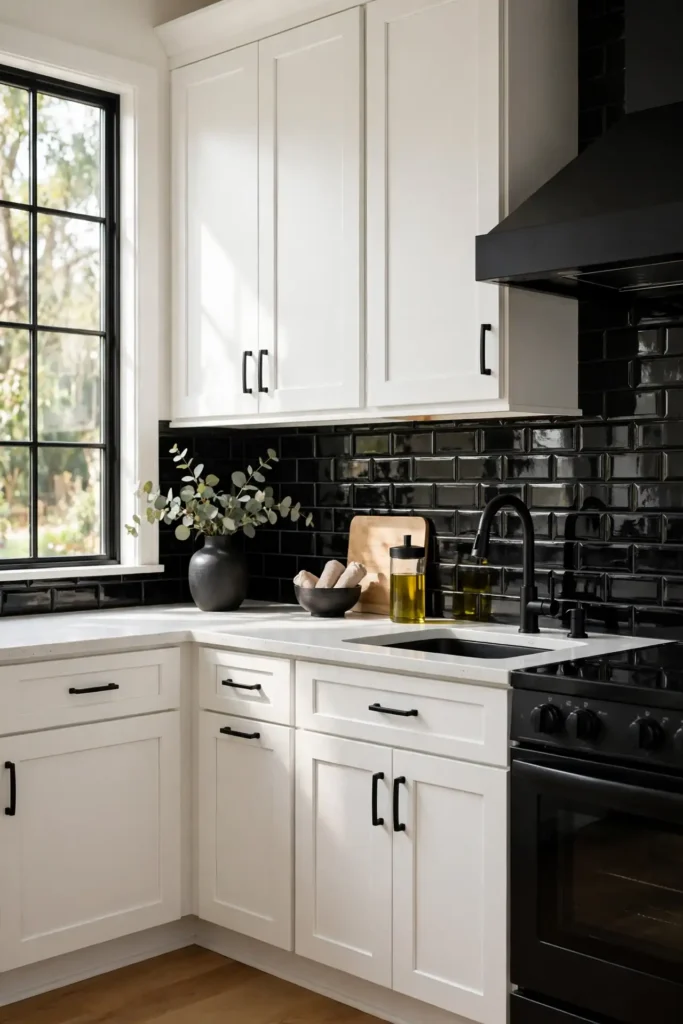
Glossy black ceramic subway tile costs $4 to $10 per square foot at Home Depot and Lowe’s, making this one of the most affordable statement looks. Black grout keeps the wall reading as one dark plane, while white grout creates a striking graphic grid, so choose based on how bold you want to go. Black tile shows dust and water spots, so wipe it down regularly and consider a matte finish in hardworking cooking zones. Pair with white quartz counters, matte black hardware, and plenty of lighting to keep the space balanced. Add warm wood accents to soften the contrast.
12. Brick Veneer
Brick veneer gives your white kitchen the warm, historic character of a converted loft or old farmhouse. Thin brick tiles in warm reds, whitewashed tones, or soft browns add texture and age against the crisp finish of white cabinets, and the rough surface catches light beautifully. Whitewashed or German-schmear brick keeps the palette light and pairs seamlessly with white cabinetry, while natural red brick creates a bolder rustic contrast. This look belongs in farmhouse, industrial, and cottage kitchens, and it makes new construction feel like it has a story and genuine soul.
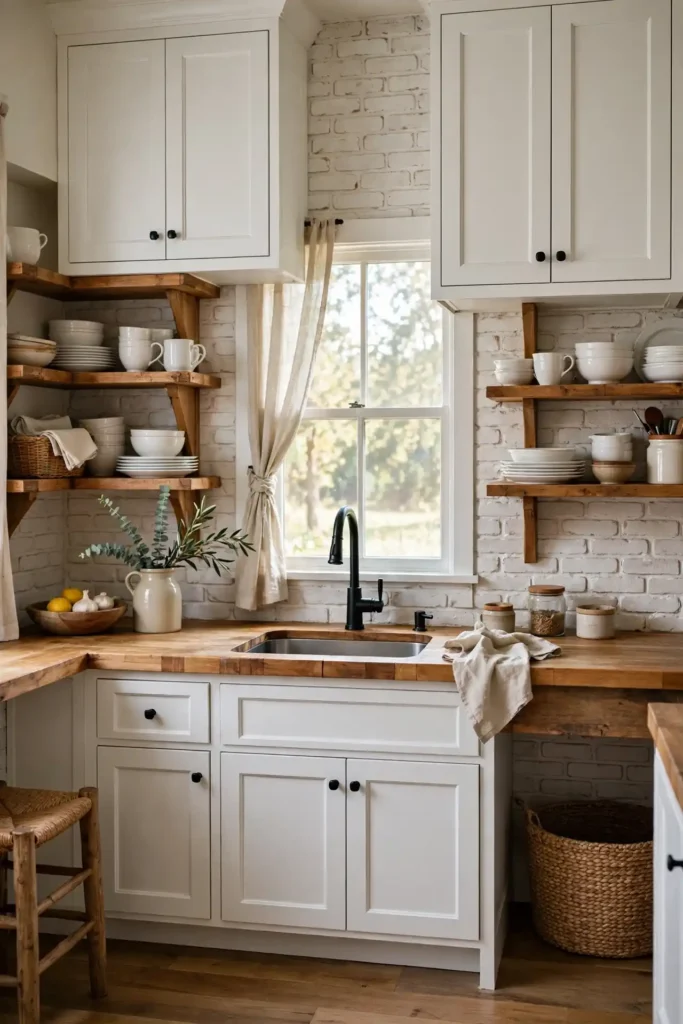
Thin brick veneer costs $8 to $15 per square foot at Home Depot, Lowe’s, and specialty suppliers, and it installs like tile with mortar and grout. Whitewashing is a simple DIY: thin white latex paint with water and rag it over the brick, or use a German schmear technique with mortar for heavier coverage. Seal the brick with a matte stone sealer to protect it from grease, since brick is porous. Pair with butcher-block counters, black hardware, and open wood shelving for a cohesive rustic look. Keep the brick to one wall or the range area so the texture reads as an accent, not a cave.
13. Beadboard Backsplash
Beadboard is the budget-friendly charmer that gives a white kitchen instant cottage character. The narrow vertical grooves add texture and a handcrafted feel that tile cannot replicate, and painted the same white as your cabinets, it creates a seamless, built-in look. Beadboard works because it softens the kitchen, making it feel like a cozy cottage rather than a sterile workspace, and it pairs perfectly with farmhouse sinks and vintage-style hardware. It suits farmhouse, cottage, and coastal kitchens best, especially in older homes where the style feels authentic. A simple chair rail or trim cap finishes the top edge cleanly.
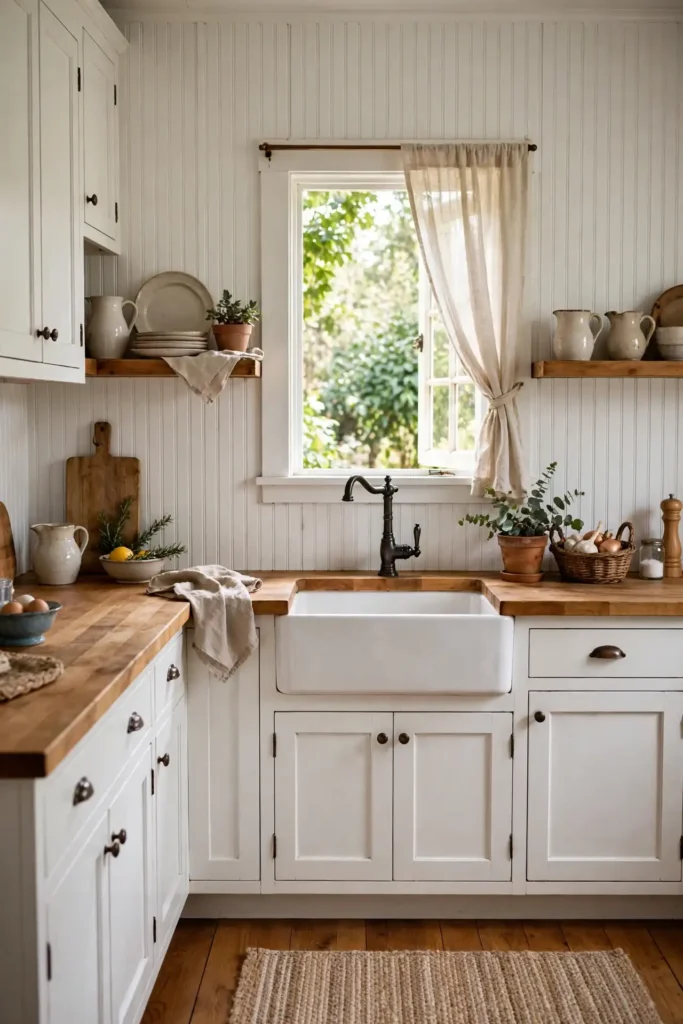
Beadboard panels cost $1 to $4 per square foot at Home Depot and Lowe’s, making this one of the cheapest backsplash options available. Use moisture-resistant PVC beadboard or marine-grade plywood panels behind the sink and range, since standard MDF swells with water. Install with construction adhesive and a few brad nails, caulk the seams, and paint with a scrubbable satin or semi-gloss enamel in your cabinet white. Add a chair-rail cap where the beadboard meets the wall for a finished look. Pair with butcher-block counters and oil-rubbed bronze hardware for a warm farmhouse feel, and wipe splatters quickly since paint is less stain-proof than tile.
14. Glass Tile
Glass tile brings shimmer and light to a white kitchen like nothing else. The translucent surface reflects both natural and under-cabinet light, making the backsplash glow and the whole kitchen feel brighter. Against white cabinets, glass tile in aqua, sea green, or pale gray adds a touch of color with an airy, luminous quality, while clear or white glass keeps things minimal and sleek. Glass tile suits contemporary, coastal, and transitional kitchens, and it is naturally stain-proof since it never absorbs grease or moisture, which makes cleanup behind the range effortless.
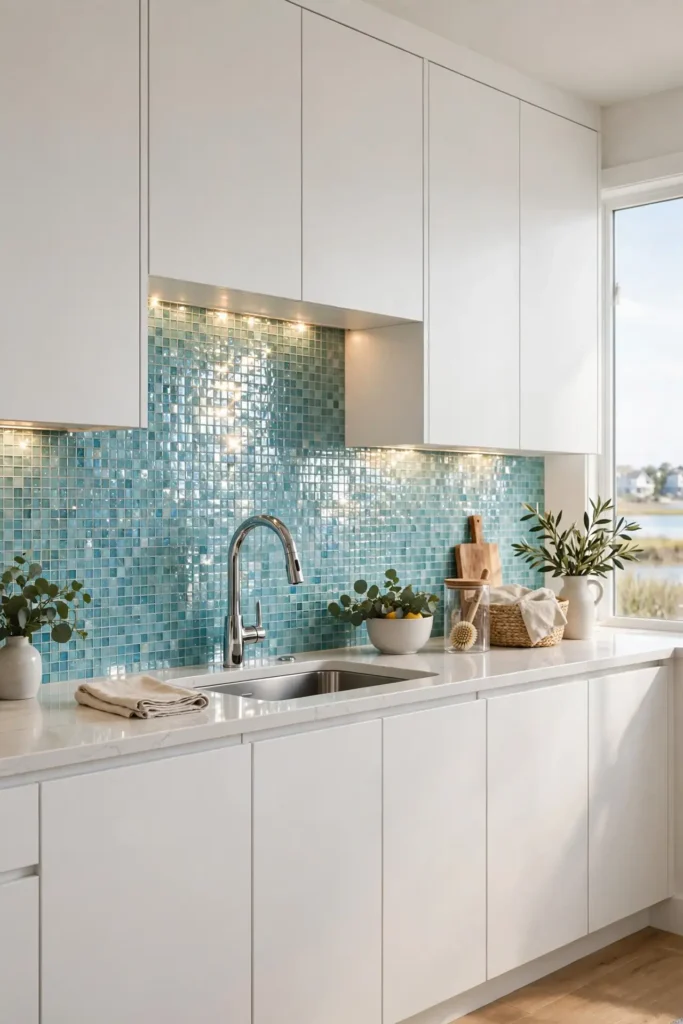
Glass mosaic sheets cost $10 to $25 per square foot at Floor & Decor and specialty tile shops. Installation needs a white thinset, because gray mortar shows through translucent glass and dulls the color. Cut glass tile with a wet saw and a glass blade to avoid chipping, and use unsanded grout to prevent scratching the surface. Keep the palette simple: one color or a soft blend reads elegant, while multi-color blends can look dated fast. Pair with white quartz counters and polished chrome or nickel hardware to amplify the light, airy feel. Under-cabinet LED lighting is almost mandatory to show off the reflective quality.
15. Quartz Backsplash
A quartz backsplash continues your countertop material straight up the wall for a seamless, ultra-clean look. With no grout lines at all, the surface is completely nonporous, so tomato sauce, grease, and wine wipe off with a damp cloth. Against white cabinets, a white or light-gray quartz with soft veining keeps the kitchen calm and cohesive, while a boldly veined quartz turns the wall into a statement. This look fits modern, transitional, and minimalist kitchens perfectly, and it is the easiest backsplash to maintain of any option on this list.

Expect $50 to $100 per square foot installed, since the backsplash is fabricated from the same slabs as your counters and installed by the stone fabricator. Ask for a full-height quartz backsplash from counter to upper cabinets, or a 4-inch integrated curb with tile above if you want to save money. Quartz never needs sealing, unlike marble or granite, which is a major selling point for busy families. Pair with matching or complementary quartz counters, simple slab-front white cabinets, and minimal hardware for a sleek look. Avoid pairing heavily veined quartz with busy flooring, since the two patterns can fight each other.
16. Fish Scale Tile
Fish scale, also called mermaid or scallop tile, adds whimsical texture that makes a white kitchen feel special and custom. The overlapping curved shape creates a rhythmic, organic pattern that catches light across each scallop, giving the wall movement and dimension. Against white cabinets, fish scale tile in soft white, pearl, or pale blue feels coastal and romantic, while deep green or navy versions make a bolder statement. This shape shines in coastal, bohemian, and eclectic kitchens, and it is a favorite for beach houses and powder rooms. It brings a playful, artistic energy that plain square tile simply cannot match.
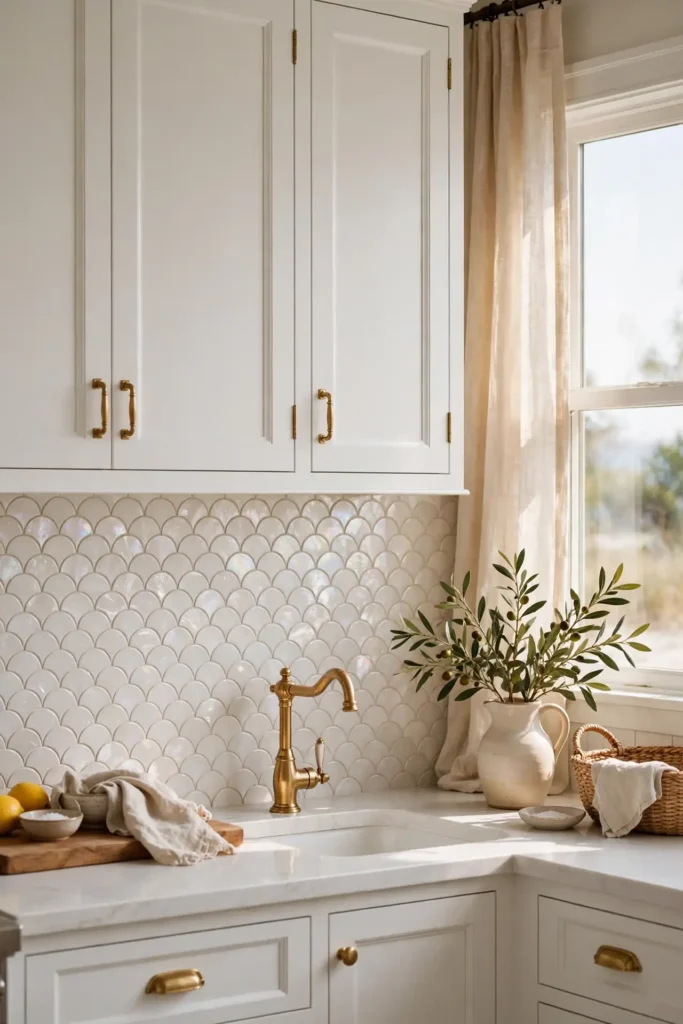
Fish scale mosaic sheets cost $12 to $30 per square foot from suppliers like Fireclay Tile and Floor & Decor, with handmade versions running higher. Installation is slower than square tile because of the curves, so budget extra labor or time. Use white or color-matched grout to emphasize the scallop shape rather than the grid, and seal grout well since the many curves create lots of grout lines. For a budget take, use fish scale peel-and-stick tiles at $6 to $10 per square foot behind a small area. Pair with white quartz counters, brass hardware, and light walls to keep the whimsical shape feeling elegant rather than kitschy.
17. Checkerboard Tile
Checkerboard tile brings retro diner charm to a white kitchen with instant graphic punch. The alternating black-and-white squares create a bold pattern that feels playful and classic at the same time, and against white cabinets the black squares provide the contrast that keeps the room from feeling washed out. This look works in farmhouse, retro, and eclectic kitchens, and it is especially fun in breakfast nooks or behind a range where the pattern becomes a focal point. A smaller checkerboard in marble reads elegant and Parisian, while larger squares in ceramic feel casual and vintage.

Standard 12-by-12-inch checkerboard sheets or individual 4-inch and 6-inch tiles cost $5 to $15 per square foot at Home Depot and Floor & Decor. Keep the checkerboard to one accent area, like the range wall or a coffee bar, and use simple white subway tile elsewhere so the pattern does not overwhelm. Marble checkerboard costs $15 to $30 per square foot and needs sealing, while ceramic checkerboard needs none. Pair with white counters, chrome or black hardware, and simple Shaker cabinets to let the pattern shine. Avoid busy counters and patterned floors in the same space, since checkerboard plus another pattern quickly becomes visual chaos.
18. Picket Tile
Picket tile is the elongated hexagon that gives your backsplash a fresh, fence-like geometry. Longer and narrower than a standard hexagon, the picket shape creates vertical rhythm that makes walls feel taller, and the pointed ends add an architectural detail that plain rectangles lack. Against white cabinets, white or cream picket tile feels modern and tailored, while colored picket in sage, navy, or terracotta adds personality. This shape works in modern, transitional, and Scandinavian kitchens, and it is a great middle ground if subway tile feels too common but you still want something timeless.
Picket tile costs $8 to $18 per square foot at Floor & Decor, Bedrosians, and specialty shops, with handmade-look versions at the higher end. Install it vertically for the classic picket-fence effect or horizontally for a wider, more relaxed feel. Use tight 1/16-inch joints and a grout color close to the tile so the unusual shape reads clearly. Order 15 percent extra since the pointed ends create more waste at edges and outlets. Pair with simple white quartz counters and matte black or brass hardware, and keep the rest of the kitchen quiet so the distinctive shape gets the attention it deserves.
19. Tile to the Ceiling
Running tile all the way to the ceiling is the designer trick that makes a white kitchen look custom and expensive. Instead of stopping at the upper cabinets or the standard 18-inch backsplash height, the tile continues behind open shelving, around the range hood, and up to the ceiling line. Against white cabinets, a full-height tile wall adds texture and presence that makes the kitchen feel larger and more finished, since the eye travels uninterrupted from counter to ceiling. This approach works in modern, transitional, and farmhouse kitchens, and it is especially powerful behind a statement range hood.

Full-height tiling roughly doubles your tile and labor cost, so budget $10 to $30 per square foot installed depending on the tile you choose. Keep the tile choice calm, like white subway, handmade-look ceramic, or soft zellige, since a bold pattern at full height can overwhelm. This is the perfect place for a vertical stack or herringbone layout, which looks intentional at scale. Pair with white cabinets that reach the ceiling, minimal hardware, and simple counters so the tiled wall reads as architecture rather than decoration. Add under-cabinet and in-shelf lighting to highlight the texture after dark.
20. Range Accent
A range accent backsplash concentrates your design budget where it has the most visual impact. Instead of tiling every wall, you install a special tile, slab, or pattern just behind the cooktop, framed like a piece of art between the surrounding simpler backsplash. Against white cabinets, a range accent in marble mosaic, patterned cement tile, or a bookmatched stone slab becomes the kitchen’s focal point without overwhelming the space. This approach works in every kitchen style, from traditional to modern, and it is the smartest way to use an expensive tile you love but cannot afford everywhere.

Frame the accent with a simple border or let it run from the cooktop to the hood in a clean rectangle. Budget $200 to $800 for the accent area depending on the material, since you are only covering 10 to 20 square feet. Marble mosaic, handmade zellige, or a small marble slab all make stunning range accents at $15 to $40 per square foot. Keep the surrounding backsplash quiet, like white subway tile or plaster, so the accent stands out. Pair with a statement range hood in white, brass, or stainless to complete the vignette. This is also the ideal spot for that bold patterned tile you have been eyeing.
21. Painted Tile
Painted tile is the rental-friendly and budget-friendly refresh that transforms a dated backsplash without demolition. Specially formulated tile paint or an epoxy-based kit bonds to ceramic, porcelain, and even glass tile, letting you turn a tired beige or busy patterned backsplash into crisp white or a fresh color that complements your white cabinets. This works because paint is the cheapest way to change the look, and against white cabinets a freshly painted white or soft sage backsplash looks intentional and clean. It suits renters and budget remodelers best, buying you years before a full renovation.
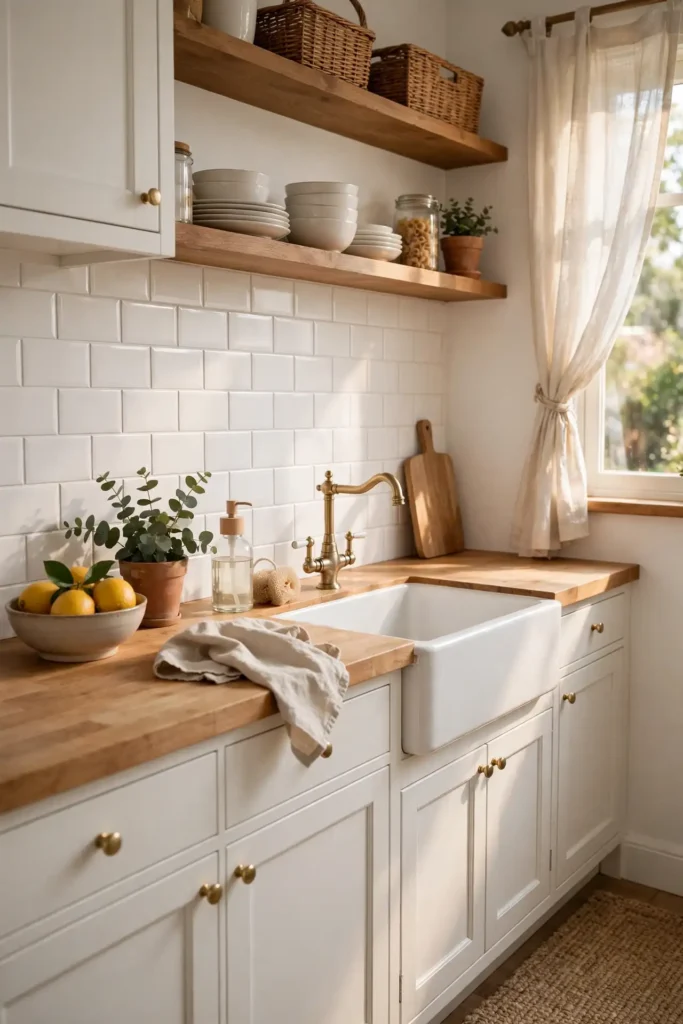
Tile paint kits cost $50 to $100 and cover a standard backsplash, available at Home Depot and Lowe’s from brands like Rust-Oleum. Prep is everything: degrease with TSP, scuff-sand the glaze, apply a bonding primer, then two coats of tile paint, and let it cure for the full recommended time before exposing it to water. The finish lasts several years with gentle cleaning but will eventually chip in heavy-splash zones near the stove. Pair your painted backsplash with updated hardware and fresh caulk for a surprisingly polished result. This is a cosmetic fix, not a forever solution, so plan a real tile upgrade when the budget allows.
22. Coordinate With Hardware
Your backsplash and cabinet hardware should feel like they were chosen together, because the eye reads them as one composition. Against white cabinets, the hardware finish sets the tone: polished nickel and chrome feel crisp and classic, brass and champagne bronze add warmth and richness, and matte black creates bold modern contrast. Match the mood of your tile to your metal: handmade zellige and marble pair beautifully with warm brass, while glossy white subway and glass tile sing with polished nickel. Keeping the finishes in the same family makes the whole kitchen feel professionally designed rather than assembled piecemeal.

You do not need every metal to match, but limit yourself to two finishes maximum. A good rule is to match the faucet to the cabinet hardware and let the lighting be the second metal if you want variety. Budget $3 to $12 per pull for quality hardware from Amerock, Liberty, or Hickory Hardware at Home Depot and Lowe’s. Before committing, tape hardware samples to the cabinets and hold tile samples beside them in natural light, since metals shift color dramatically under warm versus cool lighting. Pair warm brass with warm white grout and cool nickel with bright white grout for a cohesive finish.
Choosing Grout for a Kitchen Backsplash With White Cabinets
Grout is the quiet decision that changes how your whole backsplash looks, so choose it deliberately. With white cabinets, bright white grout creates a seamless, minimal wall where the tile pattern melts together, which is ideal for marble, zellige, and full-slab looks. Light gray or warm gray grout outlines each tile and adds definition, making subway and hexagon patterns pop while hiding cooking stains far better than white. Dark grout like charcoal creates a graphic, high-contrast grid that suits modern and industrial kitchens but can look busy in a small space.
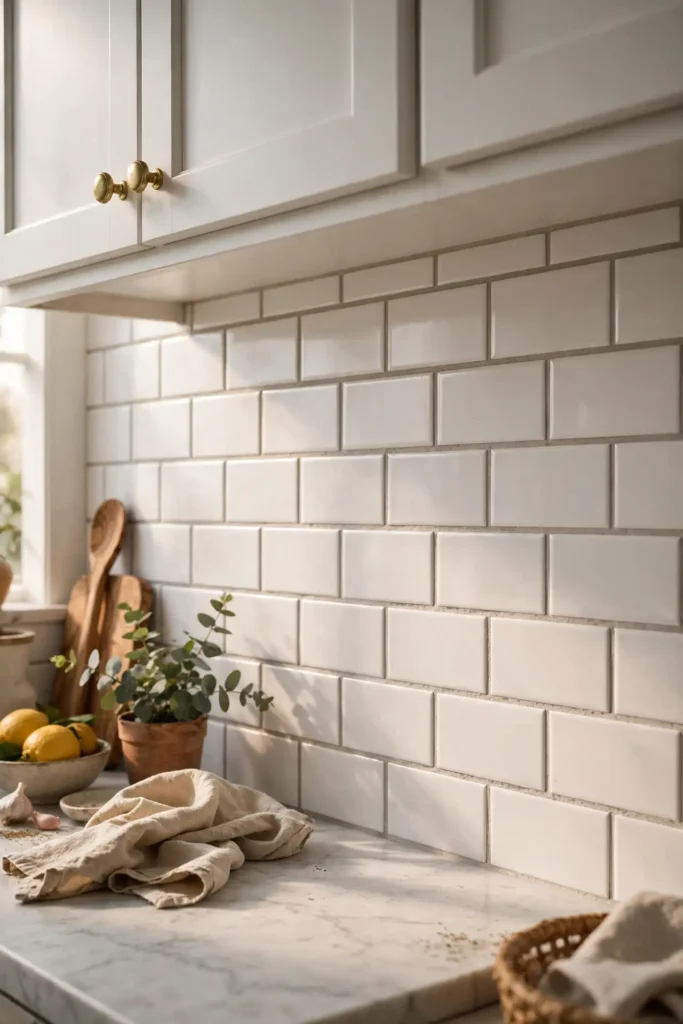
For durability, choose a stain-resistant grout like Mapei Flexcolor CQ or Laticrete SpectraLOCK, which cost $30 to $60 per container and resist staining without annual sealing. Standard cement grout costs under $20 but needs a penetrating sealer applied after installation and yearly touch-ups behind the stove. Use unsanded grout for joints under 1/8 inch and sanded grout for wider joints. Test your grout color on a sample board next to your tile and cabinets in daylight, since grout dries lighter than it looks wet. Whatever you choose, keep it consistent across the whole backsplash for a professional finish.
Matching Backsplash to Countertops
The backsplash and countertop share a border, so they need to look like intentional partners, not accidental neighbors. With white cabinets, the safest formula is to let one surface be the star: if your counters have bold veining or heavy movement, choose a quiet backsplash like white subway tile or plaster, and if your counters are simple white quartz, you have freedom to go bold with patterned or colored tile. Pull one undertone from the countertop, warm or cool, and echo it in the tile and grout so the two surfaces feel related.
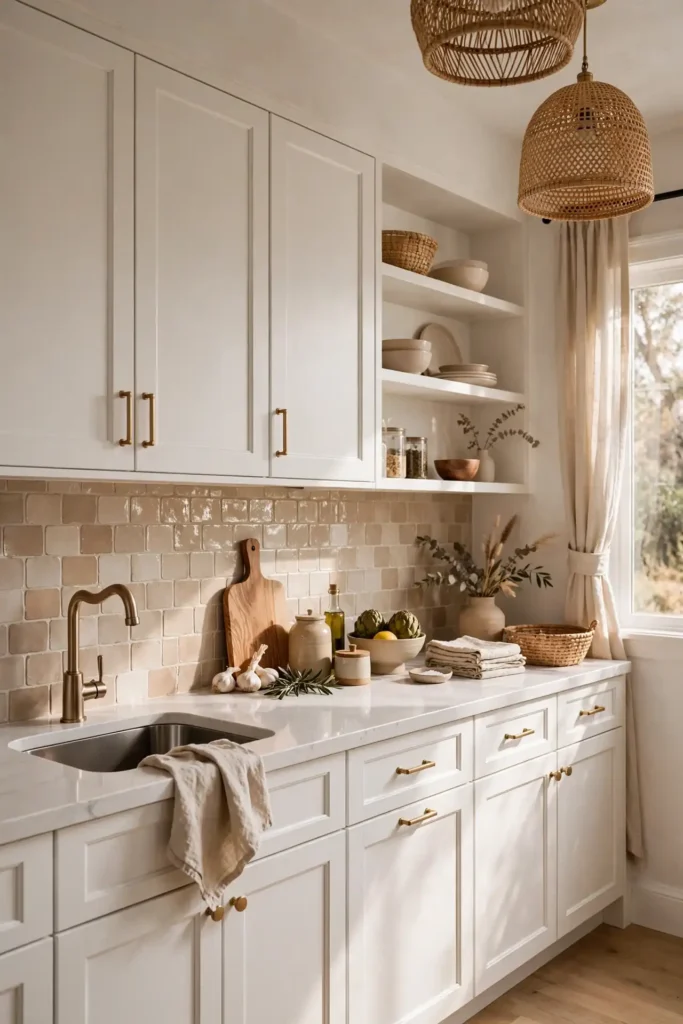
Bring a countertop sample when you shop for tile, and view them together in natural light before buying. White quartz counters pair with almost anything, while busy granite needs a solid-color backsplash to avoid pattern overload. Butcher-block counters warm up cool white tile, and dark soapstone or black granite counters love the contrast of white subway tile with white cabinets. A full-height slab of your countertop material used as the backsplash is the most foolproof match of all, though it costs $50 to $100 per square foot installed. When in doubt, choose the simpler backsplash, since you can always add color with accessories.
Budget-Friendly Backsplash Ideas
A beautiful backsplash does not require a luxury budget, and white cabinets make affordable materials look more expensive. Peel-and-stick tiles cost $5 to $10 per square foot and install in an afternoon with just a utility knife, and the best ones from Smart Tiles and Tic Tac Tiles are heat- and moisture-resistant enough for real kitchens. Paint is even cheaper: a $50 tile paint kit or a fresh coat of scrubbable satin paint on beadboard completely changes the wall. Standard white ceramic subway tile at $2 to $4 per square foot from Home Depot looks timeless and custom when installed well.
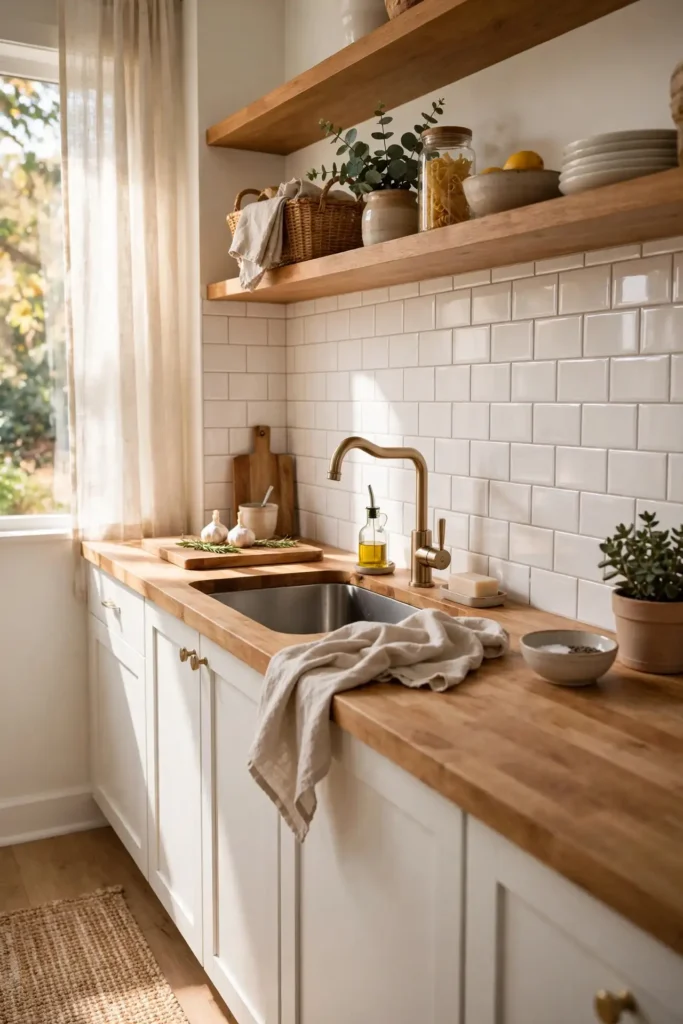
Stretch your dollars by tiling only the range wall or the area behind the sink, which are the highest-impact zones, and paint the remaining walls in a washable satin finish. Shop clearance and overstock at Floor & Decor and Habitat for Humanity ReStores, where you can find quality tile for under $3 per square foot. Doing the installation yourself saves $500 to $1,500 in labor on a typical kitchen, and subway tile in a simple offset pattern is the most forgiving DIY layout. Pair your budget backsplash with updated hardware and fresh caulk, which cost little but make everything look new and intentional.
Backsplash Styles by Kitchen Style
Different kitchen styles call for different backsplashes, and matching the tile to your style keeps the room feeling cohesive. Farmhouse kitchens love white subway tile, beadboard, or brick veneer paired with butcher-block counters and black hardware. Modern kitchens shine with full-height quartz, large-format porcelain, or vertical-stack tile in a minimal palette. Traditional kitchens suit marble subway, herringbone, or handmade zellige with polished nickel hardware. Coastal kitchens glow with glass tile, fish scale, or soft blue ceramics, while industrial kitchens handle black tile, concrete-look porcelain, or exposed brick. Cottage kitchens welcome beadboard, soft florals, and warm handmade-look ceramics with vintage-style hardware.
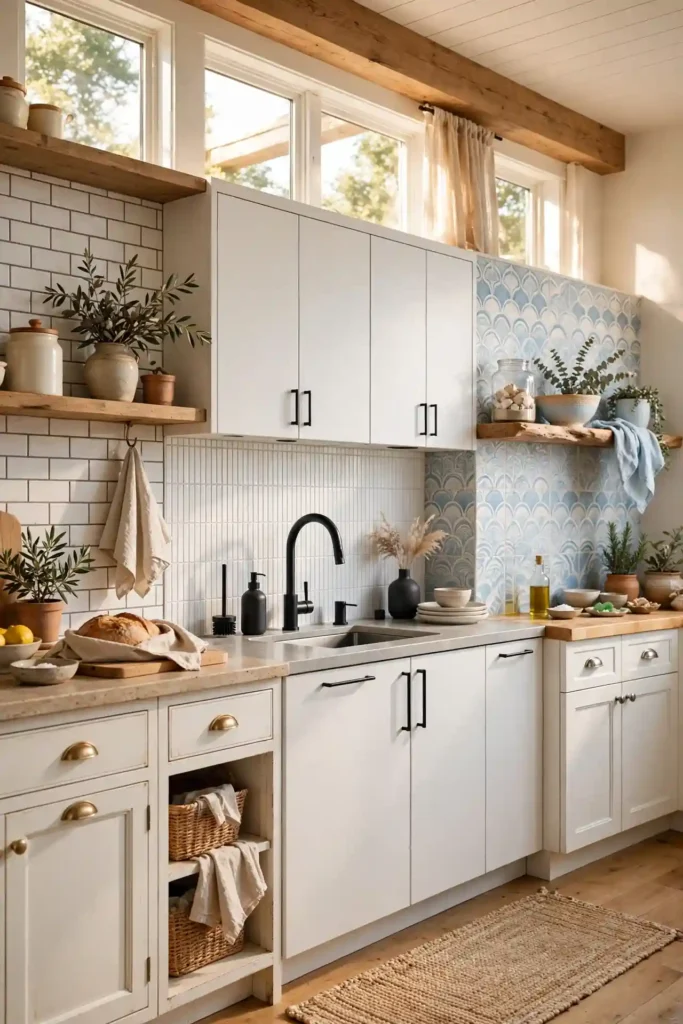
Start by naming your style honestly, then choose a backsplash from its classic playbook before adding one personal twist. A modern farmhouse kitchen, for example, pairs white Shaker cabinets with classic subway tile, then adds warmth through brass hardware and wood shelving. Transitional kitchens, the most common in the US, blend elements: a simple subway or zellige backsplash with quartz counters and mixed metals. If your style is still evolving, white subway tile is the universal donor that works everywhere and lets you change the style later through accessories, paint, and lighting without retiling.
A farmhouse kitchen with shaker cabinets pairs naturally with classic subway tile, beadboard, brick or handmade zellige. These materials add texture and a lived-in warmth. Black or brass hardware and a farmhouse sink complete the look.
A traditional kitchen suits marble, herringbone patterns and hand-painted tiles. Blue and white Delft-style tiles or a marble slab behind the range feel elegant and timeless. A coastal kitchen looks fresh with glossy blue tile, fish scale shapes or glass mosaics that echo the sea.
If your kitchen blends styles, choose a backsplash that bridges them. Zellige, for example, works in modern, farmhouse and Mediterranean kitchens alike because its handmade texture feels both fresh and timeless.
Common Mistakes to Avoid
The most common backsplash mistake is choosing tile under harsh store lighting without seeing it next to your cabinets at home. Fluorescent showroom lights lie, so always bring samples home and tape them to the wall, then check them in morning, afternoon, and evening light before committing. Another frequent error is picking a busy patterned tile and pairing it with busy granite counters, which creates visual chaos instead of charm. Let one surface lead and keep the other quiet. Skipping the dry layout is another pitfall: always lay out your pattern on the floor first to plan cuts around outlets and edges.

Grout mistakes are just as costly, since dark grout on handmade-look tile can look dirty and white grout behind a greasy stove stains fast. Choose a stain-resistant grout and a color that suits your cooking habits. Do not forget the 15 percent overage rule: running out of tile mid-project means the dye lots will not match when you reorder. Finally, avoid stopping tile at an awkward height with no trim; end at a natural line like the upper cabinets, the ceiling, or a finished Schluter edge. A clean termination makes even budget tile look professionally installed.
When it comes to kitchen backsplash with white cabinets, the best results come from balancing style, comfort and everyday function. Use this list as your go-to guide for kitchen backsplash with white cabinets, and start with the ideas that fit your space best. Save this guide on kitchen backsplash with white cabinets so you can come back to it when you are ready to update your home. Good kitchen backsplash with white cabinets choices work in homes of every size and budget. Planning your kitchen backsplash with white cabinets one step at a time keeps the project simple and affordable.
How to Choose a Kitchen Backsplash With White Cabinets Step by Step
Start by defining your budget and style, since those two decisions narrow thousands of options to a manageable few. Set a per-square-foot target: under $5 points you toward ceramic subway, beadboard, or peel-and-stick, while $15 to $30 opens up handmade-look ceramic, glass, and marble-look porcelain. Next, collect samples of tile, grout, and countertop materials and view them together against your white cabinets in natural light at different times of day. Photograph the combinations, since photos reveal clashes your eye misses in person. Bring a cabinet door or drawer front to the store so you can compare whites accurately.

Then plan the layout: decide whether tile stops at the upper cabinets, runs to the ceiling, or features a range accent, and measure the square footage carefully. Order 15 percent extra tile and all your trim pieces, like Schluter edges or bullnose, before demolition starts. If you are hiring out, get three quotes and ask to see the installer’s previous backsplash work, since tile quality lives or dies on craftsmanship. DIYers should practice cuts on spare tile and rent a wet saw for $50 to $70 per day. Install, grout, seal if needed, and caulk the joint where tile meets countertop for a clean, waterproof finish.
- Identify your cabinet white and countertop pattern.
- Decide on a calm or bold backsplash.
- Choose tile material, shape and layout.
- Pick grout color.
- Order extra tile and plan installation height.
Final Thoughts on Kitchen Backsplash With White Cabinets
White cabinets are the perfect canvas for a backsplash, because they give you total freedom to go bold, stay classic, or land anywhere in between. Whether you choose timeless white subway tile, warm terracotta, moody black, or a full marble slab, the white cabinetry will frame your choice beautifully and keep the kitchen feeling bright. The best backsplash is the one that fits your budget, suits your cooking habits, and makes you happy every time you walk into the room. Trends come and go, but a well-chosen tile with white cabinets has staying power that outlasts every fad.
Before you buy, bring samples home, test them in your light, and live with them for a few days. Measure twice, order extra tile, and invest in good grout and a skilled installer if you are not DIYing. Small details like a clean edge trim, well-placed outlets, and under-cabinet lighting elevate any backsplash from good to stunning. Your kitchen is the hardest-working room in your home, so choose materials that can handle real cooking and still look beautiful. Take your time with the decision, and enjoy the process of creating a kitchen that truly feels like yours.
Save these ideas and follow along for more kitchen inspiration.
Frequently Asked Questions About Kitchen Backsplash With White Cabinets
The most asked question is what color backsplash goes best with white cabinets, and the honest answer is that almost anything works because white is neutral. White subway tile is the timeless default, gray and greige add soft contrast, navy and emerald add drama, and natural stone adds warmth. The right choice depends on your countertops, flooring, and personal style rather than any strict rule. Another common question is whether the backsplash should be lighter or darker than the counters: there is no rule, but keeping one surface quiet while the other makes a statement prevents visual competition.

People also ask about cost and maintenance. A typical kitchen backsplash costs $500 to $2,500 installed depending on tile choice and whether you DIY, with ceramic subway at the low end and marble or handmade tile at the high end. For maintenance, porcelain, ceramic, and quartz need almost no upkeep beyond wiping, while natural stone needs periodic sealing. Grout stays cleaner with a stain-resistant formula like Mapei Flexcolor CQ. If you are unsure about a bold choice, use it as a range accent and keep the rest simple, which gives you personality without full commitment.
What backsplash goes best with white cabinets?
White subway tile, zellige, marble and colored tiles like green or blue all work well.
Should backsplash be lighter or darker than cabinets?
Either works. Lighter feels seamless, darker creates contrast.
What grout color is best for a white backsplash?
Light gray hides stains and adds subtle definition.
Should backsplash go to the ceiling?
Behind open shelves or the range, tiling to the ceiling looks custom.
Is subway tile outdated?
No. Subway tile remains a timeless choice, especially in new layouts.




Leave a comment