


Black countertops make a strong statement in any kitchen. They are dramatic, sophisticated and surprisingly versatile, pairing with white cabinets for crisp contrast, wood for warmth or bold colors for a designer look. They also hide stains and crumbs better than light surfaces.
These 20 black kitchen countertops ideas cover materials, finishes and cabinet pairings to help you choose. For related inspiration, see our black kitchen ideas and these moody kitchen ideas.
Things to know about black counters:
- Honed finishes hide fingerprints better than polished.
- Soapstone develops patina and needs oiling.
- Quartz is durable and low maintenance.
- Balance black counters with plenty of light.
1. Black Granite With White Cabinets
Black granite paired with white shaker cabinets is the classic high-contrast kitchen move, and it still looks fresh today. The dark stone grounds the room while the white cabinetry keeps everything bright, so the space feels dramatic instead of cave-like. Choose a polished slab like Ubatuba or Black Pearl, both of which carry tiny gold and copper flecks that catch the light and add warmth. Expect installed black granite to run roughly $45 to $75 per square foot at Home Depot, which makes it one of the most budget-friendly paths to a natural stone look. Those busy speckles also hide crumbs and water spots far better than a solid black surface, so everyday messes stay invisible between cleanings.
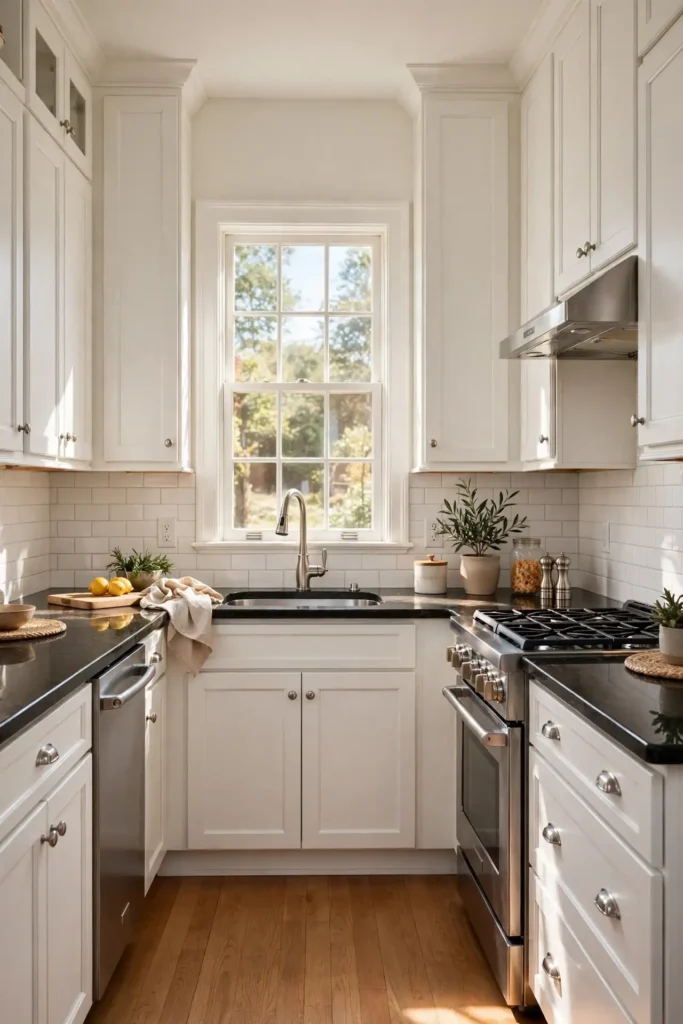
For installation, stick with a standard 1.5-inch edge profile and an undermount sink to keep the transition clean and modern. Granite needs sealing once a year with a stone sealer from Lowe’s, which costs about $20 and takes under an hour — skip this and you risk stains from oil and red wine. Pair the counters with satin nickel or matte black hardware, and consider a warm wood floor to soften the contrast. If you cook often, pick a honed or leathered finish instead of polished; it scatters reflections and disguises fingerprints, making the counters look freshly wiped even on your busiest weeknight.
2. Honed Soapstone
Honed soapstone gives you a soft, matte black surface with a velvety feel that polished stones simply cannot match. It is a natural quarried stone, mostly gray when new, that deepens to a rich charcoal as you oil it over time. This is the material of choice for farmhouse, historic, and science-lab-inspired kitchens because it looks handmade and honest. Soapstone runs about $70 to $120 per square foot installed, and most fabricators will show you the full slab before cutting. Unlike granite, it is nonporous enough that acids like lemon juice will not etch it, which makes it forgiving for real cooking.
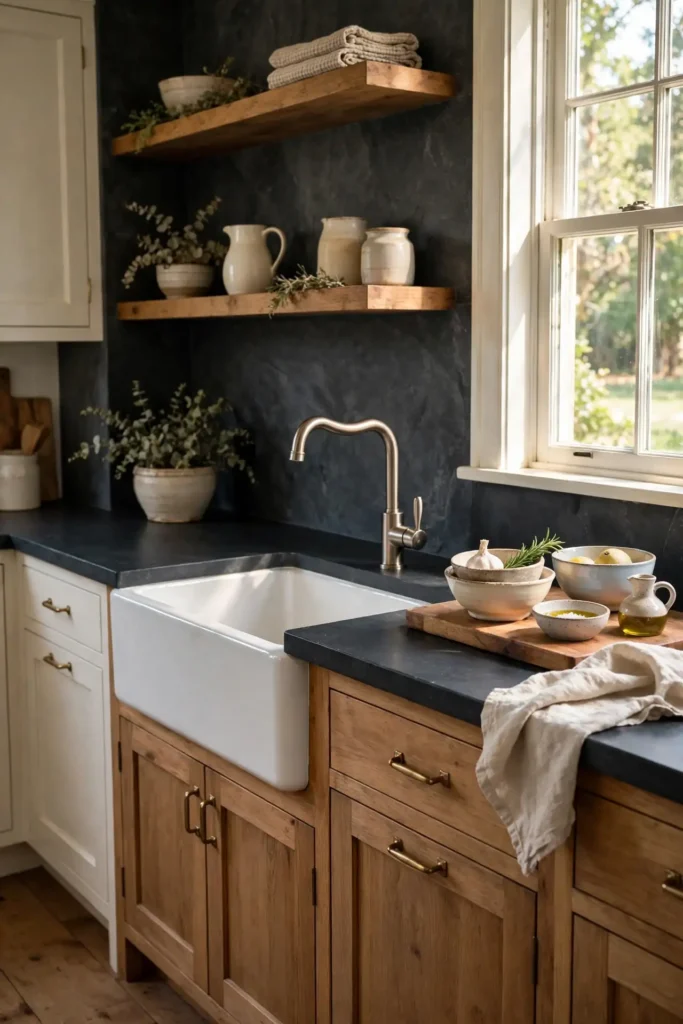
The trade-off is softness: soapstone scratches and dents more easily than granite or quartz, so cutting boards and trivets are non-negotiable. Many owners love how the patina develops — mineral oil rubbed in every few months evens out the color and brings out that deep black finish. Scratches can be sanded out with fine-grit sandpaper, a repair that takes ten minutes and costs nothing. Pair soapstone with open wood shelving, a farmhouse sink, and unlacquered brass fixtures for a look that ages gracefully. If you want a kitchen that shows character instead of hiding it, soapstone is your stone.
3. Black Quartz
Black quartz is the easiest-care way to get dark counters, because it is engineered from crushed stone bound with resin and needs no sealing ever. Brands like Caesarstone and Cambria offer deep blacks such as Caesarstone’s Black Tempal and Cambria’s Blackwood, with subtle veining or a pure solid finish. Installed pricing typically falls between $60 and $120 per square foot, putting it in line with mid-range granite. Because the pattern is manufactured, every slab looks consistent, which helps if you want your island and perimeter counters to match perfectly. Quartz also resists stains from coffee, wine, and turmeric far better than most natural stones.
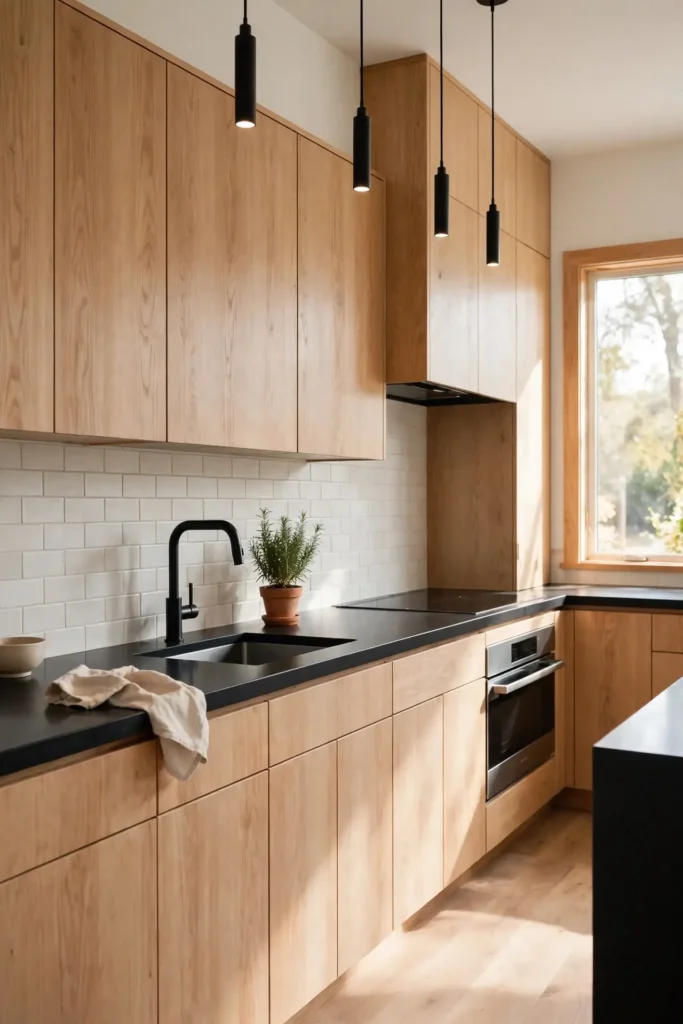
The one rule with quartz is heat: never set a hot pan directly on it, because resin can scorch and discolor above about 300 degrees. Always keep a trivet or two on hand. Quartz also fades in direct sun, so use window treatments if your kitchen gets strong afternoon light. Pair black quartz with white oak cabinets for a modern Scandinavian feel, or with navy lowers for a moody, layered look. For busy families who want the drama of black counters without the maintenance calendar, quartz is the practical winner.
4. Black Marble With White Veining
Black marble with white veining, like Nero Marquina, is the most dramatic slab you can put in a kitchen. The stark white veins cut across the deep black field like lightning, and no two slabs are alike. Because it is a statement material, it works best as a focal point — a waterfall island or the range wall — with quieter counters elsewhere. Installed black marble generally costs $90 to $150 per square foot. Bookmatch the veining at the island so the pattern mirrors itself across the seam; your fabricator can dry-lay the slabs before cutting to get the match right.
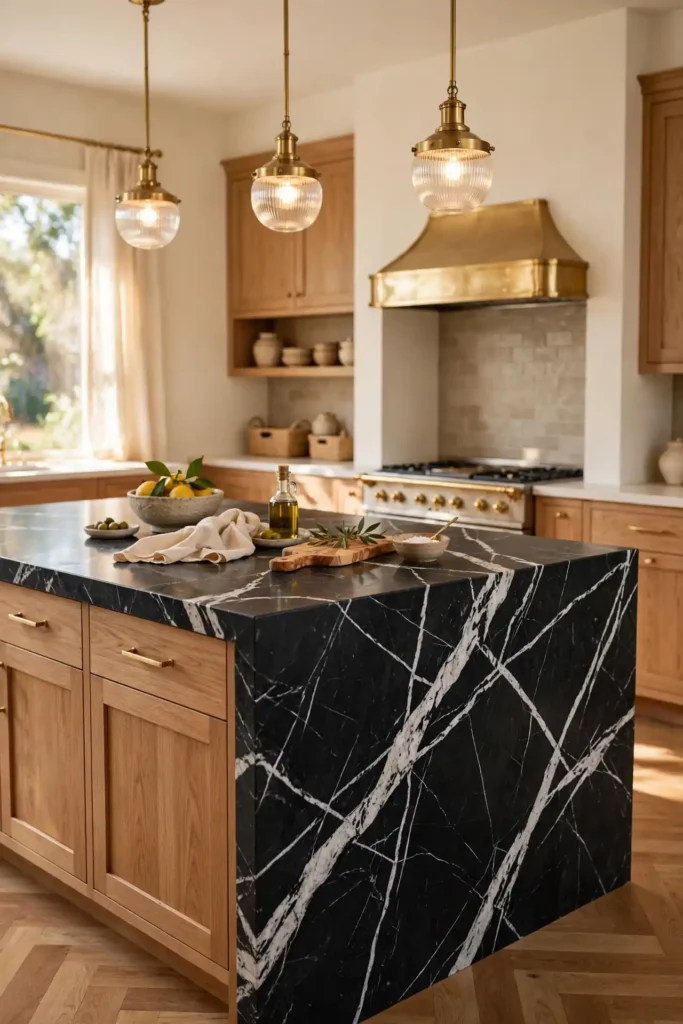
Marble is the high-maintenance member of the stone family: it etches from acids and stains from oils, so sealing every six to twelve months is essential. Many owners embrace the etching as a lived-in patina, but if that idea bothers you, look at quartz or porcelain slabs that mimic Nero Marquina with zero upkeep. Pair black marble with brass fixtures, warm white walls, and oak floors to keep the drama grounded. This is not a practical choice — it is a design choice — and in the right kitchen it is unforgettable.
5. Black Butcher Block
Black butcher block brings warmth and texture that stone cannot offer, because it is real wood with visible grain. Most black butcher block is ebonized walnut or stained maple, sealed with a food-safe hardwax oil. It costs about $40 to $80 per square foot, which makes it one of the cheapest ways to go dark, and a skilled DIYer can install a section in a weekend. The wood surface is gentle on knives and forgiving under dropped dishes, which is a genuine advantage if you prep a lot of food. Butcher block also pairs beautifully with both white and dark cabinets, since the grain adds movement.
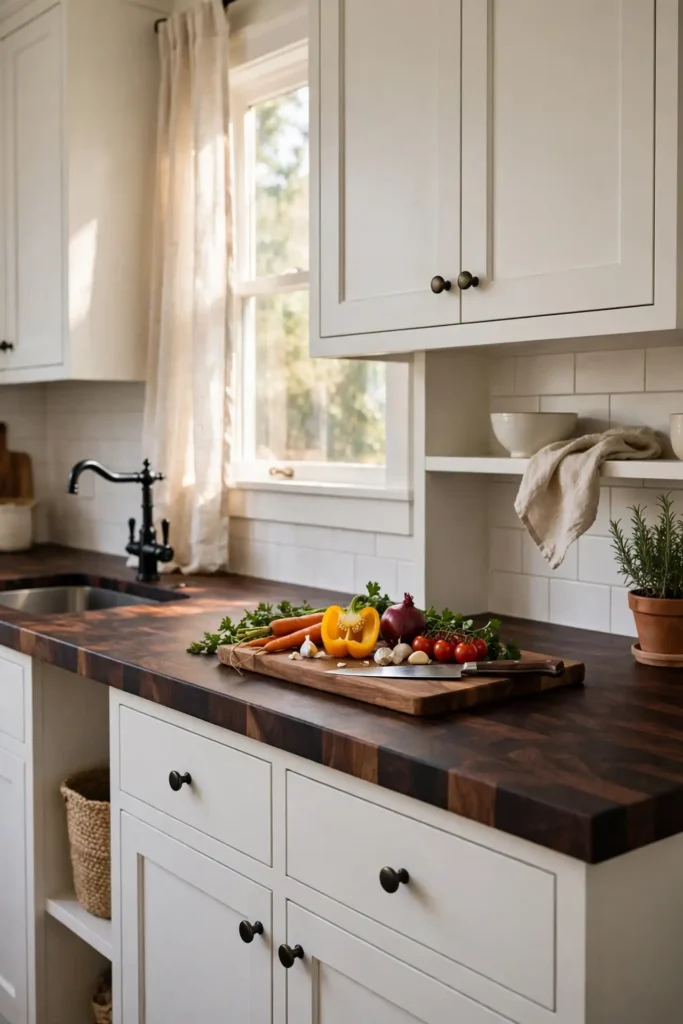
The maintenance is real: you need to oil the surface monthly with mineral oil or a beeswax conditioner, and water left pooling will leave dark rings. Choose a penetrating oil finish rather than polyurethane if you want to cut directly on it. Many homeowners use butcher block on the island only and stone on the perimeter, which gives warmth where you gather and durability where you do messy work. Sand out stains with 220-grit paper and re-oil, and the top looks new again. For a cozy, tactile kitchen, black wood is hard to beat.
6. Black Counters With Wood Cabinets
Black counters on wood cabinets create a rich, earthy kitchen that feels warm rather than stark. Medium-tone woods like white oak and walnut work best, because their grain shows through and keeps the dark counters from feeling heavy. Avoid very dark walnut with black counters unless the room has abundant light, since the combination can go muddy. This pairing suits transitional and modern-rustic styles especially well. Price-wise, your counters stay in the standard range — black granite at $45 to $75 per square foot installed, or quartz at $60 to $120 — while wood cabinets cost more than painted ones, so plan your budget accordingly.
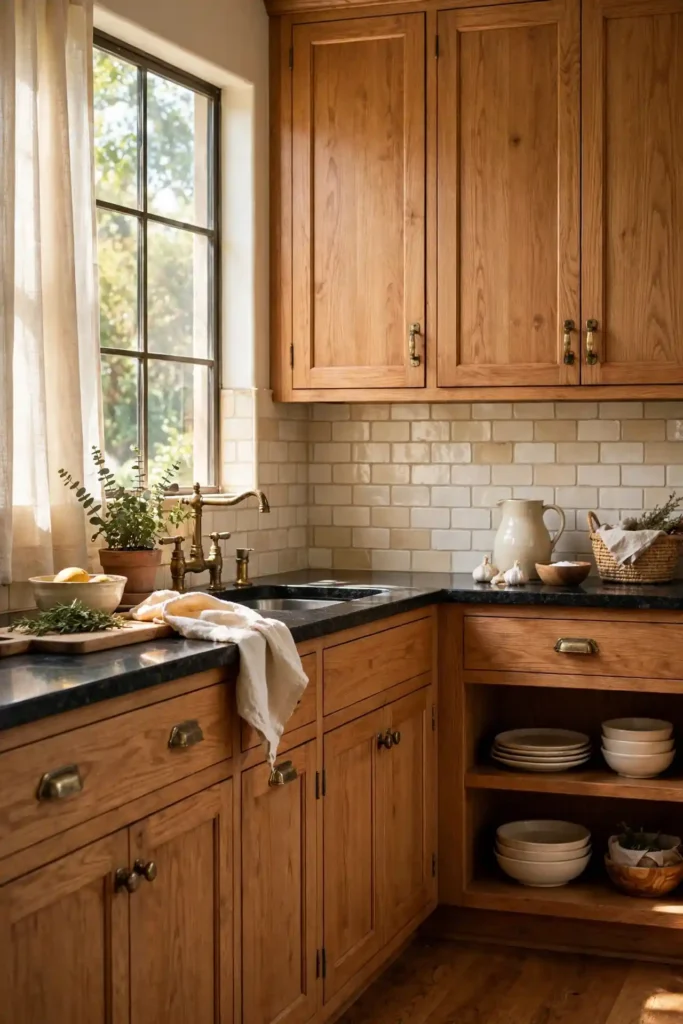
To keep the look balanced, run a light backsplash such as handmade-look ceramic tile or pale plaster. Warm under-cabinet lighting at 2700K to 3000K makes the wood glow against the dark stone. Hardware in aged brass or oil-rubbed bronze ties the wood tones together. Keep the island in the same wood if your kitchen is small, and only mix cabinet colors in larger rooms. This combination reads as timeless rather than trendy, which is exactly why designers keep specifying it year after year. Finish with a linen runner and wooden cutting boards displayed on the counter for extra warmth.
7. Black Counters With Green Cabinets
Green cabinets with black counters are the pairing designers are specifying most right now, from deep forest green to muted sage. The green reads as a neutral but adds personality, and the black stone sharpens it into something sophisticated rather than country. Try Farrow & Ball’s Studio Green or Sherwin-Williams’ Evergreen Fog for the cabinetry, then top with honed black granite or leathered quartz. Green cabinets typically add 10 to 15 percent to the cost of white painted cabinets, so get quotes before you commit. The combination photographs beautifully, which is one reason it dominates Pinterest boards.
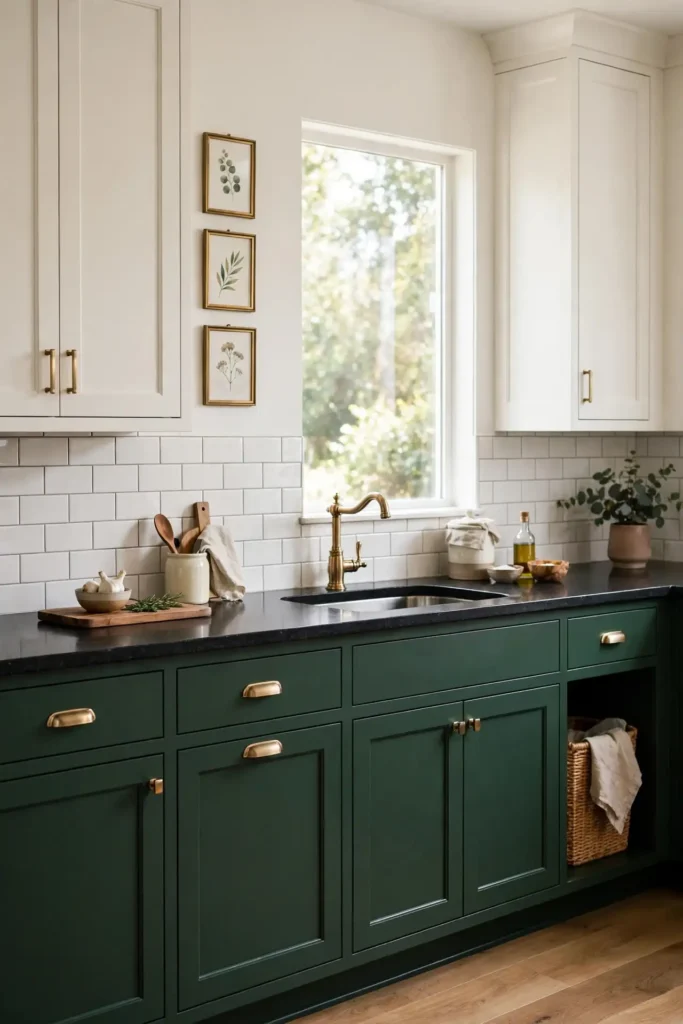
Balance the moody lowers with light elements: a white or cream backsplash, pale oak floors, and plenty of task lighting. Brass hardware is the classic partner for green, and it pops against black counters too. If you worry about commitment, test the pairing by painting one island in green before doing the whole kitchen. Keep upper cabinets in a warm white to prevent the room from feeling closed in. This look rewards confidence — go all in on the green, and the black counters will make it feel intentional. A few brass-framed art prints and fresh greenery complete the confident, collected look.
8. Black Counters With Navy Cabinets
Navy cabinets with black counters deliver a moody, tailored kitchen that feels like a private club. The key is contrast in finish: pair matte or satin navy paint with a polished black counter so the two darks read as layers instead of one blob. Benjamin Moore’s Hale Navy and Sherwin-Williams’ Naval are the go-to shades, both deep enough to anchor the room. Black quartz or polished granite at $60 to $120 per square foot works best here, since a honed finish can make the palette feel flat. Expect this combination to feel formal and grown-up, which suits traditional and transitional homes.
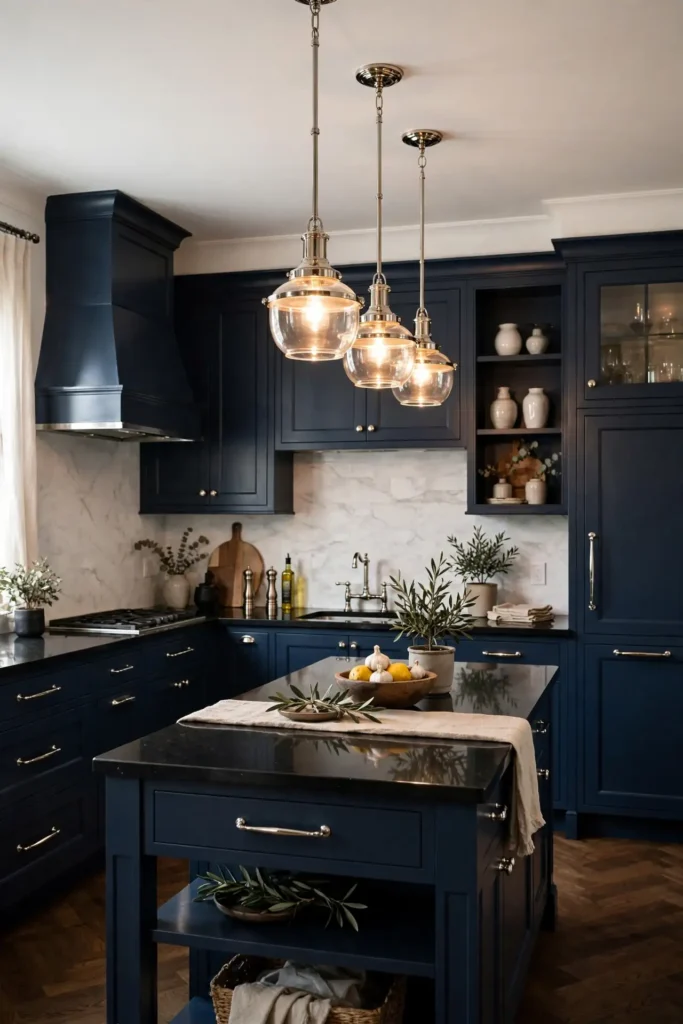
Lighting makes or breaks a navy-and-black kitchen, so plan for layered light: pendants over the island, under-cabinet strips, and a bright backsplash. White or marble-look tile on the backsplash bounces light around and keeps the darks from closing in. Polished nickel or chrome hardware reads crisper than brass against navy. Keep the ceiling and trim bright white, and consider glass-front uppers to break up the mass of dark cabinetry. Done well, this pairing is dramatic but never gloomy. Add a large mirror or metallic backsplash accent to bounce even more light through the space. These reflective touches keep the moody palette feeling luxurious rather than heavy.
9. Black Island Only
Putting black counters on the island only is the smart compromise when you love dark stone but fear a fully dark kitchen. The island becomes the anchor piece, especially with a waterfall edge or a thick mitered profile, while light perimeter counters keep the room airy. This approach also saves money: you buy one dramatic slab of black marble or quartzite instead of outfitting the whole kitchen. A typical island needs 25 to 40 square feet of stone, so budget roughly $1,500 to $4,000 depending on the material. The two-tone effect looks intentional and custom, not like a budget compromise.

For cohesion, repeat black elsewhere in small doses: matte black faucets, cabinet pulls, or pendant lights. Keep the perimeter counters in a warm white or light gray so the island stands out. Make sure the island slab is the star — choose something with veining or movement, like a black quartzite with gold veining. Seams matter more on an island, so ask your fabricator about slab sizes before you finalize the island dimensions. This is the easiest way to get the black-counter look with the least risk. Coordinate bar stools in a warm material like leather or oak to soften the dark stone.
10. Leathered Granite
Leathered granite is black granite with a textured, matte finish that feels almost like soft hide under your hand. The leathering process brushes the stone with diamond-tipped brushes, which opens the grain and gives it a subtle sheen rather than a high polish. For black stones like Black Pearl or Cambria-style absolute black granite, leathering adds depth and hides fingerprints, water spots, and crumbs dramatically better than polished. Installed leathered granite runs about $55 to $85 per square foot, a modest premium over polished. The texture also makes the stone less slippery when wet, a small but real safety plus.
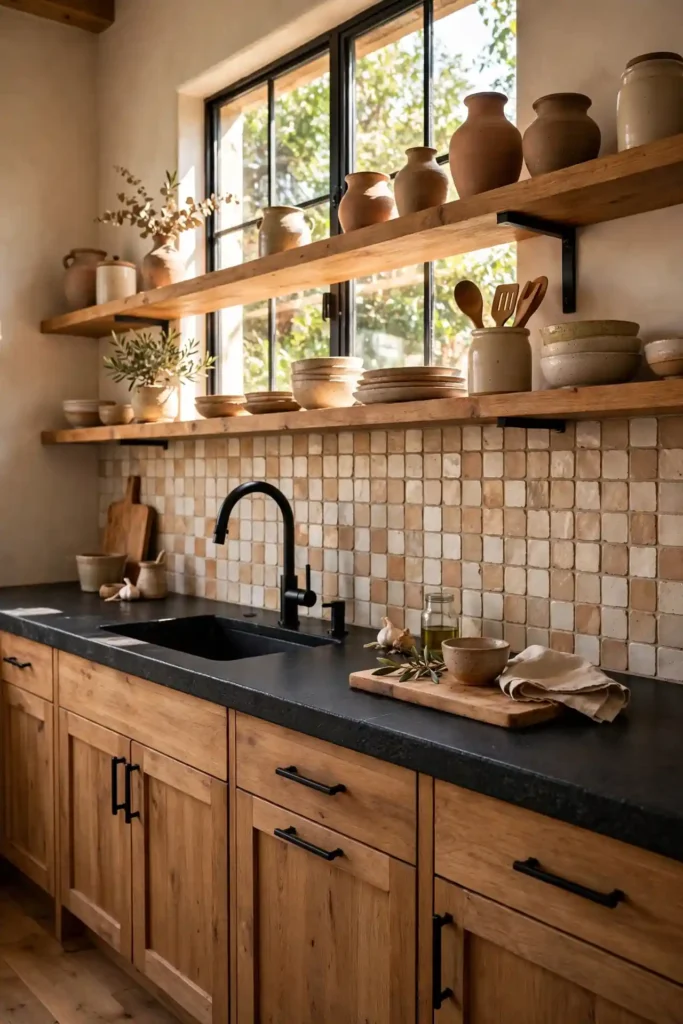
Because the finish is matte, leathered granite suits modern farmhouse, rustic, and organic-modern kitchens beautifully. It still needs annual sealing like any granite, though the texture can make application slightly more time-consuming. Pair it with natural wood, handmade tile, and matte black fixtures for a cohesive tactile palette. Avoid pairing leathered granite with very glossy backsplashes; the finish contrast can look accidental. Run your hand across samples at the stone yard before deciding — the texture is the whole point, and photos do not capture it. Bring home a sample and test it with olive oil and coffee to preview real-life staining.
11. Black Concrete
Black concrete counters deliver an industrial, handmade look that no quarried stone can imitate. They are usually cast in place or precast off-site, then stained or integrally pigmented to a charcoal or true black. Expect to pay $80 to $130 per square foot for professional fabrication, though DIY kits from brands like Cheng run a few hundred dollars for an average kitchen. Concrete is endlessly customizable: embed aggregate, choose any edge profile, and pour a matching integrated sink. The matte, slightly varied surface gives kitchens a crafted, one-of-a-kind feel that suits lofts and modern farmhouses.

The catch is maintenance: concrete is porous, so it must be sealed with a food-safe penetrating sealer and waxed periodically. Even sealed, it can develop hairline cracks and patina over time — embrace this as character or choose another material. Never cut directly on it, and wipe up acids quickly. Concrete is heavy, so confirm your cabinets can support roughly 20 to 25 pounds per square foot before you commit. Pair black concrete with warm wood, blackened steel, and Edison-style pendants. It is a statement for people who want their kitchen to feel made, not manufactured.
12. Black Counters With White Subway Tile
Black counters with white subway tile is the foolproof combination that works in nearly every kitchen style. The glossy 3-by-6-inch tiles bounce light around and keep the dark counters from overwhelming the room, while the grid pattern adds just enough visual texture. Classic subway tile costs as little as $3 to $8 per square foot at Home Depot, so the backsplash stays budget-friendly. Run the tile in a stacked pattern for a modern feel or classic running bond for timeless appeal. Either way, the white tile acts as a bright frame that makes black stone look richer.
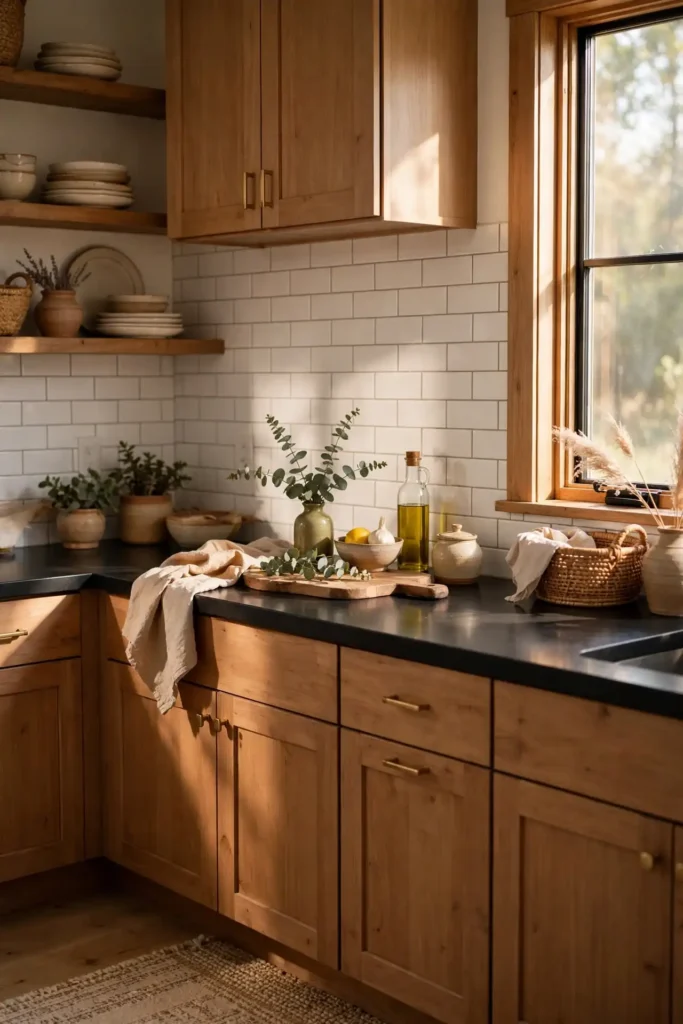
Grout choice changes the whole effect: white grout keeps things seamless and clean, while dark grout adds graphic contrast and hides stains. For black counters, a light gray grout is the sweet spot — it defines the tile pattern without shouting. Extend the tile to the ceiling behind open shelving or the range hood for extra impact. Pair with brushed nickel hardware and warm wood floors to avoid a stark black-and-white feel. This is the combination to choose when you want black counters but need the kitchen to stay bright and classic.
13. Black Counters With Zellige
Zellige tile paired with black counters is the designer move that brings handmade character to a dark kitchen. These Moroccan clay tiles have an uneven, glossy surface that ripples light across the wall, which keeps black counters from feeling flat or severe. Authentic zellige from suppliers like Clé Tile or Riad Tile runs $25 to $45 per square foot — a splurge, but you need far less tile than countertop. Choose a warm white or soft ivory zellige for contrast, or a deep green zellige for a tonal, moody wall. The handmade variation means no two installations look alike.
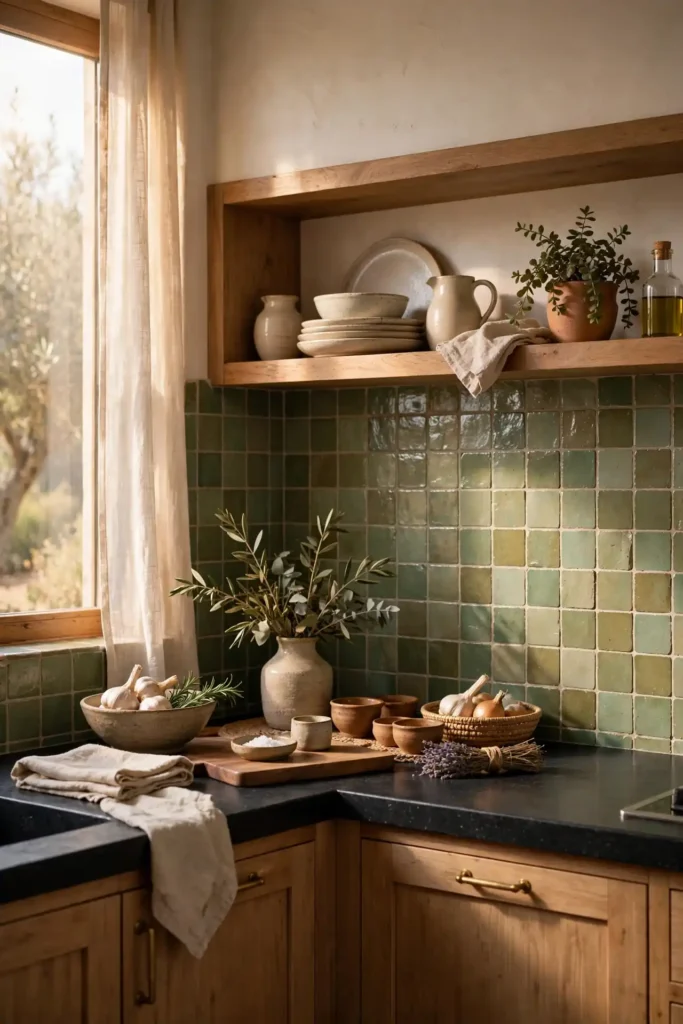
Because zellige is irregular, installation costs more than standard tile — budget extra for a skilled setter and expect more waste. Seal the grout well, since the uneven surface can trap grease near the range. Pair zellige with honed black counters rather than polished, so the glossy tile is the star and the stone recedes. Brass or unlacquered fixtures complement the artisanal feel. This combination suits Mediterranean, boho, and eclectic kitchens especially well. If your black counters feel too severe, zellige is the fastest way to soften them with soul.
14. Black Waterfall Island
A black waterfall island, where the stone cascades down both sides to the floor, is the most sculptural way to use dark counters. The continuous veining or pattern wraps over the edge, turning the island into a monolithic statement piece. This treatment works best with dramatic slabs — Nero Marquina marble, black quartzite with gold veining, or a bold black quartz. Budget an extra slab or two beyond the countertop square footage, since the waterfall panels consume significant material; expect $2,000 to $6,000 for the island stonework alone. Mitered edges give a seamless folded look that elevates the whole kitchen.
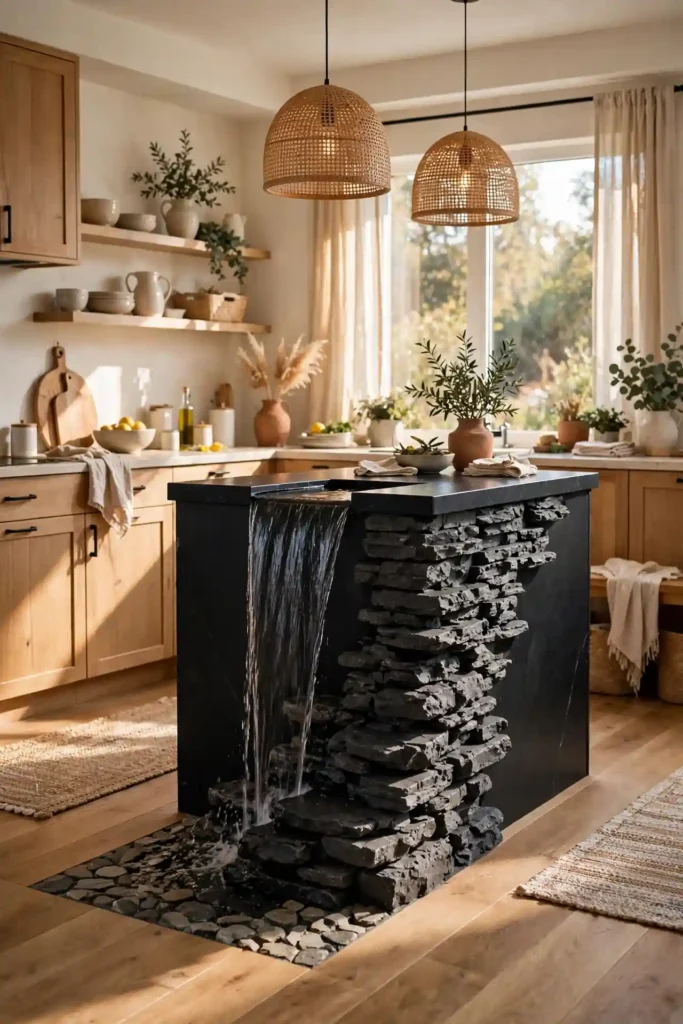
Waterfall islands demand precise fabrication, so choose an experienced stone shop and confirm they can bookmatch the veining across the miter. Keep the island base simple — no corbels or fussy details — because the stone is the ornament. The waterfall sides take abuse from feet and vacuum cleaners, so a durable material like quartz or granite beats marble here. Pair with minimal bar stools and a quiet perimeter palette so the island stays the hero. In an open floor plan, a black waterfall island anchors the entire living space like a piece of furniture.
15. Black Counters With Brass Hardware
Brass hardware against black counters is the jewelry of the kitchen — it warms the dark stone and adds a tailored gleam. Unlacquered brass develops a living patina that pairs beautifully with the depth of black granite or quartz, while polished brass reads more formal and lacquered brass stays bright with less upkeep. Expect to pay $8 to $25 per pull for quality solid brass hardware, versus $3 to $8 for zinc imitations. Use the brass consistently across cabinet pulls, the faucet, and pendant lights so it reads as a deliberate scheme rather than a random accent.
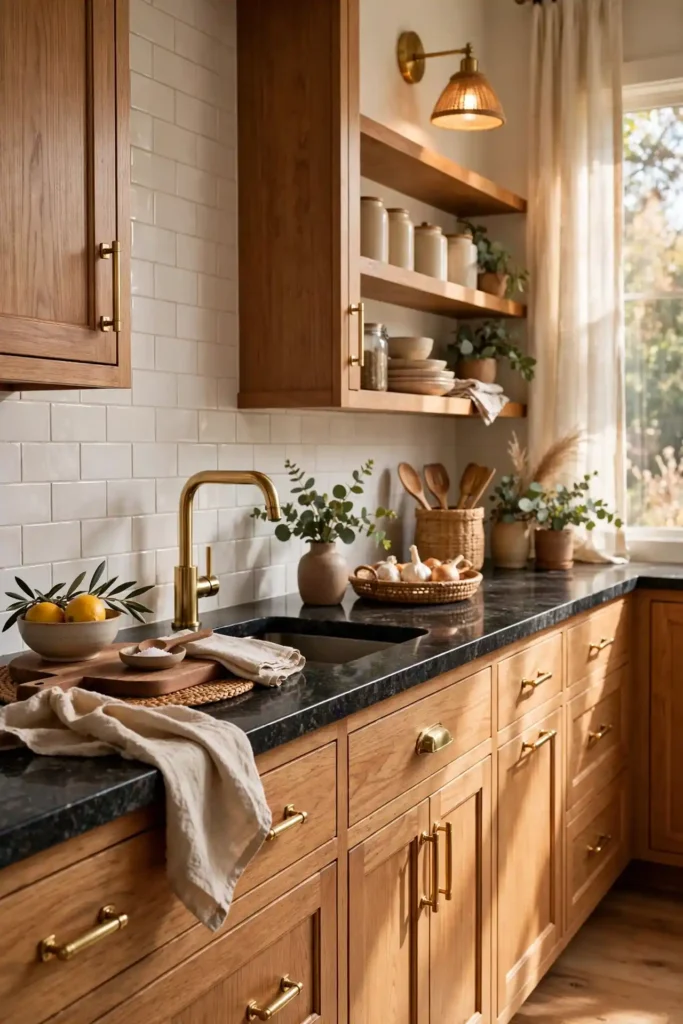
The key is proportion: brass should be the accent, not the star. Keep it to hardware, lighting, and one or two accessories like a paper towel holder or pot rail. Too much brass against black can veer into glitz, especially with polished finishes. Satin or brushed brass is the safest choice for most kitchens. Pair this combination with white or cream cabinetry for classic contrast, or with deep green for a rich, layered look. Brass and black is a timeless pairing that has survived every trend cycle. Clean unlacquered brass with a gentle polish only when you want to slow the natural patina.
16. Black Counters in a Small Kitchen
Black counters can absolutely work in a small kitchen if you balance them with light everywhere else. The trick is contrast: white or pale upper cabinets, a light backsplash, and light flooring keep the room feeling open while the dark counters add depth and definition. A galley kitchen with white shaker cabinets and black quartz counters feels crisp and intentional, not cramped. Keep the counter profile slim — a 1.25-inch eased edge instead of a chunky ogee — because heavy edges eat visual space. Under-cabinet lighting is non-negotiable in a small dark-counter kitchen.
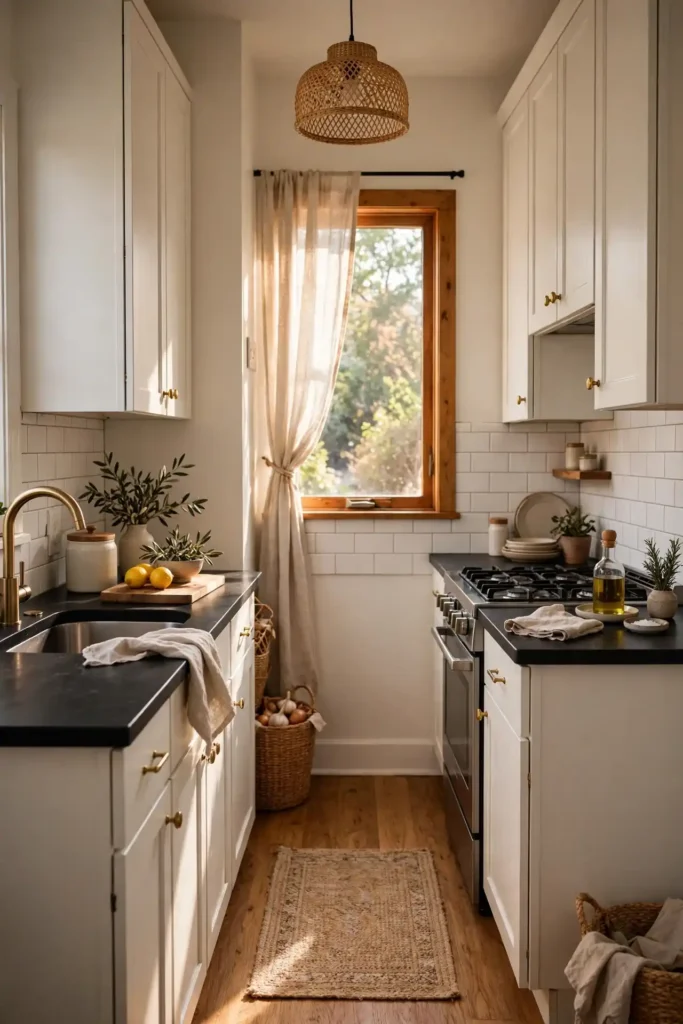
Choose materials that reflect light: polished granite or quartz bounces more light than honed finishes. Keep clutter off the counters, since dark surfaces show every crumb and a small kitchen has nowhere to hide it. A single-bowl undermount sink maximizes usable counter space, and a light-colored backsplash like glossy white tile amplifies brightness. Skip the busy patterns; a subtle black stone reads calmer in tight quarters. With the right balance, black counters make a small kitchen feel designed rather than default. Mount a slim rail with hanging utensils to free precious counter space without adding visual weight. Every inch counts, and vertical storage keeps the dark counters clear and calm.
17. Black Farmhouse Style
Black counters in a farmhouse kitchen add a modern edge to the classic rustic formula. The traditional farmhouse palette of white shiplap, apron sinks, and wood beams gets instant sophistication from a dark stone top. Honed black granite or soapstone works best here — the matte finish feels handmade and pairs with the casual farmhouse spirit better than high polish. A farmhouse sink in white fireclay creates a beautiful focal point against the dark counters. Budget-wise, this style is friendly: butcher-block-look accents, open shelving, and painted cabinets keep costs down while the black stone provides the wow.
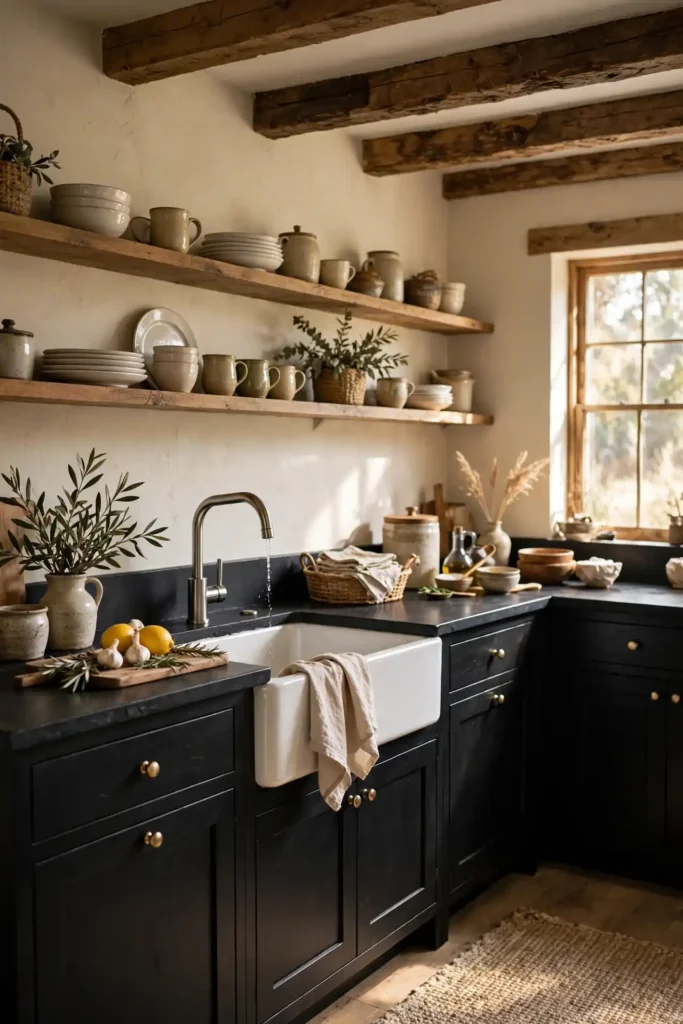
Mix textures to keep the look warm: reclaimed wood beams, a worn runner rug, and woven pendant shades soften the dark counters. Matte black fixtures tie everything together, from the faucet to the cabinet latches. Avoid going too dark overall — keep walls warm white and let natural light do the heavy lifting. This style suits homes where the kitchen is the gathering place, because the black counters ground the room without making it feel precious. It is farmhouse with a backbone. Display wooden cutting boards and ironstone pitchers on open shelves for authentic farmhouse charm.
18. Thin Profile Black Counters
Thin profile black counters, at just 3/4 inch to 1 inch thick, give kitchens a sleek European look that chunky stone cannot match. The slim edge reads as modern and precise, and it makes a great choice for contemporary and Scandinavian-inspired kitchens. Most fabricators achieve the look by mitering standard slabs, so you still get the strength of full-thickness stone with a delicate profile. Expect to pay a 15 to 25 percent premium for mitered edges over standard eased edges. Black quartz and porcelain slabs work especially well in thin profiles because their patterns are consistent.
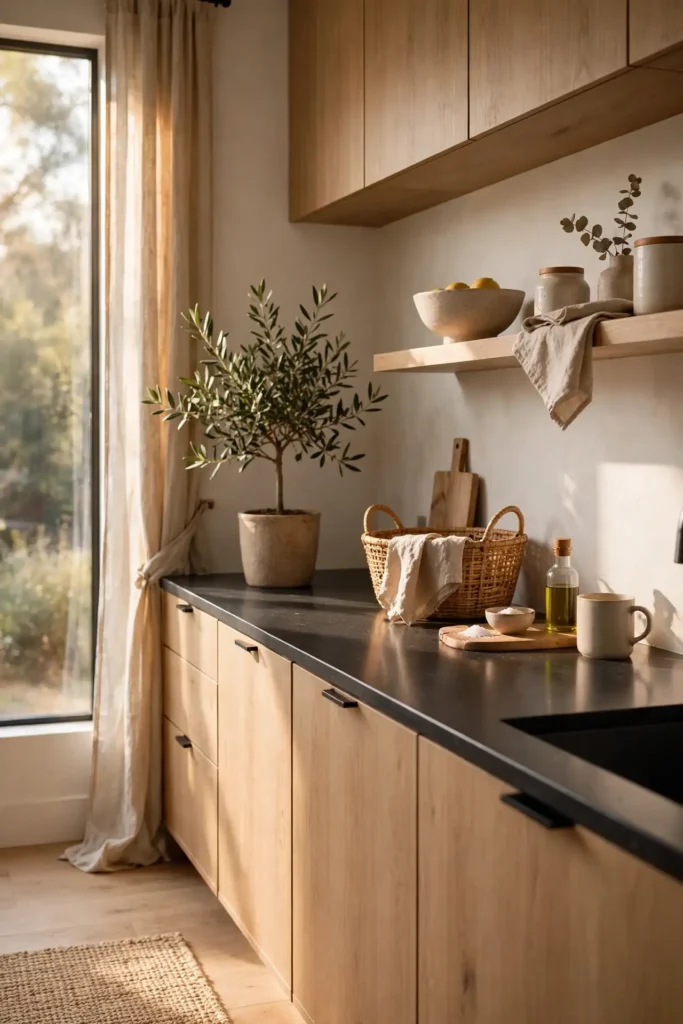
Thin counters pair best with flat-panel cabinets, integrated appliances, and minimal hardware — anything fussy fights the clean lines. Keep the backsplash simple, like a full-height slab of the same black material or a quiet plaster wall. Because the edge is delicate, avoid heavy chopping directly on thin-profile stone and be gentle with the corners. In open floor plans, the slim profile keeps the kitchen feeling light and architectural. If your style leans minimal, thin black counters are the sharpest choice. Handle the mitered corners gently during installation, since the folded edge is more vulnerable before setting. Once installed, the slim profile is surprisingly sturdy for daily use.
19. Black Counters With Marble Backsplash
Pairing black counters with a marble backsplash is the high-low move that looks expensive without doubling your stone budget. Run a white or light gray marble like Carrara or Calacatta on the wall behind black granite or quartz counters, and the contrast is pure luxury. Marble backsplash tile runs $15 to $40 per square foot installed, far less than a full marble countertop. The white veining in the marble picks up light and keeps the black counters from feeling heavy. This combination suits transitional and traditional kitchens where you want elegance without going fully dark.
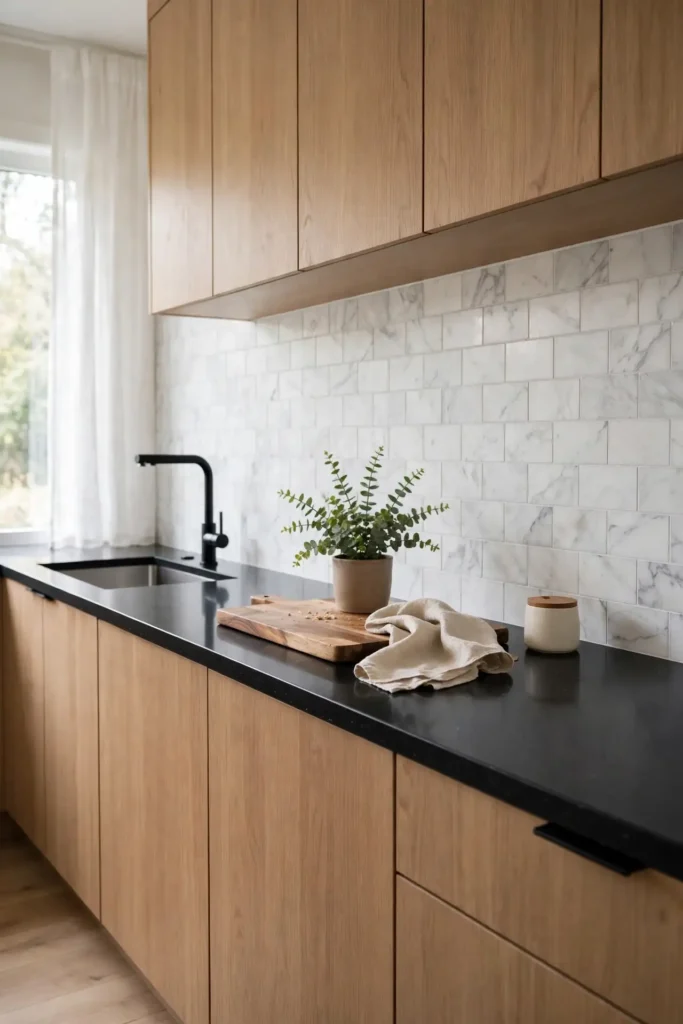
Seal the marble backsplash annually, since cooking splatter and grease will stain unsealed stone. Choose a honed marble tile rather than polished for a softer look that forgives splatter. Keep the grout lines tight — 1/16 inch — for a refined installation. If full marble tile feels pricey, marble-look porcelain at $5 to $12 per square foot gives a similar effect with zero sealing. Pair with polished nickel fixtures to echo the marble’s cool tones. This is the pairing for anyone who wants their kitchen to feel like a boutique hotel.
20. Balance With Warm Materials
Black counters need warm materials around them or the kitchen can feel cold and severe. Wood is the fastest fix: oak floors, walnut open shelves, or a butcher block section on the island instantly soften dark stone. Warm metals like brass and copper add glow, while textiles — a runner rug, linen curtains, woven bar stools — bring in the softness stone lacks. Even warm white paint on the walls, something creamy rather than stark, changes how black counters read. Think of black as the anchor and warmth as everything that keeps it from feeling like a showroom.
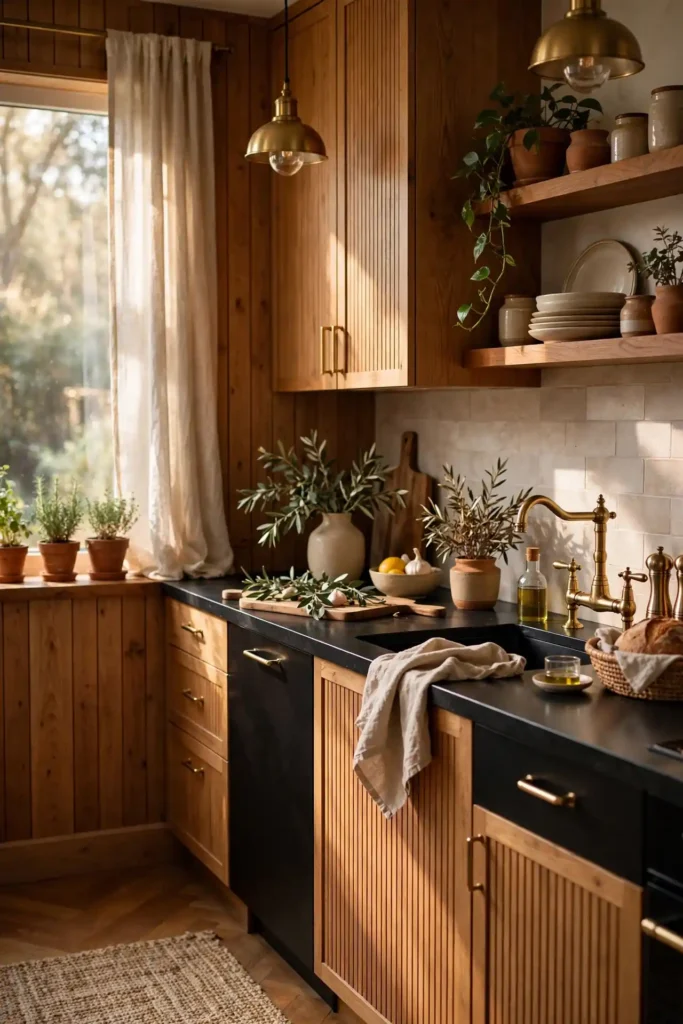
Lighting temperature matters enormously: 2700K to 3000K bulbs make black counters look rich, while 4000K-plus daylight bulbs can make them look flat and gray. Add pendant lights with warm-toned shades over the island and under-cabinet strips to wash the backsplash in light. Plants are another easy warmer — a few green stems on black stone look striking. If your kitchen already has black counters and feels chilly, start with a wood cutting board collection and a jute runner. Small warm layers transform the space without a single renovation. A bowl of fresh fruit adds living color and makes the whole kitchen feel instantly welcoming.
Choosing a Material for Black Kitchen Countertops
Choosing the right black countertop material comes down to how you cook, how you clean, and what you will tolerate in maintenance. Granite at $45 to $75 per square foot installed is the value pick: heat-resistant, hard, and forgiving of busy patterns, but it needs annual sealing. Quartz at $60 to $120 per square foot needs no sealing and resists stains beautifully, but it cannot take hot pans. Marble at $90 to $150 per square foot is the beauty queen with the highest upkeep. Soapstone and concrete sit in the middle on price and offer handmade character with their own care routines.
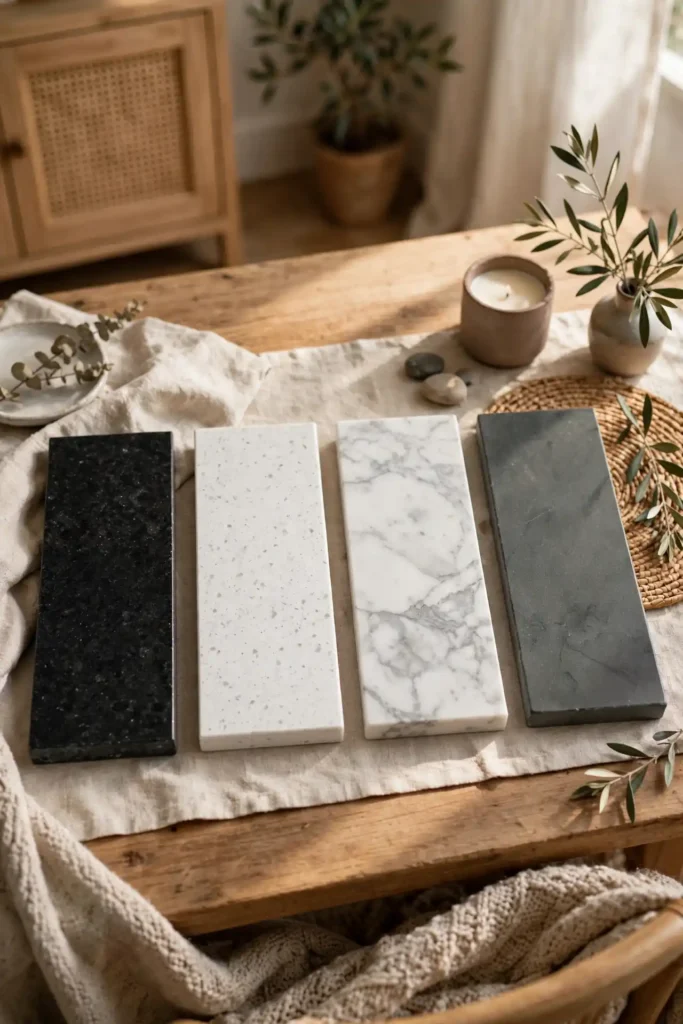
Start by visiting a stone yard and handling full slabs, because small samples lie about pattern scale. Bring a cabinet door or paint swatch so you can judge the combination in person. Ask each fabricator about their warranty, seam placement, and lead time — good shops book out six to eight weeks. Check that your cabinets are level and can support the weight, especially for concrete or thick stone. Finally, be honest about your habits: if you set hot pans down without thinking, cross quartz off the list. The best material is the one that fits your real life.
Consider how you cook and how much maintenance you are willing to do. Busy family kitchens often benefit from quartz or honed granite, while those who love patina may prefer soapstone.
Do Black Countertops Show Everything?
Honestly, yes — black countertops show crumbs, dust, water spots, and fingerprints more than light counters do, and you should know that before you commit. Every light-colored speck stands out against the dark surface, which means you will wipe them down more often. Polished black is the worst offender because the glossy finish highlights every smudge. But this is not a dealbreaker for most owners: a quick daily wipe with a microfiber cloth and a pH-neutral stone cleaner takes under two minutes. The upside is that you always know when the counters are clean.
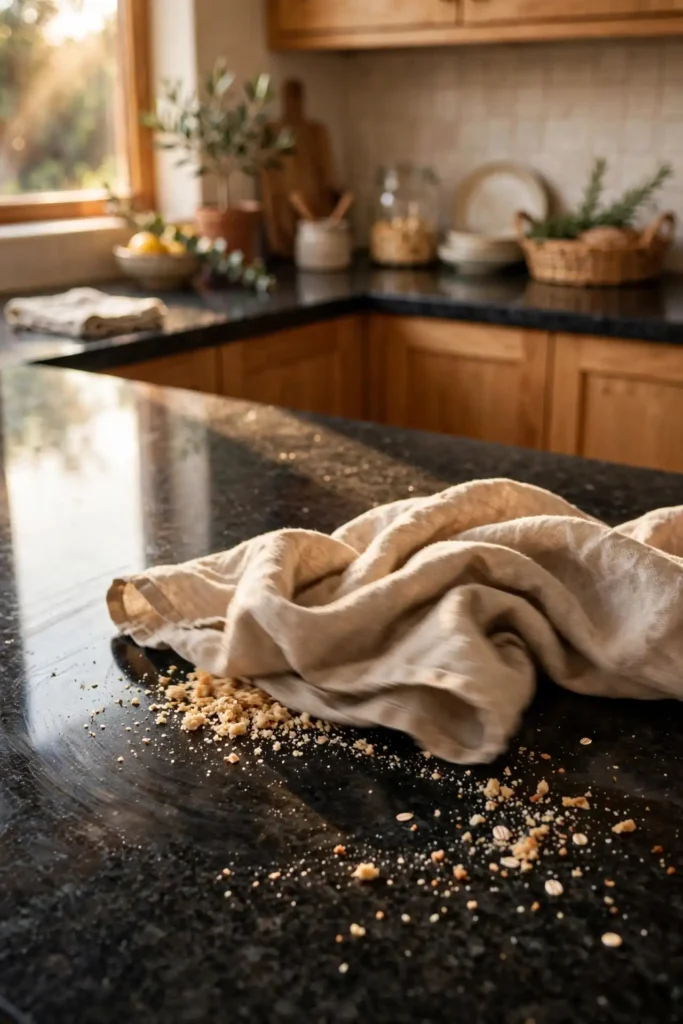
You can minimize the visibility of mess by choosing the right finish and pattern. Honed, leathered, or matte finishes hide smudges dramatically better than polished stone. Busy patterns like speckled granite camouflage crumbs far better than solid black quartz. Keep a squeegee or microfiber cloth in a drawer near the sink so wiping becomes a habit, not a chore. Many owners report that after two weeks, the quick wipe-down becomes automatic. If you are already someone who wipes counters daily, you will barely notice the difference. A robot vacuum running daily also keeps the dust and crumbs around dark counters under control.
Lighting Black Countertops
Lighting is what separates a stunning black-counter kitchen from a gloomy one, so plan it as carefully as the stone. Start with under-cabinet LED strips at 2700K to 3000K, which wash the backsplash in warm light and make the counters glow at their edges. Add pendant lights over the island — two or three, hung 30 to 36 inches above the countertop — for task light and visual warmth. Recessed ceiling lights on dimmers give you control: bright for cooking, low for evening entertaining. Without layered light, black counters absorb illumination and the kitchen feels flat.
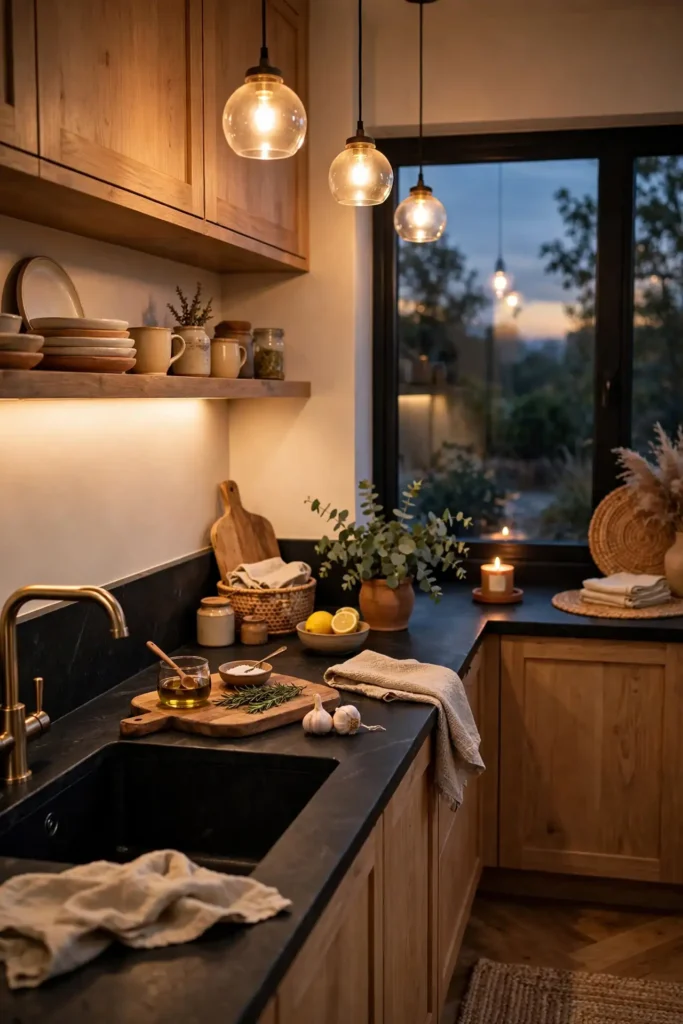
Natural light matters too. If your kitchen has windows, keep treatments sheer so daylight reaches the counters; black stone looks richest in soft natural light. Avoid cool daylight bulbs above 4000K, which can make black counters look gray and lifeless. Reflective surfaces help: a glossy backsplash, glass pendants, or a mirrored range hood bounce light around the room. Put dimmers on every switch — they cost about $25 each at Home Depot and transform the mood. Good lighting does not just show off black counters; it makes the whole kitchen feel larger.
When it comes to black kitchen countertops, the best results come from balancing style, comfort and everyday function.
How to Choose Black Kitchen Countertops Step by Step
Start by setting your budget, because black countertop materials span from $40 per square foot for butcher block to $150 for marble. Next, list your non-negotiables: do you set down hot pans, hate sealing, or have kids who spill? That list eliminates options fast — hot-pan cooks should skip quartz, sealing-haters should skip granite and marble. Then visit two or three stone yards to see full slabs in person, bringing a cabinet door sample for comparison. Photograph your favorites in natural light, since showroom lighting lies. Narrow it to two materials before you request quotes.
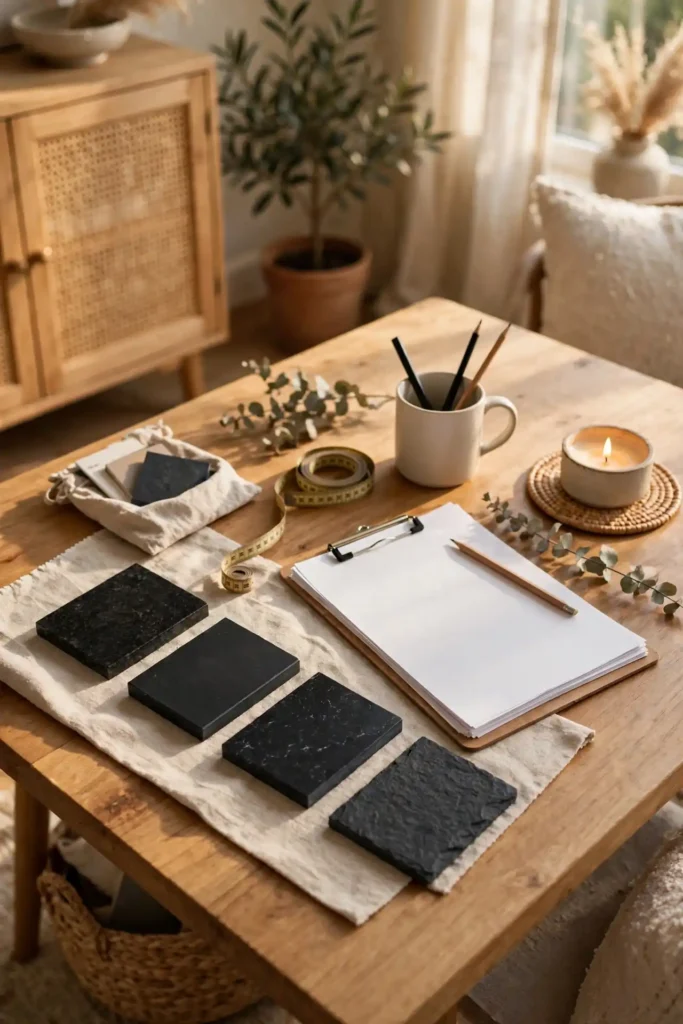
Get itemized quotes from at least three fabricators, and make sure each includes templating, fabrication, installation, sink cutouts, and edge profiles — surprise fees live in the details. Ask about lead times, which typically run four to eight weeks, and confirm seam placement before they cut. Check reviews and ask to see recent installations. Once you choose, schedule templating only after cabinets are fully installed and level. The whole process from selection to installation usually takes six to ten weeks, so plan your renovation timeline accordingly and keep a backup plan for the sink.
Follow this process:
- Choose a material based on maintenance needs.
- Select a finish: polished, honed or leathered.
- Decide on cabinet color pairing.
- Pick a backsplash that balances the counters.
- Plan lighting to keep the kitchen bright.
Final Thoughts on Black Kitchen Countertops
Black kitchen countertops are one of the most rewarding design choices you can make, because they add drama, depth, and a sense of intention to any kitchen. Whether you choose budget-friendly granite, easy-care quartz, or statement marble, the dark surface anchors the room and makes everything around it look sharper. The keys to success are simple: balance the darkness with light cabinets or backsplashes, layer your lighting, and choose a material that matches your real cooking habits. Do those three things and black counters will feel like the obvious choice.
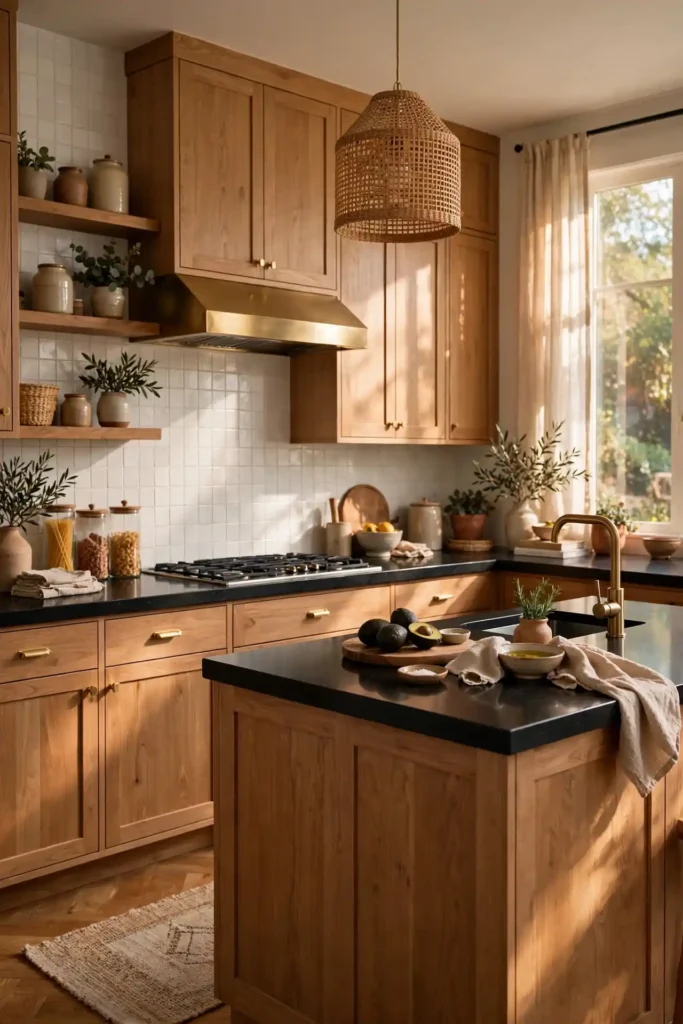
Do not let the maintenance myths scare you off. Yes, black shows crumbs, and yes, some stones need sealing — but millions of homeowners manage both without a second thought. Start with samples in your own kitchen, live with them for a week, and notice how the light hits them morning and evening. If the look still excites you after seven days, commit with confidence. A kitchen should reflect the people who cook in it, and black counters say you cook with style. Pin your favorite combinations, compare quotes, and enjoy designing a kitchen that feels unmistakably yours.
Save these ideas and follow along for more kitchen inspiration.
Frequently Asked Questions About Black Kitchen Countertops
Are black countertops hard to keep clean? They show crumbs and dust more than light counters, but a daily wipe with a microfiber cloth and stone-safe cleaner keeps them looking sharp. Choosing a honed or leathered finish and a speckled pattern hides smudges far better than polished solid black. Most owners find the extra wiping takes under two minutes a day. What is the cheapest black countertop material? Black butcher block at $40 to $80 per square foot installed is the most affordable, followed by black granite at $45 to $75. Laminate in black patterns can run even less, around $20 to $40 per square foot.
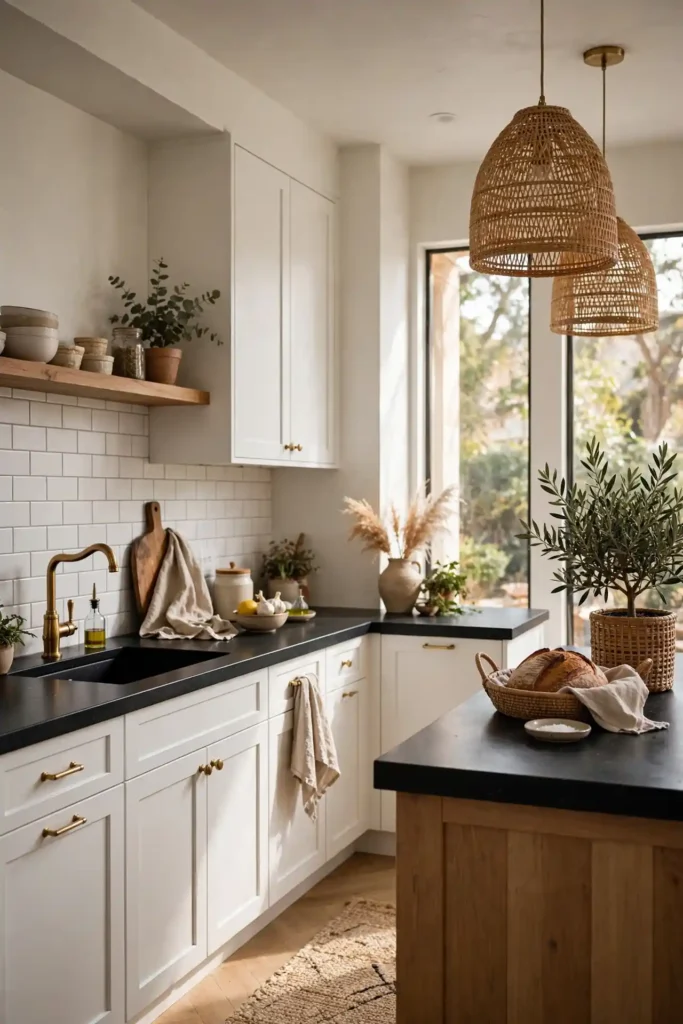
Do black countertops make a kitchen look smaller? They can if the whole kitchen goes dark, but paired with white cabinets, a light backsplash, and good lighting, black counters add depth without shrinking the room. Keep the counter profile slim and the palette balanced. Which black countertop is best for busy families? Quartz is the top pick: no sealing, excellent stain resistance, and consistent patterns, at $60 to $120 per square foot installed. Just use trivets for hot pans. Can you put hot pans on black granite? Yes — granite handles heat well, though trivets are still smart to prevent thermal shock on thinner edges.
Are black kitchen countertops a good idea?
Yes. They are stylish, hide stains and pair with many cabinet colors.
Do black countertops scratch easily?
Granite and quartz are durable; soapstone can scratch but scratches can be sanded.
What cabinets go with black countertops?
White, wood, green, navy and gray cabinets all work.
Do black countertops make a kitchen look smaller?
They can, so balance them with light cabinets and good lighting.
What is the best black countertop material?
Quartz for low maintenance, granite for durability and soapstone for character.




1 Comment