

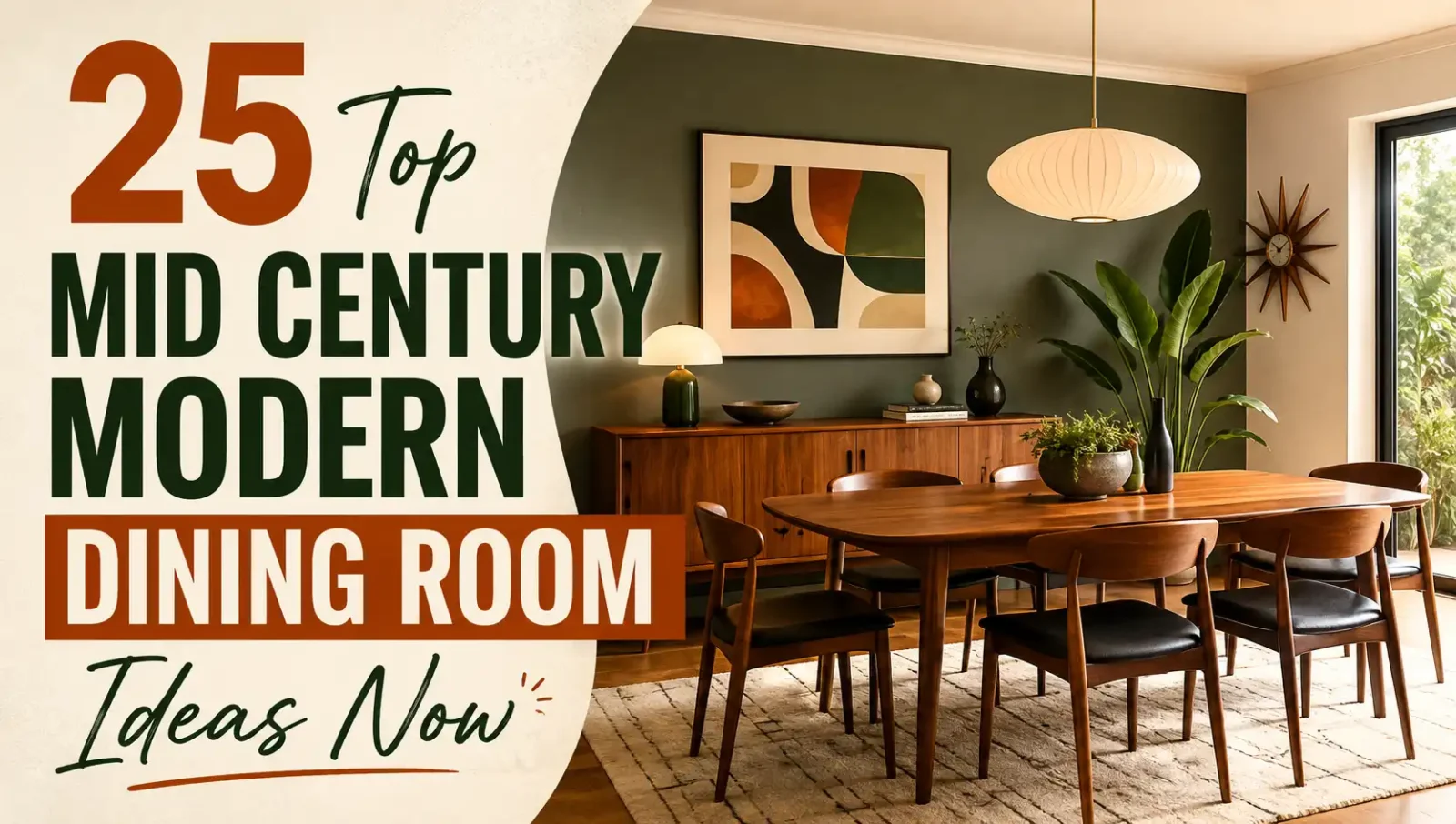
Mid century modern refuses to date, and the dining room is where it performs best. The style emerged between the 1940s and 1960s around a simple belief: furniture should be honest, functional and beautifully made, with clean lines, tapered legs and warm timber doing the work instead of heavy ornament. In a dining room that translates into pieces that feel light on the floor, materials that age gracefully, and a layout that leaves room to breathe. It is also remarkably practical — mid century proportions were designed for real homes, not palaces, so they suit modern apartments perfectly.
This guide covers 25 top mid century modern dining room ideas that look current in 2026 rather than like a period reconstruction. You will find guidance on iconic chairs, walnut and teak tables, sputnik and globe lighting, colour palettes built on mustard and olive, credenzas, sunburst mirrors, statement wallpaper and the art of mixing eras. Each idea explains what makes it authentically mid century and how to apply it without the room tipping into theme-park territory.
1. Walnut Oval Dining Table
A walnut table with a softly rounded oval top is the single most defining mid century dining purchase. The oval shape improves circulation in tight rooms because there are no corners to catch hips, and it seats more people comfortably than a rectangle of the same footprint. American black walnut, with its chocolate tone and straight grain, was the era’s signature timber. Look for a pedestal or splayed-leg base rather than four corner legs, which keeps sightlines open and lets the tabletop appear to float above the floor.
2. Tapered Leg Furniture
The tapered leg is mid century modern’s fingerprint. Narrowing toward the floor and often angled outward, it lifts furniture visually and creates negative space beneath every piece. In a dining room this matters practically: you see more floor, so the room reads larger and lighter than the same square footage filled with solid, floor-touching furniture. Apply the principle consistently across the table, chairs and sideboard. Brass or black ferrules on the leg tips are an authentic detail worth seeking out.
3. Eames-Style Moulded Shell Chairs
Moulded shell chairs remain the most recognisable mid century seating. The single-piece seat and back curves to support the body without upholstery, and the base options — dowel legs, Eiffel wire, rockers, swivels — let you change the character entirely. Fibreglass versions have the authentic texture and slight translucency; polypropylene reproductions are lighter and more affordable. Mixing shell colours around one table, using two or three tones from the same family, gives a playful look that suits family dining rooms.
4. Wishbone and Woven Seat Chairs
Hans Wegner’s wishbone silhouette bridges mid century modern and Scandinavian design, and its woven paper cord seat introduces texture that moulded plastic cannot. The Y-shaped back is sculptural from every angle, so these chairs look good even when pushed away from the table. Oak and beech versions keep a room light; smoked or black-stained frames add contrast. The paper cord seat is surprisingly durable and can be rewoven decades later, which makes them a genuine long-term purchase.
5. Teak Sideboard or Credenza
The credenza is mid century modern’s storage hero: low, long, tapered-legged and usually teak or rosewood. In a dining room it stores linens and serveware while providing a surface for serving, drinks or lamps. Its horizontal proportion balances the vertical of a tall window or pendant. Look for sliding doors, integrated finger pulls and dovetailed drawers as markers of quality. A vintage Danish credenza is often the piece that makes an entire room feel authentically of the period.
6. Sputnik Chandelier
The sputnik fixture, with arms radiating from a central sphere and exposed bulbs at each tip, captured the space-age optimism of the late fifties. Over a dining table it throws light in every direction and functions as sculpture when switched off. Brass finishes read warmer and more period-correct; black or chrome push it contemporary. Scale carefully — a sputnik should be roughly half to two-thirds the width of the table, hung 30 to 34 inches above the surface.
7. Globe Pendant Lighting
Opal glass globes deliver diffused, glare-free light that flatters faces across a dining table, which is exactly what you want during a long dinner. A single oversized globe suits a round table; a row of three smaller ones works along a rectangle. The simple sphere is timeless enough to survive changing trends while remaining unmistakably mid century when paired with a brass stem and canopy. Fit a dimmer so the same fixture works for homework and dinner parties.
8. Warm Wood and White Wall Contrast
The classic mid century backdrop is a warm white or soft off-white wall that lets timber furniture take the lead. Because walnut, teak and rosewood are all rich and reddish-brown, a cool grey wall can fight them; a creamy white or warm bone tone flatters them instead. This restraint also allows you to introduce colour through art, textiles and ceramics, changing them seasonally without repainting. Add architectural interest with a single accent wall rather than pattern everywhere.
9. Mustard Yellow Accents
Mustard is arguably the era’s signature colour, and it works because it reads as a warm neutral rather than a bright. Introduce it through upholstered dining chair seats, a runner, cushions on a banquette or a single artwork. Against walnut and white it looks sunlit and cheerful; against deep teal or charcoal it becomes striking. Keep mustard to roughly ten percent of the room’s palette — enough to register clearly, not enough to overwhelm.
10. Olive and Avocado Green
Olive, sage and avocado green run through mid century interiors and have returned strongly in contemporary schemes. Green sits naturally beside wood because both come from the same organic family, so the pairing never looks forced. Use it on a feature wall behind the dining table, on velvet chair upholstery, or in ceramic vessels on the credenza. Muted, dusty greens feel more sophisticated in 2026 than the saturated avocado of original seventies kitchens.
11. Burnt Orange and Rust Textiles
Burnt orange brings warmth and energy without the intensity of true red. In a dining room it works best in textiles — a wool rug, seat pads, curtains — where the fabric texture softens the saturation. Rust pairs beautifully with teak, brass and cream, and it looks especially good under warm evening lighting. Combine it with olive and mustard for a full period palette, or use it as a single accent against neutrals for a more restrained modern take.
12. Statement Geometric Wallpaper
Mid century graphics leaned into repeating geometry: circles, ovals, atomic starbursts and abstract organic shapes. A single papered wall behind the dining table adds the pattern the period loved while keeping the rest of the room calm. Choose a design with generous negative space rather than dense repetition, so the wall supports the furniture instead of competing. Pull one colour from the paper into the chairs or lighting to tie the scheme together.
13. Sunburst Mirror
The sunburst or starburst mirror is instantly period-defining and works hard in a dining room by bouncing light around and adding a focal point above a credenza. Brass or gilt rays feel classic; walnut spoke versions read more Danish. Scale it to the furniture beneath — roughly two-thirds the width of the sideboard. Because it is circular and radiating, it also breaks up the rectangular geometry of tables, doors and windows.
14. Tulip Table for Small Spaces
Eero Saarinen’s pedestal table solved what he called the ugly, confusing world of legs beneath tables. The single central column means chairs tuck fully underneath and nobody straddles a leg, making it exceptional in compact dining areas. The round marble or laminate top with a white base is light, sculptural and pairs with almost any chair style. It is one of the few tables that works equally well in a period-faithful room and a fully contemporary one.
15. Built-In Banquette Seating
Banquettes suited mid century open planning, tucking a dining zone into a corner or window bay without wasting circulation space. Upholster the seat in a durable boucle, wool or vinyl in a period colour, and add storage beneath the base for table linens. A banquette on one side with chairs opposite keeps the arrangement feeling light rather than boxed in. It also seats more people than individual chairs along the same run.
Read More Blogs on: decormellow.com
16. Brass Hardware and Accents
Brass was the era’s warm metal of choice, appearing on lamp stems, drawer pulls, table edges and light fittings. Unlacquered brass develops a patina over time that suits the mid century preference for materials that age honestly rather than staying artificially pristine. Repeat brass at least three times in a dining room — the pendant, the credenza handles and a bowl or candlestick — so it reads as a deliberate thread rather than an accident.
17. Indoor Plants in Sculptural Planters
Mid century interiors embraced houseplants as living sculpture, particularly monstera, rubber plants, fiddle leaf figs and snake plants with strong graphic leaves. Raise them in a tapered wooden plant stand or a ceramic pot on legs to echo the furniture’s lifted geometry. A tall plant in the corner of a dining room softens hard angles and connects the interior to the outdoors, which was a central concern of the period’s architecture.
18. Abstract and Op Art Wall Pieces
Art of the era was confidently abstract: bold blocks of colour, hard-edged geometry, and optical patterns that play with the eye. A large single canvas above a credenza has more impact in a dining room than a scattered gallery wall, and it suits the era’s preference for a few strong statements. Choose a piece containing your accent colour, and hang it so the centre sits at roughly eye level for a standing adult.
19. Open Shelving with Curated Ceramics
Floating shelves displaying pottery, glass and books introduce personality without visual clutter, provided you edit ruthlessly. Mid century ceramics — matte glazes, earthy tones, simple silhouettes from makers such as Heath or Danish studio potters — suit the aesthetic exactly. Leave real gaps between groupings so each object can be seen. In a dining room, shelving beside or above a credenza also keeps everyday serveware within easy reach.
20. Room Divider Screens
Open-plan mid century homes used slatted timber screens and modular shelving units to separate a dining area from a living room without blocking light. A vertical slat divider preserves sightlines and airflow while giving the dining zone definition. Modular systems with adjustable shelves and cabinets add storage at the same time. This is a particularly useful idea in apartments where one large room must serve several functions.
21. Terrazzo and Stone Surfaces
Terrazzo, travertine and marble appeared throughout mid century interiors as counterpoints to warm timber. A travertine tabletop on a wooden base, or a terrazzo credenza top, adds mineral coolness that stops an all-wood room feeling heavy. The speckled surface of terrazzo also disguises crumbs remarkably well under a dining table. Keep the stone honed rather than highly polished for a finish truer to the period.
22. Mixing Vintage and New Pieces
The most convincing mid century dining rooms are not entirely vintage. Combining one or two genuine period pieces — usually the credenza or the table — with newer chairs, lighting and textiles keeps the room comfortable and functional. Vintage pieces bring patina and proportion that reproductions rarely match, while new items handle daily wear. This mix also prevents the room reading as a museum set rather than a place people actually eat.
23. Low-Profile Silhouettes
Mid century furniture sits lower than traditional equivalents, with slimmer backs and thinner arms. In a dining room, choosing chairs with lower, more open backs preserves sightlines across the table and toward windows, which makes the whole space feel more spacious and sociable. Avoid tall, upholstered dining chairs with high solid backs — they are comfortable but they visually wall off the table and undermine the airy quality the style depends on.
24. Slatted Wood Wall Panelling
Vertical timber slats over a plain wall add rhythm, warmth and subtle acoustic softening — genuinely useful in a dining room with hard floors. Oak, walnut and stained ash all work, and the repeated vertical lines reinforce ceiling height. Panelling one wall behind the table creates a natural backdrop that requires no artwork. Keep slat spacing consistent and finish with a matte oil so the wood looks natural rather than lacquered.
25. Bar Cart or Drinks Station
Entertaining was central to mid century domestic life, and the bar cart was its emblem. A brass and glass two-tier cart in a dining room corner holds bottles, glassware and a cocktail shaker while adding a mobile, glamorous accent. Alternatively, dedicate the top of the credenza as a fixed drinks station with a tray, decanters and a small lamp. Either approach adds function and immediately signals a room designed for hosting.
Conclusion
Mid century modern works in dining rooms because its core principles — clean lines, honest materials, lifted furniture and restrained colour — solve real problems in real homes. You do not need a house full of vintage originals to achieve it. Start with one anchor piece, ideally a walnut or teak table or credenza, add tapered-leg seating, hang a globe or sputnik fixture, then layer in mustard, olive or rust through textiles and art. Keep the walls warm and quiet, leave breathing room around the furniture, and mix eras so the space feels lived in. Done properly, it is a dining room that will still look right in twenty years.
Frequently Asked Questions
What defines a mid century modern dining room?
Clean geometric lines, tapered legs, warm woods such as walnut and teak, minimal ornament, and a warm palette built around mustard, olive, rust and burnt orange. Furniture sits low and lifted off the floor, creating an open, airy feel.
What wood is most authentic for mid century furniture?
American black walnut and Danish teak are the two signature timbers, with rosewood used in higher-end pieces. Oak and beech appear frequently in Scandinavian designs from the same period and give a lighter, paler alternative.
What colours work best in a mid century modern dining room?
Warm white or bone walls with accents of mustard yellow, olive green, burnt orange, teal and chocolate brown. Keep accents to a small percentage of the room and let timber tones provide the dominant warmth.
Can I mix mid century furniture with modern pieces?
Yes, and the best rooms usually do. Anchor the space with one or two authentic mid century pieces, then add contemporary chairs, lighting or rugs. This keeps the room functional and stops it looking like a period reconstruction.
What lighting suits a mid century dining table?
Sputnik chandeliers, opal glass globe pendants and arc floor lamps are the most characteristic options. Hang pendants 30 to 34 inches above the tabletop and choose a fixture roughly half to two-thirds the table’s width.
Is mid century modern still in style in 2026?
Yes. Its emphasis on proportion, natural materials and functional simplicity has kept it relevant for over seventy years. Current interpretations favour muted, dustier versions of the original colours and mix the style with organic modern and Japandi elements.



Leave a comment