

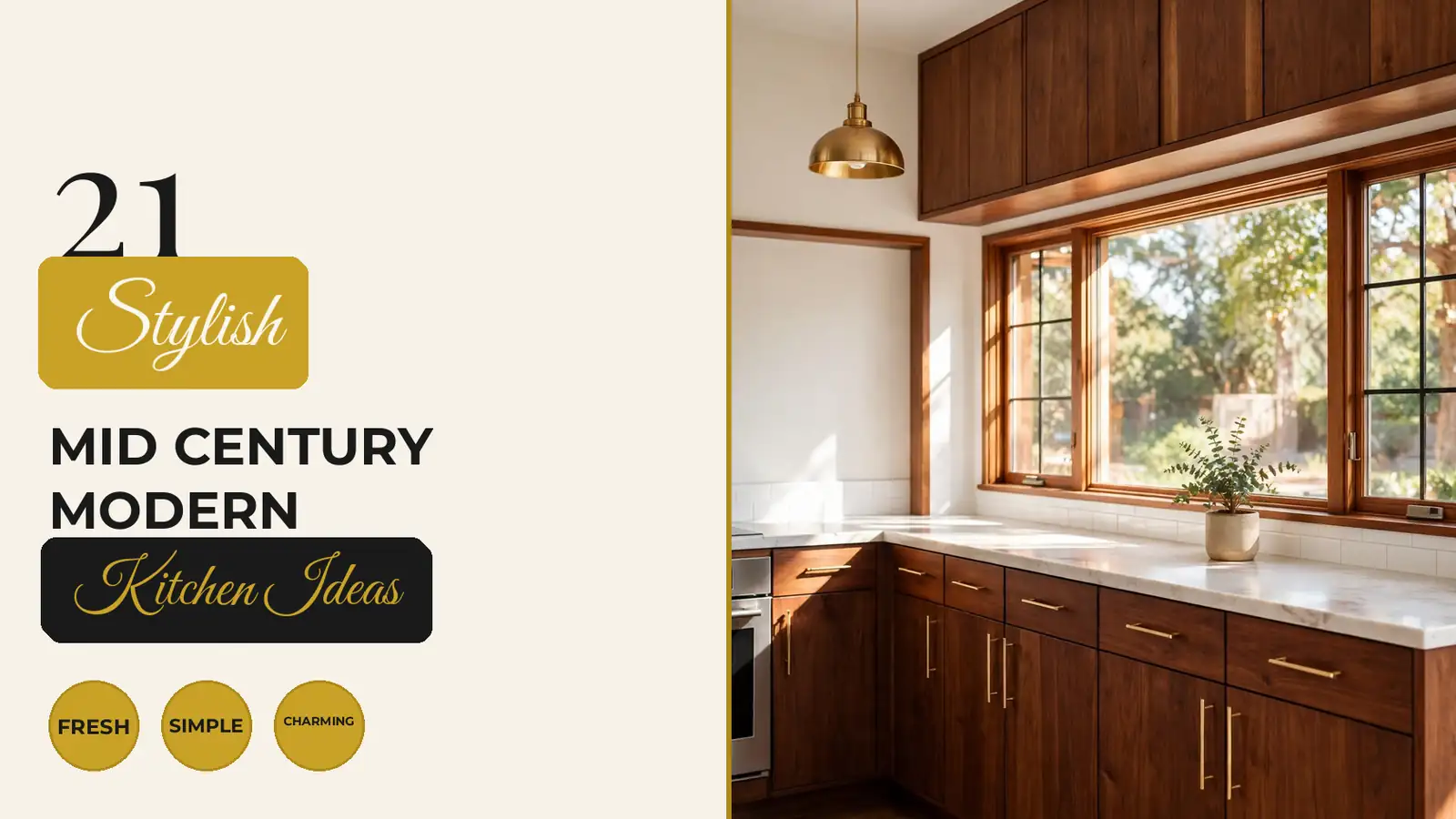
Mid-century modern design has never really gone out of style. Its clean lines, warm wood, playful colors and functional layouts feel as fresh today as they did in the 1950s and 1960s. A mid century modern kitchen blends retro charm with practical, everyday comfort.
These 21 ideas cover cabinets, lighting, tile, color and decor to help you create the look. For related inspiration, see our mid-century modern dining room ideas and these mid-century modern bathroom ideas.
Key mid century modern kitchen elements:
- Flat-panel or slab cabinet doors, often in walnut or teak.
- Simple, slim hardware or integrated pulls.
- Globe, Sputnik or cone lighting.
- Pops of color like orange, teal, mustard or olive.
1. Walnut Slab Cabinets
Walnut slab cabinets are the signature move of a mid century modern kitchen, and they bring a warmth that flat white cabinets simply cannot match. The rich, dark grain of American black walnut gives your kitchen depth without feeling heavy, especially when you pair it with a crisp white countertop or pale backsplash. Slab fronts keep everything clean because there are no raised panels or busy moldings, just smooth doors that let the wood speak. Book-matched veneer on the uppers creates continuous grain patterns that look custom and expensive. Flat-pack walnut-look fronts from IKEA run roughly $80-$120 per door, while genuine rift-sawn walnut cabinetry from a local shop typically starts near $400 per linear foot installed.

If full walnut cabinetry blows your budget, concentrate the real wood where your eyes land most, like the perimeter uppers or a single tall pantry wall. You can wrap the island in a more affordable wood-look laminate while keeping authentic walnut on the visible uppers, and most guests will never spot the difference. Finish matters as much as species, so choose a clear matte lacquer that protects the grain without adding shine. Keep hardware minimal with slim brass or black bar pulls mounted near the top edge of lowers and the bottom edge of uppers. Wipe walnut down with a damp microfiber cloth only, since harsh cleaners can dull the finish over time.
2. Teak Cabinets
Teak cabinets were the darling of 1950s and 1960s kitchens, and they are back in a big way for mid century modern renovations today. The honeyed, golden-brown tones of teak glow under warm lighting and pair beautifully with mustard, olive, and burnt-orange accents. Because new teak is expensive and often unsustainably harvested, look for reclaimed teak from architectural salvage yards or certified plantation teak, which keeps costs and guilt in check. Reclaimed teak cabinet fronts generally run $150-$300 per door depending on condition and rarity. Teak veneer over plywood boxes is the smartest compromise, giving you the authentic look at a fraction of the cost.

Teak’s natural oils make it forgiving in a kitchen, since it resists moisture and stands up to daily steam from the stove. You can leave it with a simple oil finish and refresh it once a year with a coat of teak oil from Home Depot, a job that takes about an hour. Pair teak lowers with open shelving up top to keep the kitchen feeling light and airy rather than boxy. If your teak looks tired, lightly sand with 220-grit paper and re-oil rather than painting over it. For a cohesive look, repeat teak in a cutting board, stool seats, or a floating shelf so the wood feels intentional throughout the room.
3. Two-Tone Cabinets
Two-tone cabinets give you the best of both worlds: warm wood where you want character and painted color where you want freshness. A classic mid century modern pairing is walnut or teak lowers with soft white or cream uppers, which keeps the room bright while grounding it with natural grain. You can also flip it and put a bold color like Sherwin-Williams Dignity Blue on the island while the perimeter stays in warm wood. This approach costs no more than a single finish since you are simply splitting the cabinet package, though your painter may charge an extra $200-$400 for a second paint color.
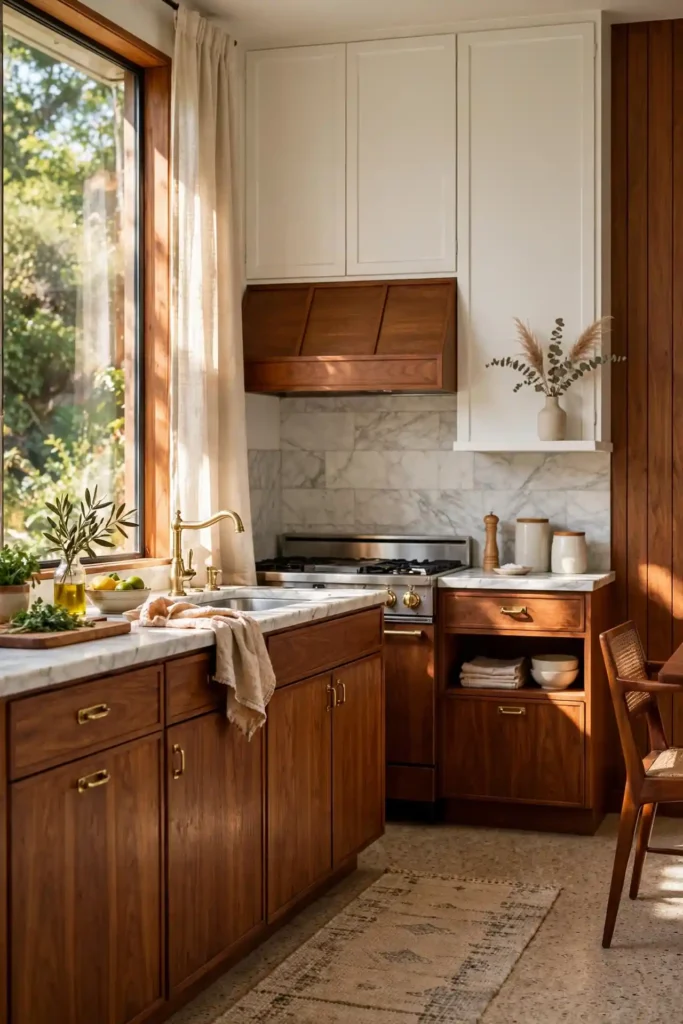
The trick to pulling off two-tone cabinets is keeping the split deliberate and balanced. Use one material for all the uppers and another for all the lowers rather than mixing randomly door to door. Pick colors with similar undertones so walnut’s warmth does not fight a cool gray. Test your paint color with a quart sample on the actual cabinet box, then view it in morning and evening light before committing. Two-tone schemes also hide wear well, since the hardworking lower cabinets in wood show fewer scuffs than painted doors. Step back after installation and confirm the two tones read as a designed contrast, not a mistake.
4. Colorful Cabinets
Colorful cabinets are how you make a mid century modern kitchen feel personal instead of museum-like. The era loved confident color, so consider Benjamin Moore’s Hale Navy for lowers, Behr’s Back to Nature in a soft sage, or a dusty mustard like Sherwin-Williams Compatible Cream on an island. Saturated colors work best below the counter where they anchor the room, while uppers stay light to keep things open. A gallon of cabinet-grade enamel like Benjamin Moore Advance runs about $65-$80 and covers roughly 400 square feet, enough for an average kitchen with two coats.

Preparation decides whether painted cabinets last five years or fifteen. Remove every door and drawer front, label them with painter’s tape, and sand with 120-grit followed by 220-grit for a smooth base. A bonding primer is non-negotiable on laminate or previously finished wood, so do not skip it. Spray or use a high-density foam roller to avoid brush marks, and let each coat cure a full 24 hours. Pull hardware before painting and consider updating to simple brass knobs while you are at it. Your colorful cabinets will look professionally done and survive daily cooking when you prep properly.
5. Globe Pendants
Globe pendants capture the atomic-age optimism of mid century modern design in one simple fixture. A cluster of frosted glass spheres hanging over the island or dining table throws soft, even light without harsh shadows, which flatters both food and faces. Budget-friendly options at Target and IKEA start around $25-$50 per pendant, while mid-range versions from West Elm or CB2 run $150-$300 each. Hang a single large globe, 12 to 16 inches in diameter, over a small island, or group three smaller globes at staggered heights over a long one. Keep the bottom of the shade 30 to 36 inches above the countertop for task lighting without blocking sightlines.

Mix and match globe sizes for a curated look rather than buying a prepackaged set that feels generic. Clear glass globes with vintage-style Edison bulbs give a warm glow, while opal white globes diffuse light for a softer effect. Install a dimmer switch so you can shift from bright meal prep to cozy dinner light with one slide. If your ceiling is low, choose semi-flush globe mounts that still deliver the look without head bumps. Globe pendants pair especially well with walnut cabinets and brass hardware, since the warm metal echoes the era’s love of mixed finishes. Clean the glass every few months because kitchen grease builds up fast.
6. Sputnik Chandelier
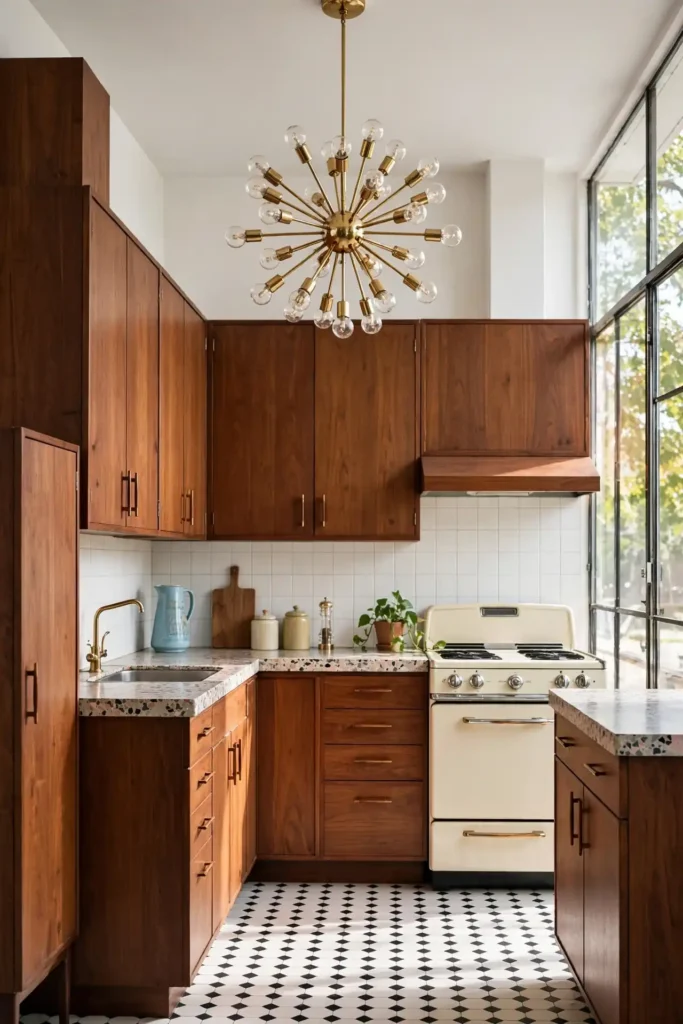
A Sputnik chandelier is the instant icon of mid century modern style, and it turns a kitchen ceiling into a conversation piece. Those radiating arms with exposed bulbs were inspired by the 1957 satellite launch, and they throw light in every direction for genuinely useful illumination. Reproduction sputnik fixtures start around $80-$150 on Amazon for a 12-light version, while authentic vintage pieces from a dealer can reach $800 or more. Choose a fixture 24 to 32 inches wide for an average 10-by-12-foot kitchen, and center it over the island or breakfast table. Hang it so the lowest bulb sits at least 7 feet above the floor.

Scale and finish make or break a Sputnik chandelier. Brass and black are the most authentic finishes and play nicely with walnut cabinets and geometric tile. Swap the included bulbs for dimmable LED globes at 2700K for that warm vintage glow without the heat or energy waste. A licensed electrician can swap an old flush mount for your sputnik in about an hour, typically costing $150-$250 for labor. If you rent or cannot rewire, look for a plug-in sputnik with a fabric cord that drapes to the wall. Keep a microfiber duster handy because those arms collect kitchen dust quickly, and wipe the fixture monthly.
7. Terrazzo Countertops
Terrazzo countertops bring speckled, confetti-like character straight from 1960s design history into your mid century modern kitchen. The chips of marble, quartz, and glass suspended in cement or resin give every slab a one-of-a-kind pattern that hides crumbs and smudges better than solid surfaces. Real terrazzo runs $75-$150 per square foot installed, which makes it a splurge, but terrazzo-look porcelain slabs and quartz options from brands like Cambria start near $60 per square foot. Choose larger aggregate chips for a bolder retro statement or fine speckles for a subtler effect. Warm gray or cream bases with amber and rust chips pair beautifully with walnut cabinets.

Terrazzo is harder than marble and resists heat better, though you should still use trivets under screaming-hot pans. Seal cement-based terrazzo once a year with a food-safe penetrating sealer, a 30-minute job you can do yourself. For a budget version, terrazzo-patterned contact paper at $15 a roll can refresh a rental kitchen for a fraction of the cost. Pair terrazzo counters with simple slab cabinet fronts so the busy pattern does not compete with ornate doors. Ask your fabricator for a honed finish rather than polished if you want the authentic mid century matte look. Your counters become the kitchen’s artwork with zero maintenance beyond daily wiping.
8. Geometric Backsplash
A geometric backsplash is the easiest way to inject mid century modern pattern without committing to busy wallpaper. Think starbursts, hexagons, chevrons, and quatrefoil tiles in a tight palette of two or three colors. Cement-look porcelain tiles from Floor & Decor start around $3-$6 per square foot, while handmade-look options from Fireclay Tile run $15-$25 per square foot. A classic move is white hex tiles with a single mustard or teal accent row, or a starburst mosaic behind the range as a focal point. Limit patterned tile to the backsplash zone, roughly 18 inches between counter and upper cabinets, so it reads as jewelry rather than noise.

Installation is a weekend-friendly project if you are handy. A 3-by-5-foot backsplash needs about two bags of thinset, a $30 tile saw rental from Home Depot, and a day of patience. Keep grout lines tight at 1/16 inch for a modern look, and choose a grout color that matches the tile’s lightest tone so the pattern stays crisp. Seal porous cement tiles before and after grouting to prevent staining from tomato sauce splatters. Step back halfway through and sight down the rows, since geometric patterns show crooked lines instantly. Your backsplash will frame the range beautifully and give the whole kitchen a graphic punch.
9. Vertical Stacked Tile
Vertical stacked tile gives your mid century modern kitchen a fresh twist on the classic subway look. Setting slim 2-by-8-inch or 3-by-12-inch tiles upright draws the eye upward and makes standard 8-foot ceilings feel taller. Glossy handmade-look ceramic tiles from Lowe’s run $5-$10 per square foot and bounce light around a small kitchen beautifully. Stick to a single color like warm white, soft sage, or pale mustard so the vertical rhythm does the visual work. Run the tile all the way to the ceiling behind open shelving for a dramatic floor-to-ceiling effect that costs little extra in material.

The stacked layout is more forgiving to install than offset brick patterns because there is no stagger to maintain. Use 1/16-inch spacers and check plumb every few rows with a 2-foot level, since vertical lines reveal drift quickly. A tile ledger board screwed to the wall keeps your first row perfectly straight while the thinset cures. Choose a grout that matches the tile closely for a seamless modern surface, or contrast it for a graphic grid effect. Vertical stacked tile pairs wonderfully with floating wood shelves and black brackets. Wipe glossy tiles weekly with a damp cloth and they will gleam like new for years.
10. Tapered Leg Bar Stools
Tapered leg bar stools are the mid century modern answer to kitchen seating, echoing the splayed legs of classic Eames and Danish furniture. Look for stools with solid wood legs that angle outward, vinyl or molded seats in mustard, olive, or cognac, and a simple footrest ring. Quality reproductions run $120-$250 per stool at retailers like Article or West Elm, while solid finds at thrift stores can cost under $40 with a little hunting. Measure your counter height first: standard 36-inch counters need 24-inch seat heights, while 42-inch bar counters need 30-inch seats. Allow 24 to 28 inches of width per stool so guests are not elbowing each other.
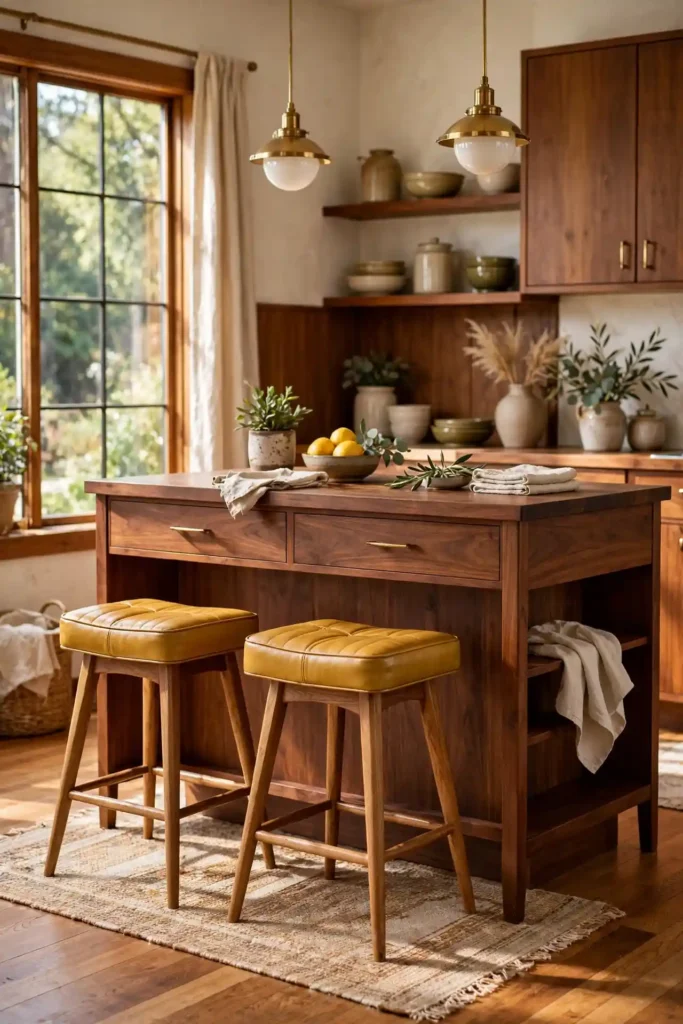
Comfort decides whether those stools get used daily or gather dust. Choose seats with a slight contour or a low backrest if your family lingers over breakfast. Swivel bases add convenience at an island but skip them if toddlers climb up unsupervised. Felt pads on the feet protect wood floors and cost about $5 for a pack. Style your stools with a small runner rug underneath only if the rug sits flat and does not wobble the legs. Tapered leg bar stools tie your kitchen to a mid century dining area across an open floor plan. Replace worn vinyl seats with new upholstery rather than tossing solid wood frames.
11. Open Shelving With Brackets
Open shelving with brackets replaces heavy upper cabinets with airy display space, a hallmark of mid century modern kitchens. Thick walnut or white oak shelves on simple black metal brackets let you show off ceramics, glassware, and cookbooks while keeping everyday dishes within reach. A 4-foot solid wood shelf with brackets costs $60-$120 from Home Depot or Etsy sellers, and most kitchens need just two or three. Mount shelves 18 to 20 inches above the countertop and keep them 10 to 12 inches deep so plates fit without crowding. Anchor every bracket into studs with 3-inch screws, since a loaded shelf can weigh 50 pounds or more.
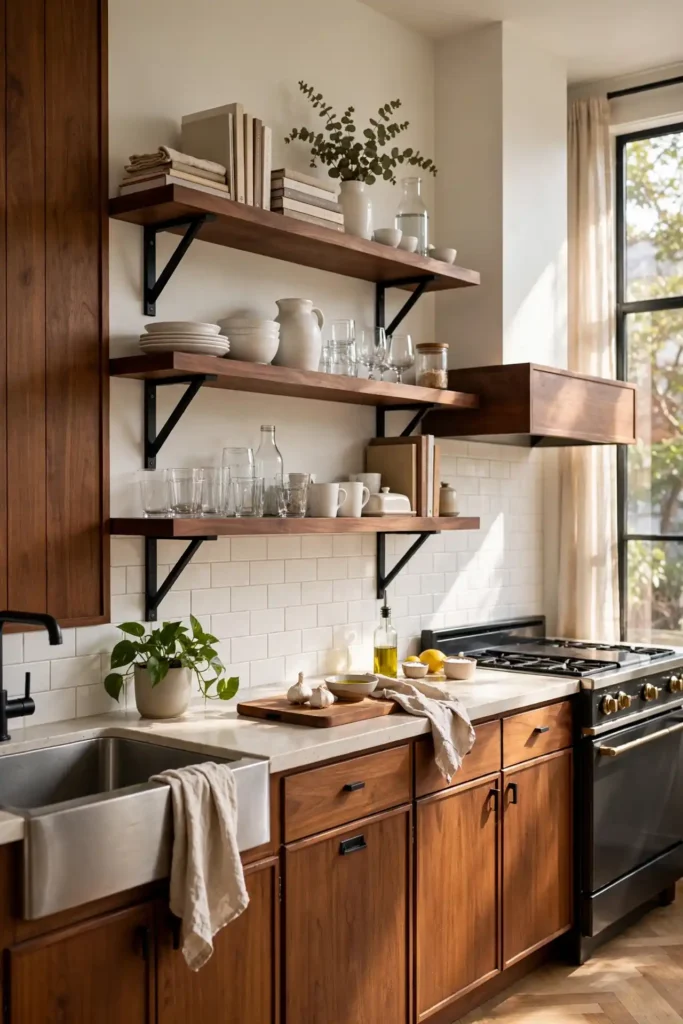
Styling open shelves takes restraint, so follow the rule of thirds: one-third everyday dishes, one-third pretty objects, and one-third breathing room. Group items in odd numbers and vary heights to avoid a flat, store-display look. Keep greasy items like cooking oils away from shelves near the range, since airborne grease settles on everything. Dust shelves weekly with a microfiber cloth and run dishes through the dishwasher before they sit out too long. If full open shelving feels risky, replace just one run of uppers beside the window. Your kitchen will feel twice as large and your favorite pieces finally get the spotlight.
12. Integrated Handles
Integrated handles, also called channel pulls or finger pulls, give cabinet doors their sleekest possible look. Instead of knobs or bars, a routed groove or aluminum channel along the door edge lets you hook a finger and pull, so nothing protrudes into your walkway. This hardware-free approach is authentically mid century, echoing the clean lines of Danish modern cabinetry. Retrofit channel pulls cost $8-$15 per foot from cabinet suppliers, while new cabinets with integrated pulls add roughly $20-$40 per door over standard fronts. Choose a J-profile for uppers where fingers lift from below and a C-channel for lowers where fingers pull from above.
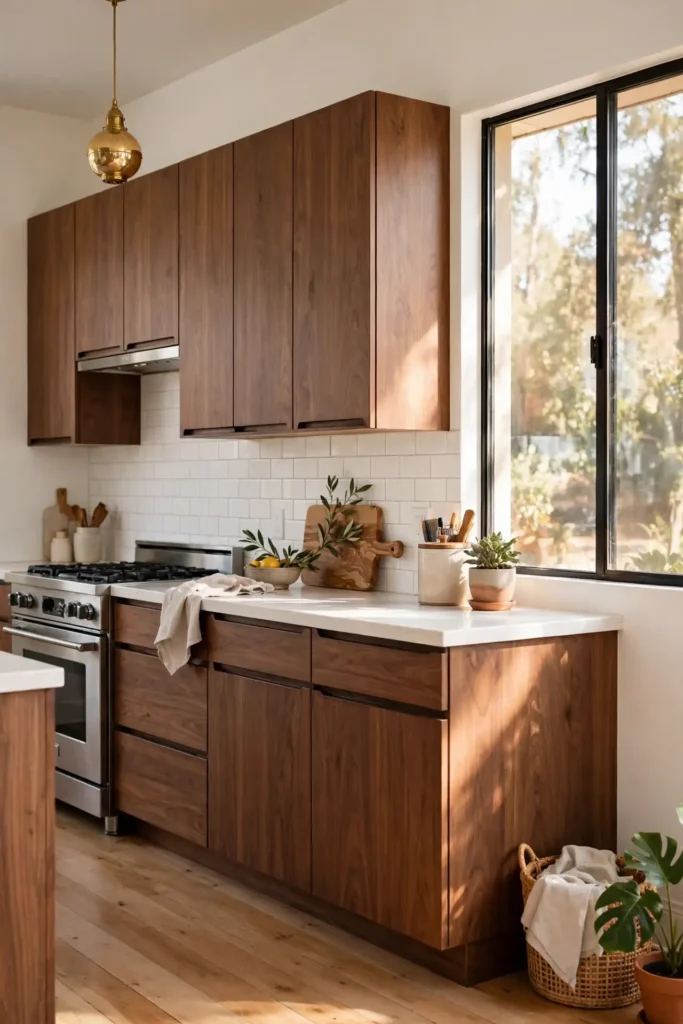
Integrated handles work best on slab or flat-panel doors since the groove reads as part of the door’s edge. Leave at least a 1-inch clearance between the channel and any adjacent wall or appliance so knuckles fit comfortably. The look stays minimal, but it does show fingerprints on dark finishes, so keep a microfiber cloth in a drawer. Pair integrated handles with touch-latch uppers if you want a completely seamless wall of cabinetry. When retrofitting, a router with a straight bit and an edge guide cuts a clean channel in about ten minutes per door. Your kitchen gains a calm, uninterrupted look that makes small spaces feel larger.
13. Retro Appliances
Retro appliances are the fun, unmistakable soul of a mid century modern kitchen. Brands like Smeg, Big Chill, and Elmira Stove Works build brand-new refrigerators, ranges, and dishwashers wrapped in 1950s curves and candy colors. A Smeg 50s-style refrigerator in cream or pastel blue runs about $2,000-$3,000, while Big Chill’s full-size retro fridges start near $4,500 with over 200 custom colors. These appliances use modern compressors and insulation, so you get vintage looks with current Energy Star efficiency. Pick one hero piece, like the fridge, and keep the range and dishwasher in simple stainless or black so the kitchen does not turn into a theme park.
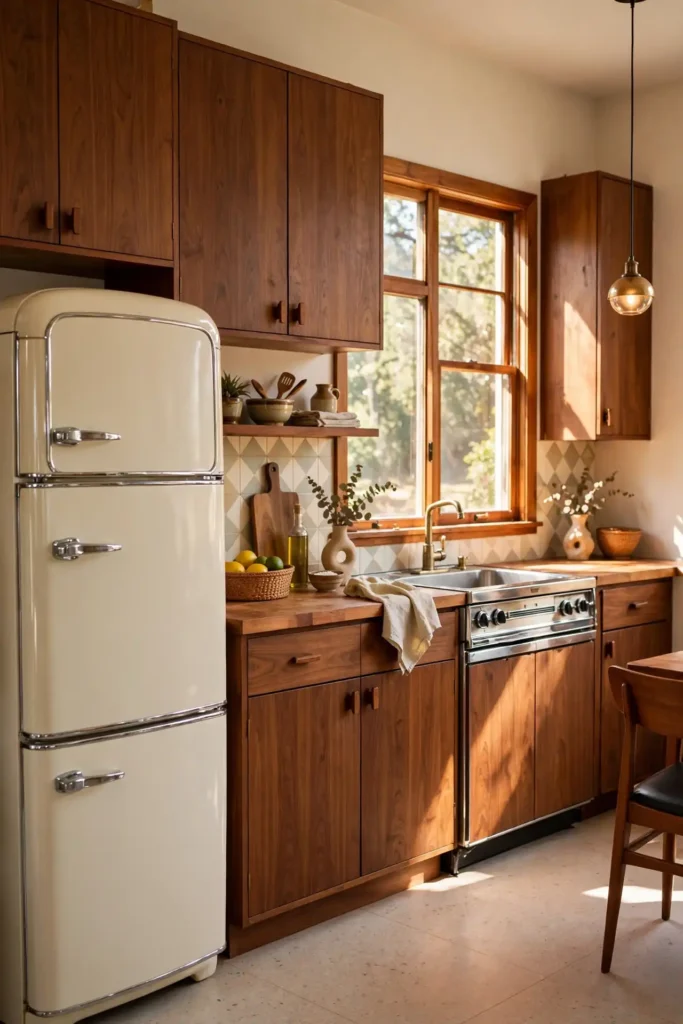
Measure your doorways and the appliance opening before ordering, since retro fridges often run deeper than standard 24-inch-deep counters. Check that the color you love works with your cabinets by ordering a $10-$20 paint chip or swatch first. Retro-style small appliances cost far less and deliver big charm: a Smeg toaster or KitchenAid mixer in retro colors runs $150-$250 and sits on the counter as decor. Keep the rest of the kitchen restrained so the appliance reads as intentional, not kitschy. Your retro fridge becomes the room’s personality, and guests will ask about it before they notice anything else.
14. Eames-Style Dining Chairs
Eames-style dining chairs bring sculptural mid century modern seating to your kitchen table or breakfast nook. The molded plywood or plastic shell with dowel or wire legs is instantly recognizable and endlessly versatile. Quality reproductions of the classic side chair run $80-$150 each from retailers like Amazon and Wayfair, while authentic vintage Herman Miller pieces fetch $300-$600 per chair. Choose walnut or rosewood dowel legs for warmth, or black wire Eiffel bases for an industrial edge. Standard dining seat height is 17 to 19 inches, which pairs with a 29-to-30-inch table. Buy one extra chair beyond your daily needs for surprise guests.
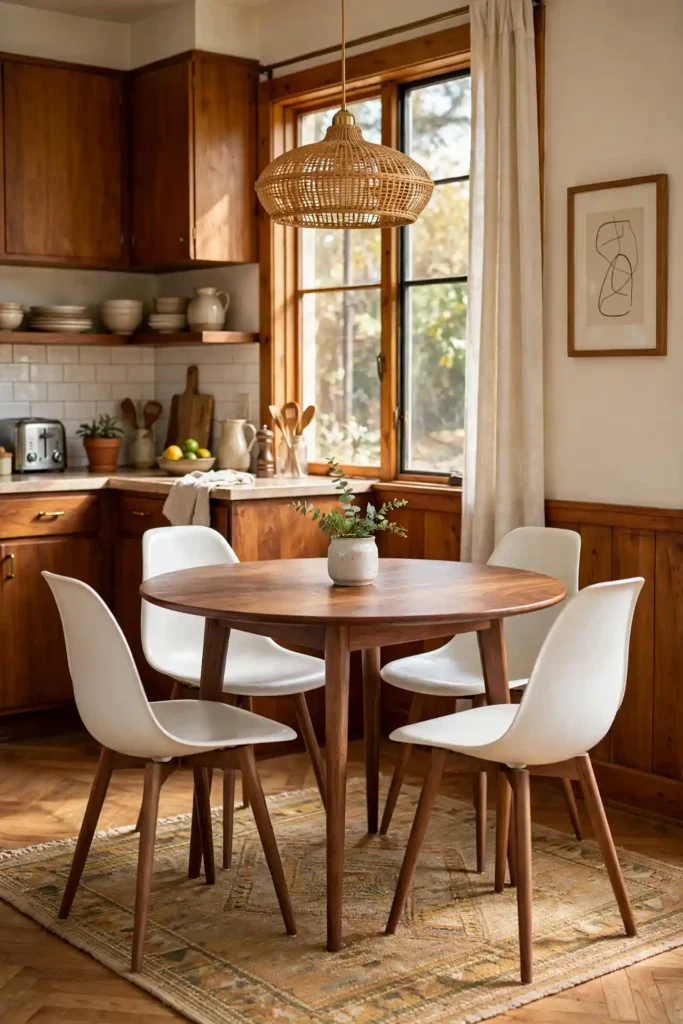
Mixing Eames-style chairs is where the fun starts. Try matching shells in two complementary colors, like white and mustard, or pair molded plastic seats at the table with an upholstered bench on one side. Add thin seat pads in a nubby wool for comfort during long dinners, secured with ties so they do not slide. Check weight limits if buying reproductions, since cheaper shells can flex under heavier sitters. Wipe molded shells with a damp cloth and tighten leg screws twice a year. These chairs work in almost any dining corner and instantly signal mid century modern intent to anyone who walks in.
15. Wood Ceiling Paneling
Wood ceiling paneling wraps your mid century modern kitchen in warmth from above, echoing the beamed and planked ceilings of classic ranch homes. Tongue-and-groove cedar or pine planks run $2-$5 per square foot at Home Depot, making a 100-square-foot kitchen ceiling a $200-$500 material project. Install planks perpendicular to the longest wall to stretch the room visually, and stain them a warm honey tone or leave them natural with clear polyurethane. Recessed can lights or slim track lighting tuck neatly between planks without breaking the wood rhythm. This works especially well in kitchens with 8-foot ceilings that need character without losing height.

Installation is straightforward for a confident DIYer with a brad nailer and a helper. Snap a chalk line for your first row, blind-nail through the tongue, and keep a 1/4-inch expansion gap at the walls hidden by trim. Run any new electrical for lights before the planks go up, since fishing wire afterward is miserable. If real wood feels like too much, wood-look PVC planks offer the same vibe with zero maintenance and better moisture resistance. Pair a wood ceiling with white walls so the room stays bright. Your kitchen gains architectural richness that paint alone can never deliver, and the wood ties directly to walnut cabinets below.
16. Clerestory Windows
Clerestory windows are the architectural secret of great mid century modern kitchens. Set high on the wall, just below the ceiling, they flood the room with daylight while keeping sightlines private and wall space free for cabinets. Adding a band of clerestory windows during a remodel costs $300-$600 per window installed, including framing and flashing. A run of three 2-by-3-foot fixed windows above the sink or range wall delivers dramatic light without the cost of full-height glass. South or east-facing clerestories give the best daylight, while north-facing ones provide soft, even light all day long.

If new windows are not in the budget, mimic the effect with what you have. Remove heavy valances and let your existing high windows work harder, or add a solar tube for about $500-$800 installed to punch daylight into a dark corner. Keep the wall beneath clerestories free of tall cabinets so light washes deep into the room. Pair them with light-colored counters and backsplashes that bounce the daylight around. Add simple roller shades in a natural linen for the rare moments you want to dim the glare. Your kitchen will feel connected to the outdoors in the true mid century spirit of blurring inside and outside.
17. Warm Wood Floors
Warm wood floors ground a mid century modern kitchen with the honeyed tones the era loved. White oak or hickory with a natural or medium stain keeps the look authentic, while avoiding the gray washes that fight the style’s warmth. Engineered hardwood runs $5-$10 per square foot installed and handles kitchen moisture better than solid wood. Run planks parallel to the longest wall to elongate the space, and choose 5-inch or wider boards for a current feel. A satin finish hides scratches better than gloss and looks more period-appropriate. Warm wood floors tie directly to walnut cabinets and teak accents above.

Protect your investment with simple habits. Put felt pads under every stool and chair leg, use a washable runner in front of the sink where water splashes, and sweep grit weekly since sand is wood’s worst enemy. Refinish site-finished floors every 7 to 10 years, or choose prefinished engineered wood with aluminum-oxide coating for maximum durability. If hardwood is out of reach, luxury vinyl plank in a warm oak look costs $3-$5 per square foot and shrugs off spills. Keep the floor tone a few shades lighter or darker than your cabinets so the woods complement rather than match exactly. Your kitchen will feel cohesive and welcoming underfoot every single day.
18. Mustard and Olive Accents
Mustard and olive accents are the color shorthand for mid century modern style, and they work magic in a kitchen. These earthy, saturated tones appear in everything from vintage Pyrex to classic upholstery, so a few well-placed hits instantly signal the era. Try mustard bar stools, an olive pendant cord, or a burnt-orange tea kettle on the stove. Small accessories cost $15-$50 each at Target or World Market, so you can layer the look without a big spend. Paint the inside of a glass-front cabinet in Sherwin-Williams Restrained Gold for a hidden pop of color. Keep accents to about 10 percent of the room’s visual weight so they energize rather than overwhelm.

Repetition makes accents feel intentional instead of random. Echo mustard in two or three spots, like stools, a rug runner, and a piece of art, rather than scattering single items everywhere. Olive works beautifully in textiles such as curtains or seat cushions because it reads as a neutral with personality. If you tire of a color, accessories swap out in an afternoon, which is the whole point of using accents rather than permanent finishes. Pair mustard and olive with warm wood and white walls for the classic palette. Your kitchen will carry that unmistakable mid century warmth without a single major renovation.
19. Atomic Clock
An atomic clock on the kitchen wall is pure mid century modern joy, with its starburst rays or boomerang shape doubling as functional art. George Nelson’s iconic designs set the template, and faithful reproductions run $80-$200 from retailers like Design Within Reach’s more affordable lines or Amazon. Hang it where you can see it from the stove and the table, typically on the wall opposite the range at eye level. A 13-to-18-inch diameter reads well in most kitchens without dominating. Battery-powered quartz movements keep time accurately with zero wiring, and one AA battery lasts about a year.
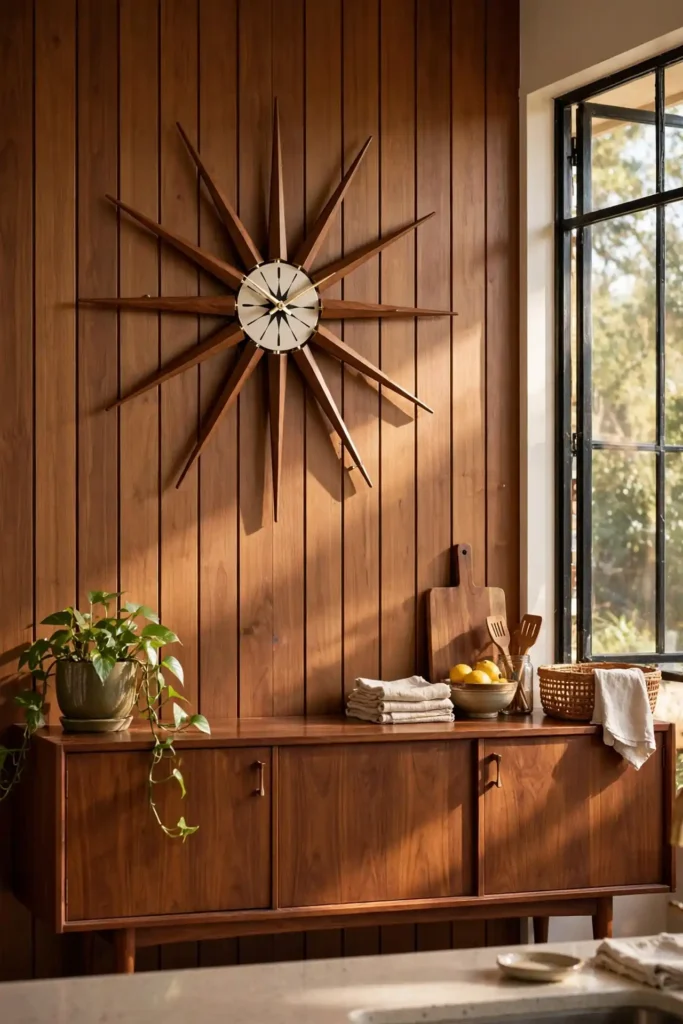
Choose a clock whose materials echo the rest of your kitchen, like walnut rays to match walnut cabinets or brass hands to match your hardware. Avoid hanging it directly above the stove, where heat and grease will age it prematurely. If the classic starburst feels too bold, a simple round clock with a walnut frame and clean numerals still nods to the era. Sync a radio-controlled atomic clock once and it sets itself, including daylight saving changes. Your wall gains a sculptural focal point that also happens to tell time, which is the mid century modern ideal of beauty serving function.
20. Plants in Ceramic Planters
Plants in ceramic planters soften the clean lines of a mid century modern kitchen with living texture. The era loved bringing the outdoors in, so a fiddle-leaf fig in the corner or trailing pothos on open shelves feels historically right. Ceramic planters in matte white, terracotta, or mustard cost $15-$40 at Target, IKEA, or local nurseries. Choose planters with drainage holes and saucers to protect wood shelves and counters from water rings. A 6-inch pothos or snake plant thrives in bright indirect kitchen light and forgives the occasional forgotten watering. Group three planters of varying heights for a styled look rather than lining them up in a row.

Kitchens are actually great homes for many houseplants because cooking adds humidity that tropical plants love. Herbs like basil, rosemary, and thyme do double duty as decor and ingredients on a sunny windowsill. Keep plants away from the direct blast of the range hood and wipe leaves monthly so they can photosynthesize through kitchen dust. A macrame or simple rope hanger adds mid century texture while freeing counter space. Start with two or three easy plants and add more once you see them thriving. Your kitchen will feel alive and fresh, and guests always notice greenery first.
21. Keep It Clean and Functional
Keeping your kitchen clean and functional is the deepest mid century modern principle of all, because the era worshipped honest, hardworking design. Start by editing ruthlessly: pull everything off the counters, keep only daily-use items, and relocate the rest to cabinets or donate it. A clear counter instantly makes a kitchen look bigger and calmer. Invest in drawer organizers at $15-$30 per set from Amazon so utensils and tools have exact homes. Store small appliances you use weekly, like the stand mixer, in an appliance garage or a deep lower cabinet with a lift shelf. When everything has a place, cleanup takes minutes instead of half an hour.
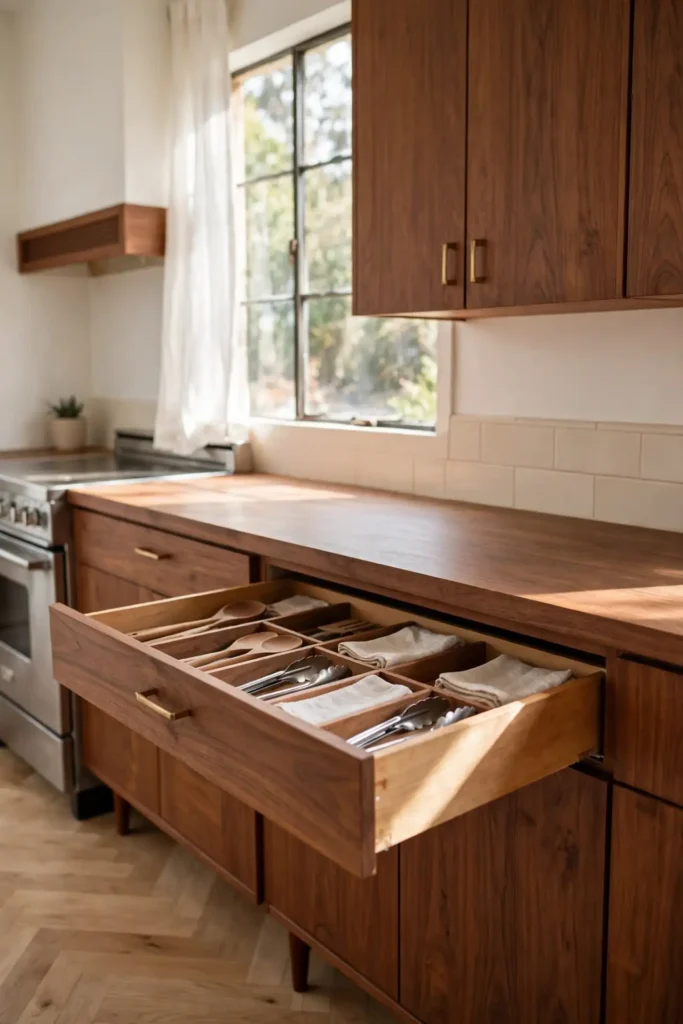
Function follows a simple triangle: keep the sink, stove, and refrigerator within a total of 13 to 26 feet of each other for efficient movement. Clear the zones around each point so you can set down hot pans and full grocery bags safely. Run the dishwasher every night and empty it every morning so dirty dishes never colonize the sink. Wipe counters and the stovetop daily with a microfiber cloth and a gentle cleaner, then deep-clean the oven and fridge quarterly. A mid century modern kitchen earns its style through how well it works, not just how it photographs. Your future self will thank you every busy weeknight.
Colors for a Mid Century Modern Kitchen
Colors for a mid century modern kitchen start with warm neutrals and build outward into confident accents. Anchor the room with warm whites like Benjamin Moore White Dove, natural wood tones, and soft grays with warm undertones. Then layer the era’s signature hues: mustard yellow, olive green, burnt orange, and teal. Sherwin-Williams has period-friendly options like Restrained Gold and Haven, while Behr’s Back to Nature captures the soft sage the era loved. Follow the 60-30-10 rule with 60 percent neutrals, 30 percent wood tones, and 10 percent bold accent color. Test every color with a large swatch on the wall and live with it for three days before committing.
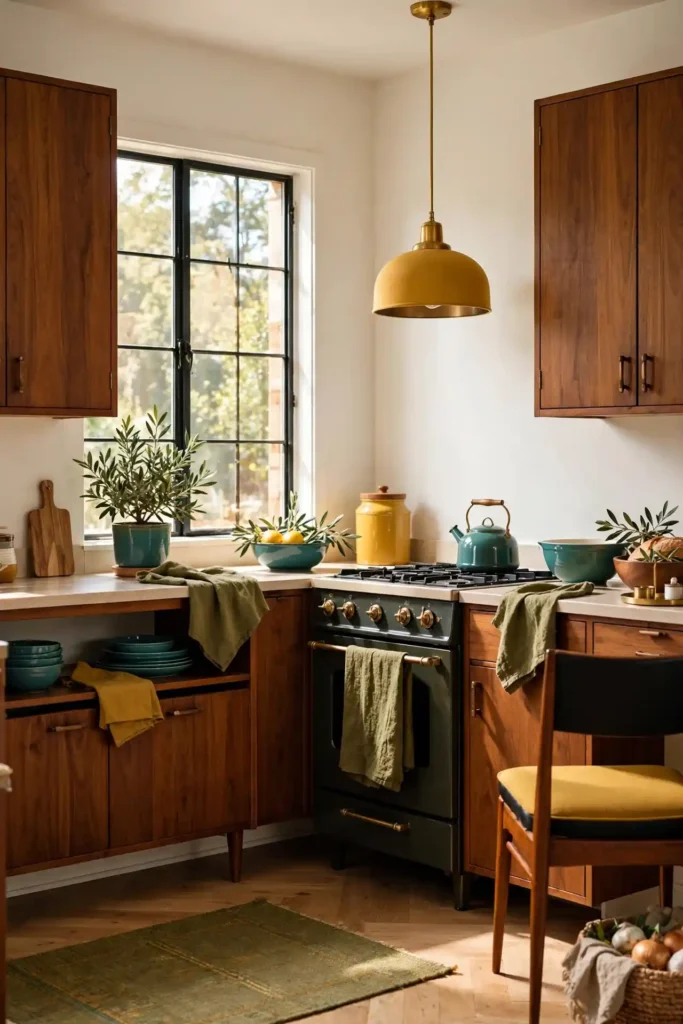
Light changes everything, so evaluate colors in morning sun, afternoon shade, and evening lamplight. North-facing kitchens need warmer colors to counteract cool light, while south-facing rooms can handle cooler teals and grays. Keep the ceiling bright white to reflect light downward, and let the floor carry the warmest tone in the room. If you are nervous about bold color, start with accessories and textiles before painting a single wall. Photograph your swatches next to your cabinets and counters, since cameras reveal clashes your eyes miss. Your palette will feel cohesive and unmistakably mid century when neutrals do the heavy lifting and color provides the punctuation.
Modernizing Mid-Century Style
Modernizing mid-century style means keeping the era’s soul while upgrading its performance for how you cook today. Keep the signature elements like walnut grain, tapered legs, and starburst motifs, but pair them with soft-close drawers, quartz counters, and LED lighting the original designers could only dream about. Swap a vintage range for a slide-in induction model that looks sleek and boils water in half the time. Add under-cabinet LED strips at $20-$40 per 16-foot reel from Amazon to light prep zones the old kitchens left shadowy. You get the look you love with the convenience you need, and nobody misses the avocado-green appliances.

The key is editing rather than copying a museum room. Keep two or three authentic vintage or reproduction pieces as anchors, then let everything else be quietly contemporary. A 1960s credenza can become a coffee station while new cabinetry handles daily storage. Upgrade the electrical panel and add GFCI outlets before styling, since safety outranks aesthetics every time. Choose performance fabrics on dining chairs so the look survives real family life. Your kitchen should feel like a thoughtful evolution of mid century design, not a time capsule. Guests will sense the era’s spirit in every detail while enjoying a kitchen that works like it was built yesterday.
Budget Tips
Budget tips for a mid century modern kitchen start with knowing where to splurge and where to save. Spend on what you touch daily: cabinet hardware, the faucet, and flooring. Save on what the eye barely registers: the pantry interior, toe kicks, and the backs of islands. Painting existing cabinets in a period color like Sherwin-Williams Evergreen Fog costs under $300 in paint and supplies versus $8,000-$15,000 for new cabinetry. Thrift stores, Facebook Marketplace, and estate sales are gold mines for authentic bar stools, pendant lights, and art at 70 percent off retail. Set a firm total budget first, then allocate 40 percent to cabinets, 20 percent to counters, and the rest to the details.

Phase the project so your wallet and your sanity survive. Do the disruptive work like flooring and electrical first, then layer in cabinets, counters, and finishes. Keep a 15 percent contingency fund because old kitchens hide surprises like outdated wiring or water damage. Track every purchase in a simple spreadsheet so small $50 trips to Home Depot do not silently double your budget. Ask contractors for itemized bids and get three quotes before signing anything. A stunning mid century modern kitchen is absolutely possible for $10,000-$20,000 when you prioritize ruthlessly and do the cosmetic work yourself. Your patience pays off in a kitchen that looks far more expensive than it was.
How to Plan a Mid Century Modern Kitchen Step by Step
Planning a mid century modern kitchen step by step starts with measuring everything twice. Sketch your floor plan on graph paper or a free tool like the IKEA kitchen planner, marking windows, doors, and plumbing locations to the inch. Decide your must-haves first, such as walnut lowers or a sputnik chandelier, then build the budget around them. Order cabinets 8 to 12 weeks before demolition since lead times are the number-one cause of project delays. Pull permits for electrical, plumbing, and structural changes through your city building department, a process that takes 1 to 4 weeks. A clear plan prevents the costly mid-project changes that blow budgets.

Next, sequence the work like a professional. Demolition comes first, followed by rough electrical and plumbing, then drywall, flooring, cabinets, counters, backsplash, and finally paint and hardware. Hire licensed pros for electrical, plumbing, and gas, and reserve DIY for painting, backsplash tile, and styling. Create a shared folder with inspiration photos, product links, and paint codes so everyone works from the same vision. Schedule countertop templating only after cabinets are fully installed and level. Walk the finished kitchen with your contractor and a roll of blue tape, marking every flaw before final payment. Your methodical plan turns a stressful remodel into a satisfying project you will enjoy for decades.
- Choose flat-panel wood or colored cabinets.
- Select countertops like white quartz or terrazzo.
- Pick a backsplash with retro pattern or stacked tile.
- Add iconic lighting and seating.
- Accessorize with period colors and ceramics.
Final Thoughts on Mid Century Modern Kitchen Ideas
Mid century modern kitchens endure because they were designed around real life, not passing trends. Warm walnut, honest materials, clean lines, and a fearless hit of mustard or teal create rooms that feel both nostalgic and completely current. You do not need a full gut renovation to capture the style: a sputnik chandelier, tapered leg stools, and a fresh coat of period-inspired paint can transform a builder-grade kitchen in a single weekend. Start with the one change that excites you most, live with it for a month, and let the room tell you what it needs next. Small, deliberate updates compound into a kitchen with genuine character.

Remember that the best mid century modern kitchens balance beauty with everyday function. Keep counters clear, invest in lighting that flatters both cooking and conversation, and choose materials that age gracefully rather than demanding perfection. Your kitchen should welcome busy weeknights and slow Sunday mornings with equal ease. Whether you splurge on custom teak cabinetry or score a vintage clock at a flea market, every choice should serve the way you actually live. Trust your instincts, enjoy the process, and build a kitchen that feels unmistakably yours for the next twenty years.
Save these ideas and follow along for more kitchen inspiration.
Frequently Asked Questions About Mid Century Modern Kitchen Ideas
Mid century modern kitchens blend the design language of roughly 1945 to 1975 with the way we cook today. Readers most often ask which elements matter most, how much a remodel costs, and whether the style works in small or rental kitchens. The short answer is that warm wood tones, clean-lined cabinetry, geometric patterns, and a confident accent color carry the look, while modern lighting and appliances keep it practical. Budgets range from a $500 cosmetic refresh with paint and accessories to a $25,000 full renovation with custom cabinetry. Small kitchens actually suit the style beautifully because its clean lines and light palettes make tight spaces feel larger.
Use the questions below as your quick-reference guide before you start shopping or calling contractors. Each answer distills the key decisions from this guide into actionable next steps, from choosing cabinet finishes to planning your lighting layout. Bookmark this page and return to it as your project moves from inspiration to installation. The FAQ block that follows covers costs, colors, materials, and layout essentials in one scannable place. With these answers in hand, you can plan your mid century modern kitchen with confidence and avoid the expensive mistakes that derail so many remodels.
What defines a mid century modern kitchen?
Flat-panel wood cabinets, clean lines, iconic lighting and pops of retro color.
What colors are mid century modern?
Teal, orange, mustard, olive, turquoise and warm wood tones.
What countertops suit mid century kitchens?
White quartz, terrazzo and laminate in retro colors.
Can I make my kitchen mid century on a budget?
Yes. Paint cabinets, swap hardware and add retro lighting and stools.
Is mid century modern still popular?
Yes. It remains one of the most enduring design styles.


Leave a comment