

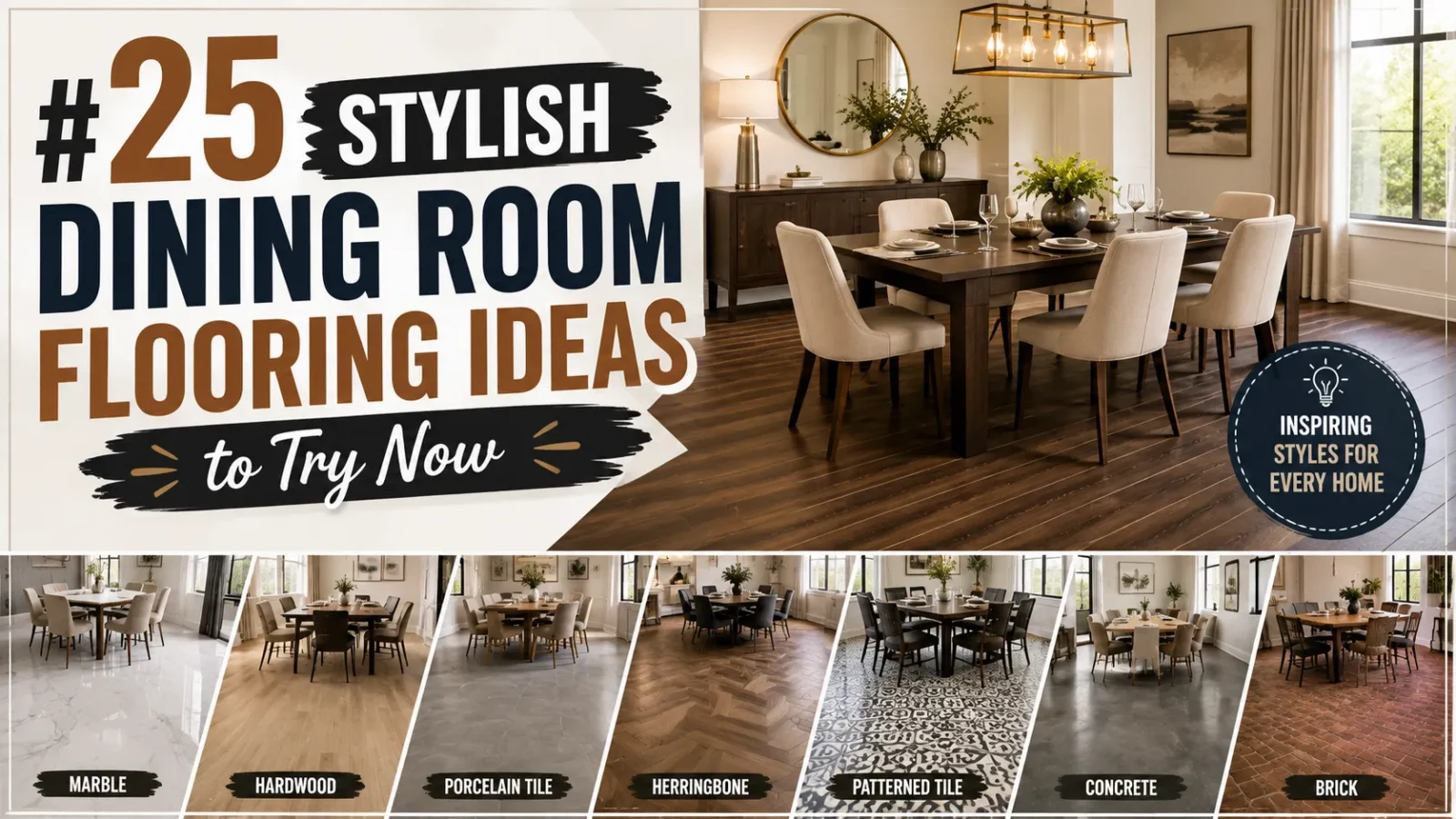
Dining room flooring does more work than almost any other surface in your home. It absorbs dropped forks, chair scrapes, spilled wine and years of daily traffic, all while setting the visual tone for the room. The right floor makes a small dining nook feel expansive, grounds a formal dining space, or ties an open-plan kitchen-diner together. Whether you are renovating from scratch or simply refreshing a tired surface, choosing between hardwood, tile, vinyl and stone comes down to durability, budget, maintenance and the mood you want your dining table to sit inside.
This guide walks through 25 stylish dining room flooring ideas that designers actually specify in 2026, from timeless white oak planks and herringbone parquet to bold checkerboard tile, warm terrazzo and budget-friendly luxury vinyl. Each idea explains the look, the practical trade-offs and who it suits best, so you can match a floor to your lifestyle rather than just a mood board. Read through, save your favourites, and you will finish with a clear shortlist of dining room floor ideas worth pricing up.
1. Warm White Oak Hardwood
White oak is the default choice for a reason: it is hard-wearing, neutral and flatters almost every dining table finish. Its subtle grain and honeyed undertone bring warmth without pushing the room into orange territory the way red oak sometimes does. A matte or natural oil finish hides crumbs and scuffs far better than high gloss, which matters under a dining table. Choose a Janka rating around 1360 or higher for daily chair movement. White oak also takes stain beautifully, so you can go pale Scandinavian or deep smoked later without replacing the boards.
2. Herringbone Wood Parquet
Herringbone instantly signals craftsmanship. Short wood blocks laid in a zigzag draw the eye across the floor, making narrow dining rooms feel wider and giving a plain rectangular space real architectural interest. It works equally well in period homes with cornicing and in minimalist new builds where it becomes the only pattern in the room. Expect higher installation costs, since labour is roughly double that of straight planks, and allow extra material for cutting waste. Keep the rest of the scheme calm — a simple table and quiet walls — so the floor stays the hero.
3. Wide-Plank Engineered Wood
Wide planks of 7 to 9 inches show off more grain per board and create fewer visible seams, which makes a dining room read as calmer and larger. Engineered construction, with a real wood veneer over a plywood core, resists the expansion and contraction that causes solid wood to cup or gap in rooms with underfloor heating or humidity swings. That stability makes it a smart pick for open-plan kitchen-diners. Look for a wear layer of at least 3mm if you ever want to sand and refinish it down the line.
4. Luxury Vinyl Plank (LVP)
Luxury vinyl plank is the practical answer for families, rentals and anyone who has ever watched a toddler launch a bowl of pasta. It is fully waterproof, softer and warmer underfoot than tile, and modern embossed-in-register printing means good LVP genuinely reads as wood from standing height. Click-lock systems float over most subfloors, so installation is fast and often DIY-friendly. Choose a wear layer of 20 mil or more for a dining room. The main trade-off is resale perception — buyers still value real wood — and it cannot be refinished.
5. Large-Format Porcelain Tile
Oversized porcelain tiles, typically 24×48 inches or larger, dramatically reduce grout lines, and fewer grout lines means less to clean under a dining table. Porcelain is denser and less porous than ceramic, so it shrugs off spilled red wine, olive oil and repeated mopping. It pairs naturally with underfloor heating, solving the coldness complaint. Rectified edges allow grout joints as tight as 2mm for a near-seamless look. The catch is weight and subfloor flatness: large formats need a perfectly level base or tiles will lippage and rock.
Read More Blogs on: decormellow.com
6. Patterned Encaustic Cement Tile
If your dining room is otherwise plain, patterned cement tile gives it a personality transplant. Moroccan-inspired geometrics, Victorian florals and simple two-tone stars all work, and the handmade colour variation adds depth that printed tile cannot fake. Encaustic tiles are porous, so they must be sealed before grouting and resealed periodically — non-negotiable in a room where sauces get spilled. Use pattern as a defined “rug” area beneath the table with plain border tiles around it, which keeps the effect deliberate rather than overwhelming.
7. Natural Travertine Stone
Travertine brings a soft, sun-warmed Mediterranean quality that suits farmhouse, rustic and modern-organic dining rooms alike. Its creamy beiges and walnut veining hide dust and crumbs remarkably well. Honed or tumbled finishes give grip and a matte, lived-in surface, while filled travertine offers a smoother, more formal look. Because it is a calcium-based stone, travertine etches when it meets acid, so vinegar, lemon juice and wine need prompt wiping and an impregnating sealer is essential. Treated properly, it ages into something genuinely beautiful.
8. Polished Concrete
Polished concrete gives a dining space an industrial, gallery-like calm and works especially well in extensions with large glazing, where its thermal mass evens out temperature swings. Because it is a single monolithic slab, there are no seams, grout lines or edges for crumbs to lodge in — arguably the easiest dining floor to sweep. Densified and polished to a 400 to 800 grit level, it resists staining well. Add a large textured rug and upholstered chairs to soften the acoustics, since hard concrete can make a dining room echo noticeably.
9. Marble Flooring
Nothing communicates formal dining quite like marble. Carrara offers soft grey veining on white, Calacatta gives bolder dramatic movement, and Nero Marquina delivers high-contrast luxury for a moody scheme. Under a chandelier, marble bounces light around the room. Realistically, it is a high-maintenance choice: it is soft, etches easily and stains from oil and wine, so honed finishes and diligent sealing are advisable over polished. For the look with far less anxiety, marble-effect porcelain has become genuinely convincing at close range.
10. Dark Walnut Hardwood
Deep walnut floors make a dining room feel intimate, enveloping and slightly formal — ideal for a separate dining room used mostly in the evening. The rich chocolate tone flatters brass hardware, cream upholstery and warm-toned lighting. Be realistic about maintenance: dark floors show dust, pet hair, footprints and every crumb far more than mid tones. A matte or wire-brushed finish with visible grain texture hides these far better than a glossy sheen. Balance the darkness with a light rug and pale walls so the room does not close in.
11. Chevron Pattern Flooring
Chevron differs from herringbone in one key detail: the plank ends are cut at an angle so they meet in a continuous, uninterrupted V. The result is sharper, more linear and slightly more contemporary. Run the point of the V toward the room’s focal point — a window, fireplace or serving buffet — and it creates a subtle sense of direction and length. Chevron demands precision cutting and an experienced installer, so factor labour into your budget. In a dining room with a round table, the contrast between curve and angle is particularly striking.
12. Black and White Checkerboard
The checkerboard floor has returned with real force, appearing in everything from Parisian bistro-style dining rooms to maximalist English interiors. Laid on the diagonal it widens a narrow space; laid square it feels crisper and more graphic. You can execute it in marble, porcelain, vinyl tile or even painted plywood on a tight budget. Softening the contrast — cream and charcoal rather than pure white and pure black — keeps it elegant instead of costume-like. It hides dirt better than any single-colour floor, which is a genuine practical bonus.
13. Terrazzo Flooring
Terrazzo scatters chips of marble, quartz and glass through a cement or resin binder, producing a speckled surface that is playful, durable and outstanding at disguising crumbs. Poured in situ it becomes seamless, while terrazzo-look porcelain tiles offer the aesthetic at a fraction of the price. Fine, subtle aggregate reads as a quiet neutral texture; large bold chips become a statement. It suits mid-century, contemporary and eclectic dining rooms and pairs beautifully with warm wood furniture that softens its cool, mineral character.
14. Cork Flooring
Cork is the most comfortable dining room floor to stand on, which matters if you host long dinners or spend hours at the table working. It is warm underfoot, naturally sound-absorbing — a real advantage in echo-prone open-plan spaces — and harvested sustainably from bark that regrows. Modern cork comes in planks and tiles with convincing finishes far beyond the beige corkboard cliché. The trade-off is softness: chair legs can dent it, so felt pads are mandatory, and direct sunlight will fade it over time.
15. Bamboo Flooring
Strand-woven bamboo is remarkably hard, often out-scoring oak on the Janka scale, while remaining a rapidly renewable material harvested in five to seven years. Its fine, linear grain gives a clean contemporary look that suits minimalist and Japandi dining rooms. Carbonised bamboo offers a deeper caramel tone but is measurably softer than natural. Quality varies enormously between manufacturers, so buy from a reputable brand with low-VOC adhesives. Like wood, it dislikes standing moisture, so wipe spills promptly rather than letting them sit.
16. Slate Tile
Slate delivers rugged texture and a natural colour range spanning charcoal, plum, rust and green, often within a single batch. Its cleft surface provides genuine slip resistance, useful where the dining area flows straight from a garden door. Slate is dense, frost-proof and extremely long-lived, making it a strong choice for indoor-outdoor continuity. The riven texture does trap crumbs more than a smooth floor, so a good vacuum matters. Sealing enhances the colour depth and makes routine cleaning considerably simpler.
17. Whitewashed or Limewashed Wood
Whitewashing lifts a wood floor without erasing its grain, producing a soft, bleached, coastal quality that makes dining rooms feel airy and light-filled. It is especially effective in north-facing rooms that struggle for natural light, and in cottages where a dark floor would feel oppressive. Limewash and hardwax oil finishes let you control opacity, from a faint haze to a solid chalky white. Expect to reapply oil finishes every few years in high-traffic zones, though touch-ups blend far more easily than lacquer repairs.
18. Reclaimed Barn Wood
Reclaimed timber brings history no new product can imitate: nail holes, saw marks, patina and a colour depth built over a century. In a dining room it creates an immediate sense of gathering and permanence, which suits farmhouse, rustic and industrial schemes. Sourcing from a reputable reclaimer matters — boards should be kiln-dried, de-nailed and moisture tested. Costs vary widely depending on species and provenance. The imperfections that make it beautiful also mean it forgives new scratches better than any pristine floor.
19. Wood-Look Porcelain Tile
Wood-look porcelain gives you plank appearance with tile performance: fully waterproof, scratch-resistant, pet-proof and compatible with underfloor heating. Digital printing has improved so much that high-end versions replicate knots, grain and colour variation convincingly, especially in longer plank formats with multiple face patterns. Use a grout colour matched closely to the tile so the joints recede and the illusion holds. It is an especially smart choice in open-plan layouts where the dining zone flows directly from a kitchen prone to splashes.
20. Layered Area Rug Over Hardwood
Sometimes the best flooring idea is what you put on top. A generously sized rug beneath the dining table defines the zone, absorbs sound and protects the floor from chair movement. Size it so all chair legs stay on the rug when pulled out — usually 24 to 30 inches beyond the table edge on every side. Flatweaves, low-pile wool and indoor-outdoor polypropylene clean far more easily than shag. Layering a patterned rug over a natural jute base adds texture depth without committing to permanent pattern.
21. Sisal and Jute Natural Fibre
Natural fibre flooring brings organic texture and a relaxed, coastal-meets-rustic feel that stops a formal dining set looking stiff. Sisal is the tougher of the two and holds up better to traffic, while jute is softer underfoot but more prone to shedding and staining. Both are sensitive to moisture, so they suit dining rooms where spills are unlikely rather than homes with small children. Wall-to-wall installation over a good underlay looks intentional and expensive, and the neutral tone works with nearly any palette.
22. Laminate Flooring
Laminate remains the value champion. A high-density fibreboard core with a photographic decor layer and a tough melamine wear layer gives excellent scratch resistance, often better than real wood, for a fraction of the cost. Look for AC4 or AC5 ratings and a water-resistant core if the dining space adjoins a kitchen. Modern bevelled edges and registered embossing have closed much of the realism gap. It cannot be sanded, and prolonged standing water remains its weakness, but for fast, affordable transformation it is hard to beat.
23. Painted Wood Floors
Painting an existing timber floor is the highest-impact, lowest-cost change on this list. A single flat colour — soft grey, deep forest green, glossy black — reads as deliberate and designerly, while stencilled borders or painted checks add pattern for the price of a tin. Preparation is everything: sand, prime and use a proper floor paint or two-pack polyurethane topcoat. Expect wear at chair positions and treat that as part of the charm, or plan to refresh the paint every few years.
24. Mixed-Material Zoning and Tile Inlay
In open-plan homes, changing flooring material can define a dining zone without building walls. A rectangle of patterned tile inset into surrounding wood creates a permanent “rug” that never slips or needs cleaning. Alternatively, run practical tile through the kitchen and transition to wood exactly where the dining area begins. The key is a clean, well-detailed threshold — a slim brass or matching-timber strip — and floors of equal thickness so there is no trip hazard or awkward step.
25. Radiant Heated Flooring
Underfloor heating is less a surface than an upgrade that changes how every surface feels. It makes tile, stone and concrete genuinely pleasant underfoot, removes the need for radiators, and frees up wall space for a sideboard or artwork. Electric mat systems suit retrofits in a single dining room, while hydronic systems make more sense in whole-house renovations. Always confirm your chosen floor covering is rated for the maximum surface temperature, and pair it with a programmable thermostat to control running costs.
Conclusion
The best dining room flooring is the one that survives your actual life while still looking the way you want it to. If you host often and hate maintenance, porcelain, LVP or polished concrete will serve you well. If you want warmth and long-term value, white oak, engineered wood or herringbone parquet remain unbeatable. And if your budget is tight, painted boards, laminate or a well-chosen rug can transform the space this weekend. Start by being honest about spills, pets and traffic, then choose the most beautiful option that comfortably handles that reality — the floor you never worry about is the one you will love longest.
Frequently Asked Questions
What is the best flooring for a dining room?
Engineered hardwood and porcelain tile are the two strongest all-round choices. Engineered wood offers warmth, resale value and stability under heating; porcelain offers waterproof, scratch-resistant durability. For families on a budget, luxury vinyl plank delivers most of the practicality at a lower cost.
Should dining room flooring match the kitchen?
In open-plan layouts, running the same flooring throughout makes the space feel larger and more cohesive. In separate rooms, a change of material is perfectly acceptable — just keep the tones related so the transition looks intentional rather than accidental.
Is carpet a bad idea in a dining room?
Wall-to-wall carpet is generally impractical because food and drink spills are inevitable and difficult to remove. A washable low-pile rug over a hard floor gives you the softness and sound absorption without the permanent staining risk.
How do I protect my dining room floor from chair scratches?
Fit felt pads to every chair leg and replace them annually, as grit embeds in worn pads and acts like sandpaper. A properly sized rug under the table is the most effective protection, and matte finishes disguise minor scratches better than gloss.
What dining room flooring is easiest to clean?
Large-format porcelain tile and polished concrete are the easiest, because they have few or no grout lines and are impervious to liquids. Luxury vinyl plank is a close third and is warmer and quieter underfoot.
Do dark or light floors work better in a small dining room?
Lighter floors reflect more light and generally make a small dining room feel more open. Dark floors can still work if the walls and ceiling stay pale, creating contrast and depth rather than a closed-in box.\








Leave a comment